Homologs First, Sister Chromatids Second
Read the transcript of “Homologs First, Sister Chromatids Second”
Film transcript: Homologs First, Sister Chromatids Second
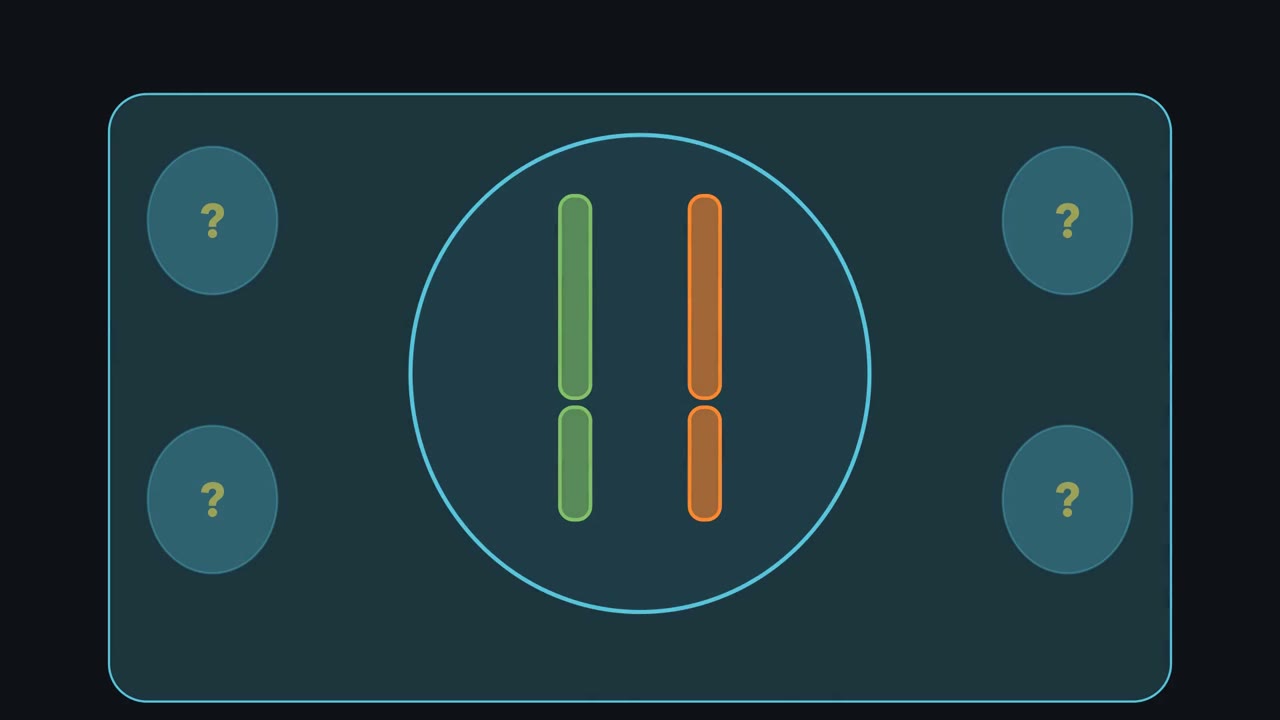
How can a cell halve its chromosome sets without losing any chromosome type? Watch this cell carry a large pair and a small pair. Green chromosomes came from one parent. Orange chromosomes came from the other. Every pair carries the same kinds of genes. The partners in each pair are homologous chromosomes. They carry genes in matching positions, but their alleles may differ. An allele is a version of a gene. Matching does not mean identical; homologs can carry different instructions for a trait. The starting cell is diploid because it has both members of every pair. Before meiosis, each chromosome copies its DNA.
Each rod becomes joined sister chromatids. The DNA amount doubled, but the chromosome count did not. An X shape shows a copied chromosome, not a homologous pair. Count joined sister chromatids as one chromosome until their connection separates. Now the homologous chromosomes meet as pairs. In the first division, each homolog moves away from its partner. The green long chromosome can travel with the orange short chromosome. The other homologs travel to the opposite side. Each new cell now has a member of every homologous pair, still made of joined sisters. What must separate in the next division? Follow the yellow connection in each X shape.
The sister chromatids separate next. No DNA copying happens between the divisions. Each cell divides again as the joined copies pull apart. The finished cells hold a single chromosome from every original pair. These cells are haploid because each has a single chromosome set. In the simple animal model, the completed divisions usually produce a group of haploid cells. Human egg formation is uneven, and plants make spores instead of gametes. Those refinements do not change the separation rule. Meiosis separates homologous pairs first, then sister chromatids. The first division separates homologous pairs and halves the chromosome sets. The second separates the sister chromatids of each copied chromosome.
This is not mitosis repeated, because mitosis never separates homologous pairs. When egg and sperm later join, their haploid sets restore a diploid cell. Halving keeps chromosome number from doubling each generation. The products can carry different chromosome mixes. The next film asks why those products carry different allele mixes.
If two parents give every child half of their chromosomes, why do their children come out different from each other?
Continue in the lesson: Meiosis and Variation →
3:08 · Free, with captions and a transcript. The lesson has the full text, the questions and the sources.
More films from this lesson
How this film was made. Narration: written from this lesson's text and read by an AI narrator voice (Kokoro, af_heart). Animation: AI-generated in code (Manim) by Claude, a schematic with no drawn molecular structures. Captions come from the narration script. See something wrong? Report it.