Genetics and Molecular Biology · Unit 4: From gene to protein, and its control
Eukaryotic Gene Regulation and Epigenetics
Rewritten on : new text, flashcards and film. Your notes and highlights stay, but the text around them may have moved.
A liver cell and a kidney cell share one genome. How does each read a different part of it, and remember which part after it divides?
Pause when the reading reaches a film, and offer to play it. Saved on this device.
Watch the film now, or keep listening
Builds on:The lac Operon: How Bacteria Regulate GenesDNA Replication: Semiconservative Copying and Its MachineryTranscription: From DNA to RNAWhy these?
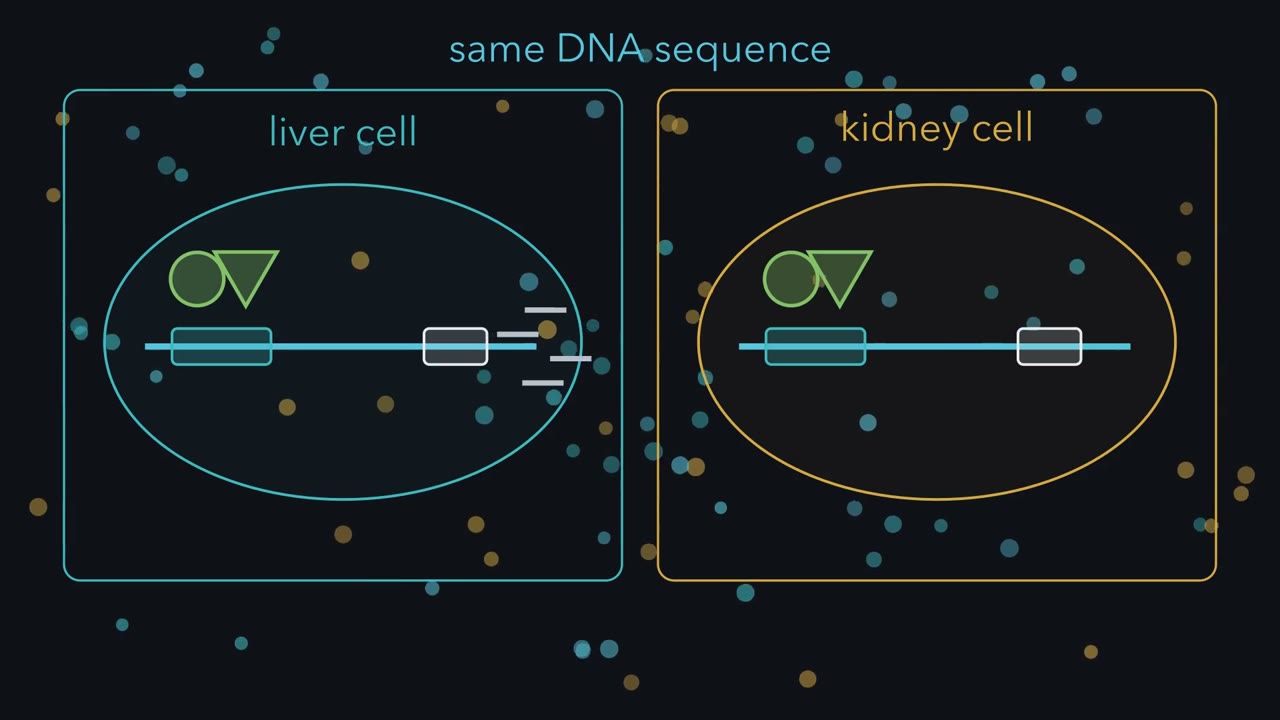 ▶ Watch Access, Then Assembly · 3:53
Read the transcript of “Access, Then Assembly”
Film transcript: Access, Then Assembly
Two cells carry the same genome. Why can they read different genes? Watch one gene in each nucleus. The DNA sequence matches. Yet one cell makes many messenger RNA molecules, while the other makes almost none. The puzzle is not missing genes. It is selective use.
Eukaryotic DNA is packed into chromatin. Blue DNA wraps around gold nucleosomes. Packing does not make every gene permanently silent. It makes access conditional. Proteins must reach the promoter before transcription can begin. Packed DNA is harder, not impossible, to read. Remodelling complexes can move nucleosomes. As one gold block slides aside, the white promoter becomes reachable. Some pioneer factors can bind nucleosomal DNA, so access and regulator binding can influence each other. The promoter stays fixed while nucleosomes shift around it. Access is only one requirement. A teal enhancer can sit far from the promoter. Sequence-specific transcription factors bind the enhancer and recruit coactivators.
Mediator helps connect these regulators with RNA polymerase II at the promoter. The enhancer itself is DNA, not a diffusible protein. Now predict. Matching enhancer factors are present, but a nucleosome still covers the promoter. Is strong transcription guaranteed? Hold both requirements in view: regulatory assembly and access. Decide before the machinery moves.
No, not in this simplified case. The matching factors supply regulatory information, but the covered promoter remains hard to use. Bound factors can recruit a remodeller. Once it shifts the nucleosome, the assembled regulators can help raise transcription. Enhancers often act by combinations.
Picture a committee whose decision depends on which members arrive. One factor alone may do little. Two together may recruit machinery effectively. Different cells supply different combinations. Return to the two cells. Their DNA still matches. In the liver cell, the needed factors and accessible promoter coincide. In the kidney cell, a needed factor may be missing. A repressor could also explain low output. A reporter assay can test these pieces beside a promoter. Deleting a piece tests necessity, and testing it alone tests sufficiency. Combining pieces tests cooperation, and reversing one tests orientation. But the assay moves DNA from its native setting.
A genomic deletion is a stronger test there. The same genome can therefore support different outputs. Chromatin changes reachability. Enhancer-bound regulators change recruitment, including recruitment of enzymes that change reachability. Neither layer works as a universal switch. Together they make gene use conditional on cell state.
From the film
- Gene output depends on accessible DNA and the regulators present.
- Nucleosomes make access conditional rather than impossible.
- Factor combinations bound at enhancers recruit coactivators and Mediator to raise transcription.
- Reporter assays test a DNA fragment outside its native genomic setting.
Nearly every cell in your body carries the same genome, yet a liver cell and a kidney cell read different genes, and their daughters usually keep the pattern. How can one DNA sequence support different, stable outputs?
The one idea. Gene output depends on accessible DNA and the regulators present; cell memory requires regulatory states to be propagated or restored after replication.
Scope: this rule organizes the transcriptional and memory mechanisms in this lesson; small RNAs add a further layer after transcription. Access and regulator binding influence each other, and inherited cellular states are not the same as transgenerational inheritance in mammals.
Chromatin makes access conditional
In the lac operon a bacterial promoter is open unless a repressor sits on it; eukaryotic genes start from the other side, packed into chromatin.
The unit of packing is the nucleosome: about 147 base pairs of DNA wrap nearly twice around a core of eight histone proteins, two copies each of H2A, H2B, H3 and H4. The 1997 crystal structure from Karolin Luger, Timothy Richmond and colleagues held 146 base pairs. The linker histone H1 binds the short linker DNA between nucleosomes and helps fold the string into compact fibres; it is not part of the octamer.
A nucleosome on a promoter generally blocks the proteins that start transcription, as a needle catches thread between spools more easily than thread pressed against one. The first film’s remodeller has a test-tube basis: the ATP-driven yeast SWI/SNF complex slid nucleosomes along DNA in a reconstituted system.
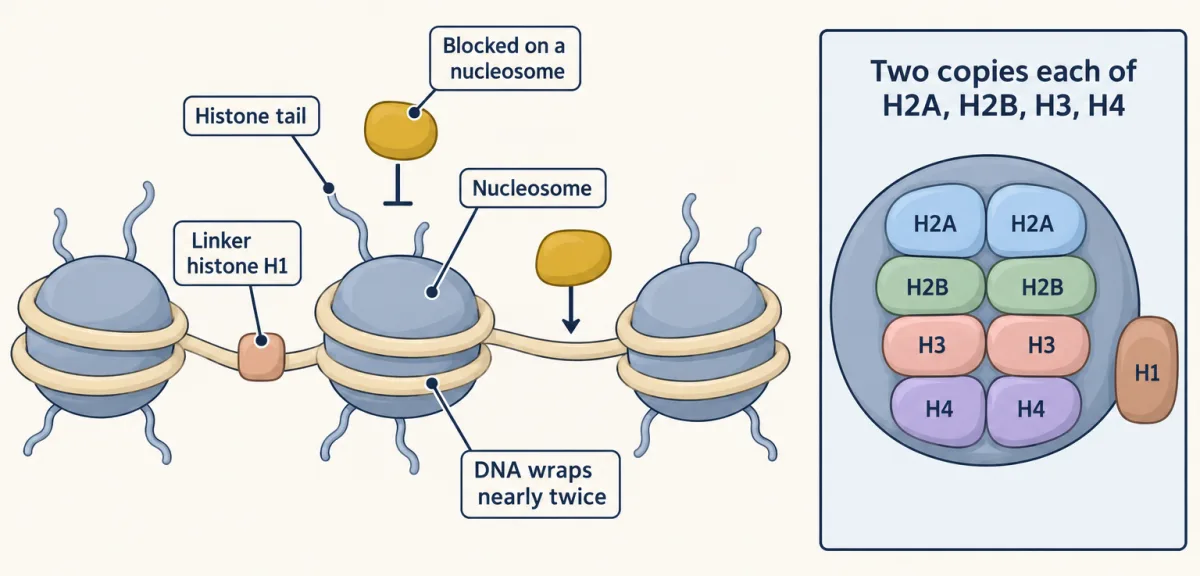
Each histone has a tail, rich in lysine and arginine, that sticks out of the core and carries chemical marks.
Enhancers: control from a distance, by combination
An enhancer is DNA that raises transcription from a promoter and can act at a distance and in either orientation; the first was found in 1981, in a piece of the virus SV40 DNA (see Walter Schaffner’s profile). “Can” matters: not every enhancer does both, and in Drosophila cells thousands of enhancers preferred one of two kinds of core promoter.
The first film’s sequence-specific transcription factors include some switched on by hormones (nuclear receptors) or by signaling to the nucleus. Their coactivators include histone acetyltransferases (HATs, below), and the Mediator complex links them to RNA polymerase II at the promoter. The film’s DNA loop is the usual picture; how direct the enhancer–promoter contact must be is still debated.
The film’s committee means combination, not a literal stable group: a modest set of factors, combined differently, can specify far more patterns than there are factors, as in the motor neuron code.
Worked problem: mapping a liver enhancer
A 600 bp region upstream of a gene contains elements A, B and C. Each version is cloned beside the gene’s promoter driving luciferase and put into liver and kidney cells. Assume equal uptake has been corrected with a second reporter, each value is the mean of independent repeats, and activity is scaled so that promoter alone = 1.
Predict. Before any arithmetic, which rows test whether B is necessary, whether B alone is sufficient, and whether orientation matters?
| Construct | Liver | Kidney |
|---|---|---|
| A + B + C | 100 | 2 |
| Delete A | 95 | 2 |
| Delete B | 4 | 1 |
| Delete C | 30 | 2 |
| B alone | 5 | – |
| C alone | 2 | – |
| B + C | 90 | – |
| B + C, reversed | 88 | – |
- A. Removing it leaves 95 of 100, so A adds little when B and C are both present. It is not inert: without C, A + B gives 30 against 5 for B alone, so A partly substitutes for C.
- B. Removing it drops 100 to 4, a 25-fold fall (100 ÷ 4 = 25), so B is necessary. B alone gives only 5, so it is not sufficient.
- C. Removing it drops 100 to 30, about 3.3-fold; alone it gives 2.
- B and C together give 90, 90% of the full region. If each simply added its own increase above the promoter-alone baseline (5 − 1 = 4 for B, 2 − 1 = 1 for C), you would expect about 1 + 4 + 1 = 6; if they multiplied, about 5 × 2 = 10. The observed 90 is about nine times even the multiplied guess. B and C cooperate in this reporter, as expected if factors on both must be present at once; the data do not show that the factors touch.
- Orientation. Reversed B + C gives 88, 98% of 90: orientation does not matter here.
- Kidney. Nothing exceeds 2. The simplest reading is that a factor B or C needs is missing in kidney cells; a kidney repressor would also fit.
Answer: of the constructs tested, the minimal liver enhancer is B + C, acting combinatorially, with A partly redundant with C. Its role at the native gene needs a test there, such as deleting B in the genome.
Rule to keep: the enhancer works as a committee, so B and C together give far more than either alone, and packed DNA is hard to read. This is a sketch of the logic using the lesson’s liver numbers, not a prediction for any real gene.
Small RNAs control messages after transcription
In 1993 Rosalind Lee, Rhonda Feinbaum and Victor Ambros reported that lin-4, a gene that times larval development in C. elegans, does not appear to encode a protein. It made short RNAs partly complementary to repeated sites in the 3’ untranslated region (3’ UTR) of lin-14 mRNA. Such RNAs were later named microRNAs (Going deeper).
A microRNA gene is transcribed into an RNA that folds into hairpins. In animals, Drosha cuts the hairpin out in the nucleus, and Dicer trims it in the cytoplasm to a duplex of about 22 nucleotides; plants use a Dicer-like enzyme for both steps in the nucleus. One strand guides an Argonaute protein to target mRNAs, mostly to their 3’ UTRs. Pairing centres on a seed of about seven nucleotides near the guide’s 5’ end; outside it, animal microRNAs mostly pair imperfectly. They destabilize the mRNA and repress its translation; in the animal cells measured, lower mRNA levels accounted for most of the drop in protein output. Plant microRNAs often pair fully and direct cleavage.
Predict. A guide pairs fully with its target rather than mainly through a seed. Which fits better: destabilization with some translational repression, or cutting at the paired site?
Extensive pairing through the guide’s central region can let a slicer-competent Argonaute (Argonaute2 in mammals) cut the target at the paired site; canonical siRNAs, which pair fully, use this branch of RNA interference. In 1998 Andrew Fire, Craig Mello and colleagues found that injected double-stranded RNA silenced the matching gene far more effectively than either single strand in worms. Dicer cuts long double-stranded RNA into short interfering RNAs (siRNAs) of 21 to 22 nucleotides. In many mammalian cells long double-stranded RNA sets off broad antiviral responses, so RNAi there needed short synthetic siRNAs (Elbashir, Tuschl and colleagues, 2001). RNAi as a tool is in forward and reverse genetics.
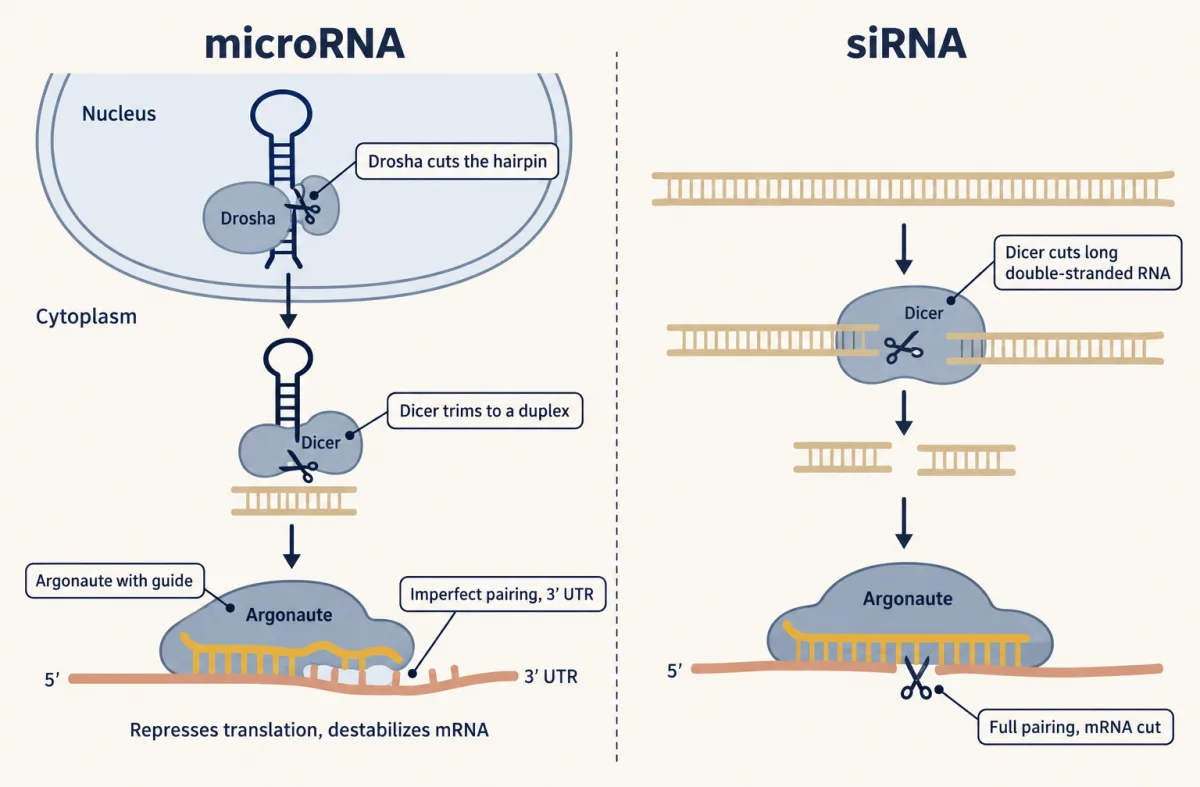
A transfected siRNA’s silencing fades as the siRNA is diluted through divisions, yet a silenced promoter can stay silent through many. The rule’s second half: cell memory requires regulatory states to be propagated or restored after replication.
Read the transcript of “Rebuilding the Memory”
Film transcript: Rebuilding the Memory
After DNA is copied, why do daughter cells not simply forget which genes were silent? The first film showed that access and regulators shape output. Now follow one regulatory state through replication and division. The sequence survives, but the state still needs maintenance.
Replication copies the DNA sequence. It does not automatically place every chemical mark on both new molecules. Look at a methylated CpG site, where a C is followed by a G. Each daughter duplex first has one old marked strand. Its partner is a new unmarked strand. The two strands now differ at each marked site. One carries inherited positional information. The other carries freshly copied sequence. A maintenance system must distinguish them before both daughter molecules can regain a similar pattern. Now predict. Which strand can guide restoration of the methylation pattern: the old marked strand or the new unmarked strand? Hold both possibilities beside the same CpG positions.
The old marked strand supplies the template. Guided to these half-marked sites, DNMT1 copies the old pattern onto the new strand. It is the main maintenance enzyme here. Other methyltransferases lay down new patterns. In mammals, dense methylation of a promoter CpG island goes with a silent gene, within promoter-specific limits. A restored pattern can therefore help keep that promoter quiet in both daughters. When the pattern is restored after replication, both daughters can inherit a similar regulatory state. That does not guarantee identical expression. It helps preserve the conditions under which the gene remains hard to read.
Similar does not mean perfectly fixed. An epigenetic change is inherited across cell divisions without changing DNA sequence. Mitotic inheritance is well established through DNMT1 and more. X inactivation and imprinting can keep one gene copy silent through many divisions. Inheritance through a whole animal's germline is a different claim. It is documented in plants and in C. elegans. In mammals, most DNA methylation is erased and rewritten in developing germ cells and in the early embryo. That is one reason transgenerational claims remain limited and contested. So chemical marks are not permanent ink.
Maintenance machinery must restore a state after replication, and other regulators can oppose it. Cellular memory is an active process. Replication creates the need again each time. It is not evidence that every acquired state crosses generations.
From the film
- Cell memory requires regulatory states to be propagated or restored after replication.
- After replication, DNMT1 copies the methylation pattern from the old strand onto the new one.
- Mitotic epigenetic inheritance is established, but mammalian transgenerational claims are limited and contested.
Marks on histones and on DNA
Acetylation. Histone acetyltransferases (HATs) add an acetyl group to lysine, removing its positive charge; histone deacetylases (HDACs) take it off. Acetylated chromatin goes with active genes. One reason is structural: in nucleosome arrays built in the test tube, histone H4 acetylated at lysine 16 stopped the arrays folding into compact fibres. In 1996 C. David Allis’s laboratory cloned a histone acetyltransferase from the ciliate Tetrahymena that resembled yeast Gcn5, a protein known to be needed to activate certain genes, and recombinant Gcn5 acetylated histones.
Histone methylation. Marks are named by histone, residue and modification: H3K4me3 is histone H3 carrying three methyl groups on lysine 4.
Predict. A result says only “histone methylation increased.” Without the residue, can you tell whether transcription rose or fell?
No. The residue sets the meaning, so “methylation silences” is wrong for histones in general:
- H3K4me3 sits at the promoters of active genes.
- H3K27me3, placed by Polycomb complexes, marks repressed genes, many of them developmental regulators.
- H3K9me3 marks heterochromatin, the densely packed, mostly silent chromatin. In 2001 two laboratories (Bannister and colleagues; Lachner and colleagues) reported that the protein HP1 binds H3 methylated at lysine 9 but not at lysine 4.
Brian Strahl and Allis proposed in 2000 that combinations of marks are read like a code; the “histone code” is still a hypothesis. A mark can also go with activity without causing it.
DNA methylation. In mammals, DNA methyltransferases add a methyl group to carbon 5 of cytosine, mostly where C is followed by G (a CpG site). After replication, DNMT1 copies the methylation pattern from the old strand onto the new one, as in the second film; DNMT3A and DNMT3B lay down new methylation. Dense promoter CpG-island methylation goes with silence, within limits (Going deeper).
Predict. A chromatin map finds a mark wherever a gene is silent. Did the mark cause the silence, and what intervention would test it?
Location shows correlation only. A sharper test changes the mark while leaving its writer protein in place, for example with a catalytically dead writer; deleting the whole writer can remove its other functions too (the Mll3/4 case under Going deeper). One DNA-methylation reader is methyl-CpG-binding protein 2 (MeCP2), which binds methylated DNA. In cultured-cell assays it associated with a complex containing histone deacetylases, and the deacetylase inhibitor trichostatin A relieved its repression: the two marking systems work together. Mutations in MECP2 cause most cases of Rett syndrome (synapse disorders).
What “epigenetic” does and does not mean
Beyond the second film’s epigenetic examples (maintenance methylation, X inactivation and genomic imprinting; see sex linkage and beyond), a direct test of memory comes from mouse fibroblasts: heterochromatin induced by tethering HP1α to an engineered Oct4 allele persisted after HP1α was removed, when no activator opposed it.
Germline inheritance across generations is documented in plants and C. elegans but limited and contested in mammals, partly because of the reprogramming the second film showed; it needs careful generation counting.
Predict. A pregnant mother is exposed. Which is the first generation that was not directly exposed?
Exposing a pregnant mother (F0) also exposes her F1 embryos and the germ cells inside them that will form F2, so F3 is the first unexposed generation; after exposure of a father alone, it is F2. Studies of the Dutch Hunger Winter found methylation differences, decades later, in people exposed to famine before birth; they were exposed themselves, so that is not transgenerational inheritance. In human data, shared genes, environment and culture confound the inference. None of this is health or diet advice.
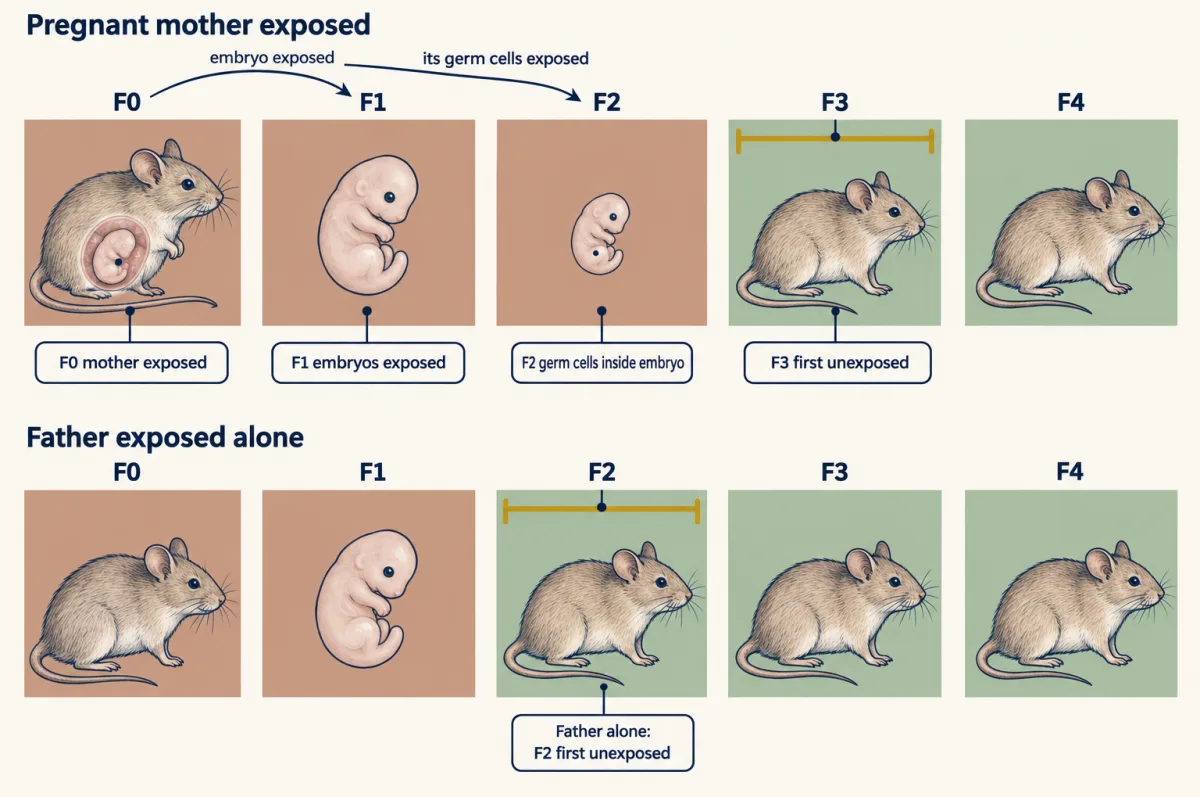
Design problem
Pregnant mice fed a methyl-donor diet bear offspring with altered coat colour at a locus whose expression is controlled by a promoter derived from a transposon. Design an experiment to decide whether the effect is transmitted epigenetically to later generations.
Saved in this browser only.
One way to do it
- Count generations. The F0 mother, her F1 embryos and their germ cells (future F2) are all exposed, so only F3 and later can show transgenerational inheritance.
- Remove the mother’s environment. Transfer embryos into unexposed females to control the uterus, and cross-foster pups to unexposed mothers to control nursing; swapping newborns alone cannot undo prenatal exposure.
- Separate the parents. Breed affected males and affected females separately to unexposed mates, and score coat colour in each line through F3 and F4. The male line avoids the uterus, milk and egg cytoplasm, though sperm still carry small RNAs that can affect offspring. At the best-studied locus of this kind, agouti viable yellow, the effect passed through the female germ line, so test both lines.
- Rule out a DNA change. Sequence the locus, transposon included, in each generation, and use inbred lines so that a variant elsewhere in the genome cannot explain the shift.
- Measure the mark. Bisulfite-sequence the transposon promoter in tissue and in sperm or eggs of each generation, and ask whether methylation tracks coat colour.
Run unexposed control lines alongside and score blind. A shift reaching F3 through either parent, with no sequence change and with methylation following it, would support epigenetic transmission at this locus.
Going deeper
The lin-4 and microRNA record
lin-4 made RNAs of about 22 and 61 nucleotides, and Gary Ruvkun’s laboratory showed that the lin-14 3’ UTR is needed for the repression. Nobody called lin-4 a microRNA then; the term came in 2001, after let-7 was found in 2000 and shown to be conserved, when cloning studies turned up many more such RNAs. For targets of animal microRNAs in HeLa cells and mouse neutrophils, lower mRNA levels accounted for at least 84% of the reduced protein output (Guo and colleagues, 2010).
Exceptions and counter-examples in chromatin and DNA methylation
In mouse embryonic stem cells with catalytically dead Mll3 and Mll4, enhancers lost the H3K4 monomethylation these enzymes place, yet transcription changed only slightly. DNA methylation can regulate one promoter rather than a whole gene, as at alternative promoters inside SHANK3. And it is not universal: budding yeast and C. elegans have little or no 5-methylcytosine, and Drosophila very little.
Your notes
Select any text in the lesson to highlight it or add a note to it. Your highlights and notes are saved in this browser and collected in your notebook.
This browser is not letting the site save anything (a private window or strict privacy settings), so highlights and notes will be lost when you leave the page.
How we measure it
Luciferase reporter assay
A candidate DNA fragment is placed beside a minimal promoter driving firefly luciferase and put into cells, usually with a second reporter to correct for how much DNA each well took up. Light from the luciferase reaction, divided by the second reporter's signal, measures how well that fragment activates that promoter in that cell type. It does not show what the fragment does at its native place in the genome.
Chromatin immunoprecipitation with sequencing (ChIP-seq)
Proteins are cross-linked to DNA in cells, the chromatin is broken into pieces, and an antibody pulls down one protein or one histone mark with the DNA bound to it. Sequencing that DNA maps where in the genome the protein or mark sits. It shows location and correlation, not cause.
Bisulfite sequencing
Treating DNA with bisulfite converts unmethylated cytosine to uracil but leaves 5-methylcytosine as it is. After PCR and sequencing, a C that still reads as C was methylated (or hydroxymethylated), and one that reads as T was not, giving methylation site by site.
RNA interference knockdown
Double-stranded RNA, a synthetic siRNA or a hairpin RNA matching a gene is introduced into cells or animals, and Argonaute guided by the small RNA destroys the matching mRNA. Gene output falls while the DNA is unchanged. Off-target pairing means a phenotype needs a second independent RNA and, ideally, rescue of the phenotype by a copy of the gene the RNA cannot target.
Practice questions on this lesson (3) → MCAT-style, original, each with an explanation
Where this lesson fits
Before thisReview first
- The lac Operon: How Bacteria Regulate GenesThis course · Lesson 19
You need the bacterial repressor-operator logic from there to see how eukaryotic regulation starts from a packed, closed state instead.
- DNA Replication: Semiconservative Copying and Its MachineryThis course · Lesson 13
You need semiconservative copying from there to see why marks on old strands must be restored on new ones.
- Transcription: From DNA to RNAThis course · Lesson 16
You need RNA polymerase and promoter basics from there to understand what enhancers and accessible DNA help start.
After thisStudy next
- Cancer as a Genetic DiseaseThis course · Lesson 21
This lesson takes regulatory states further: cancer involves lost control of gene expression and changes in regulators.
- Forward and Reverse Genetics: Screens, RNAi and CRISPRThis course · Lesson 24
This lesson's RNAi and enhancer-deletion logic is used there to test what a gene or element does.
- Complex Traits, Heritability and GWASThis course · Lesson 26
Most trait-linked variants sit in regulatory DNA like enhancers, which this lesson explains.
Suggested by an AI model from the lessons themselves, then checked. How we use AI
Finish line
Test yourself
8 questions
Practice and MCAT-style, with explained answers.
Next · Lesson 21
Cancer as a Genetic Disease
If cancer is a genetic disease, why are most of the DNA changes in a tumor not inherited?
Continue →