Genetics and Molecular Biology · Unit 1: Inheritance
New to this? Review it at high school level: Meiosis and Variation
Chromosomes and Meiosis: The Physical Basis of Mendel's Laws
Rewritten on : new text, flashcards and film. Your notes and highlights stay, but the text around them may have moved.
A fruit fly cell has eight chromosomes and its sperm have four. Which four does a sperm get, and what decides it?
Pause when the reading reaches a film, and offer to play it. Saved on this device.
Watch the film now, or keep listening
Builds on:Mendel's Peas: Segregation and Independent AssortmentWhy these?
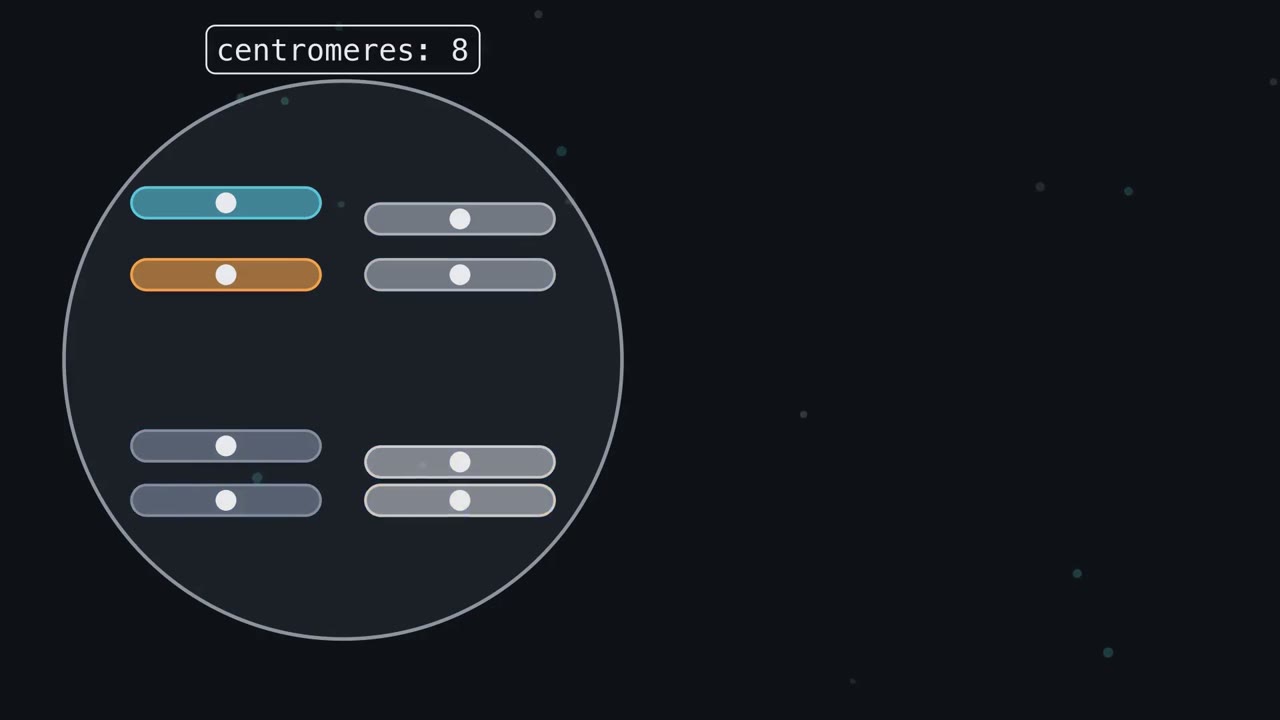 ▶ Watch One of Each Pair, by Coin Toss · 3:41
Read the transcript of “One of Each Pair, by Coin Toss”
Film transcript: One of Each Pair, by Coin Toss
Which four chromosomes does a fruit fly sperm get? The fly's body cells hold eight. Its eggs and sperm hold four, one from each of four pairs. Mendel worked out his laws from counts of peas. He never saw what did the separating. These two chromosomes are homologs, one inherited from each parent. They carry the same genes at the same places. But they can carry different versions, called alleles. Blue carries one allele, and orange carries the other. Follow the colours. Before meiosis, in S phase, each chromosome is copied. The two copies are sister chromatids, joined at the centromere. Count centromeres, not arms. A copied chromosome is still one chromosome.
Meiosis is one round of copying, then two divisions. In the first, the homologs find each other and line up side by side. Then the pair sits across the middle of the cell, its homologs facing opposite poles. Anaphase I pulls the homologs apart. Each new cell gets one member of the pair. Count its centromeres: one. The cell is already haploid, with one homolog of this pair. That chromosome is still two sister chromatids. No DNA is copied in between. In the second division, the sisters part. That makes four products. Two carry blue's allele, and two carry orange's. That two-and-two split is what Mendel's model expects. It is his law of segregation, seen as chromosome movement.
Now add a second pair, green and purple, on a different chromosome, carrying a second gene. Here is the question. Does the way the blue pair faces the poles change the way the green pair faces? No. Each pair faces the spindle by its own coin toss. Blue may end up with green, or blue with purple.
Ignoring crossovers for now, one meiosis takes just one of these layouts. So one meiosis gives only two kinds of gamete, two of each. Independence shows only when you count many meioses. Both layouts are equally likely. So all four kinds of gamete appear, a quarter each. That is independent assortment. Each extra pair is one more coin toss. So the combinations climb fast, with two choices for every pair. This holds for genes on different chromosomes.
Genes close together on one chromosome tend to travel together. And something has to hold each pair together until it is dealt. That is chapter 2. So here is the idea, in the simple Mendelian model. Meiosis I deals one homolog of each pair to each cell. Each pair is dealt by its own fair coin toss. Meiosis II then splits sisters.
Segregation is the deal. Independent assortment is the coin tosses.
From the film
- Homologs are the two members of a chromosome pair, one from each parent; sister chromatids are the two copies made in S phase.
- Count centromeres to count chromosomes: a copied chromosome is still one chromosome.
- Meiosis I deals one homolog of each pair to each cell and meiosis II splits sisters, so each gamete gets one allele of each gene: the law of segregation.
- Each pair faces the spindle by its own coin toss, so genes on different chromosomes assort independently.
- Independent assortment is a count over many meioses; ignoring crossovers, one meiosis gives only two kinds of gamete.
A fruit fly cell holds eight chromosomes. Its eggs and sperm hold four, one from each of four pairs. Which four, crossing over aside, is settled at one moment of one division.
In the previous lesson you met Mendel’s two laws: the two alleles of a gene separate into different gametes, and alleles of different genes enter gametes independently. Mendel inferred both from counts of peas but never saw what did the separating. The first film, at the top of this page, showed it: meiosis, the cell division that makes eggs and sperm, dealing out chromosomes that come in pairs, one member of each pair, a homolog, from each parent. What the film left out: the counts exams ask for, the egg’s lopsided division, what crossing over changes, and how the idea was proved.
The one idea. In a normal meiosis, meiosis I deals one homolog of every pair to each daughter cell, and each pair is dealt by its own fair coin toss. Meiosis II then splits sisters, the two copies made of each chromosome before meiosis began. The deal gives the law of segregation: each gamete gets one allele of each gene, so an Aa cell gives two A and two a. The coin tosses give independent assortment, which shows only over many meioses.
Scope: a cell with two sets of chromosomes, and genes on different chromosomes. An ordinary crossover can change when A and a part, not the two-and-two count; you will predict it below. It applies wherever the rule recurs. Exceptions: gene conversion, which can give three A and one a, and meiotic drive (both in Going deeper), errors that leave gametes with too many or too few chromosomes, and genes close together on one chromosome, which tend to travel together (linkage and mapping).
Count before you divide: homologs, sisters and ploidy
The first film counted centromeres; here are the terms behind that count, plus one it left out, DNA content. Chromosomes live in the nucleus, the membrane-bound compartment that holds a eukaryotic cell’s DNA (cell compartments has more).
Think of a pair of shoes. The left and right shoes are homologs: same job, built separately, one from each parent. Now photocopy each shoe and staple the copy to it. Each stapled bundle is one chromosome made of two sister chromatids, joined at the centromere. The rule that saves most students on exams: count centromeres, not arms. A replicated chromosome is still one chromosome.
The four terms:
- Homologous chromosomes (homologs) are the left and right shoe: the two members of a pair, one inherited from each parent. They carry the same genes at the same loci (a locus is a gene’s place on the chromosome), but can carry different alleles.
- Sister chromatids are a shoe and its stapled copy: the two identical copies of one chromosome made in S phase, the stage before division when DNA is copied, still joined at the centromere.
- Ploidy is the number of complete chromosome sets in a cell. Count centromeres to get the chromosome number, then compare it with one set: a fly cell with 8 chromosomes holds two sets of 4 and is diploid (2n); a cell with 4, one set, is haploid (n).
- The C value counts DNA instead of centromeres. One unreplicated haploid set, one shoe of each pair with nothing stapled on, is 1C. A diploid cell is 2C in G1, the growth stage before S phase, and 4C after S phase.
Ploidy counts sets of chromosomes; C counts DNA. They can disagree: after S phase a fly cell holds 16 chromatids and 4C of DNA, and is still diploid.
Meiosis I separates homologs; meiosis II separates sisters
Meiosis is one round of DNA replication followed by two divisions.
Before meiosis: S phase. Every chromosome is copied into two sister chromatids. The chromosome number does not change; chromatids and DNA double.
Meiosis I: homologs pair, then part. In prophase I, early in the first division, each chromosome finds its homolog and the two line up side by side along their length. That pairing is synapsis, and a synapsed pair is a bivalent: two homologs, four chromatids (exams also call it a tetrad). While paired, homologs can exchange segments between non-sister chromatids (chromatids of different homologs), which is crossing over; it has its own section after the second film. At metaphase I the bivalents sit across the middle of the cell on the spindle, the array of protein fibres that pulls chromosomes to the poles, with the two homologs facing opposite poles. At anaphase I the homologs are pulled apart, and each daughter cell receives one member of every pair.
Meiosis II: sisters part. No DNA is copied in between. Each cell lines its chromosomes up again, and anaphase II pulls the sister chromatids apart, much as a mitosis would.
Mitosis differs at the very first step: homologs do not synapse or form bivalents. Each chromosome lines up alone and its sisters part, so both daughter cells keep the parent’s two sets. Meiosis halves the sets and shuffles them.
Worked problem. Drosophila melanogaster has 2n = 8, so n = 4. Assume normal divisions and follow one cell. The same pattern holds for any diploid.
| Stage | Chromosomes | Chromatids | Bivalents | C value |
|---|---|---|---|---|
| G1, before S | 8 | 8 | 0 | 2C |
| Prophase I, homologs paired | 8 | 16 | 4 | 4C |
Step 1. S phase doubles chromatids and DNA but not chromosomes: 8 chromosomes, 8 × 2 = 16 chromatids, 4C. Step 2. Eight chromosomes in pairs make 8/2 = 4 bivalents.
Predict. Anaphase I sends one homolog of each pair to each pole. Fill in the next two rows, for one cell after meiosis I and after meiosis II: chromosomes, chromatids, C value. Is the cell after meiosis I haploid or diploid, and does its DNA content match any cell you have already met?
Check your prediction
| Stage | Chromosomes | Chromatids | Bivalents | C value |
|---|---|---|---|---|
| Each cell after meiosis I | 4 | 8 | 0 | 2C |
| Each cell after meiosis II | 4 | 4 | 0 | 1C |
Four centromeres, one from each pair: the cell is haploid, one set. Each chromosome still has two chromatids, so its DNA content is 2C, the same as a diploid cell in G1. Ploidy and C disagree again. Anaphase II then splits the sisters: 4 chromosomes, 4 chromatids, 1C.
The commonest exam error is to say that meiosis I separates sisters. If you call a cell after meiosis I diploid, count its centromeres again.
(Male fruit flies pair their homologs in an unusual way; see Going deeper.)
Where Mendel’s laws live in the cell
Take a fly heterozygous Aa at one locus. A sits on one homolog, a on the other. After S phase one homolog carries A and A on its sisters, the other a and a. Anaphase I separates the homologs, so A and a go to different cells; anaphase II separates identical sisters. Two of the four products carry A and two carry a. That is the law of segregation, seen as chromosome movement. Crossing over can change when A and a part (a Predict after the second film), but each final product still gets one allele.
Predict. Suppose a cell skipped meiosis I and ran only meiosis II. What would the products of an Aa cell carry?
Check your prediction
Anaphase II pulls sisters apart, so each product would get one chromatid of every chromosome, from both homologs: one A chromatid and one a chromatid. Each product would be Aa, with two sets, like its parent. That is a mitosis-like division, not a reduction. Segregation needs meiosis I, the step that deals homologs apart.
Independent assortment comes from metaphase I. Each bivalent can face the spindle two ways, like a coin toss, independently of the other pairs.
Worked problem, continued. Ignoring crossing over, the fly’s 4 bivalents give
2 × 2 × 2 × 2 = 24 = 16 possible chromosome combinations in a gamete
For humans, 2n = 46 and n = 23:
223 = 8,388,608, about 8.4 million
That counts combinations across many meioses; because it ignores crossing over, it understates real variety.
Now put alleles on it. A fly is Aa Bb, with the two loci on different chromosomes, and no crossing over. In any one meiosis the bivalents take one orientation, so the four products are either 2 AB + 2 ab or 2 Ab + 2 aB: only two kinds of gamete. The two orientations are equally likely, so across many meioses each of AB, Ab, aB and ab makes up 1/4 of the gametes. Mendel’s four equal classes belong to the gametes of many meioses. For loci on different chromosomes that holds with or without crossing over; what a crossover between a locus and its centromere does to one meiosis comes after the second film.
- cells
- –
- ploidy of each cell
- –
- chromosomes per cell
- –
- chromatids per cell
- –
- DNA per cell
- –
Rule to keep: anaphase I separates homologs and anaphase II separates sisters, so one meiosis gives two kinds of product, and only across many meioses with random orientation does each of AB, Ab, aB and ab make up 1/4. This is a sketch of the logic with two chromosome pairs and no crossing over.
Independent assortment holds only for loci on different chromosomes, or far apart on one, where frequent crossing over gives similar ratios. Loci close together on one chromosome tend to travel together: linkage and mapping.
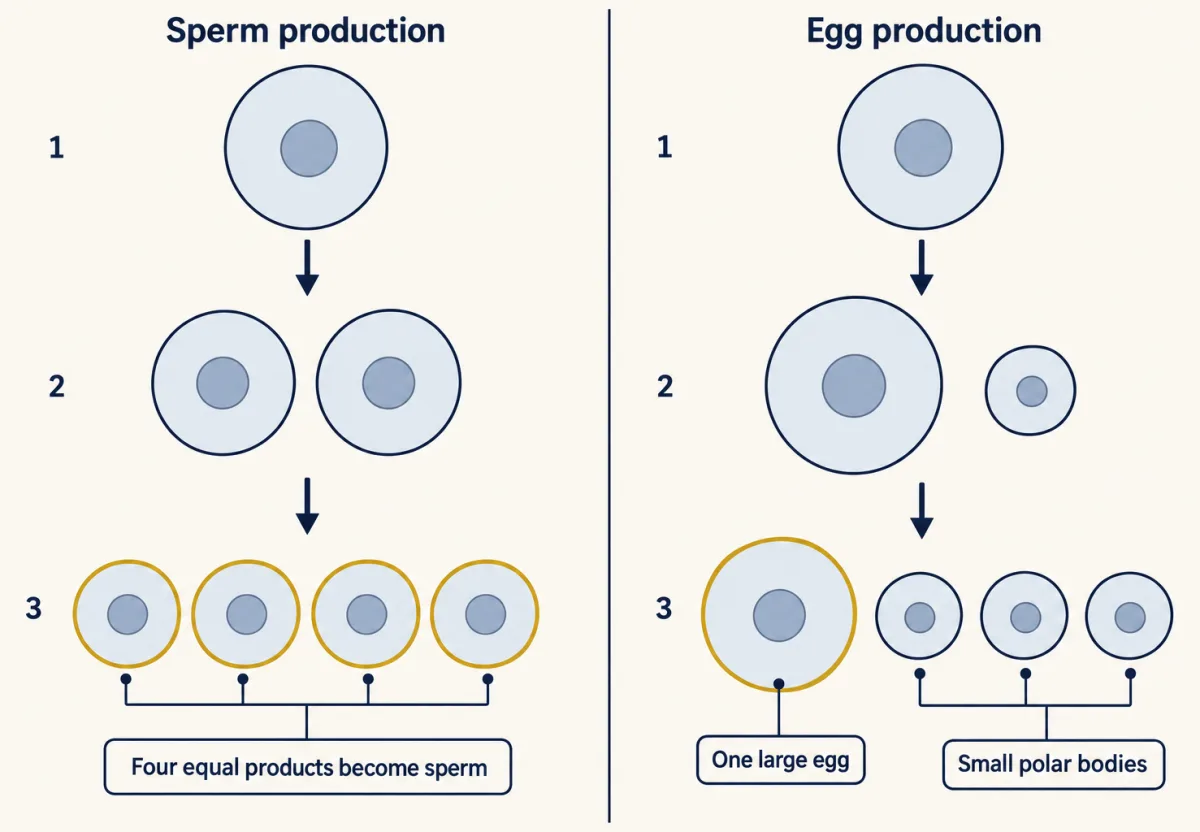
Four sperm, one egg
In sperm production, one meiosis gives four haploid cells and all four become sperm. In egg production in humans and other animals, the divisions are unequal: one large egg and small polar bodies that do not become gametes. The first polar body often does not divide, and in mammals the egg finishes meiosis II only after a sperm enters.
Predict. A woman is Aa. One of her eggs carries A. Assuming no crossover between the locus and its centromere, what did the first polar body receive?
Check your prediction
The a homolog, as two a chromatids. Anaphase I kept the A homolog, with its two A sisters, in the egg and sent the a homolog into the first polar body. The egg’s second, unequal division then put one of its two A chromatids out into another small polar body.
That wait raises a problem. In a mammalian egg the sisters must stay joined from the end of meiosis I until anaphase II, and before that the homologs had to stay joined until anaphase I. Something holds each pair, then lets go in the right order. For sisters it is a ring-shaped protein complex, cohesin, which links them from S phase. In yeast and mammals as studied, cohesin on the chromosome arms is cut at anaphase I, while cohesin around the centromeres is protected by a protein called shugoshin until anaphase II. What holds the homologs, and why cutting the arms is enough to let them go, is the second film.
Crossing over: what holds the pair, and what it does to alleles
Read the transcript of “What Holds the Pair, and What Lets Go”
Film transcript: What Holds the Pair, and What Lets Go
Why does the first division of meiosis part homologs, and not sisters? In mitosis, homologs do not synapse as a pair. Each chromosome lines up on its own, and its sisters part. In meiosis I, the sisters stay together, and the homologs part. So something must tie each pair, and let go in the right order. Start with the sisters. From S phase on, ring-shaped proteins called cohesin tie them together. The rings sit along the arms and around the centromere. In prophase I, the homologs pair along their length. A protein structure called the synaptonemal complex zips them together. While they are zipped, crossing over happens. Segments are exchanged between non-sister chromatids, one from each homolog.
It starts with a deliberate break in the DNA of one chromatid. The repair copies from the other homolog, and can end in a swap. Later in prophase I, the zipper comes apart. The homologs pull slightly away from each other. But they stay joined where the crossover was. That visible site is a chiasma. Now look at what ties the pair. The crossover, plus the cohesin on the arms beyond it, holds the two homologs together. In most organisms studied, that is the link the spindle pulls against.
So what must the cell cut, to let the homologs go at anaphase I? The cohesin on the arms. Once it is cut, the crossover no longer ties the pair. The homologs part, each still made of two sisters. Cohesin at the centromeres has to survive. A protein called shugoshin protects it until anaphase II. Shugoshin brings an enzyme, PP2A, to the centromeres. Removing phosphate there is thought to shield cohesin from being cut. So the sisters stay joined into meiosis II. At anaphase II, the centromere cohesin is cut as well, and the sisters part.
This two-step release is the pattern seen in yeast and mammals, as studied. One cut frees the homologs. A later cut frees the sisters. Each link is a point of failure. In mouse eggs, if centromere cohesin is lost too early, sisters reach meiosis II already apart. They can then go to either pole at random. Eggs can end up with too many or too few chromosomes. As studied in yeast and mammals, two links are cut in two steps. Arm cohesin goes at anaphase I, and the homologs part. Centromere cohesin goes at anaphase II, and the sisters part.
From the film
- Cohesin rings hold sister chromatids together from S phase until they are cut.
- Crossing over exchanges segments between non-sister chromatids in prophase I; a chiasma marks where it happened.
- In most organisms studied, a crossover plus the cohesin on the arms beyond it ties two homologs together until anaphase I.
- In yeast and mammals as studied, arm cohesin is cut at anaphase I, while shugoshin protects cohesin at the centromeres until anaphase II.
- When these links fail, gametes can end up with too many or too few chromosomes.
The second film showed what a crossover does to the link between homologs, but not what it does to alleles.
Predict. Go back to the Aa Bb genotype, with A and B on different chromosomes, now in a female fly (male flies do not cross over). This time one crossover falls between A and its centromere, and none near B. At which division do A and a part? How many kinds of gamete can this one meiosis give?
Check your prediction
Anaphase II.
- The crossover swaps the segment carrying the A locus between one chromatid of each homolog.
- So each homolog leaves meiosis I carrying one A chromatid and one a chromatid. Its sisters are no longer identical at A.
- A and a part at anaphase II instead. Each final product still gets one allele, and two of the four carry A.
Four kinds, one of each.
- Whichever way the bivalents faced, B goes to one cell and b to the other at anaphase I.
- Each of those cells then splits A from a at anaphase II.
- So one meiosis gives AB, aB, Ab and ab. The pooled count over many meioses is still 1:1:1:1.
The one idea, again. A crossover does not change the deal: each gamete still gets one allele, and an ordinary crossover leaves two A and two a. It can change when A and a part, and then one meiosis can give one of each of the four kinds. That the four kinds are equally common is a statement about many meioses.
The second film ran the long prophase I as one scene; cytologists divide it into substages by how the chromosomes look:
- Leptotene: the replicated chromosomes begin to condense into thin threads.
- Zygotene: homologs pair.
- Pachytene: homologs are fully synapsed, held by the synaptonemal complex, a protein structure that zips them together along their length. Crossing over is completed here, when there are four chromatids per bivalent.
- Diplotene: the complex comes apart, homologs pull slightly away from each other, and they stay joined at chiasmata (singular chiasma), the visible sites of earlier crossovers.
- Diakinesis: chromosomes condense further, still joined at chiasmata, as the cell moves toward metaphase I.
By metaphase I crossing over is over, and it is not part of a normal mitosis.
Two caveats on the second film. Its link, a crossover plus the cohesion beyond it holding homologs together until anaphase I so the spindle can pull them to opposite poles, holds in most organisms studied but not all (male fruit flies manage without; see Going deeper). And the molecular steps of the exchange, which begin with a deliberate break in the DNA of one chromatid, repaired by copying from a chromatid of the homolog, are taught in DNA repair and recombination. The 1931 maize experiment that tied a visible exchange to genetic crossing over is in Going deeper.
Sutton, Boveri and the proof
By 1902 cytologists knew that chromosomes pair and are halved in number before gametes form. Walter Sutton, a graduate student with E. B. Wilson at Columbia, worked on the grasshopper Brachystola magna, whose chromosomes differ in size. He saw that they came in matched pairs, and in 1903 argued that maternal and paternal members pair and then separate, each pair orienting independently. That predicts both of Mendel’s laws. He wrote that in his material he could not tell maternal from paternal members, so the idea remained a hypothesis.
Theodor Boveri came at it from sea urchins. In eggs fertilized by two sperm, chromosomes were distributed unevenly among three or four poles, and as a rule the resulting cells developed differently and abnormally. He concluded that development needs a particular combination of chromosomes, not merely a number, so different chromosomes carry different things. Neither man proved the theory alone. Sutton and Boveri are generally credited together, and the joined name came later.
The test of Sutton’s weak point came from Eleanor Carothers in 1913. In grasshopper males with one heteromorphic pair, meaning one member visibly larger, and an unpaired X, she could see which homolog the X travelled with. It went with each about equally often. The strongest proof came in 1916, when Calvin Bridges showed in Drosophila that rare flies with exceptional X-linked inheritance had the exceptional chromosome sets his explanation predicted, a story for sex linkage and chromosome changes.
Design problem
You repeat Carothers’ kind of study in grasshopper males with a heteromorphic pair and an unpaired X. You score 300 first meiotic divisions: the X went to the pole with the larger homolog in 154 and with the smaller in 146. These are the counts Carothers reported in 1913. Does this support independent assortment, and what would dependence look like?
Saved in this browser only.
One way to do it
Expectation. If the X and the heteromorphic pair orient independently, the X goes with either homolog with probability 1/2: expected 150 and 150.
Test. Use the chi-square statistic, sum of (observed − expected)2 / expected, taught fully in probability and crosses:
χ² = (154 − 150)2/150 + (146 − 150)2/150 = 16/150 + 16/150 = 32/150 = 0.21
With two classes there is 1 degree of freedom, and the critical value at P = 0.05 is 3.84. 0.21 is far below it, so the counts are consistent with random, independent orientation.
What dependence would look like. A large excess in one direction, for example 220 to 80 (χ² = 65.3), that recurs in other males and preparations. A single small deviation is what sampling noise would produce, though it cannot rule out a small real bias.
What this tests. Chromosomes, by sight, not alleles: two non-homologous chromosomes behave as independent assortment predicts, which Mendel’s second law needs if genes sit on chromosomes. It does not by itself show that any gene is on these chromosomes.
Going deeper
Male fruit flies pair without a zipper
The worked-problem fly is a fair general model, but males of Drosophila melanogaster are a special case: their homologs pair without a synaptonemal complex and without crossing over.
When a crossover does not move the split
One crossover between a locus and its centromere moves the A/a split to anaphase II. Two crossovers in that interval can go either way. A two-strand double, two exchanges between the same two chromatids, swaps the segment back. A four-strand double, in which every chromatid takes part once, swaps both chromatids of each homolog. Either way the sisters match again, and A and a part at anaphase I. A three-strand double leaves the sisters different, so A and a still part at anaphase II.
When the count is not two and two
The two-and-two count is the normal outcome, not an exceptionless law. The break repair that makes crossovers can also copy a short stretch of one homolog onto a chromatid of the other, with or without a crossover; this is gene conversion. At a locus inside such a stretch, one meiosis can give three A and one a.
Crossover numbers, and a zipper that flows
Crossover numbers vary even within a species. In single-sperm sequencing of 31,228 gametes from 20 men, the average number of crossovers per sperm ranged from 22.2 to 28.1 between donors. And the synaptonemal complex is less rigid than the zipper image suggests: in living C. elegans, its components behave like a liquid crystal, ordered yet able to flow.
Crossing over seen in maize
In maize, Harriet Creighton and Barbara McClintock tied the exchange of visibly marked chromosome segments to genetic crossing over in 1931; you will use that link to build maps in linkage and mapping.
Not always a fair coin
Fair segregation is itself a model with exceptions: in hybrid mouse oocytes, spindle asymmetry lets stronger centromeres orient preferentially toward the egg side of the first division.
Forty-six, not forty-eight
Even the human count needed work. The accepted diploid number was 48 until Joe Hin Tjio and Albert Levan reported 46 in 1956.
Your notes
Select any text in the lesson to highlight it or add a note to it. Your highlights and notes are saved in this browser and collected in your notebook.
This browser is not letting the site save anything (a private window or strict privacy settings), so highlights and notes will be lost when you leave the page.
How we measure it
Cytology of fixed germ cells
Testes or ovaries are fixed, sectioned or squashed, and stained so that chromosomes can be counted and their shapes compared at each stage of meiosis. Sutton and Carothers drew their conclusions from preparations of this kind; Boveri used such preparations too, alongside watching living sea-urchin embryos develop.
Heteromorphic marker chromosomes
A chromosome pair whose two members differ visibly, in size or in a knob at one end, lets you tell the homologs apart under the microscope. You can then follow each member into the daughter cells and ask whether its behaviour matches the inheritance of genes.
Chromosome spreads for counting
Dividing cells are arrested in metaphase, swollen in a dilute (hypotonic) solution so that their chromosomes separate, and spread on a slide for counting. Applied to cultured human cells, this approach gave the human diploid number of 46 reported by Tjio and Levan in 1956.
Practice questions on this lesson (5) → MCAT-style, original, each with an explanation
Where this lesson fits
Before thisReview first
- Mendel's Peas: Segregation and Independent AssortmentThis course · Lesson 1
You need Mendel's two laws from there, because this lesson shows the chromosome movements that carry them out.
After thisStudy next
- Linkage and Recombination MappingThis course · Lesson 8
It takes the case of genes on one chromosome, where independent assortment fails and crossing over sets the ratios.
- Sex Linkage, Dosage Compensation and Non-Mendelian InheritanceThis course · Lesson 6
It follows the X and Y through meiosis to explain why reciprocal crosses differ.
- Chromosome Number and Structure: Aneuploidy and RearrangementsThis course · Lesson 7
It shows how failed homolog or sister separation leaves gametes with too many or too few chromosomes.
Elsewhere on the siteFilms, simulations and method films in other courses
- Meiosis shufflerSimulation · Biology
It shuffles homologs through meiosis, showing how random orientation makes different gamete combinations.
- How One Set Becomes TwoFilm · Biology
It shows copying chromosomes then separating the sisters, the contrast against meiosis I.
Suggested by an AI model from the lessons themselves, then checked. How we use AI
Finish line
Test yourself
10 questions
Practice and MCAT-style, with explained answers.
Next · Lesson 3
Probability, Crosses and the Chi-Square Test
A 9:3:3:1 ratio predicts 312.75 round yellow seeds among Mendel's 556, and he counted 315. How far off can a count be before chance stops being a good explanation?
Continue →← Lesson 1 · Mendel's Peas: Segregation and Independent Assortment