Genetics and Molecular Biology · Skim version
Sex Linkage, Dosage Compensation and Non-Mendelian Inheritance
Read the full lesson → Skim the whole course →
The guiding idea
Why can swapping which parent has white eyes change every son?
Inheritance patterns depend on allele identity, chromosome location, and parental origin.
From the film: Why Reciprocal Crosses Split
- The route of an X-linked allele depends on its carrier parent.
- A male fly has one X, so he is hemizygous for white; his Y carries no white gene.
- Sons receive their only X from their mother, while daughters receive their father's X.
- Reciprocal crosses can separate X-linked inheritance from ordinary autosomal inheritance.
- Criss-cross inheritance: father to daughter, mother to son.
From the film: Two Ways Parent of Origin Matters
- Parent of origin can decide which DNA arrives or which allele acts.
- Organelle genomes are generally inherited from the mother, though some species show paternal or biparental transmission.
- A son can carry a maternal organelle variant, but usually only daughters pass it on.
- An imprinted gene is nuclear: both parents transmit a copy, but only one parental copy is expressed.
-
One white-eyed male: follow the X
-
How sex is decided: mammal versus fly
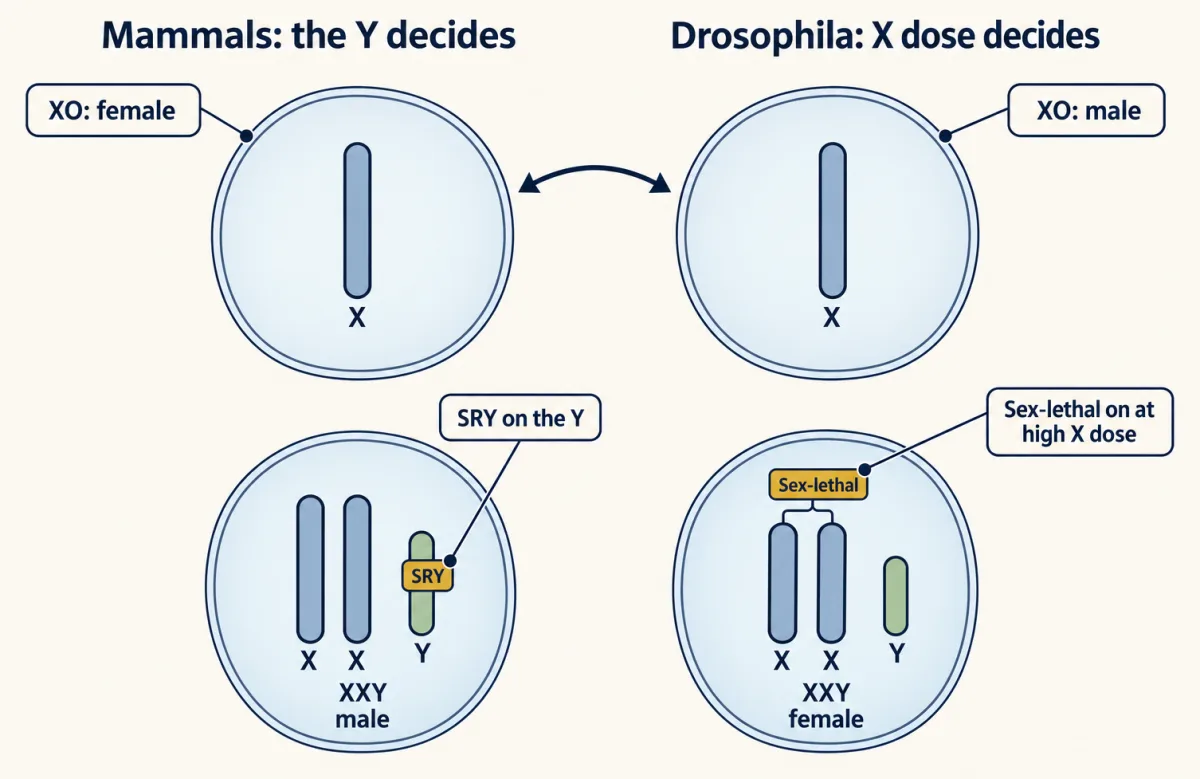
XO and XXY chromosome sets reveal opposite sex-determination rules: the Y carrying SRY is decisive in most mammals, while X dose is decisive in flies. AI-generated illustration -
Balancing X-linked output
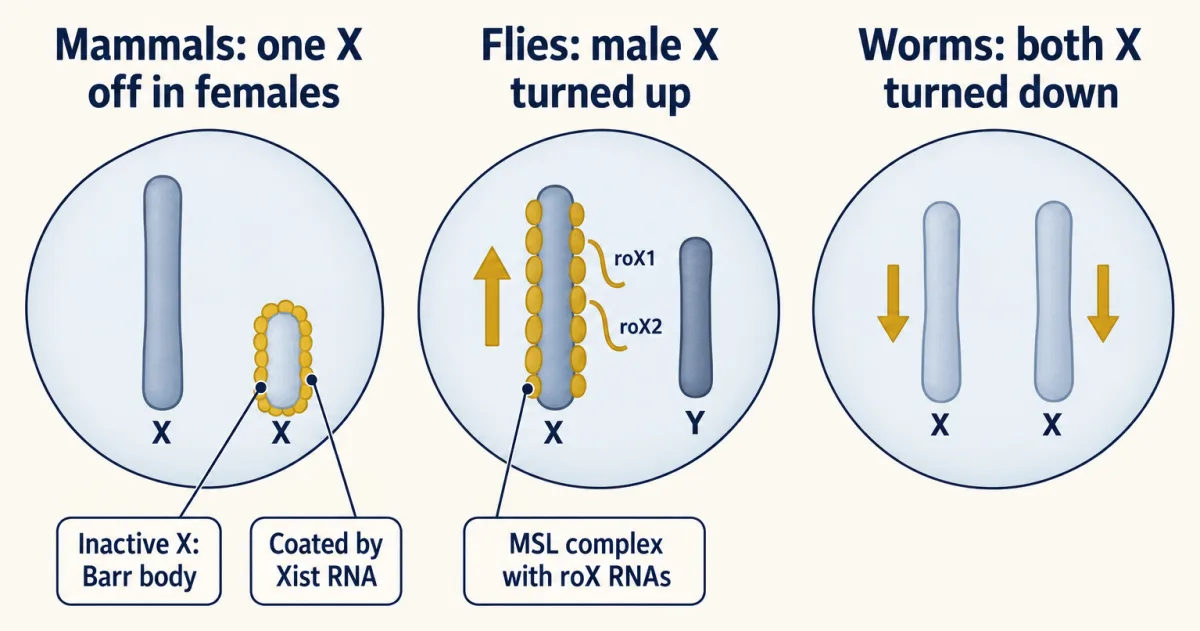
Mammals mainly inactivate one female X, flies raise output from the single male X, and C. elegans hermaphrodites reduce output from both X chromosomes. AI-generated illustration -
Genes that remember their parent
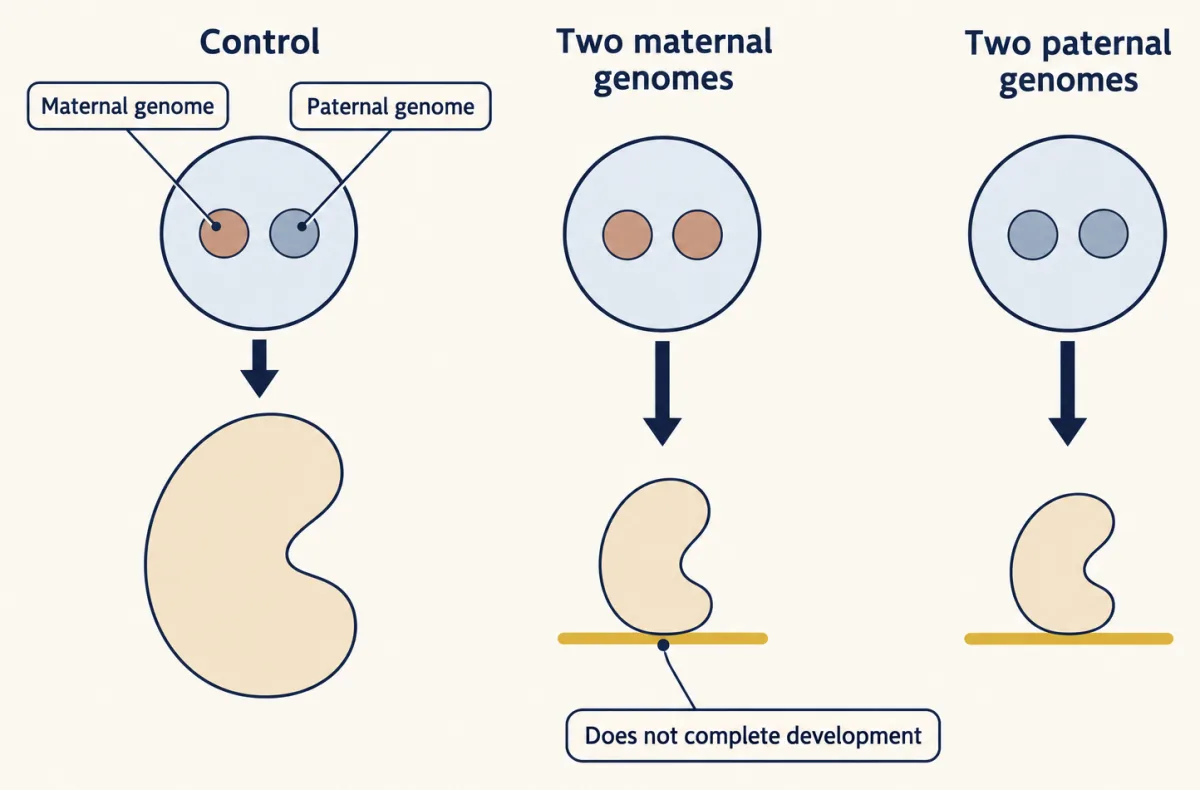
Only the operated control embryos with one maternal and one paternal genome completed normal development, showing that the parental genomes are not functionally equivalent. AI-generated illustration -
Going deeper
Where this lesson fits
Before thisReview first
- Mendel's Peas: Segregation and Independent AssortmentThis course · Lesson 1
You need segregation and the idea of dominant and recessive alleles from there to predict the F1 and F2 here.
- Chromosomes and Meiosis: The Physical Basis of Mendel's LawsThis course · Lesson 2
The lesson uses XX and XY meiosis and chromosome separation, which that lesson shows, to explain hemizygous males and Bridges' exceptions.
- Extending Mendel: Dominance, Multiple Alleles and Gene InteractionThis course · Lesson 4
It prepares you to expect phenotypes that depart from simple dominance ratios, such as mosaic patterns and parent-dependent effects.
After thisStudy next
- Chromosome Number and Structure: Aneuploidy and RearrangementsThis course · Lesson 7
Nondisjunction, which Bridges used to explain exceptional flies, is developed there as the source of extra and missing chromosomes.
- Eukaryotic Gene Regulation and EpigeneticsThis course · Lesson 20
It takes the silencing and DNA methylation behind X inactivation and imprinting further, as part of how gene expression is controlled.
Elsewhere on the siteFilms, simulations and method films in other courses
- Where the White Was HidingFilm · Biology
It shows how Punnett squares predict offspring chances, the tool used here for X-linked crosses.
- Homologs First, Sister Chromatids SecondFilm · Biology
It shows how homologs separate in meiosis, which sets which X a gamete carries.
- Copies, Halves, and PairsFilm · Life Science
It shows how sex cells get half the chromosomes, which explains why sons get their mother's X.
Suggested by an AI model from the lessons themselves, then checked. How we use AI