Copies, Halves, and Pairs
Read the transcript of “Copies, Halves, and Pairs”
Film transcript: Copies, Halves, and Pairs
Why can a strawberry runner make a copy, while brothers and sisters are different? Watch one garden tell both stories. A runner stretches from one plant and roots nearby. It has one parent. This is asexual reproduction. The new plant usually carries the same genetic information.
Sexual reproduction takes another path. Two sex cells join, usually one from each of two parents. In animals, those cells are sperm and egg. Before they join, a problem must be solved. Body cells carry chromosomes in pairs.
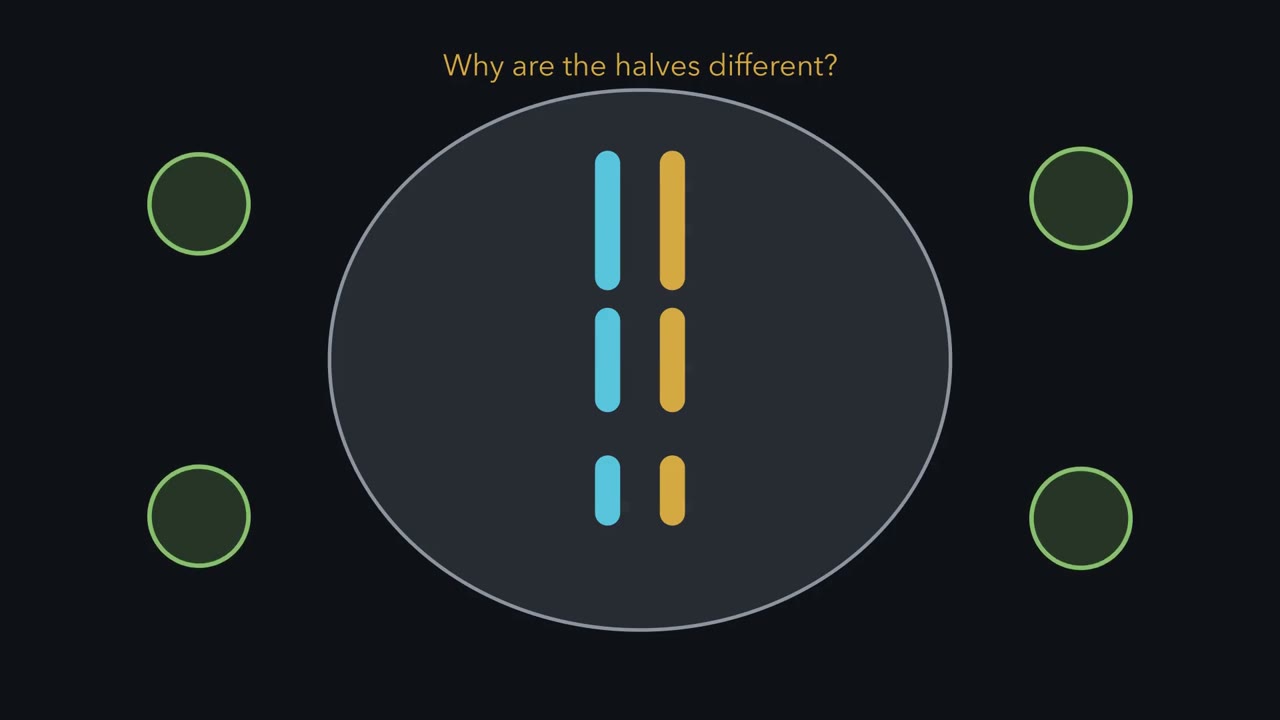
Joining two fully paired cells would double the chromosome number. Follow the blue and gold bars. Each colour marks one member of a chromosome pair. The pair carries the same kinds of genes in the same general places. One member came from the mother, and one from the father. A body cell keeps both members together. Which move could let two sex cells join without doubling the chromosome number? Watch the bars. Should every pair stay together, or should each cell carry only half? Make your prediction.
Meiosis solves the problem. The members of each pair separate. A sex cell receives one chromosome from every pair. Its chromosome number is half the body-cell number. Here is the rule. Sexual reproduction: meiosis halves chromosome number and makes mixes; fertilization restores pairs. Now a sperm and egg move together. Fertilization joins them into one new cell. Their half sets make full pairs again. Each restored pair has one chromosome from each parent. The chromosome number returns to the usual body-cell number instead of growing with every generation. Look again at the bar count.
Halving does not mean cutting chromosomes into pieces. It means placing one whole chromosome from every pair into a sex cell. When the cells join, the partners form pairs again. This movement can repeat across generations without a steady rise in chromosome number. The picture used animal sperm and egg cells.
Plants take an extra step. Meiosis first makes spores, and sex cells form later. Those sex cells still carry half. The simple model also has an exception: rare DNA changes can make an asexual copy imperfect. Return to the garden. The runner grows from one parent, so it usually carries that parent's genetic information. Sexual offspring begin when half sets join. Meiosis prevents chromosome number from doubling. Fertilization restores the pairs. The next question is why those half sets are not all alike.
Why does a strawberry runner grow into a copy of its parent, but brothers and sisters do not come out as copies of each other?
Continue in the lesson: Reproduction and Meiosis →
3:28 · Free, with captions and a transcript. The lesson has the full text, the questions and the sources.
More films from this lesson
How this film was made. Narration: written from this lesson's text and read by an AI narrator voice (Kokoro, af_heart). Animation: AI-generated in code (Manim) by Claude, a schematic with no drawn molecular structures. Captions come from the narration script. See something wrong? Report it.