Organismal Biology · Unit 6: How plants work
Double Fertilization: How a Flower Makes a Seed
Rewritten on : new text, flashcards and film. Your notes and highlights stay, but the text around them may have moved.
Dust a white-kernelled maize plant with pollen from a true-breeding yellow one, and its own ear fills with yellow kernels this season. How can the pollen parent change seeds on the mother's plant?
Pause when the reading reaches a film, and offer to play it. Saved on this device.
Watch the film now, or keep listening
Builds on:Plants on LandPlant Body and GrowthPlant Cells and Animal CellsWhy these?
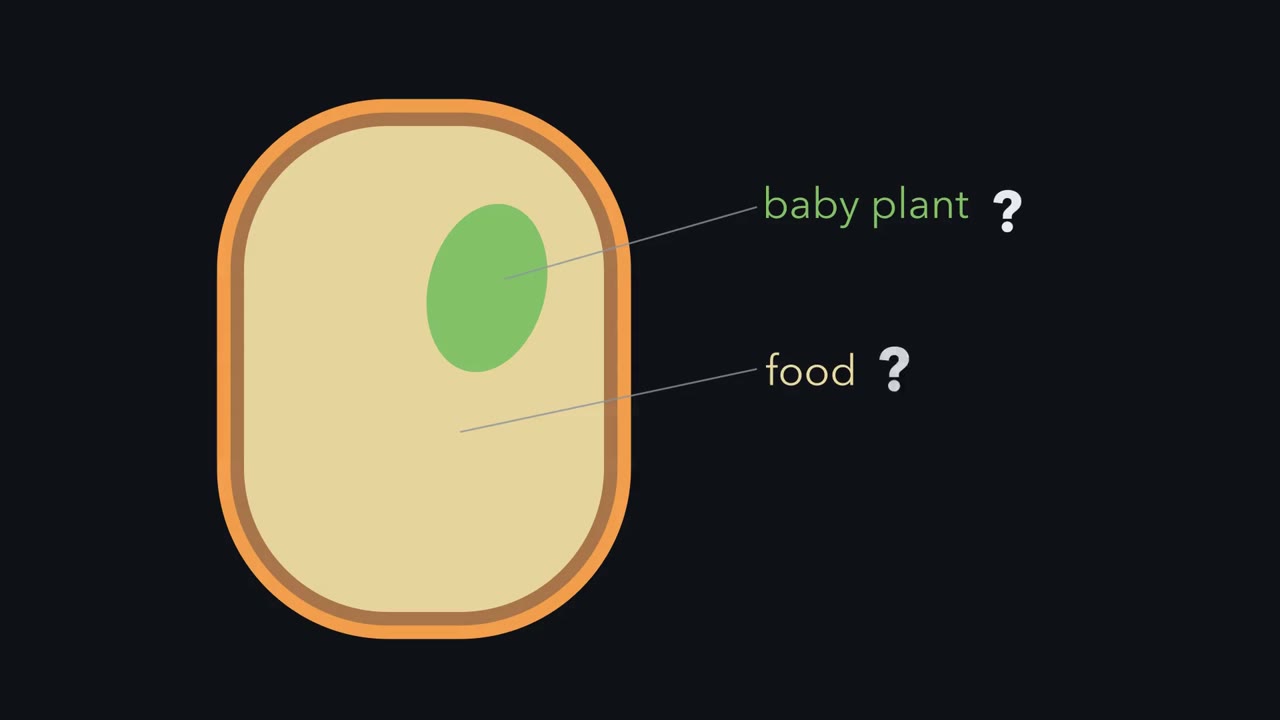 ▶ Watch Whose Cells Are in a Seed? · 3:18
Read the transcript of “Whose Cells Are in a Seed?”
Film transcript: Whose Cells Are in a Seed?
Break open a maize kernel. Part of it is a baby plant, part is its food, and part is a wrapper. Which parts came from the father? We can answer by counting chromosome sets. One set is the chromosomes of one egg or one sperm. The mother's sets will be magenta blocks. The father's will be teal. Start with the father. A pollen grain is not a sperm. It is a tiny separate generation of the plant, two or three cells, and it makes two sperm. Every cell in the grain carries one set from the father. The grain lands on a stigma, the sticky tip that catches pollen. It grows a tube down to an ovule, and the two sperm ride inside. Inside the ovule waits the mother's tiny generation, the embryo sac.
It comes from one spore, so its nuclei are all copies of one maternal set. Three kinds of cells matter. The egg holds one magenta block. The large central cell holds two identical copies of that same set. Two synergids sit beside the egg. The synergids signal to the tube. The tube bursts into one of them and releases both sperm. One sperm fuses with the egg. That makes the zygote, which grows into the embryo. Its stack is one magenta block and one teal. The other sperm fuses with the central cell. That cell already holds two copies of the mother's set. How many blocks will the new tissue carry? How many are the father's?
Three blocks, only one of them teal. This is the endosperm, the food store for the embryo: two maternal sets, one paternal. One sperm starts the baby plant, and the other starts its food. This is double fertilization. Layers of the mother's own tissue surround the embryo sac. They become the seed coat, with no teal at all. The ovary wall around the ovule becomes the fruit wall. It is the mother's tissue too. In maize, it is the kernel's thin outer skin. One kernel, three ledgers. Embryo, one and one. Endosperm, two and one. Coat and fruit wall, two and none. This count holds for most flowering plants. Water lilies, for one, change the numbers but keep the logic.
Pollen landing on a stigma is pollination. Fertilization comes later, inside the ovule, and only if a tube arrives. So the father sends one set, twice. His sets enter only the embryo and the endosperm. The seed coat and fruit wall are the mother's own tissue.
From the film
- A pollen grain is not a sperm: it is a tiny male generation of the plant whose tube carries two sperm to the ovule.
- One sperm fuses with the egg and starts the embryo: one set of chromosomes from each parent.
- The other sperm fuses with the central cell and starts the endosperm, the embryo's food store: in most flowering plants two maternal sets and one paternal set.
- The father reaches only the embryo and the endosperm; the seed coat and the fruit wall are the mother's own tissue, with no chromosomes from the pollen parent.
- Pollination moves pollen to a stigma; fertilization happens later, inside the ovule, and only if a tube arrives.
Dust the silks of a white-kernelled maize plant with pollen from a plant true-breeding for yellow kernels, and the ear that ripens on the white plant this season fills with yellow kernels. The first film counted the chromosome sets in a kernel; here those sets solve the yellow ear.
The one idea. The father reaches only the embryo and the endosperm; the seed coat and the fruit wall are the mother’s own tissue. Counting chromosome sets (one set is the chromosomes of one egg or sperm) from each parent, written maternal + paternal, shows it: embryo 1 + 1, endosperm 2 + 1, seed coat and fruit wall 2 + 0. The pollen tube brings one paternal set in each of its two sperm.
Scope: flowering plants whose embryo sac grows from one spore and whose central cell holds two copies of the maternal set: Arabidopsis, maize and most species. Water lilies, most lilies and plants that make seed without fertilization change the numbers, not the logic (Going deeper).
The parts of a flower: four rings of organs
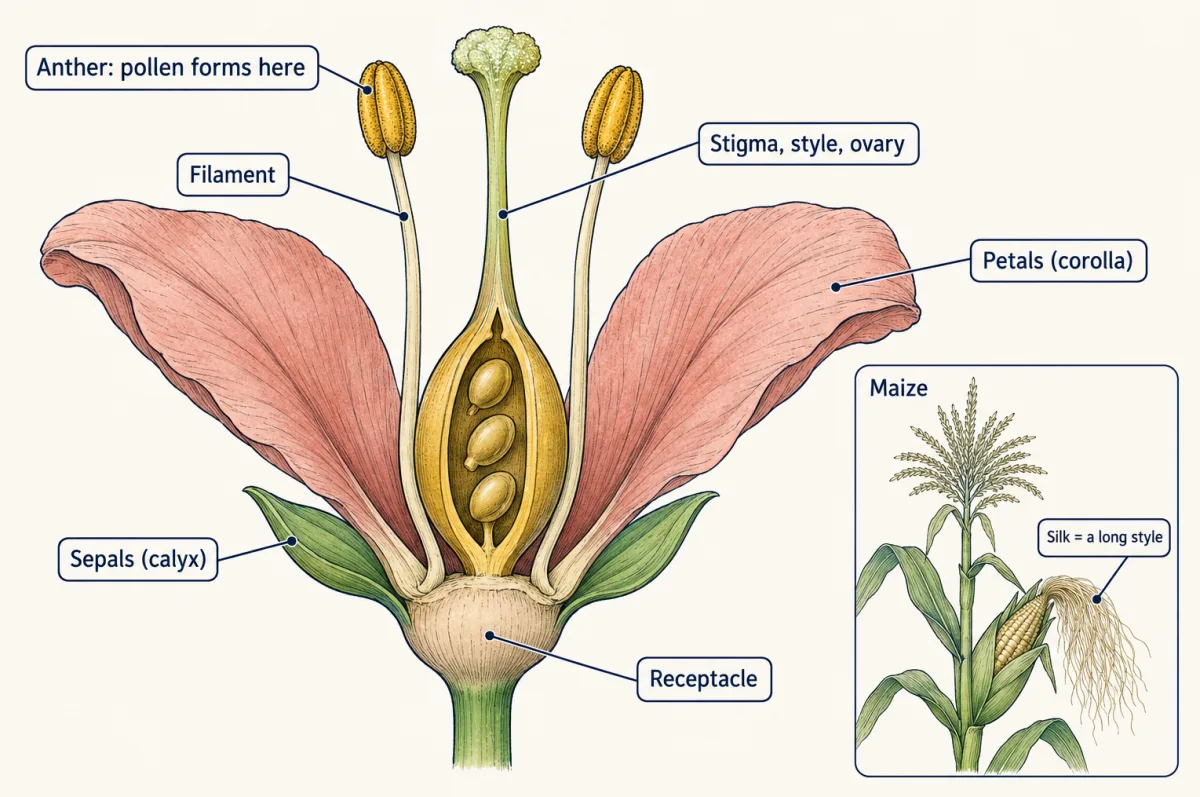
For the count, three parts matter: the anther, the stigma and the ovule. A flower is a short shoot that bears the reproductive organs of a flowering plant (an angiosperm). Typically the organs sit in four rings, or whorls, on the swollen tip of the flower stalk, the receptacle. From the outside in:
- Sepals, together called the calyx, are often green and enclose the bud.
- Petals, together the corolla, are often coloured.
- Stamens are the male organs. Each is a stalk, the filament, holding an anther, where pollen forms.
- Carpels are the female organs. A carpel has a sticky tip, the stigma, a neck, the style, and a swollen base, the ovary, which holds one or more ovules.
Not every flower has all four whorls. Maize has male flowers in the tassel and female flowers on the ear, and each silk is a long style and stigma, covered in hairs that catch pollen.
Before the sperm: two tiny generations
Recall alternation of generations (plants on land): a diploid, spore-making sporophyte alternates with a haploid, gamete-making gametophyte. In a flowering plant the gametophytes are the tiny generations the first film showed inside the flower; the table adds where each comes from.
| Male gametophyte: the pollen grain | Female gametophyte: the embryo sac | |
|---|---|---|
| Where | In the anther | In the ovule |
| Starts as | A diploid microspore mother cell divides by meiosis (chromosomes and meiosis) into four haploid microspores | In Arabidopsis, maize and most flowering plants, one haploid spore, a megaspore |
| Becomes | Each microspore divides by mitosis into a tube cell (also called the vegetative cell), which grows the tube, and a generative cell, which divides into the two sperm | Nuclei that are all mitotic copies of the megaspore’s one set: the egg, a large central cell with two polar nuclei, and two synergids |
In Arabidopsis the two polar nuclei fuse before the sperm arrive, but the central cell still carries two maternal sets. Around the embryo sac lie one or two layers of the mother’s own diploid tissue, the integuments, which leave a small opening, the micropyle.
Pollen meets pistil: one tube, two fertilizations
The first film kept pollination, the transfer of pollen from an anther to a stigma, apart from fertilization, the fusion of a sperm with a female cell inside the ovule, which may never follow. On a compatible stigma the grain takes up water; its pollen tube runs down the style, carrying sperm that have no flagella, and usually enters the ovule through the micropyle.
The film’s two fusions are double fertilization, and the endosperm they start is triploid (3n) in Arabidopsis, maize and most flowering plants. In most animals one sperm fuses with one egg, usually swimming to it (animal reproduction). Sergei Navashin (1898) and Léon Guignard (1899) first saw both fusions, in lily ovules.
Worked problem: the yellow ear
The one idea again: embryo 1 + 1, endosperm 2 + 1, seed coat and fruit wall 2 + 0. Multiply sets by n, the chromosomes in one set, to get chromosome numbers; follow alleles through the sets to get kernel colours.
Maize (Zea mays) has 2n = 20, so n = 10. Assume one gene for endosperm colour, with yellow (Y) fully dominant over white (y); in real maize the yellow deepens with each extra Y copy.
- Chromosome counts. Egg and each sperm: 1 set, 10. Central cell: 2 sets, 20. Zygote and embryo: 1 + 1 = 2 sets, 20. Endosperm: 2 maternal sets + 1 paternal set = 3 sets × 10 = 30. Seed coat and fruit wall, the mother plant’s own tissue: 20.
- The yellow ear. The white-kernelled mother is yy; the pollen comes from a true-breeding yellow plant, YY.
Predict. What colour are this ear’s kernels, and which tissue sets it?
Check your prediction
The egg is y, the central cell yy, and every sperm Y. The embryo is Yy and the endosperm yyY, so the kernels are yellow on a plant whose selfed kernels would be white. Because the endosperm is a product of fertilization, the pollen parent’s genes show in this generation’s seed: xenia.
A colour carried in the pericarp, the fruit wall around each kernel, is set by the mother’s genotype, so it does not change with the pollen parent the way endosperm colour does.
Predict. Cross Yy ♀ × yy ♂, then yy ♀ × Yy ♂. Half the Yy parent’s gametes carry Y, so half the kernels are yellow either way. Recall that both polar nuclei copy the egg’s set. Which cross gives the deeper yellow?
Check your prediction
The first. A Yy mother’s central cell is YY or yy, never Yy, so a yellow kernel’s endosperm is YYy, two doses of Y. A Y from the father comes in one sperm, so its endosperm is yyY, one dose. The rule counts sets, not alleles.
Going deeper selfs a heterozygote on a 400-kernel ear, with an interactive.
Flowers and their animals: wind, insects and coevolution
Grasses such as maize, and oaks, are wind-pollinated: their flowers have small petals or none, no nectar and exposed stigmas, and shed huge amounts of light, dry pollen, almost all of which lands nowhere useful. Field mustard, Brassica rapa, is pollinated by bees and hoverflies. Its petals, scent and nectar attract visitors, and its sticky pollen travels on them to the next flower.
Self-pollination moves pollen to a stigma of the same flower or the same plant; cross-pollination moves it to another plant, and fertilization by pollen from another plant is outcrossing. Selfing is still sexual: it uses meiosis and fertilization, so a heterozygous plant’s selfed offspring vary. Many species, wild B. rapa among them, have self-incompatibility: the stigma or style rejects pollen carrying the plant’s own incompatibility alleles.
Coevolution is reciprocal evolutionary change between interacting lineages: each changes in response to the other (mutualism, parasitism and coevolution). The Madagascar orchid Angraecum sesquipedale holds its nectar at the bottom of a spur nearly 30 cm long. In 1862 Darwin predicted a moth with a tongue to reach it; in 1903 Rothschild and Jordan described the hawkmoth Xanthopan morganii praedicta (since 2021 usually treated as a species of its own, Xanthopan praedicta).
A match like this suggests an interaction; on its own it is a hypothesis, not evidence of coevolution. Coevolution needs evidence on both sides: that moth tongues imposed selection on spur length, and that orchid spurs imposed selection on tongue length. If the tongue lengthened for other reasons and the orchid tracked it, that is one-sided adaptation.
Design problem
Gervasi and Schiestl (2017) let fast-cycling Brassica rapa be pollinated only by bumblebees, only by hoverflies, or by hand, with three replicate populations of 36 plants per treatment. After nine generations of selection and a round of crosses between replicates within each treatment, they compared the plants of generation 11. Bumblebee-pollinated plants became taller, and bumblebees preferred them in a choice test. Hoverfly-pollinated plants self-pollinated more. Is this coevolution? What does each part of the design rule out, and what more would you need? Hint: what would drift, random change in small populations, do to three replicates?
Saved in this browser only.
One way to do it
The hand-pollinated lines shared the greenhouse, so traits that changed only in insect lines are not greenhouse effects. Three replicates test repeatability: drift would push replicates in different directions, while selection by one pollinator should push them the same way.
So pollinators can drive plant evolution quickly. One hypothesis for the hoverfly result: where a pollinator delivers little outcross pollen, plants that selfed may leave more offspring.
It is not evidence of coevolution: only the plants were followed, so you would also need insects whose traits changed in response to the plants. And one pollinator in a greenhouse is not a field community, so the result shows what pollinators can do, not what they do in a meadow.
From ovule to seed, ovary to fruit
A strawberry’s red flesh is the mother’s own tissue, yet it swells only after the flower is pollinated. The second film asks what tells it to grow.
Read the transcript of “Why Does a Strawberry Swell?”
Film transcript: Why Does a Strawberry Swell?
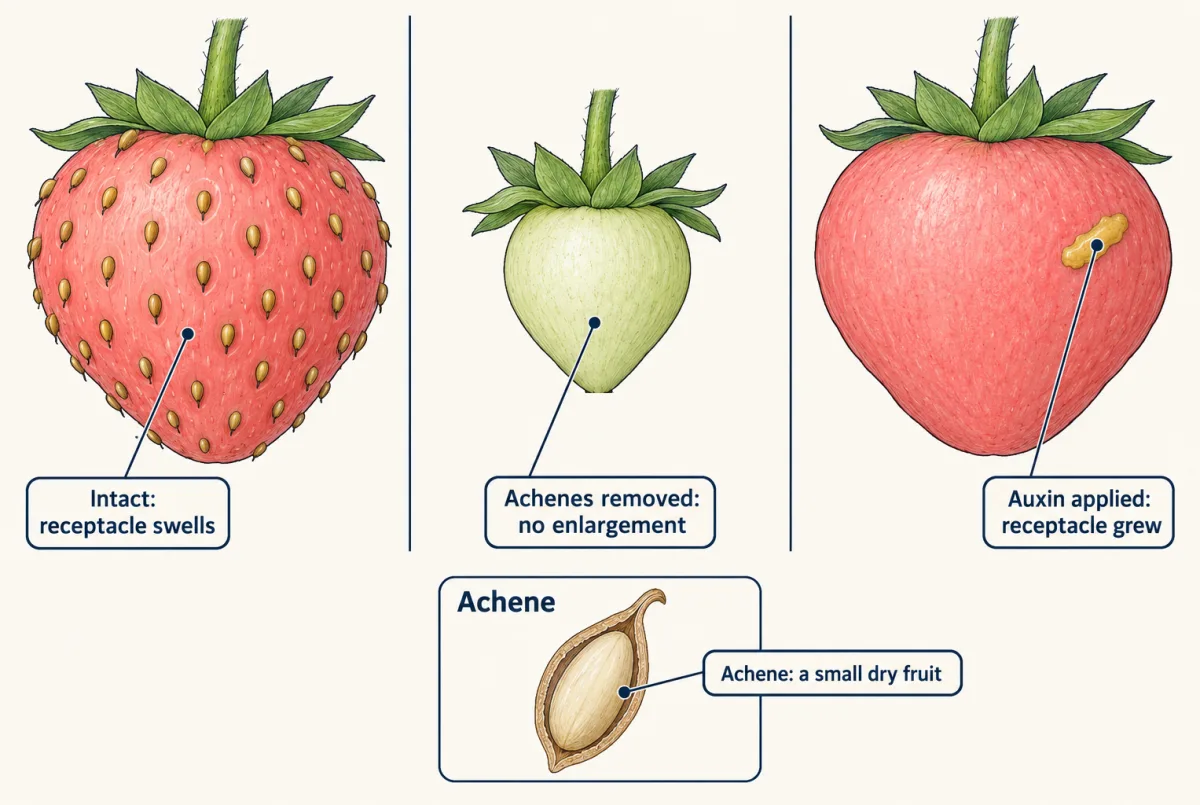
A strawberry's red flesh is the mother's own tissue, with no chromosomes from the father. So why does it swell only after the flower is pollinated? The first film counted the sets in a seed. It ended with the seed coat and fruit wall as the mother's tissue. This film asks what tells her tissue to grow. Start with the general rule. After fertilization, the ovule becomes the seed. In most flowering plants, the ovary around it becomes the fruit. A strawberry flower is unusual. It has many separate ovaries sitting on a dome. The dome is the receptacle, the swollen tip of the flower stalk. After fertilization, each ovary becomes an achene, a small dry fruit holding one seed. Those specks on the surface are the true fruits.
The red flesh is swollen receptacle. A fruit whose flesh comes from tissue other than the ovary is called an accessory fruit. Compare a tomato. Its flesh develops from the ovary itself. In 1950, Jean Paul Nitsch asked what makes the receptacle grow. He worked on young receptacles from pollinated flowers, each studded with achenes. One idea is that the receptacle grows on its own once the flower is pollinated. If so, the achenes should not matter. So Nitsch removed every achene from some young receptacles. If pollination alone were enough, what would happen to a stripped receptacle?
It did not enlarge. The intact receptacles grew, but the stripped ones stayed small. Growth needed the achenes, not just pollination. Next, Nitsch coated some stripped receptacles with a paste containing an auxin, a plant hormone. Those receptacles grew. Put the three results together. The developing achenes supply a growth signal.
Applied auxin can stand in for that signal. Notice what this does not show. Auxin was enough to restore growth. That does not prove the natural signal is auxin alone. Nor does it show how the signal moves. Back to the ledger. The flesh is all mother, two magenta blocks. In a normal fruit, it grows on a signal from the developing achenes. This is one experiment, in one kind of accessory fruit. The receptacle is the mother's tissue. But the developing achenes tell it to grow.
From the film
- After fertilization the ovule becomes the seed and, in most flowering plants, the ovary becomes the fruit, whose wall is the mother's own tissue.
- A strawberry is an accessory fruit: its red flesh is swollen receptacle, not ovary as in a tomato, and the true fruits are the small dry achenes on its surface, each holding one seed.
- Nitsch found that a pollinated receptacle stripped of its achenes did not enlarge, and that applied auxin made a stripped receptacle grow.
- So the developing achenes supply a growth signal that auxin can mimic: the receptacle is the mother's tissue, but the achenes tell it to grow. The experiment does not show that the signal is auxin alone, or how it moves.
Auxins are one family of plant hormones (plant hormones and responses); later work points to gibberellins in strawberry growth as well (Going deeper).
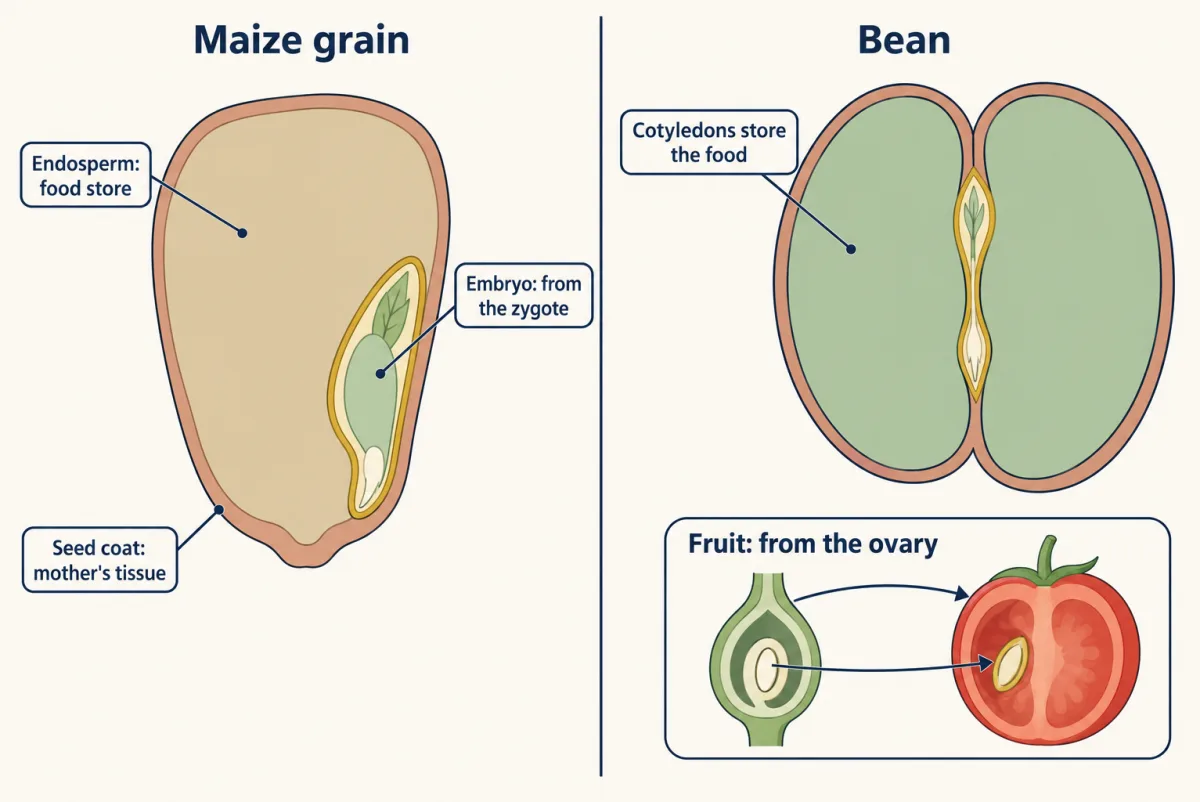
The embryo is a new diploid plant with a root tip, a shoot tip and one or two seed leaves (cotyledons); the seed coat comes from the integuments. In maize and wheat grains the endosperm persists and holds the starch; in beans, peas and shepherd’s purse (Capsella) the cotyledons absorb it as the seed develops and store the food themselves. A maize grain is a whole fruit: its thin outer layer is fruit wall, the pericarp, fused to the seed coat.
Waiting and travelling: dormancy, dispersal and clones
Seed dormancy is the failure of an intact, viable seed to complete germination under favourable conditions. In the framework used in Arabidopsis seed studies, the hormone abscisic acid (ABA) is required to induce dormancy as the seed matures. Gibberellins promote germination, which begins when the seed takes up water and ends when the embryonic root pushes out through the seed’s coverings.
Dandelion fruits carry a parachute of fine hairs and drift on the wind. Coconut fruits float and travel by sea. Jays and squirrels bury acorns and miss some, which germinate away from the parent oak.
Many plants also reproduce asexually. Strawberry stolons, or runners, are horizontal stems that root at their nodes into new plants. Potato tubers are swollen underground stems whose buds (eyes) sprout. Apomixis is seed formation in which the embryo develops without fertilization from an unreduced cell, one that keeps the mother’s full chromosome number. Dandelions are a familiar apomict.
Predict. Count the sets in an apomictic embryo. At a gene where the mother is heterozygous (carries two different alleles), what will her apomictic seedlings carry?
Check your prediction
All of the mother’s sets (2 in a diploid mother) and none from a father: a clone, so every seedling keeps every heterozygous gene. Selfed seedlings would segregate instead. In some apomicts the endosperm still needs a sperm to form.
Engineered apomixis is being studied to keep the best hybrid crops true, but in one hybrid rice it was still inefficient (Going deeper).
Going deeper
Building the gametophytes, species by species
In Arabidopsis and maize the grain is shed with three cells; in lilies it is shed with two and the sperm form inside the growing tube. In the Arabidopsis embryo sac, eight nuclei form seven cells.
When the count changes
The count assumes one megaspore and two polar nuclei. Water lilies, with one polar nucleus, make diploid endosperm, 1 maternal + 1 paternal set. Most lilies, with tetrasporic embryo sacs, regularly make 4 + 1. In apomicts the embryo carries all of the mother’s sets and none from a father, a clone of the mother.
Selfing a heterozygote: counting kernels on an ear of 400
- Selfing a heterozygote. A Yy plant self-pollinates and an ear sets 400 kernels. Both polar nuclei copy the egg’s set, so the central cell is YY when the egg is Y and yy when it is y, each with probability 1/2. The sperm carries Y or y, each 1/2, independently (probability and crosses), so the endosperm is YYY, YYy, yyY or yyy, each 1/2 x 1/2 = 1/4. Only yyy is white. Expected, assuming random fertilization and equal kernel survival: 3/4 x 400 = 300 yellow and 1/4 x 400 = 100 white (check: 300 + 100 = 400).
Letters in teal are copies from the seed parent (maternal); letters in orange are copies from the pollen parent (paternal). In this sketch, both polar nuclei and the egg descend from one megaspore (as in maize), and both sperm of one grain carry the same allele. Showing the kernel you select on the ear below.
yellow kernel white kernel selected kernel (click it, or use the arrow keys). Kernels drawn as a grid of dots.
| Endosperm (central cell + sperm) | Kernel colour | Expected of 400 | Simulated |
|---|
In this sketch: one gene, with yellow (Y) fully dominant over white (y), though in real maize the yellow deepens with each extra Y copy; every ovule is fertilized; kernels are independent; counts on the ear are random draws made by this sketch, not data; expected counts assume random fertilization and equal kernel survival. Zea mays, 2n = 20.
Rule to keep: endosperm = 2 maternal sets + 1 paternal set; embryo = 1 maternal set + 1 paternal set. Seed coat and fruit wall are the mother plant’s own tissue and never take the pollen’s genotype.
Auxin and gibberellin in strawberry growth
In Fragaria vesca, Tian and colleagues (2022) found that a gibberellin-synthesis blocker reduced the enlargement caused by applied auxin, and auxin transport from achene to receptacle remains a proposed model.
Engineered apomixis in hybrid rice
Liu and colleagues (Plant Communications, online 2022) followed engineered apomictic lines of the hybrid rice Chunyou 84 for four generations: 1.9 to 3.2% of tested offspring were clones, and in one field season seed set was 5.7 to 7%, against 75.9% for the unedited hybrid. These figures describe one engineered line, not engineered apomixis in general.
Your notes
Select any text in the lesson to highlight it or add a note to it. Your highlights and notes are saved in this browser and collected in your notebook.
This browser is not letting the site save anything (a private window or strict privacy settings), so highlights and notes will be lost when you leave the page.
How we measure it
Fixed, sectioned and stained ovules under the light microscope
Collect ovules at timed stages after pollination, fix and slice them thin, and stain the nuclei. A series of stages lets you infer the order of events, such as which male nucleus joins which female cell, though each section is a snapshot rather than a film.
Organ removal and hormone replacement
Remove a structure suspected of sending a signal (here the achenes of a strawberry), see what fails, then apply a candidate hormone in its place. If the hormone restores the response, the structure supplies a signal the hormone can mimic; it does not prove the hormone is the natural signal.
Replicated experimental evolution
Found several populations, give each a different selective regime (here, which animal pollinates), and add a control regime such as hand pollination. Differences that arise in every replicate of a treatment, and not in the controls, point to selection rather than drift or greenhouse conditions.
Laser ablation with live imaging
Destroy one chosen cell with a focused laser pulse and film what the remaining cells do. In dissected Arabidopsis ovules this tests whether fertilization of the central cell depends on a working egg.
Practice questions on this lesson (3) → MCAT-style, original, each with an explanation
Where this lesson fits
Before thisReview first
- Plants on LandThis course · Lesson 5
You need alternation of generations and the haploid gametophyte from there to follow pollen grains and embryo sacs.
- Plant Body and GrowthThis course · Lesson 22
Knowing the plant body and its growth helps you place the flower as a shoot and follow the seedling.
- Plant Cells and Animal CellsLife Science · Grade 7
Chromosome-set counting here builds on knowing that cells carry paired chromosomes, which gametes halve.
After thisStudy next
- Chromosomes and Meiosis: The Physical Basis of Mendel's LawsOne level up · Genetics and Molecular Biology
It takes meiosis further, showing which chromosomes a gamete gets, which sets the chromosome count of each seed part.
- Mendel's Peas: Segregation and Independent AssortmentOne level up · Genetics and Molecular Biology
Following alleles through gametes to seed colours takes this idea further, using ratios in pea seeds.
- Extending Mendel: Dominance, Multiple Alleles and Gene InteractionOne level up · Genetics and Molecular Biology
Gene dosage and dominance in kernels, such as yellow deepening with extra copies, extend into dominance and gene interaction.
Elsewhere on the siteFilms, simulations and method films in other courses
- Set Up: Take a Flower ApartFilm · Biology Together
It shows the parts of a real flower, including where seeds begin.
- Set Up: From Bean to BeanFilm · Biology Together
It follows a plant from seed through flower to new seed, the circle this lesson explains in detail.
- Set Up: Seeds on the MoveFilm · Biology Together
It shows how seeds get carried to new places, which this lesson treats as dispersal.
Suggested by an AI model from the lessons themselves, then checked. How we use AI
Finish line
Test yourself
8 questions
Practice and MCAT-style, with explained answers.
That's the last lesson · Next course
Cell Biology
How a eukaryotic cell is built, moves things around, divides and lives among other cells.
Start the next course →Before you move on: review the questions you missed , or go back to all lessons in this course.
← Lesson 25 · Auxin and Plant Hormones: How Plants Steer Growth