Organismal Biology · Skim version
Plants on Land
Read the full lesson → Skim the whole course →
The guiding idea
The green cushion of moss on a wall is haploid, like a human egg. So where is the diploid moss?
In a normal sexual cycle, chromosome sets change only where meiosis halves them and nuclei fuse to add them, so every stage of a land plant's two-body life cycle takes its label from those events (n or 2n for the two bodies, 3n for endosperm in most flowering plants), whichever body is the big one.
From the film: Two Bodies, One Wheel
- A land plant grows two bodies in turn: a haploid gametophyte and a diploid sporophyte.
- Meiosis halves the chromosome sets and fusion adds them; mitosis never changes the count.
- In a land plant, meiosis makes spores, and the gametophyte makes eggs and sperm by mitosis.
- In a moss the leafy plant is the gametophyte; in a fern the frond is the sporophyte.
- Do not judge the label by size: find meiosis and fusion first.
From the film: The Gametophyte Moves Inside
- In seed plants both gametophytes shrink: the female stays inside the ovule (in pine, the seed's food store), and the male travels as pollen.
- A pollen grain is a male gametophyte of a few cells, and its tube carries sperm to the egg without outside water.
- A pine seed holds three generations: a 2n coat, an n food store from the female gametophyte, and a 2n embryo.
- In Arabidopsis, one sperm joins the egg to make a 2n zygote; the other joins the central cell's fused 2n nucleus to make 3n endosperm.
- Endosperm's label is the sum of the sets that fused: 3n in Arabidopsis and most flowering plants, not all.
-
Two bodies in one life cycle
-
Moss and fern: exposed gametophytes, different dominant bodies
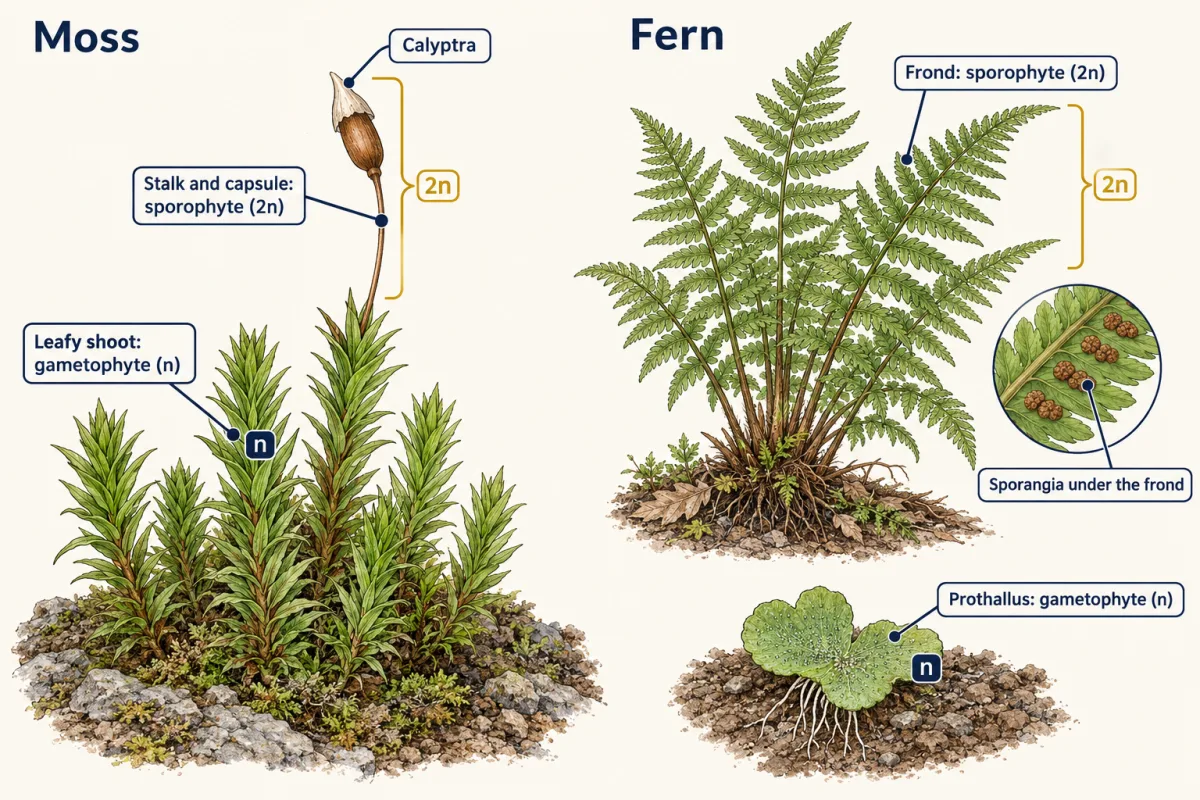
In a moss the leafy green plant is the haploid gametophyte and the stalk and capsule are the diploid sporophyte; in a fern the frond is the sporophyte and the small prothallus is the gametophyte. The conspicuous body is not the same one in both. AI-generated illustration -
Seed plants: the gametophyte moves inside
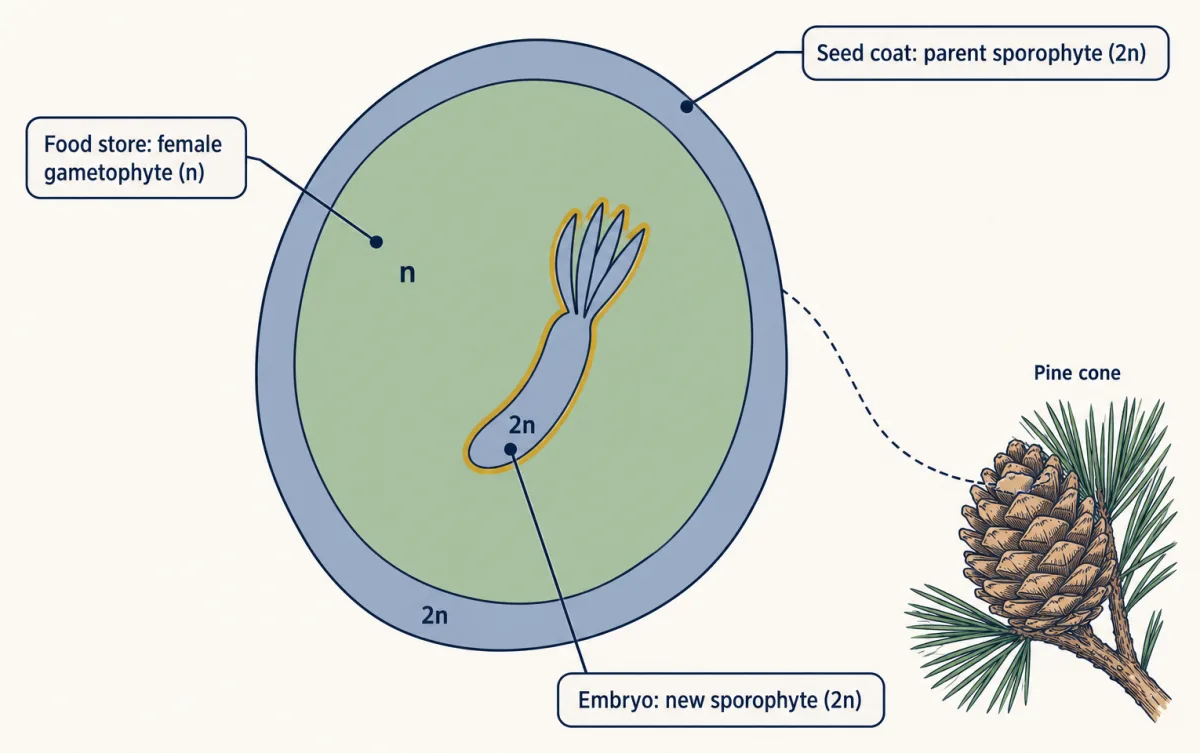
A pine seed holds tissue from three generations: a seed coat from the parent sporophyte (2n), a food store that is the female gametophyte (n), and the embryo, the new sporophyte (2n). AI-generated illustration -
The rule gives the label, not the body
-
Problems of land and the innovations that eased them
-
Branches, not a staircase
-
Going deeper
Where this lesson fits
Before thisReview first
- Meiosis and VariationBiology · High school
You need meiosis halving chromosome sets and mitosis keeping them the same to place n and 2n in the cycle.
- The Cell Cycle and MitosisBiology · High school
You need to know that mitosis copies a cell without changing its chromosome number.
After thisStudy next
- Double Fertilization: How a Flower Makes a SeedThis course · Lesson 26
It takes the flower's embryo sac and double fertilization further, building on the 3n endosperm counted here.
- Moving Water and Sugar in PlantsThis course · Lesson 23
It explains how xylem and phloem move water and sugar, the vascular tissue introduced here.
- Plant Body and GrowthThis course · Lesson 22
It shows how the sporophyte body grows, building on the diploid plant found here.
Elsewhere on the siteFilms, simulations and method films in other courses
- Set Up: Take a Flower ApartFilm · Biology Together
Taking a flower apart shows the parts where pollen and ovules, the male and female gametophytes' homes, form.
- Set Up: From Bean to BeanFilm · Biology Together
It follows a flowering plant from seed to seed, the sporophyte-to-seed loop this lesson labels.
Suggested by an AI model from the lessons themselves, then checked. How we use AI