Ecology and Evolution · Skim version
Molecular Evolution
Read the full lesson → Skim the whole course →
The guiding idea
Two species left no fossil of their split. Can their genes still tell you when it happened?
Neutral changes are fixed, on average, at the rate they arise, so the count of differences between two species grows steadily with time and can be dated from one calibrated split; a departure from that count is a clue to selection, not proof.
From the film: Why Genes Keep Time
- A substitution is a mutation that has spread to every member of a lineage.
- Differences between two species build up on both branches since their common ancestor.
- On average, neutral mutations become substitutions at the rate they arise, whatever the population size: a bigger population makes more, but each is less likely to spread.
- Sequences alone cannot tell a fast rate over a short time from a slow rate over a long one; an outside date, usually a fossil, is needed, and it can date another split only if the two share a rate.
- The oldest fossil of a group gives a minimum age: the real split was earlier.
From the film: Reading Selection in Genes
- A synonymous change keeps the amino acid; a nonsynonymous, or replacement, change alters it.
- If synonymous changes are neutral, omega = dN/dS reads selection on the protein: below 1 suggests purifying selection, near 1 is consistent with neutrality, above 1 suggests positive selection.
- The McDonald-Kreitman test compares the ratio of replacement to synonymous changes among variants within a species with the same ratio among differences fixed between species.
- At Adh in fruit flies, fixed differences held more replacements than the variants predicted, which McDonald and Kreitman suggested reflected adaptive fixation.
- Each test is a model inference: a departure from the neutral count is a clue to selection, not proof, and needs further checks before it counts as adaptation.
-
Sequences as a record
-
Why the clock ticks
-
Reading time: calibration
-
When the tick rate varies
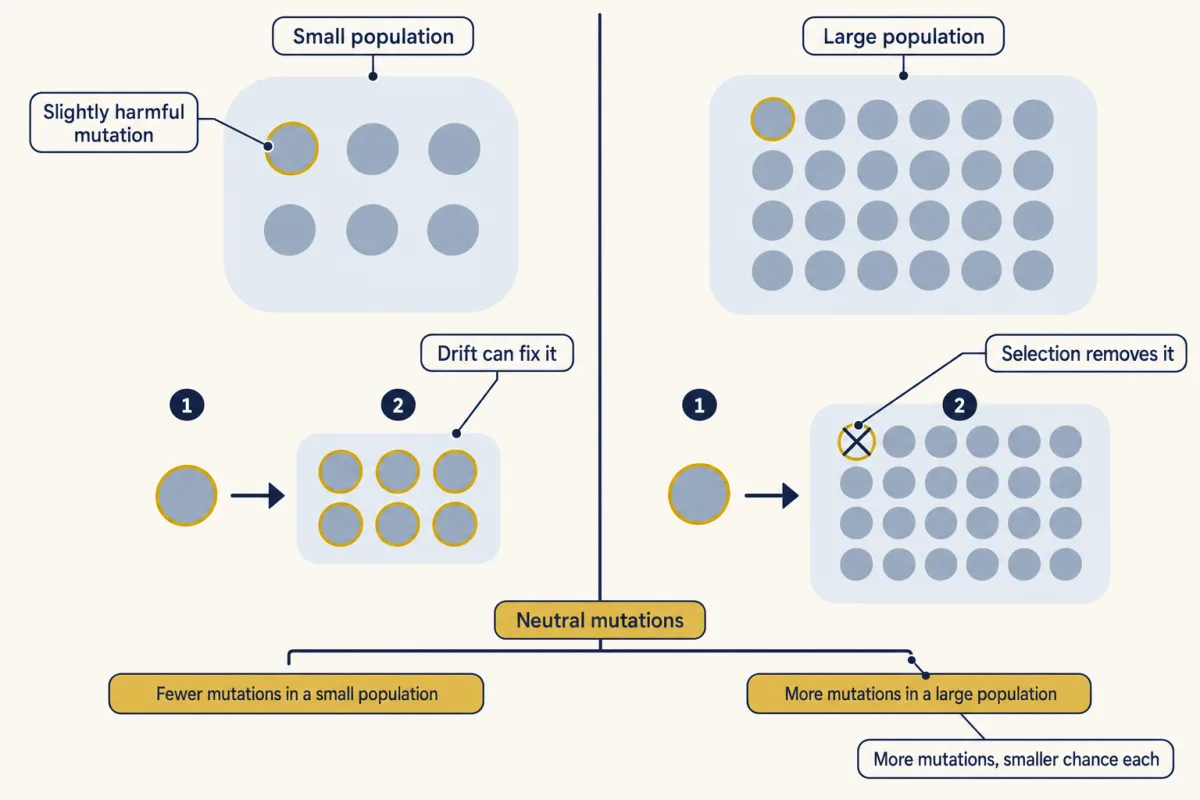
For slightly harmful mutations, drift can fix them in a small population while selection removes them in a large one, so their substitution rate depends on the effective population size. For strictly neutral mutations it does not: more mutations in a large population are offset by a smaller chance that each fixes. AI-generated illustration -
Reading selection in coding sequences
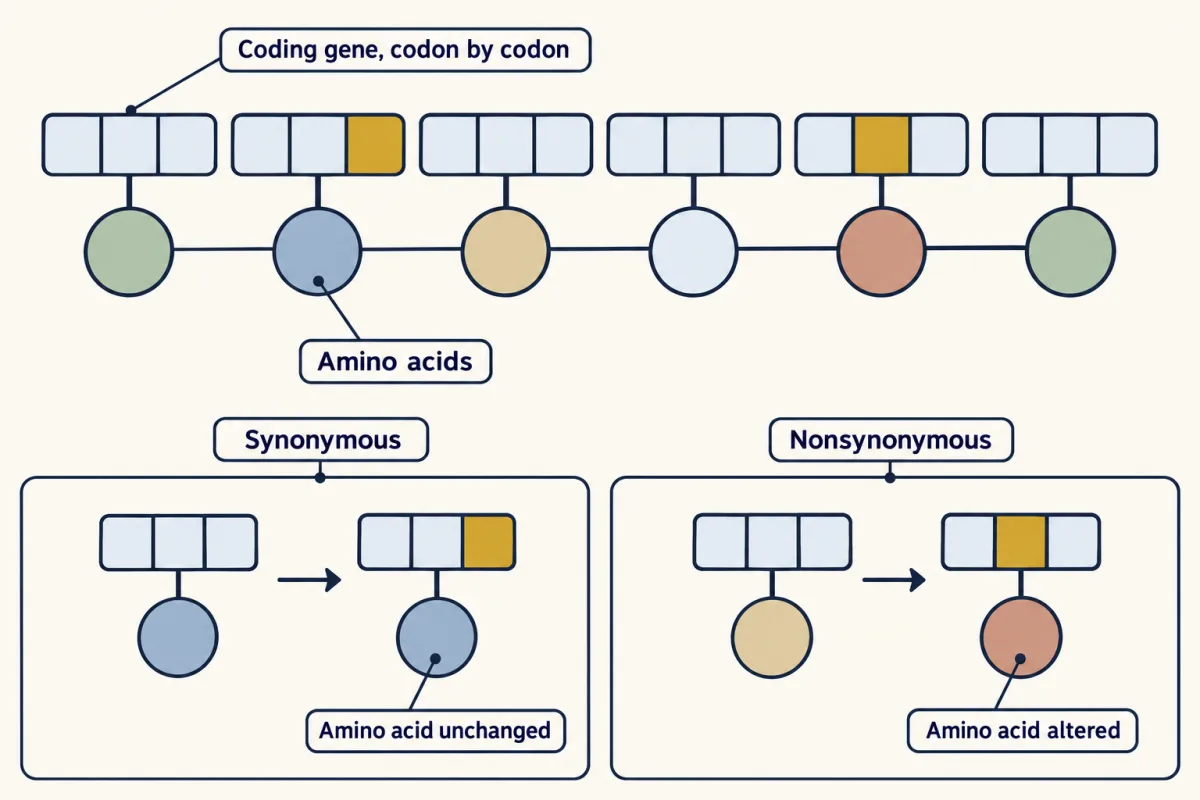
In a coding gene, a nonsynonymous change alters the amino acid and a synonymous change does not, because the genetic code has several codons for most amino acids. That is why dS can serve as a built-in control for dN. AI-generated illustration -
When the signal misleads
-
Going deeper
Where this lesson fits
Before thisReview first
- Reading Phylogenetic TreesThis course · Lesson 2
You need to read trees and see that branch lengths and split points are inferences before dating a split.
- Drift, Gene Flow and Competing ExplanationsThis course · Lesson 4
Fixation of neutral variants by drift, and the role of effective population size, is used here without being re-taught.
- How to Test an Evolutionary ExplanationThis course · Lesson 1
This lesson treats a departure from the neutral count as a clue to selection, not proof, which follows that testing logic.
After thisStudy next
- Evolution of DevelopmentThis course · Lesson 6
It uses sequence comparison and tests of selection on coding versus regulatory changes to ask what changed in evolution.
- Speciation: How Barriers to Gene Flow EvolveThis course · Lesson 7
Dated splits and gene divergence between species are used to ask when and how barriers to gene flow evolved.
- Human Evolutionary History: An African Origin and Archaic AncestryThis course · Lesson 9
It applies calibrated divergence dating and ancestral variation to when human populations split.
Elsewhere on the siteFilms, simulations and method films in other courses
- Fluctuation test: induced or already there?Simulation · Genetics and Molecular Biology
Mutation rate sets the neutral substitution rate here, and this fluctuation test shows mutations arise before selection.
- Why Dominance Does Not Spread an AlleleFilm · Genetics and Molecular Biology
It shows how drift and selection change allele frequencies, the basis for fixation of neutral and advantageous mutations.
- Before the Phage ArrivesFilm · Genetics and Molecular Biology
New mutations arising at a steady rate are the raw material the clock counts.
- The Molecule Behind the TreeFilm · Biology
It shows ribosomal RNA sequence differences used to infer ancestry across all cellular life.
Suggested by an AI model from the lessons themselves, then checked. How we use AI