Films · Genetics and Molecular Biology
Why Dominance Does Not Spread an Allele
Read the transcript of “Why Dominance Does Not Spread an Allele”
Film transcript: Why Dominance Does Not Spread an Allele
A dominant allele shows its trait whenever a person carries it. Why does it not spread until nearly everyone carries it? Follow the allele copies, not just the visible trait. Their count will expose the answer. Each person holds a genotype, an allele pair at one locus. Population genetics asks a different question. Across everyone, what fraction of all copies are blue? That fraction is an allele frequency. An individual cannot supply that population-wide fraction. The pool contains blue copies and gold copies. Their fractions are called p and q. Together they fill the pool. Dominance changes which pairs show a trait, but it adds no blue copies.
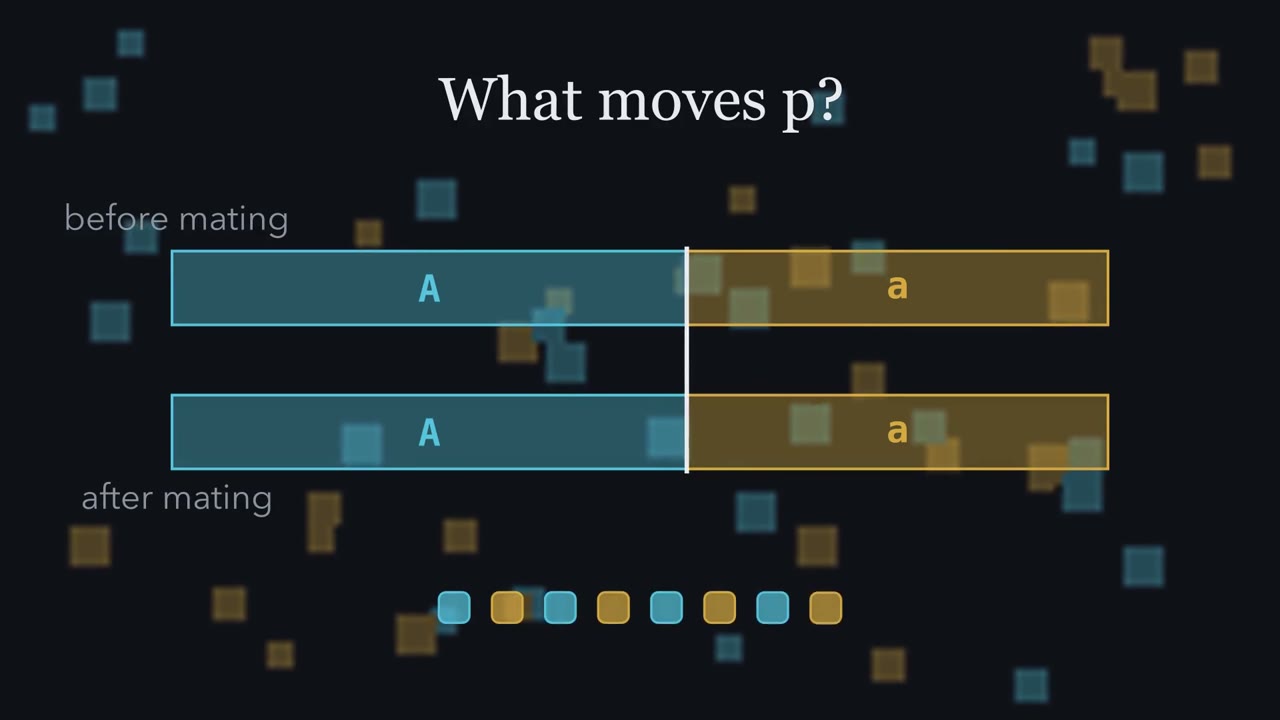
The pool measures inheritance, not outward appearance. Now let eggs and sperm pair at random. Before they pair, predict the next blue fraction. Does random pairing increase it, decrease it, or leave it unchanged? Keep your eye on the copies.
Random means each draw follows the pool's current mix. Draw blue from both lanes, and the pair is a blue homozygote. Draw unlike colours, in either order, and the pair is heterozygous. Draw gold from both, and the pair is a gold homozygote. No draw remembers which phenotype carried a copy. The square gives the expected Hardy-Weinberg genotype proportions.
Blue homozygotes occupy p squared. Heterozygotes occupy both mixed regions. Gold homozygotes occupy q squared. Together the regions fill the whole next generation. These areas describe people, not new allele copies. Recount blue copies in the new people. Every blue homozygote contributes only blue. Every mixed pair contributes half blue. Together those shares return exactly to p. Random mating changed the pairings, not the allele frequency. Dominance still changes the visible count. Both blue homozygotes and heterozygotes show the dominant trait. Yet visibility is not transmission advantage. A visible effect is not a copying mechanism. Without unequal survival, reproduction, or another force, blue copies receive no extra route forward.
This is a baseline, not a claim that real populations are motionless. It assumes a large population, random mating at this locus, and no force changing the copy pool. Hardy-Weinberg predicts genotype counts. It turns no-force reasoning into a testable expectation.
Data can then depart from that expectation. So answer the opening question by counting copies. Mating reshuffles alleles; dominance alone does not change their frequency. A changing allele bar requires something that changes which copies enter the next generation.
If a trait is dominant, why does it not take over a population?
Continue in the lesson: Population Genetics: Hardy-Weinberg and Evolutionary Forces →
3:34 · Free, with captions and a transcript. The lesson has the full text, the questions and the sources.
More films from this lesson
How this film was made. Narration: written from this lesson's text and read by an AI narrator voice (Kokoro, af_heart). Animation: AI-generated in code (Manim) by Claude, a schematic with no drawn molecular structures. Captions come from the narration script. See something wrong? Report it.