Films · Genetics and Molecular Biology
Before the Phage Arrives
Read the transcript of “Before the Phage Arrives”
Film transcript: Before the Phage Arrives
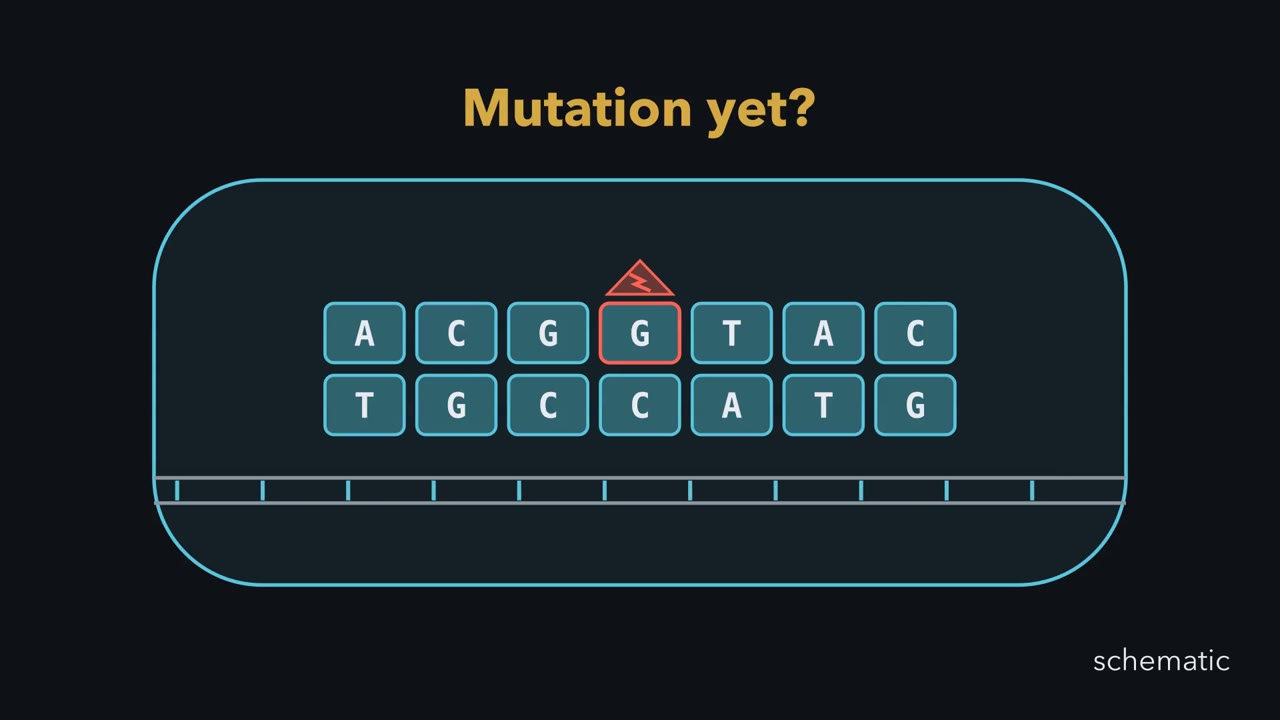
Identical bacterial cultures grow, then meet the same bacterial virus, called a phage. Why do some plates show no survivors while another shows a jackpot? Each tube began alike, and every plate receives the same phage. Every culture starts from the same bacterial strain. They receive the same food and grow to similar sizes. The selecting phage has not arrived yet. The growing branches record who descended from whom. During one division, a heritable DNA sequence change appears in one cell. That cell and its descendants carry the variant as the tree keeps growing. The changed cell cannot know whether that variant will later help. The change merely enters the population.
Timing changes the family size. An early event leaves a large yellow branch. A late event leaves only a few yellow tips. Some cultures get no event at all. Outcomes depend on whether a resistance mutation occurred and, if so, when. Another explanation was possible.
Perhaps the phage itself makes resistance after contact. Then each exposed cell gets a similar small chance, independent of its family history. The competing models therefore predict different shapes across cultures. If variants arise during growth, what pattern should appear after exposure? Similar survivor counts, or uneven counts with jackpots and empty plates? Use the family trees, not the final plates, to decide.
Now open the gate. Phage removes susceptible blue cells. Resistant yellow cells remain and form colonies. Exposure changes which variants are visible, not their earlier family histories. The phage acts as a filter applied after growth. The growth model predicts this shape: several empty cultures, some small counts, and an occasional jackpot. Contact-induced resistance predicts much tighter scatter. Averages alone can hide this crucial difference in shape. Luria and Delbrück compared many independent cultures with repeated samples from one bulk culture. Independent cultures scattered far beyond ordinary sampling and plating variation. Repeated bulk samples reveal how much scatter handling alone can produce.
The contrast tests timing. This result has a boundary. It shows that phage resistance arose before phage exposure in this system. Mutation rates can still change with cellular conditions. Changing a rate is not the same as directing a useful mutation. Mutation creates heritable DNA variants; selection changes how common they become. The sequence change starts a branch. The environment changes the branch's representation afterward. Keep origin and sorting separate whenever you interpret adaptation.
Ten bacterial cultures meet the same virus: why does one leave 52 resistant colonies while five leave none?
Continue in the lesson: Mutation: Where Variation Comes From →
3:37 · Free, with captions and a transcript. The lesson has the full text, the questions and the sources.
More films from this lesson
How this film was made. Narration: written from this lesson's text and read by an AI narrator voice (Kokoro, af_heart). Animation: AI-generated in code (Manim) by Claude, a schematic with no drawn molecular structures. Captions come from the narration script. See something wrong? Report it.