Organismal Biology · Skim version
Moving Water and Sugar in Plants
Read the full lesson → Skim the whole course →
The guiding idea
A coast redwood lifts water more than 100 m with no heart or other pump organ. Where does the force come from?
A plant has no heart or other pump organ: evaporation pulls water up the xylem under tension, and sugar loaded at a source pushes phloem sap toward the parts that use it.
From the film: Pulled From the Top
- Water crossing a membrane moves toward lower water potential, and dry air sits far below a typical leaf.
- Evaporation from wet leaf cell walls puts the water behind it under tension, a negative pressure.
- Water molecules cling together, so the pull is passed down unbroken columns of dead, hollow xylem cells to the roots.
- Height adds about 0.01 MPa of tension per metre, so the top of a 110 m redwood needs over 1 MPa before any flow.
From the film: Pushed From the Source
- At a source, such as a mature leaf, loading sugar into sieve tubes draws water in from the xylem and raises the pressure.
- At a sink, such as a root, fruit or shoot tip, sugar is removed, water leaves and the pressure falls.
- Sap flows in bulk from source to sink, down the difference in pressure plus height, so it can run down to the roots or up to a shoot tip.
- In morning glory vines, longer paths came with higher source pressure, from about 0.75 to more than 2.2 MPa, and wider sieve-plate pores, so the estimated reach of pressure flow matched the length of the vine.
-
Water potential: which way water crosses
-
The pull: what the first film left out
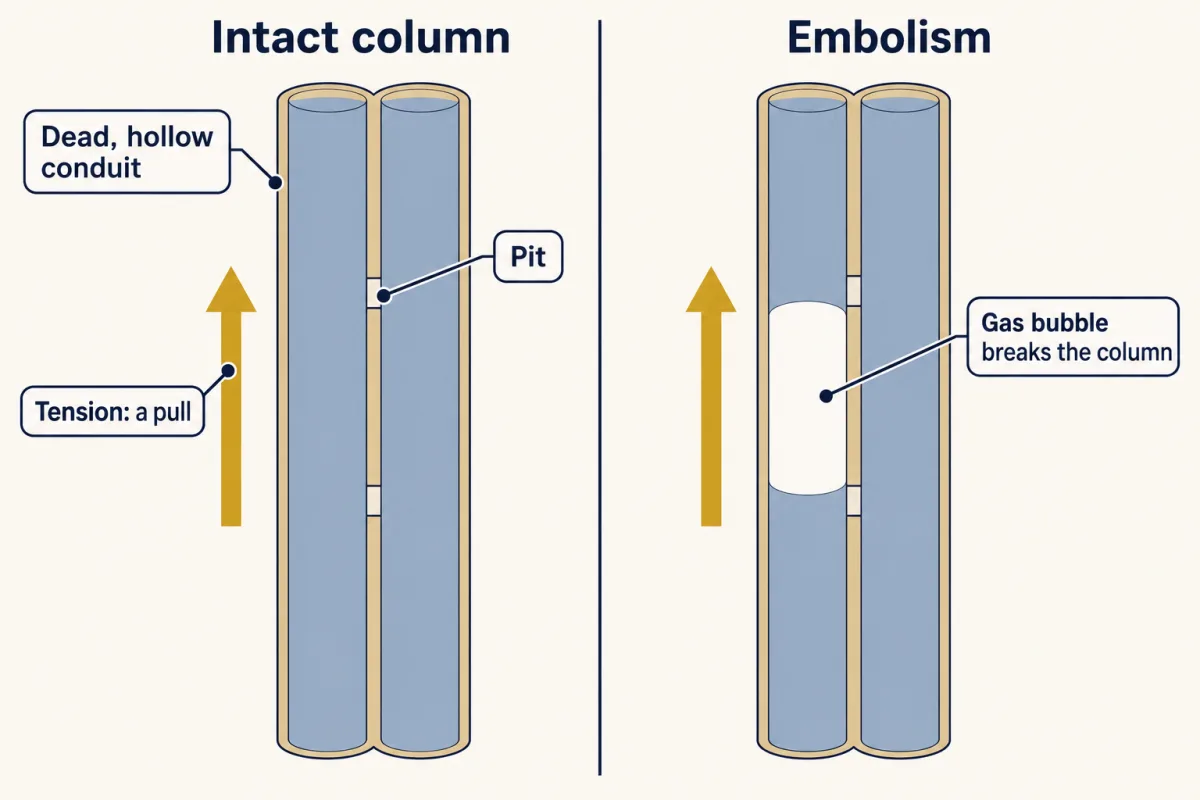
Xylem water is pulled, and a pulled column can fail: an embolism is a gas bubble that fills a conduit and breaks its column. Pits between neighbouring conduits limit how far a bubble spreads. AI-generated illustration -
Stomata: the valve on the pull
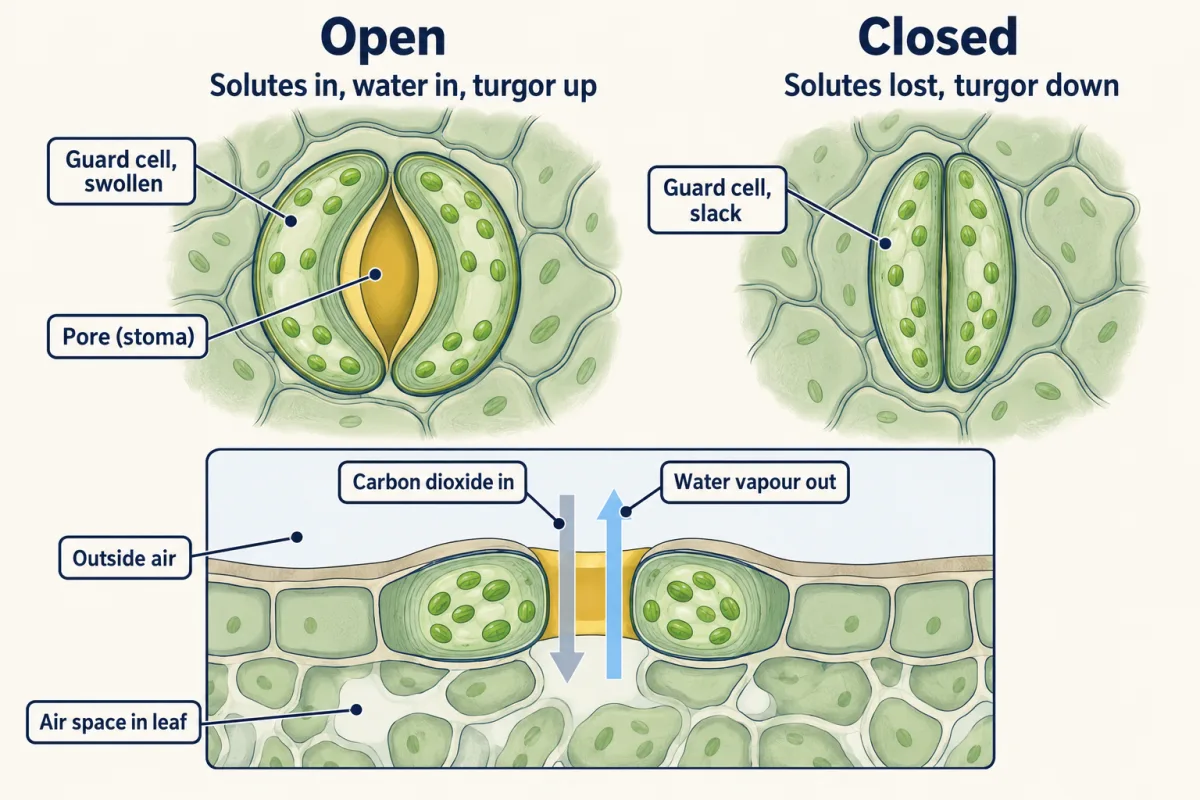
When guard cells take up potassium ions and accompanying anions, water flows in, turgor rises, and the paired cells bow apart, opening the pore. An open pore lets carbon dioxide in and water vapour out, so every opening is a trade. AI-generated illustration -
The push: what the second film left out
-
Two plumbing systems compared: xylem, phloem and a vertebrate circulation
-
Going deeper
Where this lesson fits
Before thisReview first
- Plant Body and GrowthThis course · Lesson 22
It introduces xylem and phloem, the two conducting tissues whose flow this lesson explains.
- Size, Scale and SurfaceThis course · Lesson 2
It shows why bulk flow beats diffusion over long distances, which plant sap relies on.
- What an Organism Has to DoThis course · Lesson 1
It covers the trade-off between water loss and carbon dioxide uptake that stomata control here.
After thisStudy next
- Soil, Nutrients and PartnersThis course · Lesson 24
Roots take up water and minerals into the xylem stream you have just seen pulled upward.
- Auxin and Plant Hormones: How Plants Steer GrowthThis course · Lesson 25
Abscisic acid closing stomata in drought builds on how guard cells control the pull.
Elsewhere on the siteFilms, simulations and method films in other courses
- Random Moves, One-Way DriftFilm · Life Science
It shows how water moves across a membrane toward the side with more dissolved particles.
- A Tree Made of AirFilm · Biology
It shows the sugar made in leaves that becomes the phloem cargo moved from source to sink.
- Osmosis chamberSimulation · Biology
It lets you test osmosis across a membrane, the base for predicting water movement from water potential.
Suggested by an AI model from the lessons themselves, then checked. How we use AI