Organismal Biology · Skim version
Soil, Nutrients and Partners
Read the full lesson → Skim the whole course →
The guiding idea
A green plant builds most of its body from carbon dioxide and water. What else does it need from the soil, and why can't it make it?
A green plant builds its organic compounds from carbon dioxide, water and mineral nutrients, but it cannot make an element, so how it gets each mineral nutrient depends on the form the element is in, how far that form moves, and who can take it up: hairs and fungi reach slow phosphate, ions in the root's walls must cross a living cell's membrane where the Casparian strip is complete, and partners unlock nitrogen gas the plant cannot use.
From the film: What a Root Has to Reach
- A green plant builds its organic molecules from carbon dioxide, water and mineral nutrients, but it cannot make an element: besides carbon, hydrogen and oxygen it needs 14 mineral nutrients, which most plants take chiefly from the soil.
- Phosphate moves through soil so slowly that uptake lowers it in the soil right around a root, a depletion zone; root hairs and the threads of a fungal partner reach past it.
- Nitrate moves through soil far more readily, and water flowing to the root carries it too, so for nitrate, reach matters less: how far a nutrient moves shapes how a plant must reach it.
- Elements the phloem can carry, such as nitrogen and magnesium, are moved from old leaves to new ones when supply runs short, so old leaves show the shortage first.
- Elements that stay where they are laid down, such as iron and calcium, show a shortage first in young leaves; treat these patterns as clues to test, not a key for every species.
From the film: Why the Pea Didn't Starve
- In sand watered with every mineral but nitrogen, oats grew only as far as the nitrate they were given, but peas given live soil extract formed root nodules and ended with far more nitrogen than their seeds held.
- Peas without extract, or with heated extract, formed no nodules and gained no nitrogen, so a living agent from soil was needed.
- That agent is rhizobia: inside nodule cells they become bacteroids whose enzyme, nitrogenase, turns nitrogen gas into ammonia; the plant makes no nitrogenase.
- The plant pays in carbon: sugar from its leaves is turned into malate, which fuels the bacteroids. A form the plant cannot use can be bought from a partner.
-
What a plant must get from the soil
-
Reading a sick leaf
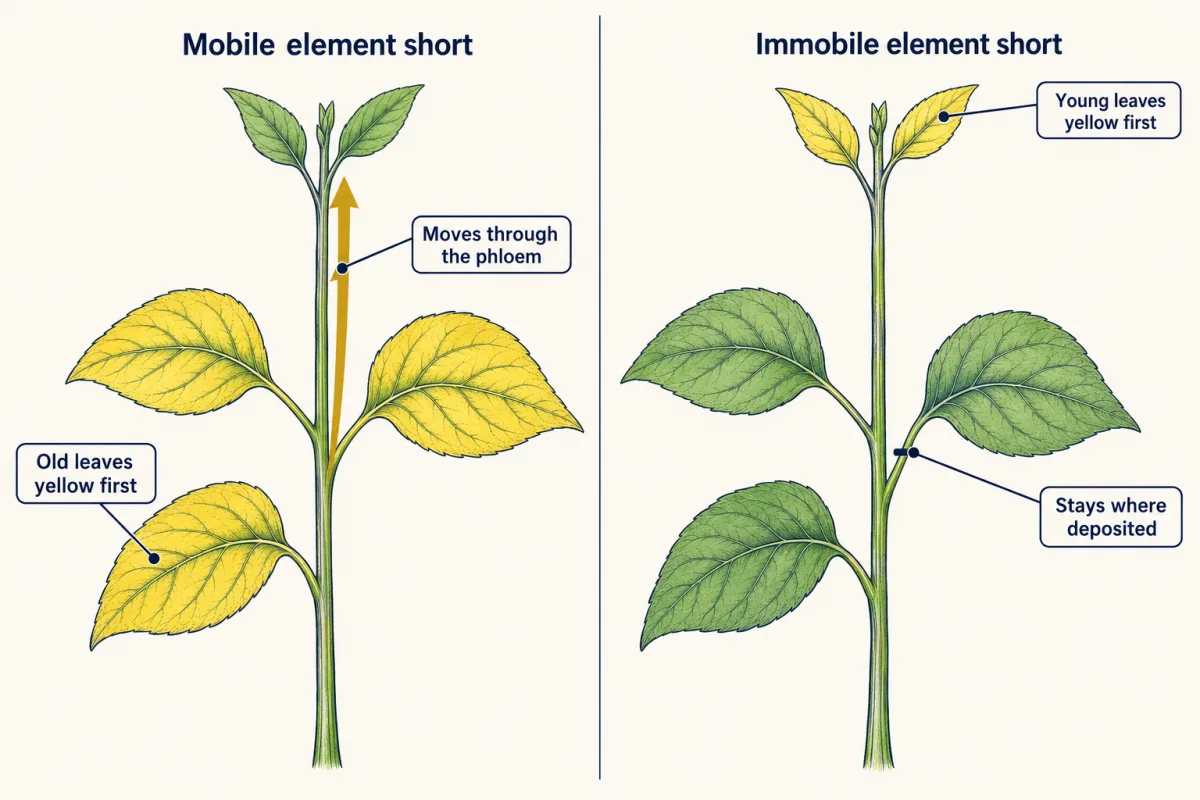
Nitrogen, phosphorus, potassium and magnesium are mobile, so a shortage tends to show first in old, lower leaves; iron, calcium and, in most species, boron stay largely where they were deposited, so a shortage tends to show first in young leaves. Treat these as examples, not a key for every species. AI-generated illustration -
Into the root: hairs, two routes and a checkpoint
-
Borrowing nitrogen and phosphorus: nodules and mycorrhizae
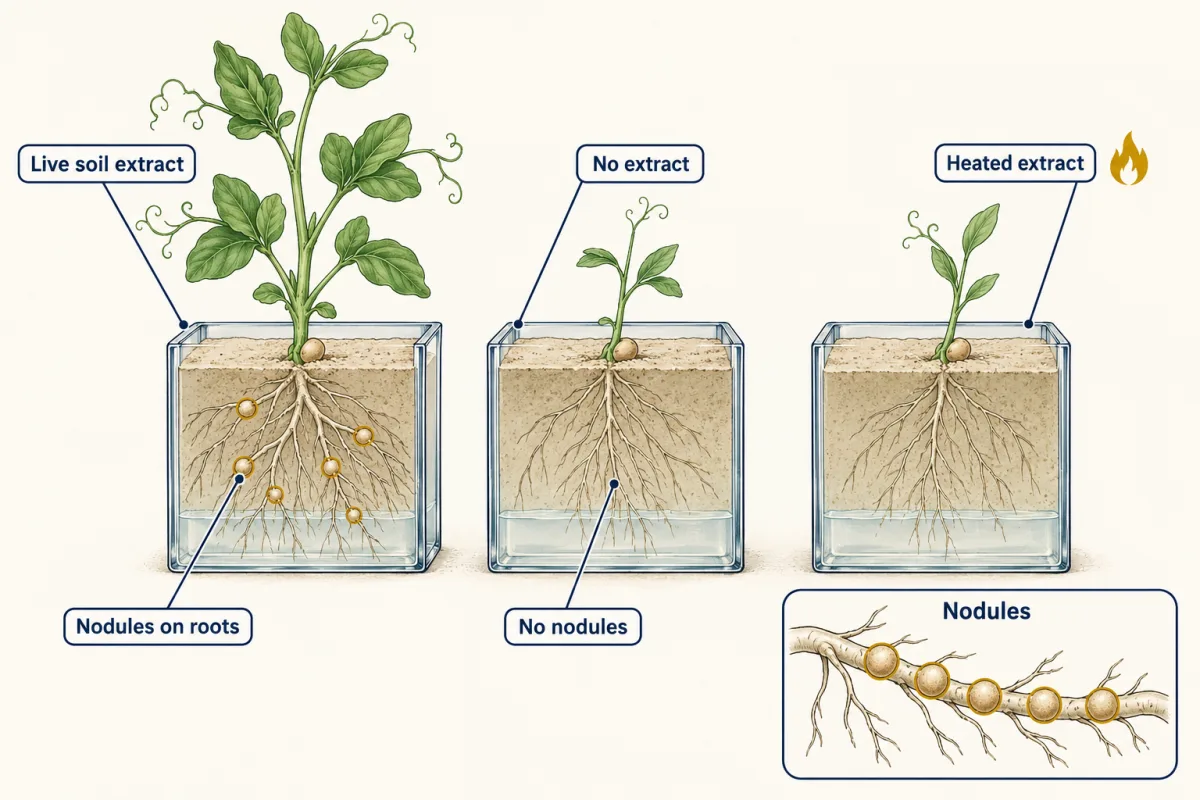
Hellriegel and Wilfarth grew peas in sterilised sand watered with every mineral but nitrogen. Only peas given live soil extract formed nodules and gained nitrogen from the air; without the extract, or with extract that had been heated, they did not. AI-generated illustration -
Plants that eat animals and plants that tap plants
-
Going deeper
Where this lesson fits
Before thisReview first
- Moving Water and Sugar in PlantsThis course · Lesson 23
You need water movement through xylem and the apoplast and symplast from there to follow ions into the root.
- Diffusion and OsmosisLife Science · Grade 7
Ion and water movement across root membranes builds on diffusion and osmosis taught there.
- Photosynthesis Feeds the WorldLife Science · Grade 7
It shows that a plant builds its body mainly from carbon dioxide and water, which this lesson takes as given.
After thisStudy next
- Auxin and Plant Hormones: How Plants Steer GrowthThis course · Lesson 25
Hormones steer how a plant responds to the nutrients and partners it finds.
Elsewhere on the siteFilms, simulations and method films in other courses
- Switch off a microbe groupSimulation · Biology
It shows how losing soybean root-nodule bacteria removes the plant's usable nitrogen.
- Nitrogen Everywhere, and Not a Bit to UseFilm · Life Science
It shows why plants cannot use nitrogen gas and how soybeans differ from corn.
- Set Up: Thirsty CeleryFilm · Biology Together
It shows water moving up a stalk, the path that carries dissolved minerals.
Suggested by an AI model from the lessons themselves, then checked. How we use AI