Biology · Unit 3: Bacteria and viruses
Microbes in Bodies and Ecosystems
Rewritten on : new text, flashcards and film. Your notes and highlights stay, but the text around them may have moved.
Why do the roots of a healthy soybean plant carry small bumps full of bacteria, and what would the plant lose without them?
Pause when the reading reaches a film, and offer to play it. Saved on this device.
Watch the film now, or keep listening
Builds on:Respiration and ATPLiving or Not? Viruses and BacteriaHow Microbes MultiplyWhy these?
Where this lesson sits
- Virginia SOL BIO.4d
- Practices BIO.1c, BIO.1d, BIO.1f
Essential question: Are bacteria and viruses always harmful, and what would happen to life on Earth without them?
-
Life Science (grade 7) LS.5 a and c
Review it at grade 7 level
In Life Science you learned that decomposers, such as fungi and bacteria, break down dead plants and animals. That returns nutrients to the soil and water, where plants can take them up again. You also learned that nitrogen cycles through an ecosystem. Air is mostly nitrogen gas, but plants and animals cannot use it in that form, and bacteria change it into forms that plants can use. You did not need the names of each step. Biology adds the other side of the story: some bacteria and viruses cause disease, and both helpers and pathogens shape whole ecosystems.
-
Biology BIO.4d You are here
This lesson
-
Biology II Biology II: Ecology, EC.4 a
Preview where it goes next
In Virginia’s Biology II Ecology course, the nitrogen cycle is followed step by step, and most steps are run by particular microbes. In fixation, bacteria turn nitrogen gas into ammonia using an enzyme called nitrogenase. In nitrification, other soil microbes turn ammonium into nitrite and then nitrate. Assimilation is plants taking those forms into their own molecules. Ammonification is decomposers releasing ammonium from dead matter. In denitrification, bacteria in low-oxygen soil and water turn nitrate back into nitrogen gas. You also connect decomposers to energy flow: as they break down dead matter, they use energy stored in it, and nutrients return to the cycle.
-
College
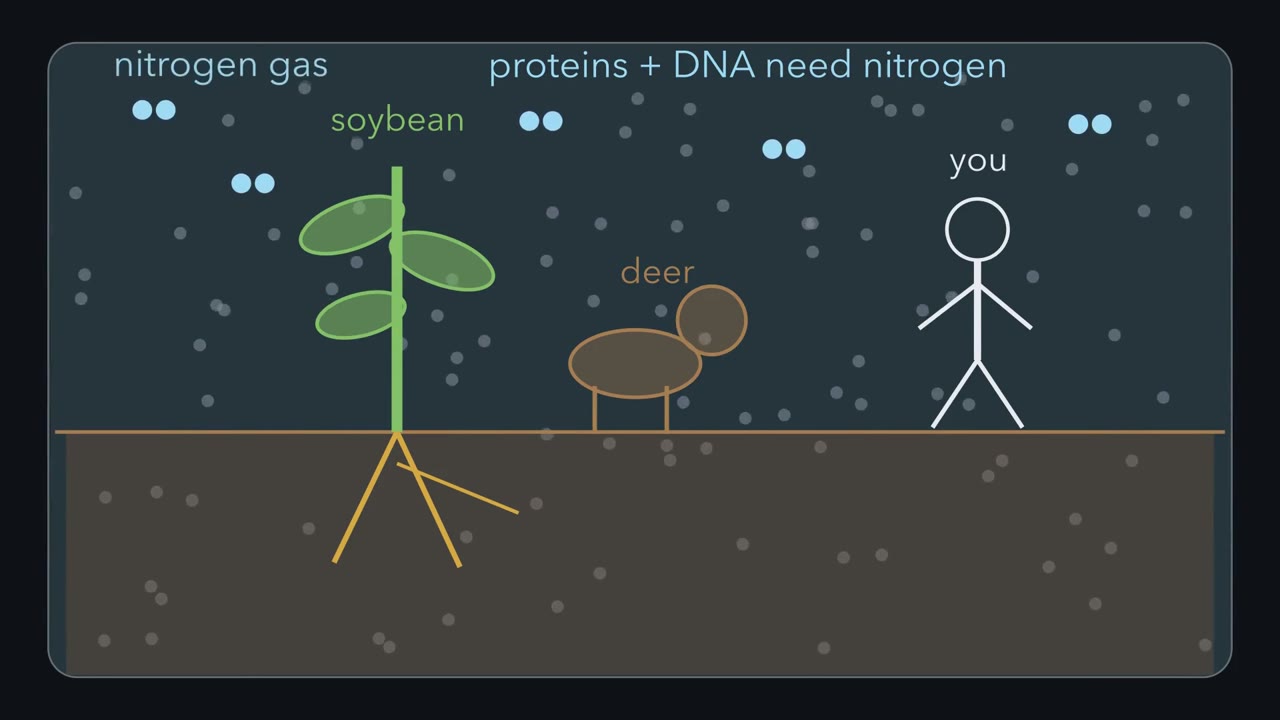 ▶ Watch Who Unlocks the Matter? · 3:21
Read the transcript of “Who Unlocks the Matter?”
Film transcript: Who Unlocks the Matter?
Every protein in your body needs nitrogen, and so does every strand of DNA. The air around you is mostly nitrogen gas. So why can't a soybean, a deer, or you use a single breath of it? Nitrogen gas is locked for plants and animals. They cannot build with it in that form. Two other stores are locked for many living things. One is a dead leaf on the ground. The other is fiber, which your own body cannot digest. So who could possibly use nitrogen gas? Make your guess before we look inside a soybean root.
Some bacteria can. They live inside small bumps on soybean roots, called nodules. There they turn nitrogen gas into ammonium, a form the plant can use. This is called nitrogen fixation. The plant pays them back. Sugar made in the leaves by photosynthesis runs down the stem to the nodules. Each partner gets something it needs. A partnership in which both species benefit is called mutualism. Now the soybean dies, and its stem lies on the soil. Bacteria and fungi grow on it. They release enzymes that break its large molecules into smaller ones. Nutrients return to the soil. These microbes are decomposers. The third store is inside you. Bacteria in your large intestine break fiber down by fermentation, without oxygen.
They make small acids your body can absorb for energy. Three locked stores, three microbes that unlock them. Each time, the microbe takes matter apart, and some of it is handed on to other living things. That is why life depends on microbes. Now look at a grapevine. A bacterium called Xylella grows in its water-carrying tubes and blocks them. The arrow runs one way, from vine to bacterium. A microbe that causes disease in its host is a pathogen. The host is the living thing a pathogen lives in or on. Here, the pathogen grows inside its host and harms it. The vine gives, and gets nothing useful back. So is a kind of microbe a helper or a harm?
Take E. coli. Most strains live quietly in your large intestine. Other strains carry extra genes that make them harmful. People who swallow enough of them in food or water can get sick. Here is the pattern. Some microbes unlock matter that others cannot use alone, and hand it on. Life depends on them. Pathogens cause disease in their hosts. Whether a microbe helps, harms or does neither can depend on its strain and where it lives.
From the film
- Air is mostly nitrogen gas, but plants and animals cannot use it; bacteria in soybean root nodules turn it into ammonium, which the plant can use.
- In return, the plant sends sugar made by photosynthesis to the nodules, and the bacteria get energy-rich food from it, a partnership called mutualism.
- Decomposers, mostly bacteria and fungi, break dead matter into smaller molecules, and gut bacteria ferment fiber your body cannot digest.
- A pathogen is a microbe or virus that causes disease in its host, the living thing it lives in or on.
- Microbes that unlock matter feed life; pathogens cause disease in their hosts. Whether a microbe helps, harms or does neither can depend on its strain and where it lives.
Dig up a soybean plant and you can find small round bumps on its roots; cut an active one open and it is often pink inside. Those bumps are packed with bacteria that turn nitrogen from the air into a form the plant can use.
Your gut also holds trillions of bacteria, and some help break down your food. Yet most of us learn the word “bacteria” next to the word “germs.” So which is it: are bacteria and viruses enemies, or are they partners that life depends on?
Watch the first film at the top of the page before you read on. It answers with a pattern:
The one idea. Microbes that unlock matter feed life; pathogens cause disease in their hosts. Some microbes take apart matter that most living things cannot use alone, such as nitrogen gas in the air, dead leaves, the fiber in your food and the remains of burst cells. They hand some of it on, so life depends on them. A pathogen is a microbe or virus that causes disease in its host. Whether a microbe helps, harms or does neither can depend on its strain (a genetic variety within one kind of microbe) and where it lives.
Scope: this is a pattern for the microbes in this lesson, not a definition of every microbe. Many microbes live on a host without harming it, and some make their own food from sunlight. Pathogens harm in several ways: by blocking, by damaging tissue, by releasing poisons called toxins, or by setting off harmful responses in the host. Strain and place are not the whole story either: the host and its surroundings can change the outcome too.
What do you think? Decide before you read.
-
Scientists disagree: Field studies of soybean roots show bacteria supplying the plant with nitrogen, and yogurt is made by two kinds of bacteria growing in milk. Some bacteria do cause disease, such as one that blocks the water pipes of grapevines.
What scientists think
Scientists disagree: Field studies of soybean roots show bacteria supplying the plant with nitrogen, and yogurt is made by two kinds of bacteria growing in milk. Some bacteria do cause disease, such as one that blocks the water pipes of grapevines.
-
Scientists disagree: In a lab model ecosystem, a virus burst ocean algae cells, and when bacteria broke down the remains, nitrogen and phosphorus appeared in the water for other living things to use. Bacteria that break down dead leaves in streams return nutrients too. Disease is one of several things microbes do.
What scientists think
Scientists disagree: In a lab model ecosystem, a virus burst ocean algae cells, and when bacteria broke down the remains, nitrogen and phosphorus appeared in the water for other living things to use. Bacteria that break down dead leaves in streams return nutrients too. Disease is one of several things microbes do.
-
Scientists disagree: In 2016 Ron Sender, Shai Fuchs and Ron Milo added up published counts for a reference adult man weighing 70 kg. They estimated about 38 trillion bacterial cells and about 30 trillion human cells, close to one to one. The older ten-to-one figure came from a rough estimate that newer counts replaced.
What scientists think
Scientists disagree: In 2016 Ron Sender, Shai Fuchs and Ron Milo added up published counts for a reference adult man weighing 70 kg. They estimated about 38 trillion bacterial cells and about 30 trillion human cells, close to one to one. The older ten-to-one figure came from a rough estimate that newer counts replaced.
Explore: switch microbes off in an ecosystem
The simulation shows a field of soybeans, a stream with fallen leaves, a deer, a person and some ocean water. Switch off one group of microbes at a time. Bars show how much matter moves along each path and how large each population is, in numbers meant only for comparison.
In this sketch: every bar starts at 100 (relative units, not a measurement) and one group is off at a time. Steps are not days or years. Only the soybean 47 comes from the lesson; every other direction and size is a display assumption, not to scale.
Rule to keep: microbes keep matter moving and shape populations, and whether a microbe helps or harms depends on which microbe it is and where it lives.
Try this.
- Before you switch off the decomposers, predict what happens to the dead leaves and the soil nutrients. Then test it.
- Switch off the nitrogen fixers. Predict which population changes first, the soybeans or the deer that eat plants.
- Switch off the pathogens. Predict whether the deer population grows without limit or levels off. Watch what happens to the plants.
- Come back after the second film. Switch off the viruses in the ocean water, and predict what happens to the number of bacteria and to the nutrients dissolved in the water.
Explain: microbes that unlock matter
- decomposer
- nitrogen fixation
- nodule
- mutualism
- microbiome
- fermentation
- pathogen
- host
- bacteriophage
- biodiversity
Feeding plants nitrogen
The first film showed the trade inside a nodule; it left out what “fixing” means and who can do it. To fix nitrogen is to fasten it into a compound that cells can build with (fix as in fasten, not repair). Among living things, only some bacteria and archaea, a second group of single-celled microbes, can do it; lightning and fertilizer factories fix nitrogen too. The nodule bacteria in soybeans, peanuts and other legumes join nitrogen to hydrogen to make ammonium, and the plant builds that nitrogen into its own proteins and DNA.
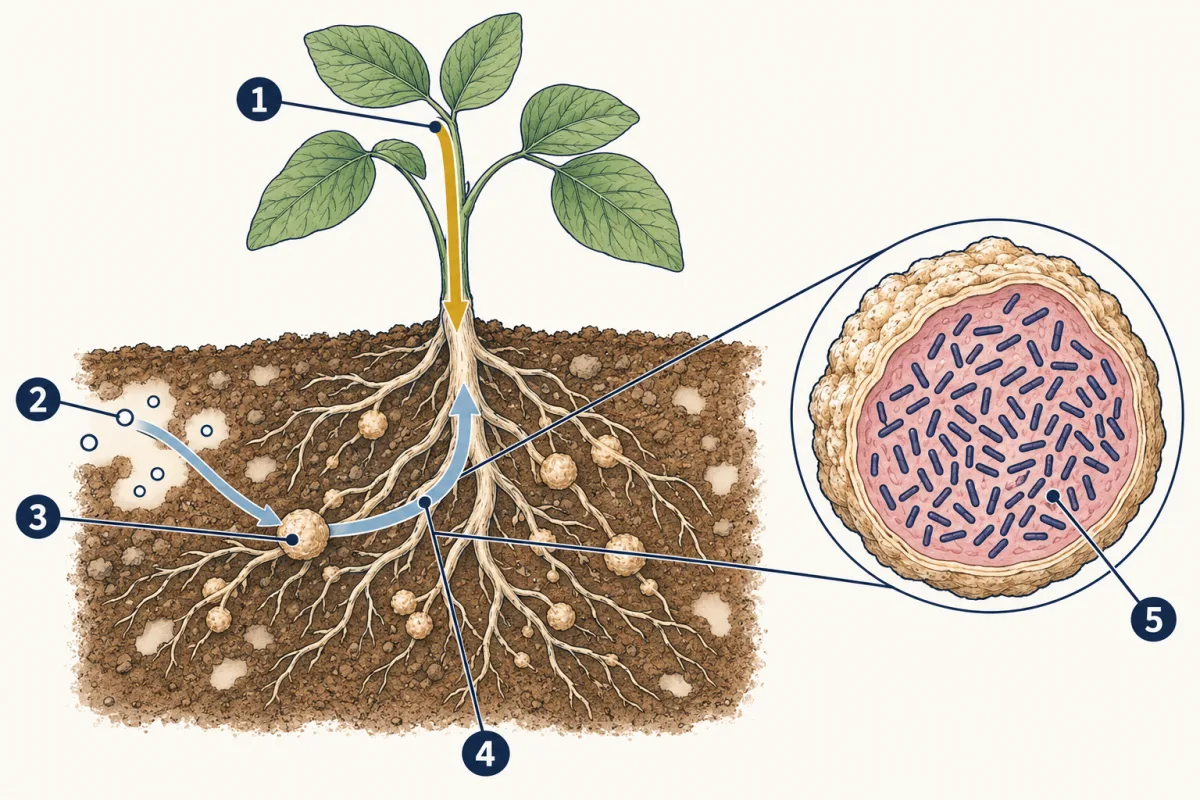
- energy-rich food
- nitrogen gas
- nodule
- ammonium
- bacteria
- blank
- blank
- nodule
- blank
- blank
Word bank: ammonium, bacteria, energy-rich food, nitrogen gas
- blank
- blank
- blank
- blank
- blank
Check your labels
- energy-rich food
- nitrogen gas
- nodule
- ammonium
- bacteria
Predict. You split a nodule and it is pink inside. Does that prove the bacteria are fixing nitrogen? Does it tell you how much?
Check your prediction
No to both. Pink or red is a field sign of fixing: a good clue, not proof, and silent on how much. For the amount, researchers compare the forms of nitrogen atoms in the plant, as in the data below.
Most of the fixed nitrogen ends up in the harvested beans. When the rest of the plant dies, decomposers break down its roots, stems and leaves, and some fixed nitrogen returns to the soil (more in Matter Cycles).
Breaking down the dead
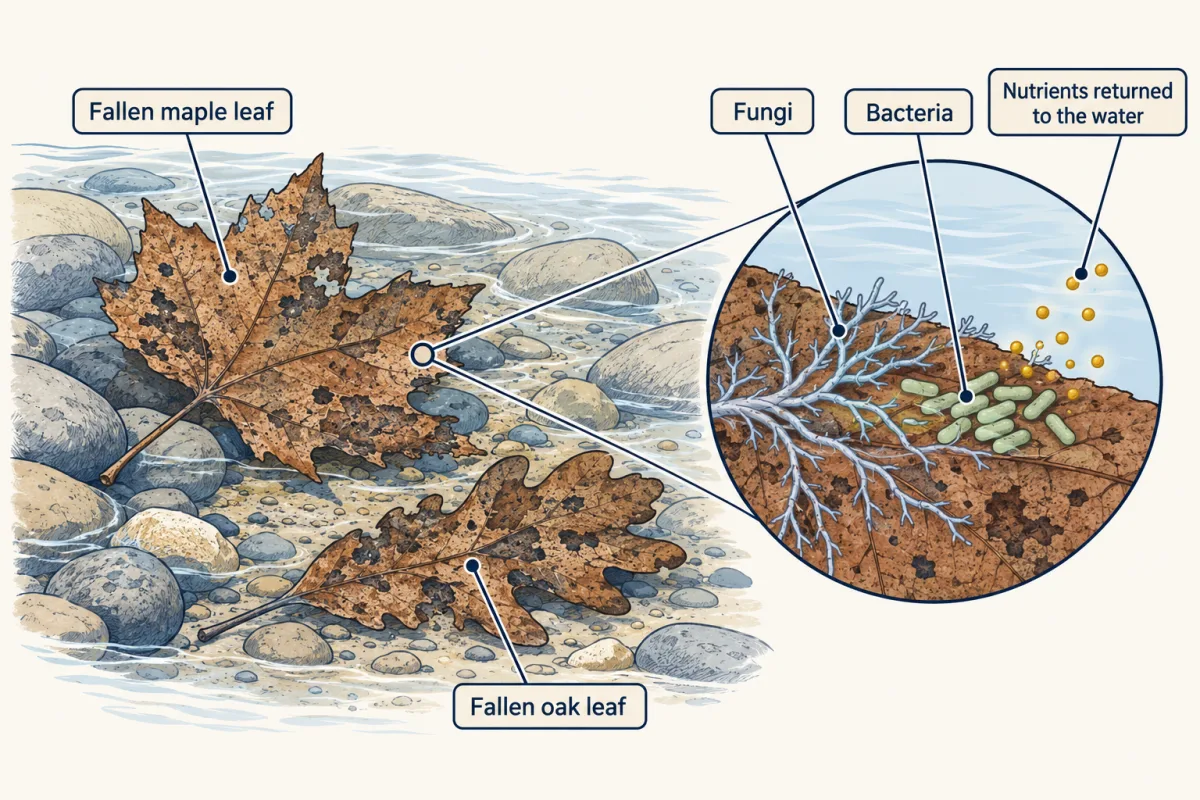
The first film showed decomposers on a dead stem. They break down wastes as well as dead organisms, and the digesting happens outside the microbe, on the dead matter itself, where the released enzymes work. Without them, dead matter would pile up with its nutrients locked inside. Bacteria are not the only ones doing it: in an Ohio stream study, both fungi and bacteria grew on fallen maple and oak leaves, and the fungi always outweighed the bacteria.
Explain: partners in your body, and pathogens
Your gut microbiome
The first film showed gut bacteria fermenting fiber without oxygen. They are part of your microbiome, the community of microbes that live in one place, such as soil, a stream or a body. Most of your gut’s bacteria live in the large intestine. The cells lining the large intestine can use the small acids the bacteria make as a source of energy. Diet matters to these partners: see the mouse study in Going deeper.
Foods and medicines
People have used bacteria for a very long time. Yogurt forms when two kinds of bacteria ferment the sugar in milk and release lactic acid, which thickens the milk and makes it sour. Bacteria can also make human medicines: E. coli carrying lab-made genes for human insulin made its two parts, which researchers joined into human insulin (see the insulin story on this page; more in Engineering Genes).
Pathogens
The first film met one pathogen, Xylella in its grapevine host. Pathogens, viruses among them, attack all kinds of hosts:
| Host | Pathogen | What it does |
|---|---|---|
| Grapevine | the bacterium Xylella fastidiosa | causes Pierce’s disease, which blocks the vine’s water-carrying tubes |
| Cattle | the bacterium Mycobacterium bovis | causes bovine tuberculosis |
| Humans | the bacterium Helicobacter pylori | causes inflammation of the stomach lining |
| Birds and humans | West Nile virus, spread by mosquitoes | causes illness, sometimes severe |
Preventing and treating these diseases is the subject of Germs, Vaccines and Antibiotics.
The first film’s E. coli showed strain at work: some strains carry extra genes that make them harmful, and people who swallow enough of them in food or water can get sick. Place matters too: E. coli from your own gut is the most common cause of bladder infections, which start when it reaches the urinary tract and clings to the bladder wall.
Explain: viruses and diseases reshape ecosystems
Pathogens do not always kill. When one does kill the cells it infects, where does their matter go? The second film follows it in a flask of seawater, then across a landscape.
Read the transcript of “When the Killer Is a Recycler”
Film transcript: When the Killer Is a Recycler
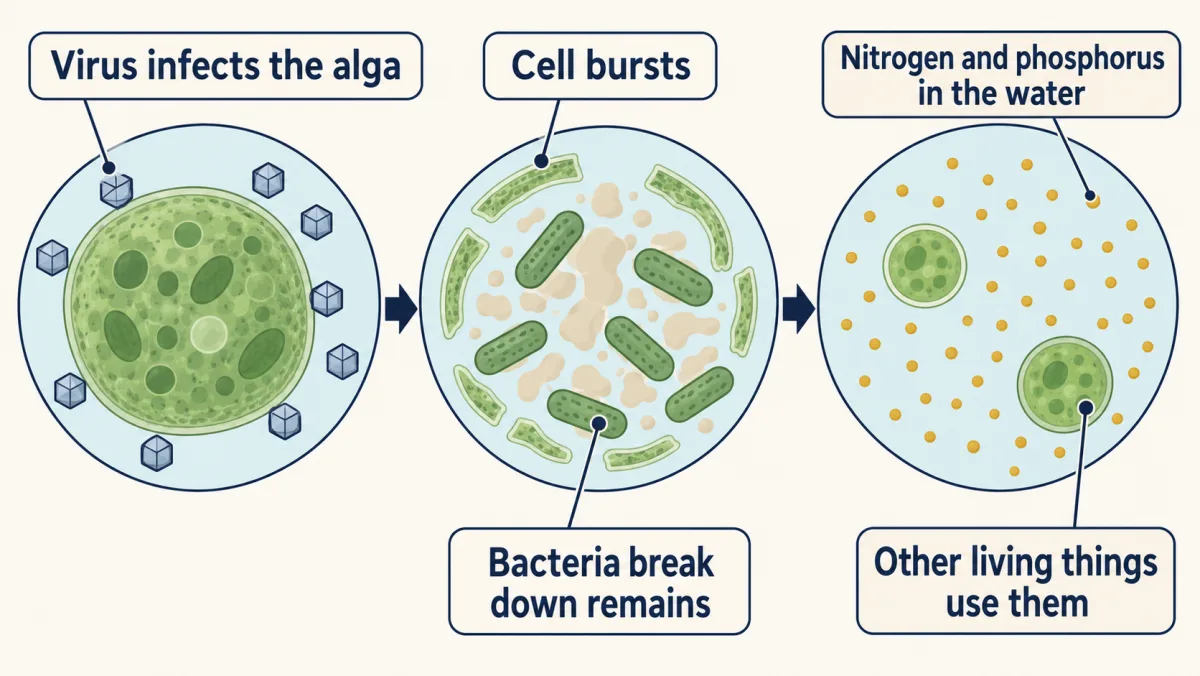
Some pathogens kill the very cells they infect, and viruses often do. That arrow from the first film ran one way, from host to pathogen. But when a virus kills a cell, where does that cell's matter go? Picture a virus bursting a cell in the ocean. A moment ago, that cell held nitrogen. Where is that nitrogen now? Ocean water holds enormous numbers of viruses. A virus that infects bacteria is called a bacteriophage, or phage for short. Other ocean viruses infect algae. Researchers built a lab model ecosystem. It was a flask of seawater with an ocean alga called Phaeocystis. Then they added a virus that infects it. The viruses infected the algae.
Then the cells burst, spilling much of what was inside them into the water. The algae were dead. Was their nitrogen gone too? No. Bacteria swarmed the remains and broke them down. The water gained nitrogen and phosphorus, in forms other living things could use. Algae and bacteria can take them up. So the nitrogen was not destroyed. The virus killed the cell, but much of the cell's matter went back into the water. A killer can also be part of a recycling chain.
Virus, then bacteria, then other living things: each step moves matter on. Now zoom out to a whole landscape, the Serengeti in East Africa. Rinderpest is a virus disease of cattle and of wild grazing animals, such as wildebeest. In the 1960s, vaccinating cattle wiped rinderpest out of the Serengeti. The virus was gone. What happened to the land? Here is a question to try. With rinderpest gone, will the Serengeti end up with more trees, or with fewer trees?
More trees. Researchers traced the chain using decades of records and computer models. First, wildebeest numbers rose. More wildebeest ate more grass. Less dry grass meant less fuel for fires. Fewer fires burned, so more young trees survived. Their analysis supported this chain, from the loss of one virus to more trees. Two scales, two lessons. In the flask, matter from the dead cells went back into the water for other living things. On the savanna, losing one virus changed which populations grew.
Viruses that burst cells can recycle matter. Pathogens can reshape ecosystems.
From the film
- A virus that infects bacteria is called a bacteriophage; other ocean viruses infect algae.
- In a lab model ecosystem, a virus burst the alga Phaeocystis, bacteria broke down the remains, and the water gained nitrogen and phosphorus.
- Viruses that burst cells can recycle matter; pathogens can reshape ecosystems. When a virus bursts a cell, some of its matter can feed other living things.
- After rinderpest was wiped out in the Serengeti, wildebeest numbers rose, they ate more grass, fewer fires burned and more trees grew.
Seawater holds millions of virus particles, phages and others, in every milliliter. By one widely cited estimate, viruses kill roughly a fifth of the ocean’s microbial biomass (the total mass of its microbes) every day. These estimates are rough and vary a lot from place to place.
Viruses also shape biodiversity, the variety of living things in a place. Each kind of phage usually infects only certain kinds of bacteria.
Predict. One kind of bacterium grows fast and becomes far more common than the rest. Will its phages spread faster or slower than the phages of rare bacteria? What happens to the other kinds of bacteria?
Check your prediction
Usually faster. A phage spreads when an infected cell bursts and its new phages meet the next host, and a common host is easier to meet. So the most common kind can be cut back hardest, which may leave room and nutrients for rarer kinds. Ecologists call this “kill the winner.” It does not always happen: some bacteria resist their phages, and some phages hide inside cells instead of bursting them. Where it does, viruses can keep more kinds of bacteria alive at once.
On land, the film’s Serengeti chain shows a pathogen reshaping a whole landscape; the cattle-virus story on this page gives its source.
Elaborate: how much nitrogen do nodules add?
| Year | Sampling date | Soybean type | Total nitrogen above ground (kg N/ha) | Nitrogen from fixation (kg N/ha) |
|---|---|---|---|---|
| 2006 | 13 Sept | Nodulating | 282 | 195 |
| 2006 | 13 Sept | Non-nodulating | 150 | not applicable |
| 2007 | 12 Sept | Nodulating | 144 | 95.0 |
| 2007 | 12 Sept | Non-nodulating | 67.6 | not applicable |
| 2008 | 23 Sept | Nodulating | 148 | 90.3 |
| 2008 | 23 Sept | Non-nodulating | 61.6 | not applicable |
These data come from a field trial by Snapp, Wilke, Gentry and Zoellner, published in 2017, at the Kellogg Biological Station in Hickory Corners, Michigan. Each value is a mean over several farming systems for one growing season. Both soybean types were Williams 82 plants, nearly identical except that one cannot form nodules. A hectare is 10,000 square meters, about one and a half soccer fields.
“Nitrogen from fixation” was estimated with nitrogen isotopes: nitrogen atoms come in a common light form and a rare heavier form, and air and soil hold slightly different mixes. Researchers compared the mix in nodulating soybeans with the mix in non-nodulating plants grown in the same conditions. They also used a reference value for soybean nitrogen that comes only from the air.
- In 2006, how much more nitrogen did nodulating plants hold than non-nodulating plants? Write it as a percentage of the non-nodulating value (divide the difference by the non-nodulating value, then multiply by 100).
- Which year had the most nitrogen from fixation? Was the gap between the two soybean types the same every year?
- Find the mean nitrogen from fixation over the three years.
Predict. In 2006 the rows differ by 132 kg N/ha, but the isotopes say the bacteria fixed 195. Where did the extra come from? Hint: subtract fixed nitrogen from the nodulating total.
Check your prediction
Above ground, the nodulating plants held only 87 kg N/ha from sources other than fixation, such as the soil (282 − 195); the non-nodulating plants held 150. With a partner supplying nitrogen, the nodulating plants got less from those other sources, so the 132 gap is 63 kg N/ha smaller than the isotope estimate. Roots were not measured, so these numbers cover only the parts above ground. Each year the bacteria supplied about three-fifths to two-thirds of the nodulating plants’ above-ground nitrogen (61 to 69 percent).
Claim, evidence, reasoning
Make a claim that answers the essential question for soybean nodule bacteria, using this data.
Start with: The bacteria in soybean nodules were blank to the plants in this trial.
Start with: In every year, nodulating soybeans held blank nitrogen than non-nodulating soybeans, for example blank compared with blank kg N/ha in 2006.
Start with: This shows blank because nitrogen fixation blank. Bacteria can also be pathogens, so whether a microbe helps or harms depends on blank.
Compare with a model answer
The bacteria in soybean nodules helped the plants in this trial. In all three years, nodulating soybeans held about two times (1.9 to 2.4 times) as much nitrogen above ground as plants that could not form nodules. The values were 282 compared with 150 kg N/ha in 2006, 144 compared with 67.6 in 2007, and 148 compared with 61.6 in 2008. The nodule bacteria turn nitrogen gas into a form plants use, and plants build proteins and DNA from it. Other bacteria are pathogens, so bacteria are not always harmful; it can depend on the microbe and where it lives. One limit: these are three seasons at one Michigan station, so a Virginia field could differ.
Saved in this browser only.
Design problem
Plan an investigation to test whether adding nodule bacteria helps soybeans grow in nitrogen-poor soil. Name your variables, your control, what you keep the same, how many plants you use, and how you keep it safe.
Saved in this browser only.
One way to do it
- Question: does adding nodule bacteria increase soybean growth in soil low in nitrogen?
- Independent variable: nodule bacteria added (a garden-store legume inoculant made for soybeans) or not added.
- Dependent variables: dry plant mass after six weeks, the number of nodules per plant, and how many split nodules are pink inside.
- Control: pots of the same sterile, nitrogen-poor potting mix with no inoculant. Sterile mix matters, because ordinary soil may already hold nodule bacteria.
- Constants: the same seed batch, pot size, amount of soil, water, light and temperature. Add no nitrogen fertilizer to either group.
- Sample size and trials: at least 10 pots per group, with pots mixed together on the shelf so neither group gets the better light. Find the mean for each group. Repeat the whole test if you can.
- Safety: wear gloves when handling the inoculant and soil, follow the product label, and wash your hands afterwards.
- What results would mean: if the inoculated plants have more nodules and a higher mean mass, that supports a benefit from the bacteria in these conditions. If both groups match, the bacteria may not have formed nodules, so check the roots.
Evaluate: check your thinking
Microbes that unlock matter feed life; pathogens cause disease in their hosts. Viruses that burst cells can recycle matter, pathogens can reshape ecosystems, and whether a microbe helps or harms can depend on its strain and where it lives.
Science practices you used: predicting and testing in a model ecosystem, reading a data table and calculating a difference, a percentage and a mean, planning a fair test with a control and many plants, and naming the limits of one study’s data.
Going deeper
Fiber and the gut lining
In a 2016 study, mice carrying a set of human gut bacteria and fed a low-fiber diet had gut bacteria that began feeding on the protective mucus that lines the gut.
Numbers from the algae experiment
In the lab model ecosystem of Jakob Haaber and Mathias Middelboe, a virus infected the ocean alga Phaeocystis. After bacteria broke down the dead algae, the water gained about 148 micrograms of nitrogen and 7 micrograms of phosphorus per liter that other living things could use.
Viruses that wait, then burst
Some phages lie hidden inside a bacterium before bursting it. A 2019 experiment on coastal water found that when viruses switched from hiding to bursting, the bacterial community became more diverse.
Your notes
Select any text in the lesson to highlight it or add a note to it. Your highlights and notes are saved in this browser and collected in your notebook.
This browser is not letting the site save anything (a private window or strict privacy settings), so highlights and notes will be lost when you leave the page.
How we measure it
Digging up roots and splitting nodules
A soybean plant is dug up with the soil around its roots, so the nodules stay attached, and a few nodules are cut open. A pink or red inside is a field sign that the bacteria are fixing nitrogen; it is a good clue, not proof, and it does not tell you how much.
Nitrogen isotope comparison
Nitrogen atoms come in a common light form and a rare heavier form, and the air and the soil hold them in slightly different mixes. By measuring the mix in a soybean and in a plant that cannot fix nitrogen, researchers estimate how much of the soybean’s nitrogen came from the air.
DNA sequencing of microbial communities
Researchers collect water, soil or gut samples and read one gene that all bacteria carry. The different versions of that gene show which kinds of bacteria are present and how many kinds there are, without growing each one in a dish.
Where this lesson fits
Before thisReview first
- Respiration and ATPThis course · Lesson 5
You need to know how cells get energy from food to follow how bacteria ferment fiber and take in sugar.
- Living or Not? Viruses and BacteriaThis course · Lesson 12
You need to know what viruses and bacteria are, and why viruses need a host, before seeing their roles in ecosystems.
- How Microbes MultiplyThis course · Lesson 13
This lesson uses how bacteria multiply and how viruses burst their host cells when it follows phages and algae.
After thisStudy next
- Germs, Vaccines and AntibioticsThis course · Lesson 15
It takes the pathogen idea further, showing how disease-causing microbes are spotted, prevented and treated.
- Matter CyclesThis course · Lesson 31
It follows the nitrogen and carbon that fixers and decomposers release as they move through whole ecosystems.
- Engineering GenesThis course · Lesson 22
It explains how bacteria are given human genes to make insulin, which this lesson only mentions.
Elsewhere on the siteFilms, simulations and method films in other courses
- Hairs, hyphae and surfaceSimulation · Organismal Biology
Root nodules and fungal partners supply a plant with nutrients it cannot get alone.
- What a Root Has to ReachFilm · Organismal Biology
It shows how plant roots depend on partner microbes for nitrogen and other minerals.
- Why Order Matters in a GutFilm · Organismal Biology
It covers how gut microbes help animals digest food they cannot break down themselves.
Suggested by an AI model from the lessons themselves, then checked. How we use AI
Finish line
Test yourself
8 questions
Practice and MCAT-style, with explained answers.
Next · Lesson 15
Germs, Vaccines and Antibiotics
In 1846, mothers in one Vienna clinic died about four times as often as mothers in the clinic next door. What could the doctors have been carrying?
Continue →