One Strand Is Enough
Read the transcript of “One Strand Is Enough”
Film transcript: One Strand Is Enough
Suppose I tore a DNA molecule down the middle and threw one half away. Could you rebuild the half I threw away, letter for letter? By the end of this film, you can. Start with one building block, a nucleotide. It has three parts: a sugar called deoxyribose, a phosphate group, and a base. The base carries the information.
DNA uses four bases: adenine, thymine, cytosine and guanine. We write them A, T, C and G. Nucleotides join into a chain called a strand. The sugar of one nucleotide bonds to the phosphate of the next. That is a covalent bond, a strong bond in which atoms share electrons. The bases stick out to one side. Now a second strand lines up, bases facing bases. Weak attractions called hydrogen bonds hold each facing pair together. But only two kinds of pair fit well. A fits with T. C fits with G. Watch what happens when A meets C. Their edges do not match, so they fit badly. That is the base-pairing rule. A always pairs with T, and C always pairs with G.
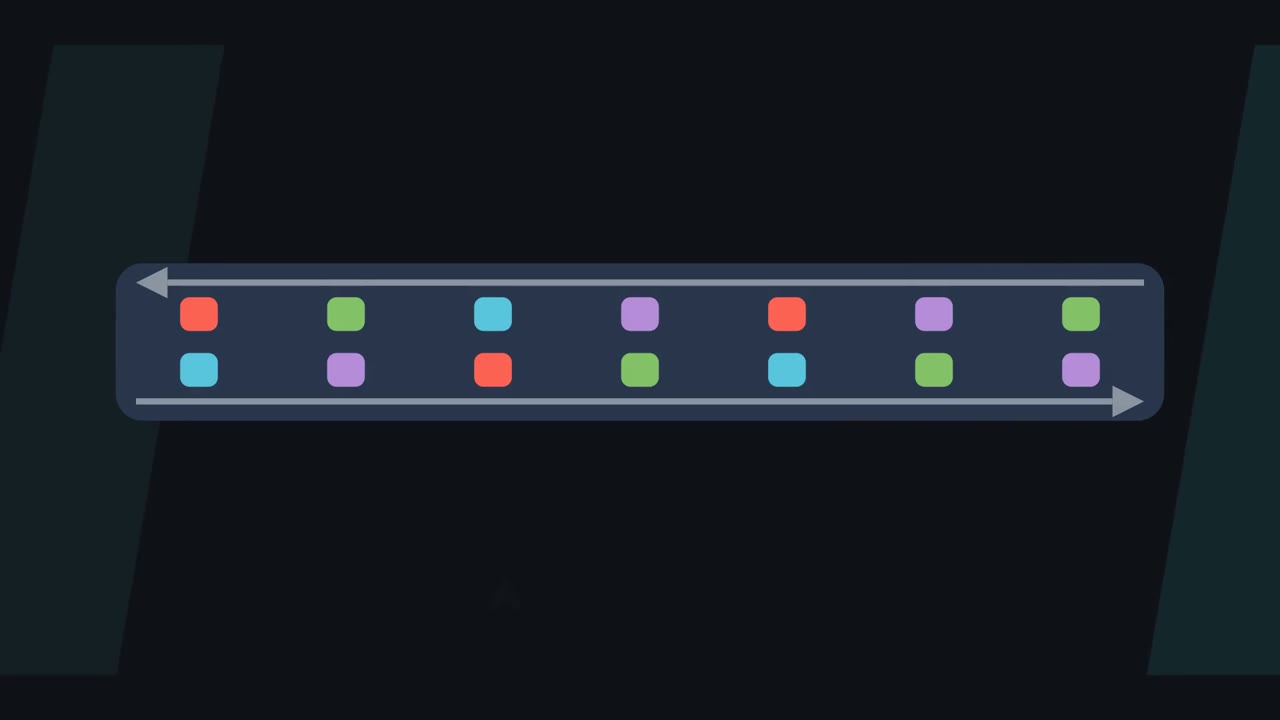
Notice the two arrowheads. Each strand has a direction, and the two strands point opposite ways. Finally the ladder twists along its length into a double helix. The backbones are the sides, and the base pairs are the rungs. Here is one strand on its own. It reads G, A, T, T, C, A. Before I fill in its partner, write the partner strand yourself.
Across from G goes C. Across from A goes T. So the partner reads C, T, A, A, G, T. Not one letter was a choice. One strand fixed every letter of the other. So here is how a cell copies DNA. Enzymes unzip the helix, and each old strand becomes a template. A template is a pattern that sets the order of a new strand. New nucleotides line up on each template, each one matching the base it faces. When copying ends, there are two molecules. Each has one old grey strand and one new gold strand. Both carry the same base order as the original. So pairing tells the cell what goes where. Because A pairs only with T, and C only with G, each strand fixes its partner.
Pairing does not yet explain how the cell gets almost every letter right.
If you kept only one strand of a DNA molecule and threw the other away, could you rebuild the whole thing, letter for letter?
Continue in the lesson: DNA: Structure and Copying →
3:06 · Free, with captions and a transcript. The lesson has the full text, the questions and the sources.
More films from this lesson
How this film was made. Narration: written from this lesson's text and read by an AI narrator voice (Kokoro, af_heart). Animation: AI-generated in code (Manim) by Claude, a schematic with no drawn molecular structures. Captions come from the narration script. See something wrong? Report it.