Life Science · Unit 7: Heredity
Reproduction and Meiosis
Rewritten on : new text, flashcards and film. Your notes and highlights stay, but the text around them may have moved.
Why does a strawberry runner grow into a copy of its parent, but brothers and sisters do not come out as copies of each other?
Pause when the reading reaches a film, and offer to play it. Saved on this device.
Watch the film now, or keep listening
Builds on:How Cells DivideDNA: The Code of LifeWhy these?
Where this lesson sits
- Virginia SOL LS.10 b
- Virginia SOL LS.2 d
- Practices LS.1 c, LS.1 d, LS.1 e
Essential question: Why don't I look exactly like my parents, or like my brothers and sisters?
-
Life Science (grade 7) LS.10 b, LS.2 d You are here
This lesson
-
Biology
Preview it at high school level
In Biology you will learn the steps of meiosis. The cell copies its chromosomes once and then divides twice. The first division pulls apart the two chromosomes of each pair. The second pulls apart the two copies of each chromosome. Up to four cells form. You will also meet crossing over, when the two chromosomes of a pair swap matching pieces, so a chromosome can carry a new mix of alleles. Random fertilization, which egg meets which sperm, adds more variety. You will count how many mixes are possible, and see what happens when chromosomes fail to separate.
-
Biology II Biology II: Genetics, GEN.4 a-c; Advanced Topics, BIOII.4 a and b
Preview where it goes next
In Virginia’s Biology II courses, the Genetics course names the stages of meiosis and studies three sources of variety: crossing over, independent assortment of chromosome pairs, and random fertilization. It also looks at nondisjunction, when chromosomes fail to separate, and what it causes, such as an extra copy of chromosome 21. Advanced Topics returns to these same sources of variety and to nondisjunction, and adds the kinds of mutations that change chromosomes and genes.
-
College
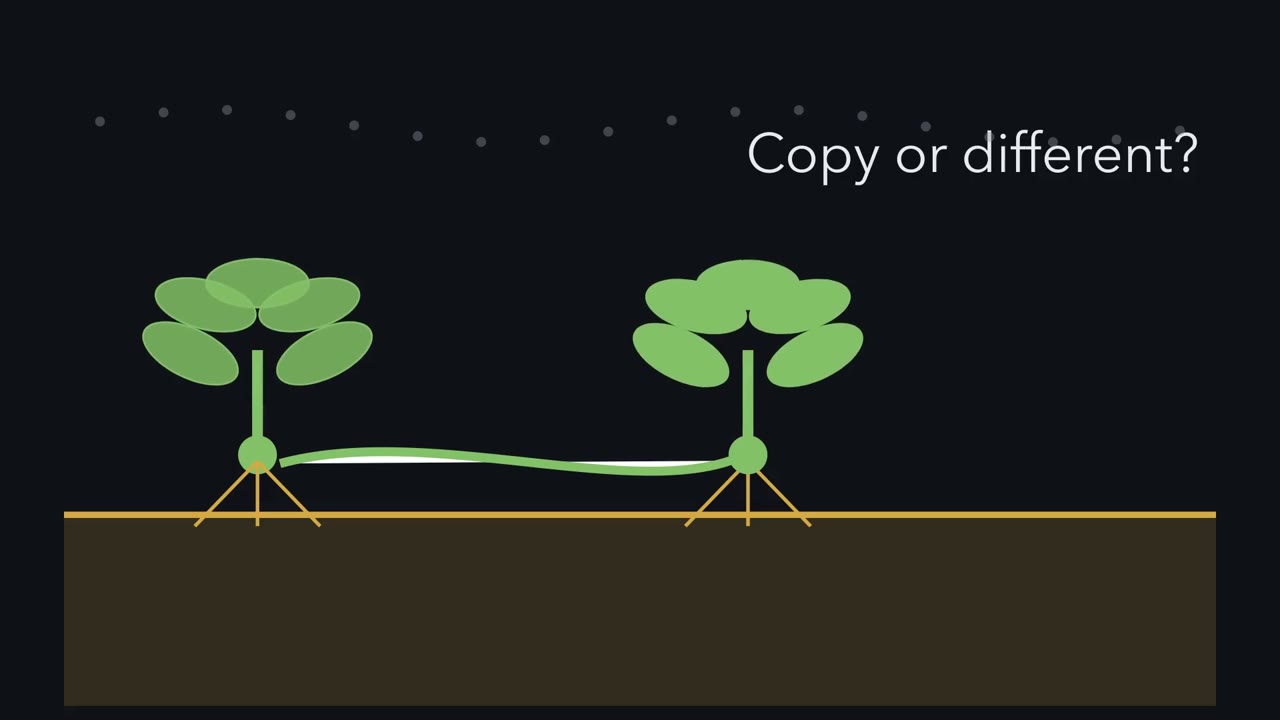 ▶ Watch Copies, Halves, and Pairs · 3:28
Read the transcript of “Copies, Halves, and Pairs”
Film transcript: Copies, Halves, and Pairs
Why can a strawberry runner make a copy, while brothers and sisters are different? Watch one garden tell both stories. A runner stretches from one plant and roots nearby. It has one parent. This is asexual reproduction. The new plant usually carries the same genetic information.
Sexual reproduction takes another path. Two sex cells join, usually one from each of two parents. In animals, those cells are sperm and egg. Before they join, a problem must be solved. Body cells carry chromosomes in pairs.
Joining two fully paired cells would double the chromosome number. Follow the blue and gold bars. Each colour marks one member of a chromosome pair. The pair carries the same kinds of genes in the same general places. One member came from the mother, and one from the father. A body cell keeps both members together. Which move could let two sex cells join without doubling the chromosome number? Watch the bars. Should every pair stay together, or should each cell carry only half? Make your prediction.
Meiosis solves the problem. The members of each pair separate. A sex cell receives one chromosome from every pair. Its chromosome number is half the body-cell number. Here is the rule. Sexual reproduction: meiosis halves chromosome number and makes mixes; fertilization restores pairs. Now a sperm and egg move together. Fertilization joins them into one new cell. Their half sets make full pairs again. Each restored pair has one chromosome from each parent. The chromosome number returns to the usual body-cell number instead of growing with every generation. Look again at the bar count.
Halving does not mean cutting chromosomes into pieces. It means placing one whole chromosome from every pair into a sex cell. When the cells join, the partners form pairs again. This movement can repeat across generations without a steady rise in chromosome number. The picture used animal sperm and egg cells.
Plants take an extra step. Meiosis first makes spores, and sex cells form later. Those sex cells still carry half. The simple model also has an exception: rare DNA changes can make an asexual copy imperfect. Return to the garden. The runner grows from one parent, so it usually carries that parent's genetic information. Sexual offspring begin when half sets join. Meiosis prevents chromosome number from doubling. Fertilization restores the pairs. The next question is why those half sets are not all alike.
From the film
- Asexual reproduction has one parent and usually makes offspring with the same genetic information.
- Sexual reproduction joins two sex cells, usually one from each of two parents.
- Meiosis gives each sex cell one chromosome from each pair.
- Sexual reproduction: meiosis halves chromosome number and makes mixes; fertilization restores pairs.
Why can a strawberry runner grow into a copy of one parent, while brothers and sisters usually differ?
The first film ends on the rule this page tests:
What do you think? Decide before you read.
-
Scientists disagree: Traits are passed on as separate units called genes. In the 1850s and 1860s, Gregor Mendel crossed yellow-seeded and green-seeded peas. Green seeds vanished in the first offspring, then came back in the next generation. A blend could not come apart again like that.
What scientists think
Scientists disagree: Traits are passed on as separate units called genes. In the 1850s and 1860s, Gregor Mendel crossed yellow-seeded and green-seeded peas. Green seeds vanished in the first offspring, then came back in the next generation. A blend could not come apart again like that.
-
Scientists disagree: Scientists count chromosomes in stained cells under a microscope. A typical human body cell has 46. An egg or sperm normally has 23. If sex cells had 46, a fertilized egg would have 92, and the number would double every generation.
What scientists think
Scientists disagree: Scientists count chromosomes in stained cells under a microscope. A typical human body cell has 46. An egg or sperm normally has 23. If sex cells had 46, a fertilized egg would have 92, and the number would double every generation.
-
Scientists disagree: Each child grows from a different egg and a different sperm. Brothers and sisters have the same kinds of genes. But sex cells usually get different mixes of the parent’s chromosomes, so siblings usually get different versions of those genes. Identical twins come from one fertilized egg, so they share nearly the same DNA.
What scientists think
Scientists disagree: Each child grows from a different egg and a different sperm. Brothers and sisters have the same kinds of genes. But sex cells usually get different mixes of the parent’s chromosomes, so siblings usually get different versions of those genes. Identical twins come from one fertilized egg, so they share nearly the same DNA.
Explore: sort chromosomes into sex cells
In the model, coloured bars are chromosome pairs. A letter such as B or b marks one version of a gene. Choose asexual or sexual reproduction and one to three pairs, then make 8 offspring. A counter shows how many different mixes appear.
Made up for this sketch, not measured: every parent is drawn with two different alleles on each pair (B and b, D and d, G and g), as in the lesson’s count of mixes. Each bar stands for one chromosome; a copied chromosome is still one chromosome, and the copying before meiosis is not drawn. Pairs split by chance with a 50 percent chance for each bar. The steps of meiosis and the swapping of pieces are left out. Two offspring count as the same mix only when every bar matches, including which parent it came from (left bar from Parent 1, right bar from Parent 2). Rare changes in DNA are not drawn. A human body cell has 46 chromosomes in 23 pairs; this sketch shows only 1 to 3 pairs.
Rule to keep: in meiosis each pair splits by chance, so a sex cell gets one chromosome from each pair, and asexual offspring are genetically the same as the one parent. This is a sketch of the logic, not a measurement.
- Predict: Will 8 asexual offspring match each other? Test and compare.
- Predict: With 1 pair, what share of sex cells will carry B? Run the model several times.
- Predict: Will 3 pairs give more different offspring than 1 pair? Test your idea.
One parent or two sex cells
- asexual reproduction
- sexual reproduction
- offspring
- sex cells
- body cells
- meiosis
- fertilization
- chromosome pair
- allele
A species lasts only if its members reproduce. Every living thing alive today came from living things before it. Offspring are the new living things made when reproduction passes on genetic information.
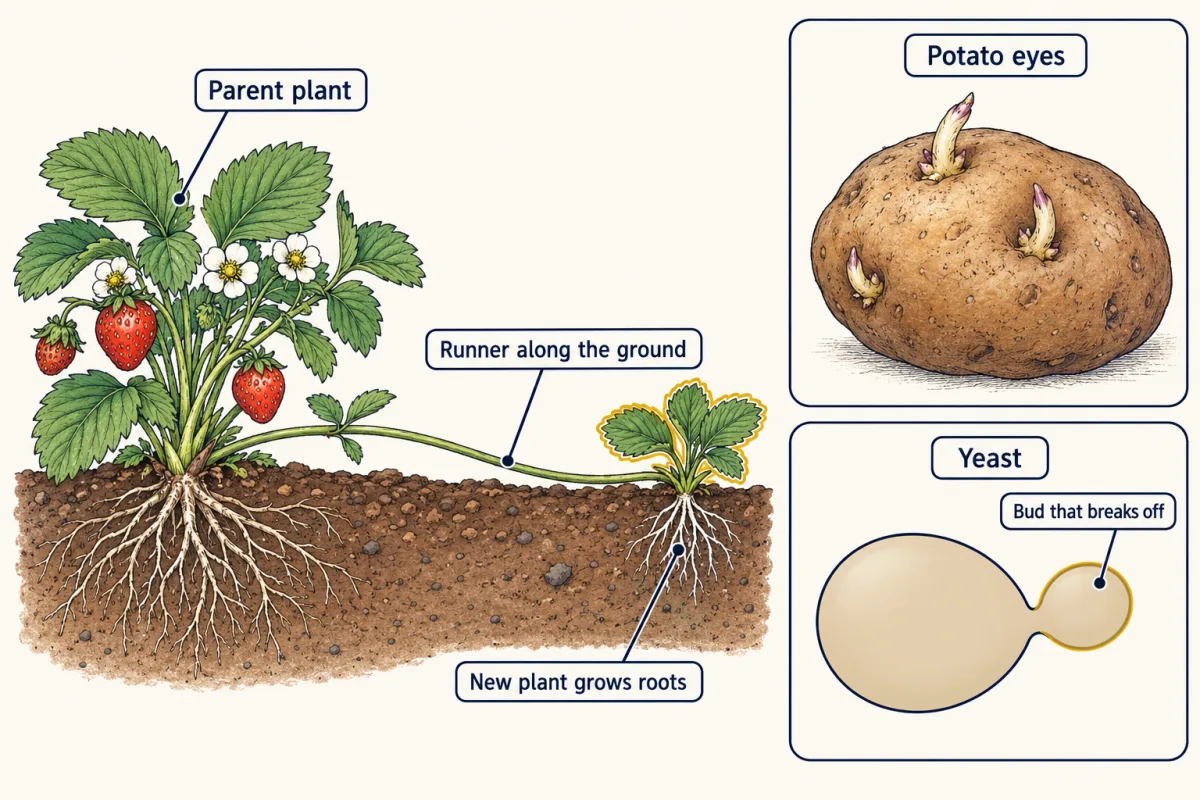
Asexual reproduction has one parent and makes offspring genetically the same, like the runner. Other examples: a potato grows from its eyes, a spider plant makes plantlets, and yeast forms a bud that breaks off. A bacterium splits in two by a simpler kind of division than mitosis. Rare DNA changes mean the copies are not always perfect.
Sexual reproduction joins two sex cells, usually one from each of two parents. Sex cells are the cells that carry genetic information to the next generation. Plants make egg cells and sperm cells carried inside pollen. Sex cells are made by special cells in animal ovaries and testes, and in plant flowers. Body cells are the other cells, such as skin, leaf or muscle cells.
Halve, then restore: the human numbers
A chromosome pair is two chromosomes with the same kinds of genes in the same general places, one from the mother and one from the father. (One exception, the X and Y pair, is in Going deeper.) Meiosis is the cell division that makes sex cells with half the parent cell’s chromosomes, one from each pair. Fertilization joins a sperm and an egg into one cell with full pairs again. A typical human body cell has 46 chromosomes in 23 pairs, so an egg or sperm normally has 23:
23 chromosomes (egg) + 23 chromosomes (sperm) → 46 chromosomes (fertilized egg)
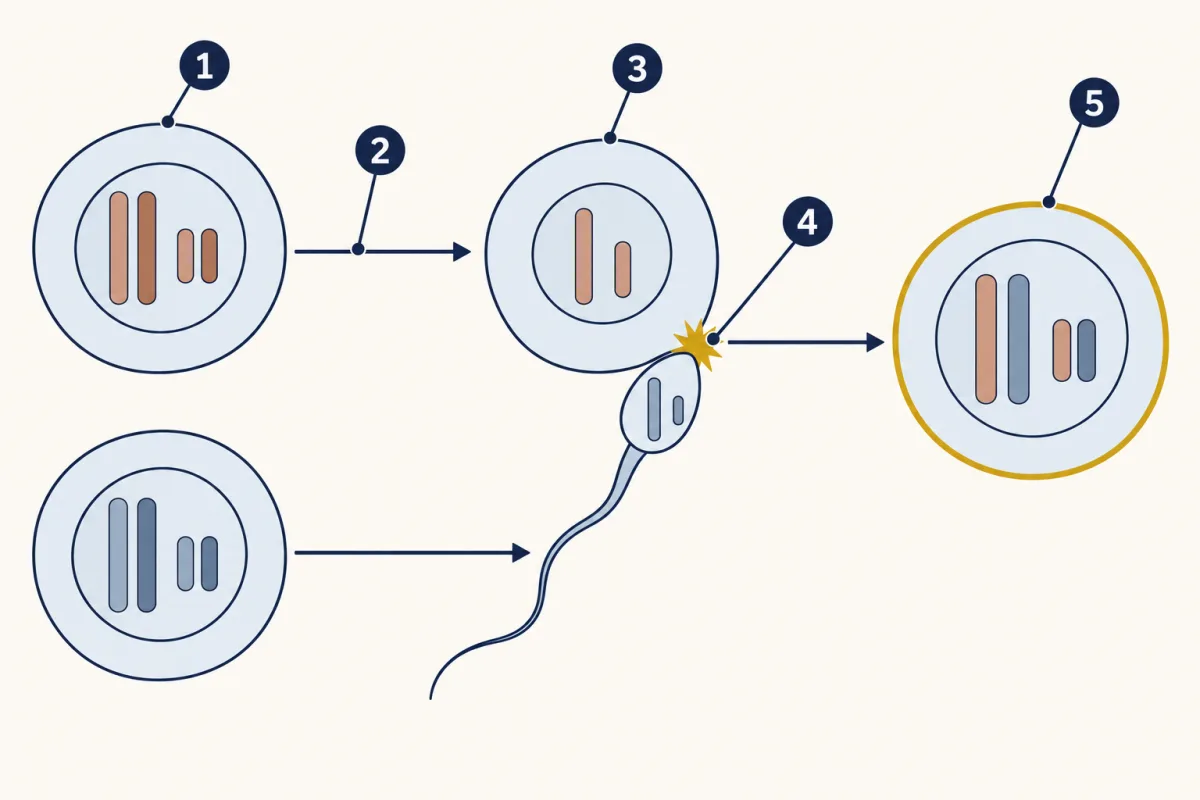
- parent cell
- meiosis
- sex cell
- fertilization
- fertilized egg
- parent cell
- blank
- blank
- blank
- fertilized egg
Word bank: fertilization, meiosis, sex cell
- blank
- blank
- blank
- blank
- blank
Check your labels
- parent cell
- meiosis
- sex cell
- fertilization
- fertilized egg
That leaves a question: which chromosome from each pair enters a sex cell? The second film follows it.
Read the transcript of “How Chromosome Pairs Make Different Mixes”
Film transcript: How Chromosome Pairs Make Different Mixes
The first film showed why sex cells carry half the chromosomes. But if every sex cell gets half, why are those halves different? Return to the blue and gold chromosome pairs. This time, follow which member enters each sex cell.
A gene can have different versions. Each version is an allele. Put capital B on the blue chromosome and lowercase b on the gold one. A sex cell receives only one member of this pair. Each sex cell has an equal chance of getting capital B or lowercase b. Across many sex cells, about half carry each. Now restore three pairs. During meiosis, each pair sorts by chance, independently of the other pairs in this model. The blue member may move left in one pair. In another pair, the gold member may move left. Each choice changes the final mix. One green sex cell now holds a blue, gold, blue pattern. Reset the parent cell and turn each pair again. Must the next sex cell match that pattern?
Predict what the independent choices will do. The next cell need not match. A gold, blue, gold pattern is also possible. Each pair still contributes one chromosome, so every sex cell has half. What changes is which member arrives. Different eggs and sperm can therefore carry different mixes of alleles. Chance does not promise exact halves in a small group. A short run can contain more copies of one allele. Across many model sex cells, the results should approach equal shares. An allele is not stronger because it appears a little more often once. Blue and gold mark two pair members, not stronger and weaker chromosomes. This model follows whole chromosomes only.
In high school, you will add crossing over. Paired chromosomes can exchange matching pieces, creating still more allele combinations. That later detail does not change today's sorting rule. Mitosis does a different job. It keeps the chromosome number and makes matching body cells for growth and repair.
Meiosis makes sex cells with half and can make different mixes. Most asexual reproduction uses the copy path; sexual reproduction uses the sorting path. Now the sibling puzzle has an answer. Each child begins from a different egg and sperm, usually carrying different allele mixes. The alleles stay separate rather than blending like paint.
Sexual reproduction: meiosis halves chromosome number and makes mixes; fertilization restores pairs.
From the film
- Sexual reproduction: meiosis halves chromosome number and makes mixes; fertilization restores pairs.
- An allele is one version of a gene.
- Each chromosome pair sorts by chance, independently of the other pairs in this model.
- Different eggs and sperm usually carry different mixes of alleles.
- Mitosis makes matching body cells; meiosis makes sex cells with half the chromosomes.
Count the mixes
The second film showed the sorting rule: each chromosome pair sorts by chance, independently of the other pairs in this model. An allele is one version of a gene. You carry two alleles of most genes, one on each chromosome of a pair. So if a parent has alleles B and b, each sex cell has a 50 percent chance of carrying B and a 50 percent chance of carrying b.
Because the pairs sort independently, the counts multiply. One pair gives 2 kinds of sex cells. Two pairs give 2 × 2 = 4. Three give 2 × 2 × 2 = 8.
Predict: What will a fourth pair do to the number of mixes?
It doubles the total again. A person has 23 pairs, so the count is 2 multiplied by itself 23 times: 8,388,608 mixes of whole chromosomes. (That count assumes the two chromosomes in every pair differ.) That is one reason siblings usually receive different mixes. Linking mixes to traits comes in Predicting Traits.
| Mitosis | Meiosis | |
|---|---|---|
| Makes | Body cells | Sex cells |
| Used for | Growth, repair, most asexual reproduction | Sexual reproduction |
| Chromosomes in new cells | Same as parent cell | Half, one from each pair |
| New cells | Match the parent cell | Can carry different mixes |
You met mitosis in How Cells Divide.
Evidence: chromosome numbers across living things
Body-cell numbers come from published counts. The sex-cell column was calculated by halving, not counted.
| Living thing | Plant or animal | Body cell (chromosomes) | Sex cell (chromosomes, calculated) |
|---|---|---|---|
| Fruit fly | animal | 8 | 4 |
| Garden pea | plant | 14 | 7 |
| Rice | plant | 24 | 12 |
| Domestic cat | animal | 38 | 19 |
| Human | animal | 46 | 23 |
| Chimpanzee | animal | 48 | 24 |
| Garden strawberry | plant | 56 | 28 |
| Horse | animal | 64 | 32 |
| Chicken | animal | 78 | 39 |
- Divide each body-cell number by its sex-cell number. What pattern do you find?
- Predict: Does a bigger chromosome number mean a more complex living thing? Compare the chicken and the human, then two more rows.
- Find the mean body-cell number of the four living things with the fewest chromosomes.
- In every row, the sex cell has blank the chromosomes of the body cell.
- This keeps the number steady because blank.
- One limit of this table is blank.
Claim, evidence, reasoning
Make a claim about what meiosis does to the chromosome number, and why fertilization brings it back, using this table.
Start with: Meiosis makes sex cells with blank the chromosomes of a body cell.
Start with: A human body cell has blank chromosomes and a sex cell has blank. A pea has blank and blank.
Start with: When two sex cells join at fertilization, blank, so the offspring has blank.
Compare with a model answer
Meiosis makes sex cells with half the chromosomes of a body cell. A human body cell has 46 and a sex cell has 23. A pea has 14 and 7, and a strawberry 56 and 28. At fertilization two sex cells join, so 23 + 23 = 46, and the offspring has the same number as its parents. One limit: the sex-cell column was calculated by halving, so the table shows the rule but does not test it.
Saved in this browser only.
Design problem
Do plants grown from runners vary less than plants grown from seeds? Plan an investigation with strawberry plants.
Saved in this browser only.
One way to do it
- Question: Do strawberry plants grown from runners of one parent vary less in leaf length than plants grown from seeds of the same kind of strawberry?
- Independent variable: how the plant was made, from a runner (asexual) or from a seed (sexual).
- Dependent variable: the length of the largest leaf in millimetres after 8 weeks. Find each group’s range, the longest minus the shortest.
- Constants: the same soil, pot size, water, light and temperature.
- Control: seed-grown plants are the comparison group. The parent plant can be an extra reference.
- Repeated trials: at least 10 plants in each group.
- Safety: wear gloves for soil, wash your hands, and do not eat the plants.
A smaller range in the runner group would fit the idea that asexual offspring share the parent’s genetic information. Some variation will still appear in both groups, because light, water and space also affect growth. Runner plants may start with food from the parent, another difference between the groups.
Going deeper
In most males, X and Y form a pair even though they match only in small parts. In plants, meiosis first makes spores and sex cells form later, but they still end up with half.
Table sources: Human and chimpanzee: a 2020 review by Suntsova and Buzdin. Cat: fat stem cells from female cats, with more than 300 dividing cells checked (Algorta and others, 2024). Horse: 44 normal horses (Blue, 1981). Chicken: Fillon and others (1998). Fruit fly: female larvae (Cherezov and others, 2020). Pea: root tips of one line (Yurkevich and others, 2018). Rice: Asian cultivated rice (Wu and others, 2018). Garden strawberry has 56 chromosomes in 8 sets of 7 (Genome Biology, 2025). Edger and others (2019) pieced together the DNA of 28 chromosomes, half the body-cell number, for the Camarosa kind.
Evaluate: check your thinking
Meiosis halves chromosome number and makes mixes; fertilization restores pairs. So siblings receive different mixes, while a strawberry runner usually carries its one parent’s genetic information.
Science practices you used: predicting with a model, finding a table pattern, supporting a claim with numbers, naming a limit, and planning a fair test with a control and repeated trials.
Your notes
Select any text in the lesson to highlight it or add a note to it. Your highlights and notes are saved in this browser and collected in your notebook.
This browser is not letting the site save anything (a private window or strict privacy settings), so highlights and notes will be lost when you leave the page.
How we measure it
Counting chromosomes under a microscope
Cells caught while dividing are stained and spread flat on a slide, so each chromosome can be seen and counted. Scientists count normal cells from many samples to find the usual number for a kind of living thing.
Controlled pollination
A gardener removes the pollen-making parts of a flower, covers it, and then adds pollen from a chosen plant. This way the scientist knows both parents of every seed and can count which traits show up in the offspring.
Where this lesson fits
Before thisReview first
- How Cells DivideThis course · Lesson 4
You need mitosis from there to compare it with meiosis, which makes sex cells instead of matching body cells.
- DNA: The Code of LifeThis course · Lesson 27
You need to know that genes are stretches of DNA on chromosomes to follow how alleles are sorted.
After thisStudy next
- Predicting Traits with Punnett SquaresThis course · Lesson 29
It uses the chance sorting of alleles into sex cells to predict which traits offspring will show.
- Mutations and VariationThis course · Lesson 31
It builds on the mixes meiosis makes by asking where new variation in offspring comes from.
- Inherited or Acquired?This course · Lesson 30
It uses the idea that offspring get genes through sex cells to separate inherited traits from acquired ones.
Elsewhere on the siteFilms, simulations and method films in other courses
- Set Up: Like Their Parents, Not the SameFilm · Biology Together
A hands-on look at how offspring resemble their parents without being identical copies.
- How One Set Becomes TwoFilm · Biology
It shows how mitosis copies each chromosome so both new cells get a full set, the contrast to meiosis.
- Cross and countSimulation · Biology
You can cross parents and count offspring to see how separating alleles gives chances of each trait.
Suggested by an AI model from the lessons themselves, then checked. How we use AI
Finish line
Test yourself
8 questions
Practice and MCAT-style, with explained answers.
Next · Lesson 29
Predicting Traits with Punnett Squares
How can two purple-flowered pea plants have a white-flowered offspring?
Continue →