Life Science · Unit 7: Heredity
Inherited or Acquired?
Rewritten on : new text, flashcards and film. Your notes and highlights stay, but the text around them may have moved.
If a parent gets a scar, why is a baby not born with it—and why can matching hydrangea cuttings bloom different colors?
Pause when the reading reaches a film, and offer to play it. Saved on this device.
Watch the film now, or keep listening
Builds on:Predicting Traits with Punnett SquaresReproduction and MeiosisDNA: The Code of LifeWhy these?
Where this lesson sits
- Virginia SOL LS.10 c
- Virginia SOL LS.11 c
- Practices LS.1 a, LS.1 c, LS.1 d, LS.1 f
Essential question: Are all my traits from my genes, or do some come from how I live?
-
Life Science (grade 7) LS.10 c, LS.11 c You are here
This lesson
-
Biology
Preview it at high school level
In Biology you will learn that dominant and recessive are not the only patterns. In incomplete dominance, neither allele fully hides the other: red and white snapdragons give pink offspring. In codominance, both alleles show at once, as in people with type AB blood, who have both the A and the B marker. Some traits, like height, are controlled by many genes. Some genes sit on the X chromosome, so a trait can show up more in boys than in girls. You will also read pedigrees, family charts that trace a trait through several generations.
-
Biology II Biology II: Advanced Survey of Biology Topics, BIOII.4 c-f; Genetics, GEN.4 b and GEN.5 b
Preview where it goes next
In Virginia's Biology II courses, you go further. The Advanced Survey course works through incomplete dominance, codominance and genes with more than two alleles. It covers genes linked on one chromosome, genes on the sex chromosomes, crosses that follow two traits at once, and traits set by many genes. The Genetics course looks at large changes in chromosomes, such as a missing or repeated piece, and at inheritance patterns that do not follow Mendel's simple rules.
-
College
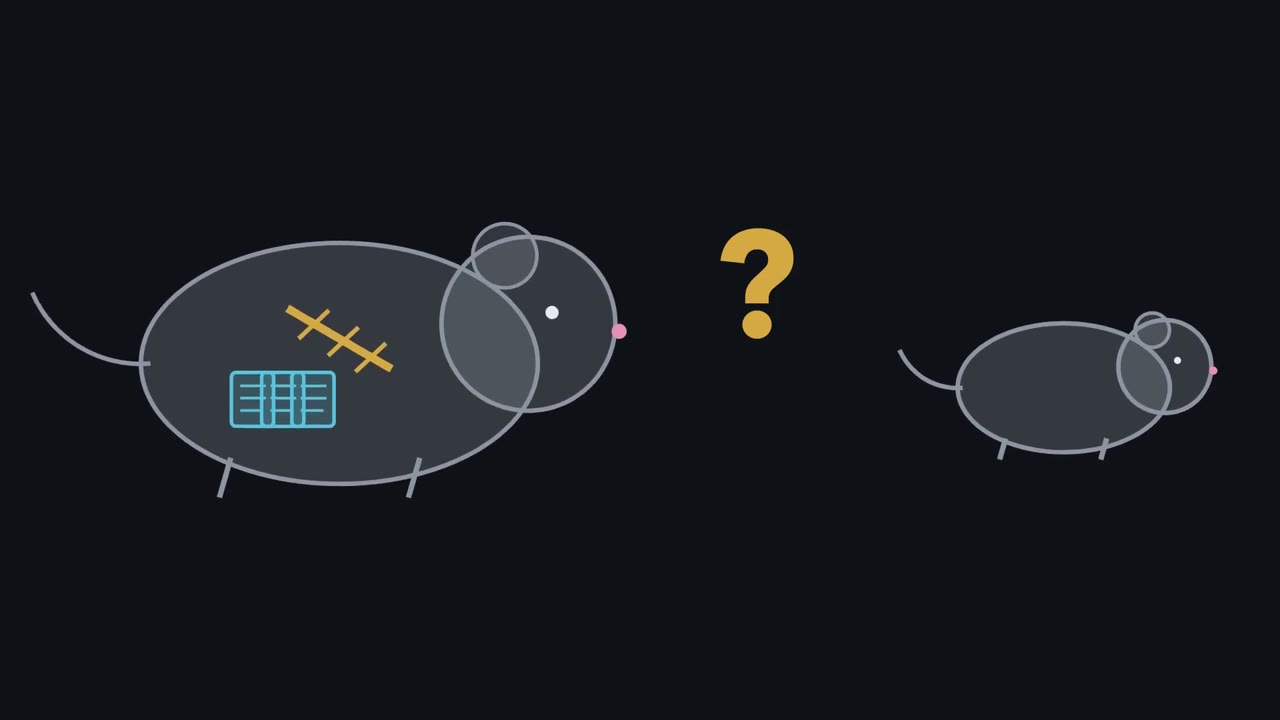 ▶ Watch What Can Cross a Generation? · 3:12
Read the transcript of “What Can Cross a Generation?”
Film transcript: What Can Cross a Generation?
A parent can gain a scar. Why is a baby not born with that scar? Follow the gold mark on this skin. Then follow the blue gene cards toward a young animal. An inherited trait passes from parent to offspring through genes. An acquired trait develops during life.
Eye color is inherited. A scar, dyed hair, a learned skill, and exercise-built muscle are acquired. These labels describe where the characteristic comes from, not whether genes act alone. In people, mice, and many other animals, offspring begin from sex cells. Those cells carry the parents' genes.
Skin cells can heal into a scar. Muscle cells can grow with exercise. Those body-cell changes do not change the genes inside the sex cells. The skin change and the gene cards now sit beside different paths. Which path can reach the offspring? Keep watching both routes before you decide.
The blue cards pass through the sex-cell gate and continue into the young. The scar reaches a red stop at the body-cell gate. Gene-coded traits can pass on; ordinary changes gained during life cannot. Ordinary means body changes like the ones shown here. Genes are not the whole story. The environment is everything around a living thing that can affect it. Soil, light, water, food, and temperature belong to it. Genes and environment can work together to shape the phenotype, the trait that appears. Variation means differences among living things of the same kind. Some differences trace to inherited alleles. Others develop as environments differ.
Many traits reflect both. Matching gene sets can meet different surroundings and produce different visible results. That is why tracing a cause works better than forcing every phenotype into a genes-only box or an environment-only box. Watch matching cuttings from a bigleaf hydrangea. Their blue gene cards stay the same. In many kinds, acidic soil lets roots take up more aluminum. That helps flowers become blue. Less acidic soil can give pink flowers. The soil changes the phenotype, not the cutting's genes. Genes set which colors are possible, while soil helps decide which appears. The same logic explains why matching genes need not make matching phenotypes.
Phenotype tells what appears, not which cause acted. First trace the cause. Then ask whether it can enter the gene route to offspring.
From the film
- Gene-coded traits can pass on; ordinary changes gained during life cannot.
- In people and many animals, offspring receive genes through sex cells.
- A scar or exercise-built muscle changes body cells, not sex-cell genes.
- Genes set which phenotypes are possible; the environment helps decide which appears.
The first film gave one test: trace a characteristic’s cause, then ask whether that cause has a path through genes to the young. Try it on two puzzles. Two cuttings from one hydrangea have the same genes, yet one can bloom blue and the other pink. And doctors think one kind of small extra finger is passed on by a dominant allele, yet it is rare.
The one idea: Gene-coded traits can pass on; ordinary changes gained during life cannot.
Scope: Ordinary changes gained during life means scars, injuries, dyes, learned skills and muscles built by exercise in people and other animals. The environment can still change the phenotype that a genotype produces. Going deeper explains how the rule differs for sex cells, plant cuttings and some effects of a parent’s experiences.
What do you think? Decide before you read.
-
Scientists disagree: Muscles grow when used, but that change is in muscle cells. A baby grows from an egg and a sperm, and exercise does not change their genes. In breeding studies, injuries to parents did not show up in their young.
What scientists think
Scientists disagree: Muscles grow when used, but that change is in muscle cells. A baby grows from an egg and a sperm, and exercise does not change their genes. In breeding studies, injuries to parents did not show up in their young.
-
Scientists disagree: Dominant only means one copy of an allele is enough for the trait to show. It says nothing about how many people have that allele. Counts of real babies show that a trait thought to be passed on by a dominant allele can be rare.
What scientists think
Scientists disagree: Dominant only means one copy of an allele is enough for the trait to show. It says nothing about how many people have that allele. Counts of real babies show that a trait thought to be passed on by a dominant allele can be rare.
-
Scientists disagree: Height is a good example. Genes from both parents matter, and so does food while you grow. Gardeners see the same thing in some flowers, where the soil changes a color that the genes make possible.
What scientists think
Scientists disagree: Height is a good example. Genes from both parents matter, and so does food while you grow. Gardeners see the same thing in some flowers, where the soil changes a color that the genes make possible.
Explore: grow a garden of genes and soil
In the simulation you grow plants like hydrangeas. A plant carries color alleles, or white alleles that block color, and you set the soil from acidic to less acidic.
- Parent’s flowers
- blue
- Young plants’ flowers
- not grown yet
- In this sketch, passed on from the parent’s change
- not grown yet
Pick an allele and slide the soil. Then change the parent and press Grow seeds.
Made up for this sketch: the soil moves in steps of 0.1 pH from 5.0 to 6.5. Blue is shown at 5.5 or lower, in between from 5.6 to 5.9, and pink from 6.0 up; the lesson’s table says “about”, so the edges here are our choice. Six young plants are drawn. Both parents have the same pair, so each young plant gets one allele from each. Nothing here is measured, and the picture is a sketch of the logic, not to scale.
The genes set which colors are possible, and the soil helps decide which one appears. A cut or a dye changes the parent’s body, not the genes in its sex cells, so the young do not get it.
Try this.
- Choose a plant with two color alleles. Move the soil slider and record which flower color shows.
- Switch to two white alleles. Answer Predict 1, then test it.
- Dye a parent’s petals, or cut its stem, and grow its seeds. Check several young plants.
Predict 1. Switch to two white alleles. Will moving the soil slider still change the flower color? Give a reason before you test it.
Explain: what can be passed on
- variation
- inherited trait
- acquired trait
- allele
- genotype
- phenotype
- dominant
- recessive
- environment
Scientists describe living things by features like color, shape, body covering and height. Variation is the differences among living things of the same kind.
An inherited trait is a trait passed from parents to offspring through genes, such as eye color or the shape of a pea seed. An acquired trait is a characteristic a living thing gets during its life, such as a scar, dyed hair, a skill like playing piano, muscles built by exercise, or the language you speak.
The first film showed why an acquired trait stops at the parent. A scar or exercise changes body cells, not the genes in sex cells. The film could not test this. The mouse experiment below tests one narrow part of it: does cutting the parents’ tails change their young’s tails?
- A scar is an blank trait, because it blank.
- Eye color is an blank trait, because it is passed on through blank.
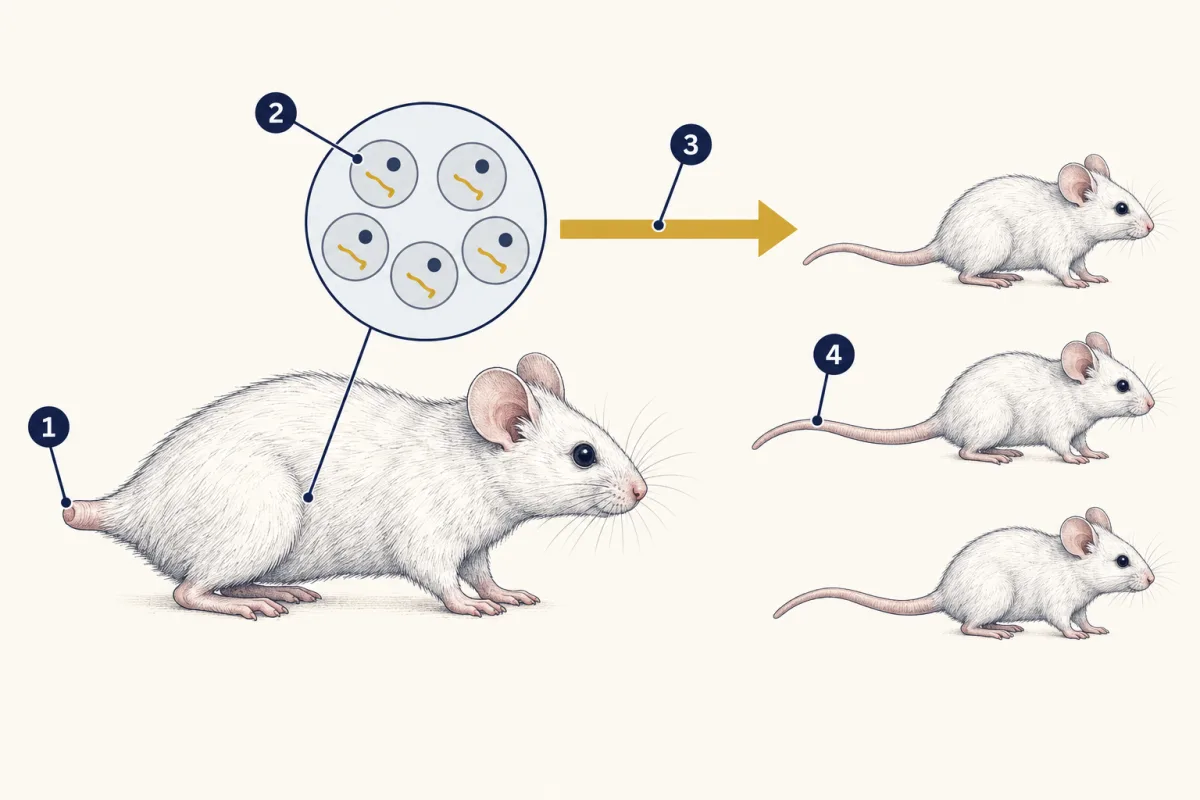
- cut tail
- sex cells
- genes pass to the young
- young with full tails
- cut tail
- blank
- blank
- young with full tails
Word bank: genes pass to the young, sex cells
- blank
- blank
- blank
- blank
Check your labels
- cut tail
- sex cells
- genes pass to the young
- young with full tails
Explain: genes and environment work together
The environment is everything around a living thing that can affect it, such as soil, light, water, food and temperature.
You get one allele, or version of a gene, from each parent (review it in that lesson). Your genotype is the pair of alleles you have. Your phenotype is the trait that shows, such as purple or white flowers.
The first film’s hydrangea cuttings are clones with the same genes. In many kinds, acidic soil lets the roots take up more aluminum, which turns the flowers blue; less acidic soil gives pink. Gardeners measure acidity with soil pH, a number where lower means more acidic.
| Soil pH (Virginia extension guide) | Flower color in color-changing hydrangeas |
|---|---|
| About 5.0 to 5.5 | Blue |
| 5.6 to 5.9 | In between |
| Above about 6.0 to 6.5 | Pink |
Some kinds of bigleaf hydrangea stay pink or white in any soil. The genes set which colors are possible, and the soil helps decide which one appears.
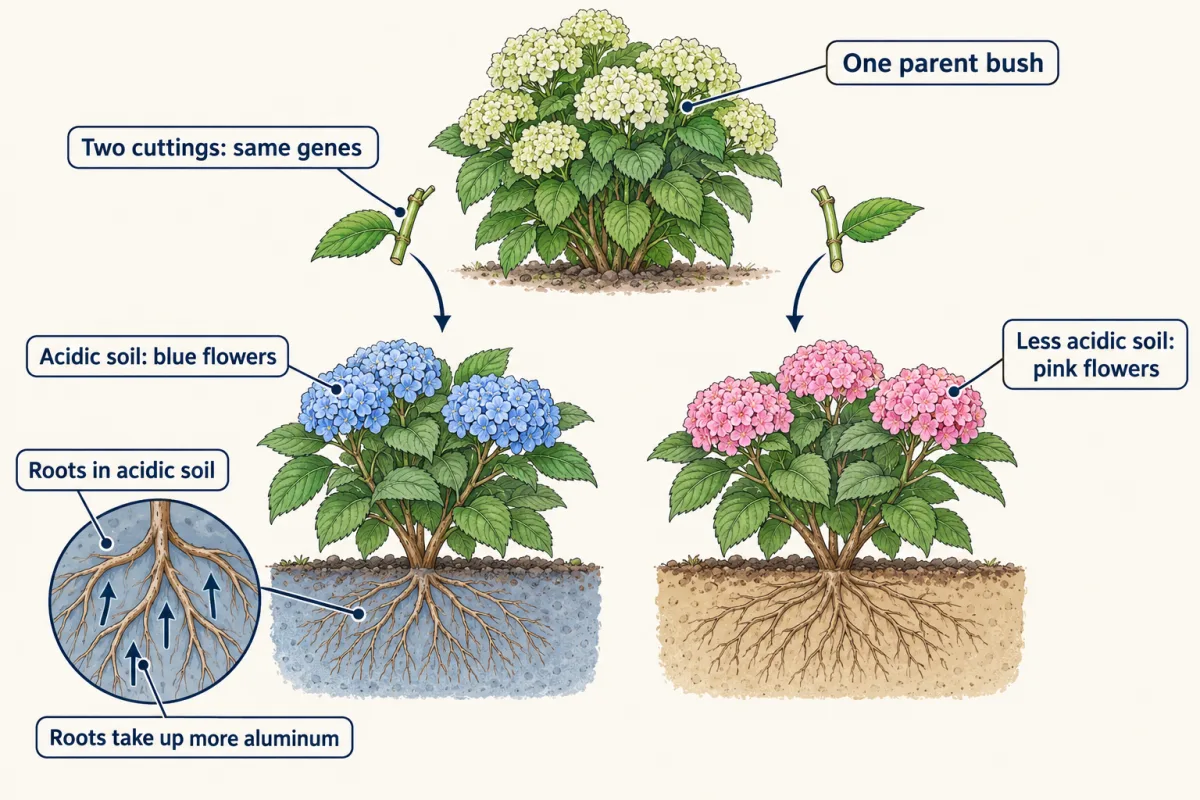
People show the same pattern. Your height depends on many genes and on food and health while you grow.
Once genes are involved, the next question is how different alleles show. The second film follows it from one individual to a whole group.
Read the transcript of “Dominant Is Not Popular”
Film transcript: Dominant Is Not Popular
The first film traced which changes can reach offspring. If an allele is dominant, must most individuals carry it? Watch a few blue cards move through this group. An allele is a version of a gene. In this simple model, an individual receives one copy from each parent. The pair is its genotype. The trait that appears is its phenotype.
Dominant and recessive describe how the pair of allele copies affects that phenotype. A dominant allele shows its trait even when only one copy is present. A recessive allele shows its trait only when both copies are recessive. So a dominant allele can mask a recessive allele in one individual.
Neither word means stronger, healthier, or better. Only a few blue allele cards are in this group. When one blue card enters a genotype pair, will its trait show? Decide before the window changes. The blue card enters, and the trait shows. That is dominance inside this individual. Yet the population bowl still contains very few blue cards. The rule for showing changed the phenotype window. It did not make the allele common in the group. Now move more blue cards into the bowl without changing the showing rule. The group display rises. Move them out, and it falls. The individual display still follows the allele pair.
Frequency belongs to the group. Dominance belongs to the relationship between alleles. A dominant trait may be common or rare. A recessive trait may also be common or rare. These are separate questions. One asks what an allele does beside another allele. The other asks how many copies exist across a whole group. The everyday word dominant can sound like winning.
Genetics uses it more narrowly. It describes how a phenotype appears when different alleles share a genotype. It does not say one allele will spread, replace another, or become common. Population frequency is a separate pattern to measure. To test a claim about commonness, count traits or alleles in a defined group. To test dominance, follow which phenotypes appear in offspring, as Mendel did with peas. One kind of evidence cannot replace the other. Later courses add inheritance patterns beyond simple dominance. So when you hear dominant, look inside one genotype pair.
Ask whether a copy shows beside a different allele. When you hear common, look across the whole group. Ask how often the allele, or its trait, occurs. Never use one answer for both questions.
From the film
- Dominant tells how an allele shows, not how common it is.
- A dominant allele shows its trait even when only one copy is present.
- A recessive allele shows its trait only when both copies are recessive.
- How common an allele or trait is in a group is separate from dominance.
Explain: dominant does not mean common
A dominant allele shows its trait even when only one copy is present; it masks the recessive one. A recessive allele shows its trait only when both copies are recessive. These rules, first worked out with peas by Gregor Mendel, explain how many inherited traits are passed on. Later courses add more patterns.
| Word | What it tells you | What it does not tell you |
|---|---|---|
| Dominant | One copy is enough for the trait to show | How many people have the trait |
| Recessive | Two copies are needed for the trait to show | Whether the trait is rare |
Elaborate: cut tails and counted traits
Starting in 1887, the German biologist August Weismann cut the tails off white mice and let them breed. He did this to the parents for five generations and looked at the young’s tails.
Predict 2. Suppose a cut tail were inherited more strongly in each generation. In which later groups would you expect changed tails to appear?
| Group of tail-cut parents | Young born | Young with short or abnormal tails |
|---|---|---|
| 1 | 333 | 0 |
| 2 | 237 | 0 |
| 3 | 152 | 0 |
| 4 | 138 | 0 |
| 5 | 41 | 0 |
| Total | 901 | 0 |
Source: August Weismann, Essays upon Heredity, English edition, 1889. He gave totals for each group, not a measurement for each mouse.
Predict 3. Add the young in the five groups. What fraction had short or abnormal tails? Write the fraction before reading the CER model.
| Trait | Allele | How common (per 100 people) | Who was counted |
|---|---|---|---|
| Small extra finger beside the little finger | Dominant (thought to be) | 0.035 | Babies the study grouped as White, Boston hospital records, 1972 to 2012 |
| Small extra finger beside the little finger | Dominant (thought to be) | 0.91 | Babies the study grouped as Black, same study |
| Rh-negative blood | Recessive | About 15 | People of European ancestry, rough estimate from a 2005 reference book |
| Rh-positive blood | Dominant | About 85 | Same group (100 minus 15) |
Sources: Holmes and colleagues, Birth Defects Research (2018) for the extra-finger rows, and Laura Dean, Blood Groups and Red Cell Antigens (2005) for the Rh rows. These are different groups counted in different ways, so the rows are a rough comparison, not a controlled test.
Predict 4. Compare the 0.035-per-100 extra-finger row with the about-15-per-100 Rh-negative row. Which is more common, and about how many times more common? Is the extra finger rare in the 0.91-per-100 row too? Why is this only a rough comparison?
Check your comparison
Rh-negative blood is about 15 / 0.035, or roughly 430 times, as common as the extra-finger trait in the 0.035 row. Even in the 0.91 row, Rh-negative blood is about 16 times as common, so the dominant trait is rare in both groups. The comparison is only rough because the groups and counting methods differ.
Claim, evidence, reasoning
Make a claim that answers the question: can an injury to parents be inherited by their young? Use the mouse data.
Start with: The data show that cutting the parents’ tails blank.
Start with: Out of blank young from five generations, blank had short or abnormal tails.
Start with: If injuries were inherited, we would expect blank. This makes sense because inherited traits pass from parent to young through blank.
Compare with a model answer
Cutting the parents’ tails did not change the tails of their young. Out of 901 young from five generations of tail-cut parents, 0 had short or abnormal tails. If injuries were inherited, some young should have been born with short tails, at least in the later groups. A cut tail is an acquired change in body cells, and inherited traits pass to the young through the genes in sex cells. One limit is that this is one experiment, on one kind of animal and one kind of injury.
Saved in this browser only.
Evaluate: check your thinking
Now answer the two opening puzzles. The two hydrangea cuttings have the same genes, which allow blue or pink; the soil in each garden decides which color shows. The small extra finger is thought to be passed on by a dominant allele, but few people carry that allele, so the trait is rare.
Science practices you used: asking questions about a puzzle, planning a fair test with a control and repeated trials, reading data tables, and making a claim with evidence and reasoning.
Design problem
Plan an investigation to test whether light changes a trait in plants with the same genes.
Predict 5. Which variable will you change, which measurements will you make, and what must stay the same for a fair test?
Saved in this browser only.
One way to do it
Question: Do cuttings from one plant grow to the same height in bright light and in shade?
- Plants: 10 stem cuttings from one coleus plant, so all have the same genes.
- Independent variable: light. Put 5 pots by a bright window and 5 pots in a shady corner of the same room.
- Dependent variables: height in centimetres and number of leaves, measured each week for 4 weeks.
- Constants: the same pot size, the same soil, the same 50 millilitres of water twice a week, and the same room temperature.
- Control: the bright-window group, which gets normal growing light.
- Repeated trials: 5 cuttings in each group; find the mean height of each group.
- Safety: wash your hands after handling soil. Never put plants in your mouth; some houseplants are harmful if eaten.
If the groups differ, the environment changed the phenotype, since the genes were the same.
Going deeper
An old inheritance idea
An old idea, often linked to the naturalist Jean-Baptiste Lamarck, said giraffes stretched their necks and passed longer necks to their young. Scientists do not accept it, because using a body part changes body cells, not the genes in sex cells.
Plants, sex cells and parents’ experiences
In animals, changes in the DNA of body cells are not passed on, but changes in sex cells can be, as the lesson on mutations and variation explains. Plants are different: a cutting is made of body cells, so a change in one branch can show up in plants grown from its cuttings. Scientists are also studying whether some experiences, such as a parent’s diet, can affect the young in other ways. That is not the same as passing on a scar or a skill.
Details of Weismann’s mouse counts
Weismann’s counts are on pages 431 to 433. He bred white mice from 1887 to January 1889. Normal newborn tails were 10.5 to 12 millimetres long.
Details of the extra-finger counts
The extra-finger study counted extra digits on hands and feet, mostly hands. It covered 289,365 births, stillbirths and pregnancy terminations for fetal anomalies.
Your notes
Select any text in the lesson to highlight it or add a note to it. Your highlights and notes are saved in this browser and collected in your notebook.
This browser is not letting the site save anything (a private window or strict privacy settings), so highlights and notes will be lost when you leave the page.
How we measure it
Breeding experiment with offspring counts
Scientists change the parents in one way, let them have young, and count how many young show a trait. Weismann's mouse counts in this lesson come from this kind of experiment.
Birth record study
Doctors record the babies born over many years in a hospital and count how many have a trait. Dividing by the number of babies gives how common the trait is in that group.
Soil pH test
A soil test kit or meter gives a pH number that tells how acidic the soil is. Gardeners compare the number with extension guides to predict the flower color of a bigleaf hydrangea.
Where this lesson fits
Before thisReview first
- Predicting Traits with Punnett SquaresThis course · Lesson 29
You need alleles, genotype, phenotype and dominant versus recessive from there to explain the extra-finger counts and the hydrangea colors.
- Reproduction and MeiosisThis course · Lesson 28
You need to know that sex cells carry the genes passed to offspring, so body changes like scars stay behind.
- DNA: The Code of LifeThis course · Lesson 27
You need to know that genes are coded in DNA to see why only gene-coded traits can pass on.
After thisStudy next
- Mutations and VariationThis course · Lesson 31
It shows which changes in DNA reach offspring, because they happen in sex cells, and so create new inherited variation.
- Natural Selection in ActionThis course · Lesson 32
It uses inherited variation, not acquired change, to explain how a population shifts over generations.
Elsewhere on the siteFilms, simulations and method films in other courses
- Set Up: Like Their Parents, Not the SameFilm · Biology Together
A child sees that offspring look like their parents but are not exactly the same.
- Cross and countSimulation · Biology
You can test how a dominant allele shows with one copy and how often it appears in offspring.
Suggested by an AI model from the lessons themselves, then checked. How we use AI
Finish line
Test yourself
8 questions
Practice and MCAT-style, with explained answers.
Next · Lesson 31
Mutations and Variation
Ten leaves grew on one white oak and share rounded lobes. Why do their sizes and shapes still differ?
Continue →