Sensory Systems · Skim version
Itch: A Sense of Its Own
Read the full lesson → Skim the whole course →
The guiding idea
A mouse missing one cluster of Mrgpr genes scratches normally to histamine but much less to chloroquine. Which parts of the itch pathway are shared with pain, and which are not?
Itch is a sense of its own: identifiable sensory neurons detect itch-producing stimuli, histamine is only one of several triggers, a peptide relay in the dorsal horn carries the signal on, and the pathway overlaps with pain without being weak pain.
From the film: Which Line Carries the Itch?
- Deleting a receptor route and ablating its whole neuron population answer different questions.
- MrgprA3-marked neurons receive several itch-producing inputs in the mouse assays shown.
- Restricted rescue shows what those neurons can drive when they alone respond.
- The behavioural assays distinguish scratching from wiping, not a reported sensation.
- Each perturbation supports only the link and assay it tests.
From the film: Order the Relay, Find the Brake
- Downstream rescue and bypass experiments can order functions in a mouse spinal relay.
- The supported order is sensory Nppb, NPRA cells, GRP and GRPR.
- Functional order does not prove direct synapses or one source of GRP.
- Removing spinal inhibitory populations can raise scratching without strengthening sensory input.
- Chemical and mechanical scratching can use partly different gates.
-
Start at the skin: one sensation, several inputs
-
How far the labelled-line claim can go
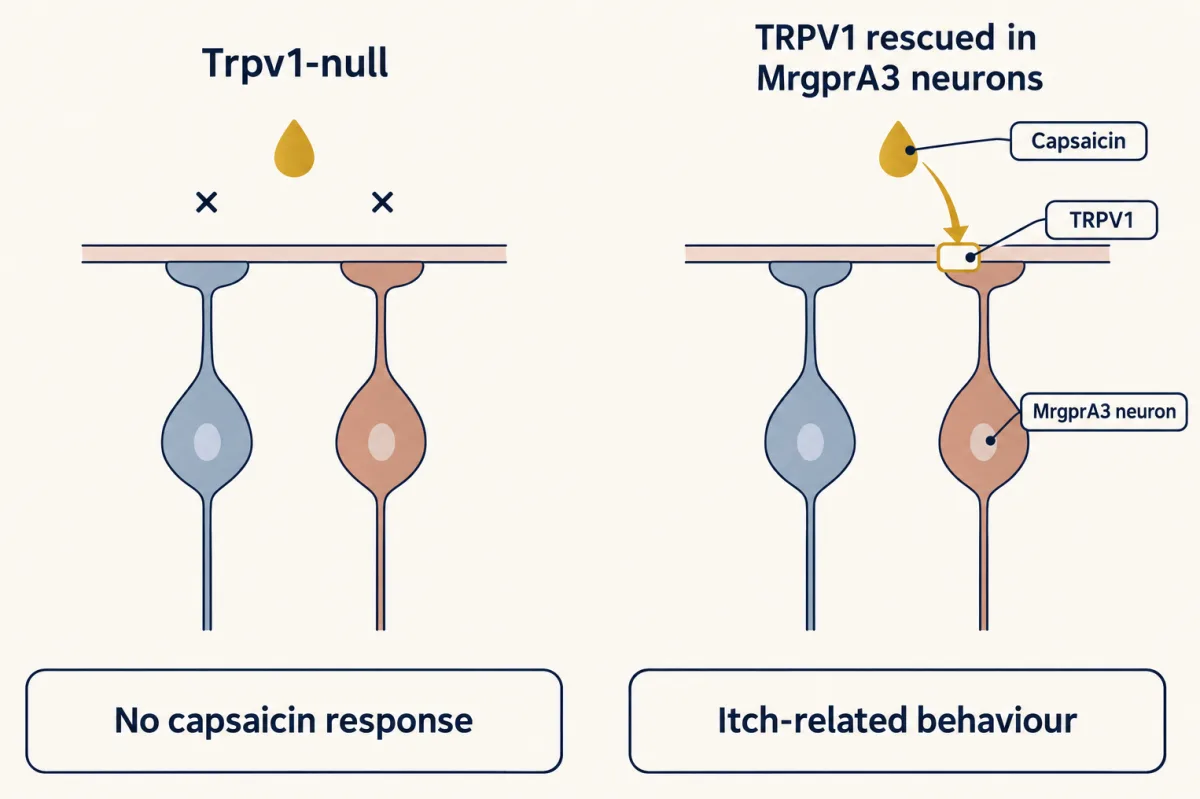
In mice on a Trpv1-null background, restoring functional TRPV1 only in MrgprA3-positive neurons made cheek-injected capsaicin evoke itch-related scratching. Capsaicin normally evokes wiping. The rescue shows what these neurons can drive when they alone can respond to capsaicin, not what every stimulus to them must produce. Neurons are drawn schematically. AI-generated illustration 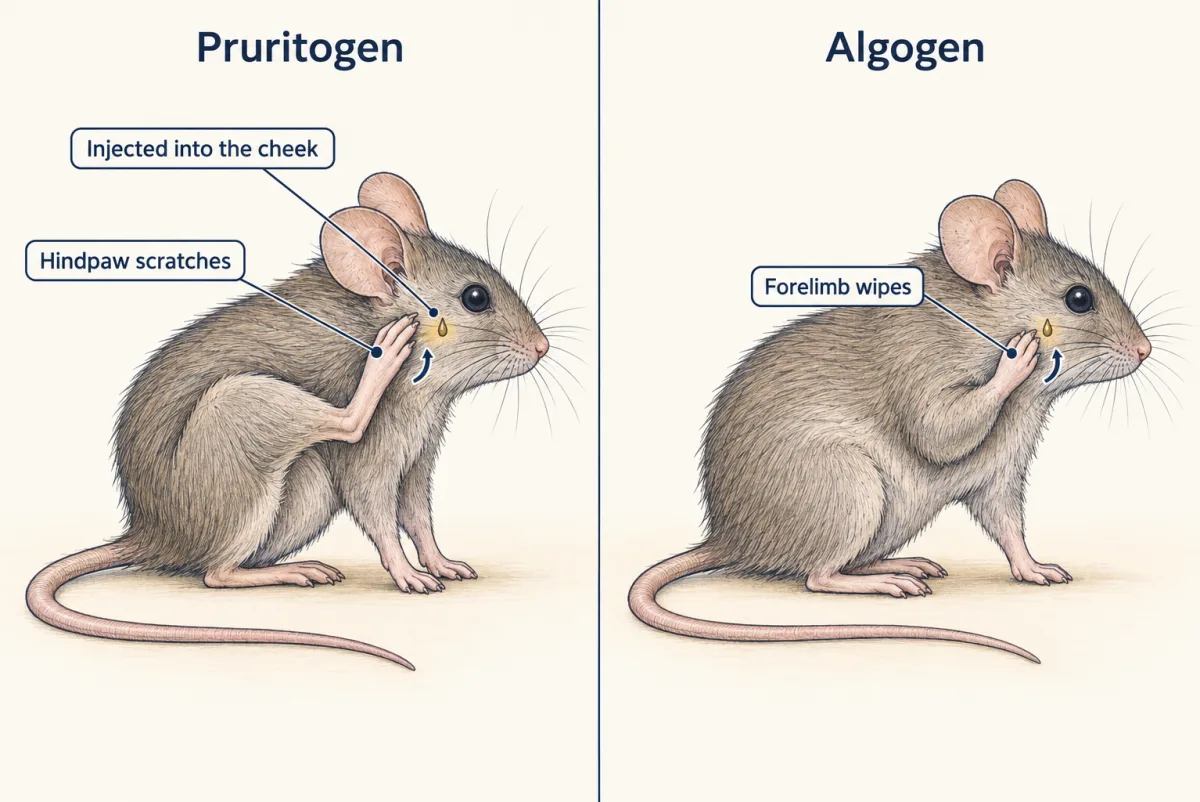
In the cheek assay, a pruritogen injected into the cheek skin (the gold mark is the injection site) evokes scratching with a hindpaw, while an algogen, a pain-causing substance, evokes wiping with a forelimb. AI-generated illustration -
What the ordered relay does not settle
-
Mechanical itch: a partly separate route
-
Immune molecules can trigger or change gain
-
Going deeper
Where this lesson fits
Before thisReview first
- Spinal Circuits That Gate PainThis course · Lesson 12
It gives the dorsal-horn circuit vocabulary and gating ideas that this lesson uses for itch relays and inhibition.
- Nociceptors and the Sodium Channels of PainThis course · Lesson 11
Itch neurons share channels and neurons with nociceptors, so you need how pain neurons are defined first.
- The Low-Threshold Mechanoreceptors: One Touch, Several SignalsThis course · Lesson 4
Mechanical itch and touch-evoked scratching assume you know the low-threshold touch neuron classes.
After thisStudy next
- Vagal Sensory Neurons: The Body Reports to the BrainThis course · Lesson 16
It uses the same genetically defined sensory neuron classes and ablation or activation logic to link neuron types to behaviour.
Suggested by an AI model from the lessons themselves, then checked. How we use AI