Biology · Unit 3: Bacteria and viruses
Germs, Vaccines and Antibiotics
Rewritten on : new text, flashcards and film. Your notes and highlights stay, but the text around them may have moved.
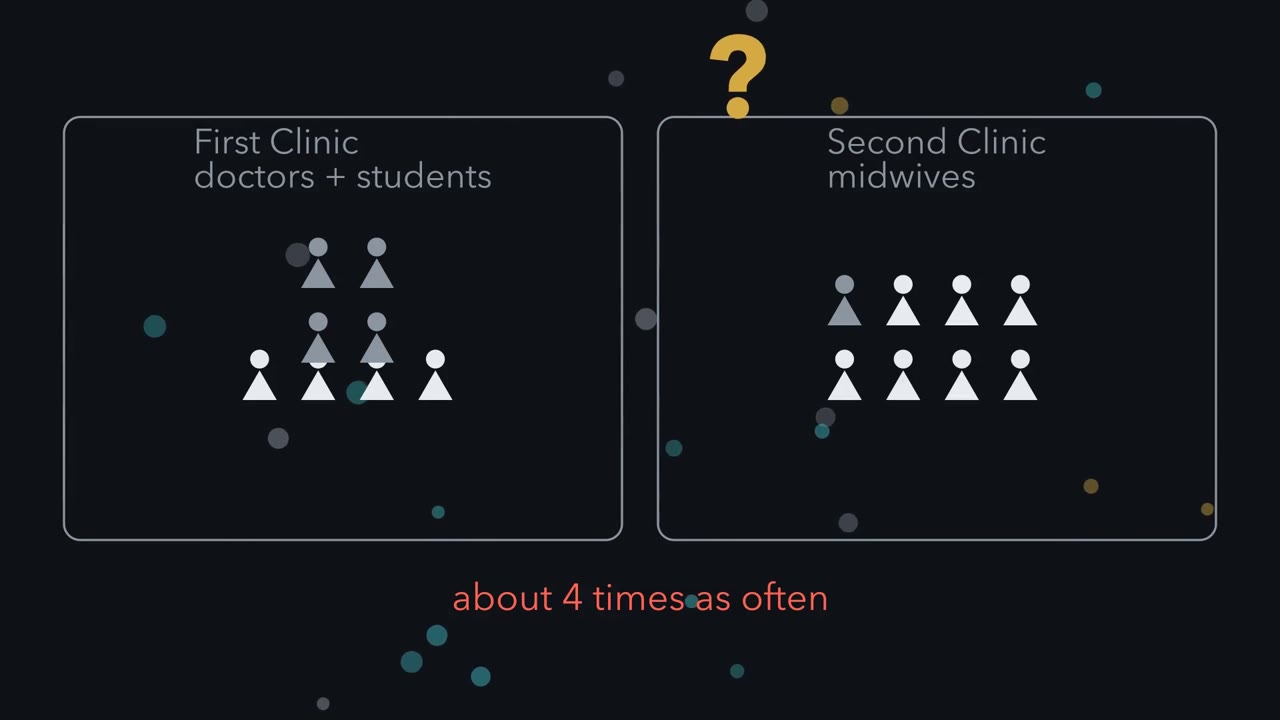
In 1846, mothers in one Vienna clinic died about four times as often as mothers in the clinic next door. What could the doctors have been carrying?
Pause when the reading reaches a film, and offer to play it. Saved on this device.
Watch the film now, or keep listening
Builds on:How Microbes MultiplyLiving or Not? Viruses and BacteriaThe Cell Cycle and MitosisWhy these?
Where this lesson sits
- Virginia SOL BIO.4e
- Practices BIO.1c, BIO.1d, BIO.1f
Essential question: How did we figure out that microbes cause disease, and how do vaccines and antibiotics work, and why don't they always succeed?
-
Life Science (grade 7)
Review it at grade 7 level
Virginia's grade 7 Life Science course does not cover germs, vaccines or antibiotics. It does teach that all living things are made of cells, that bacteria are living things made of a single cell, and that parasites are biotic factors, living parts of an ecosystem that affect other organisms. Many people know from everyday life that washing hands and cooking food help prevent illness. Biology adds the reason: many diseases are caused by microbes, and vaccines prepare the immune system against those microbes, while antibiotics act on bacteria directly.
-
Biology BIO.4e You are here
This lesson
-
Biology II Biology II: Advanced Survey of Biology Topics, BIOII.5 a and BIOII.7 c
Preview where it goes next
Virginia's Biology II courses follow this lesson in two directions. Under natural selection (BIOII.5 a), antibiotic resistance becomes the standard example of selection acting fast: bacteria divide often, so a resistant variant can take over a population in a short time. Resistance genes can also pass between bacteria, sometimes on small rings of DNA called plasmids, so a gene can spread to bacteria never exposed to the drug. Under human health (BIOII.7 c), one of several topics a teacher may choose, you may meet epidemiology, the study of how diseases spread through a population, and the cells of the immune system in more detail, including how B cells make antibodies and how some T cells kill infected cells while others help direct the response.
-
College
 ▶ Watch A Race Inside the Body · 3:21
Read the transcript of “A Race Inside the Body”
Film transcript: A Race Inside the Body
In 1846, mothers in one Vienna clinic died about four times as often as in the clinic next door. What could the doctors have been carrying? In the deadly clinic, doctors and students often handled bodies in autopsies. Then they examined mothers. Ignaz Semmelweis suspected the examiners' hands. In 1847 he had them wash in chlorine. You will test his records yourself in the lesson. But notice what he did not know. He could not name what was on those hands. Germ theory later gave the answer. Many diseases are caused by microbes, living things too small to see without a microscope. A microbe or virus that causes disease is called a pathogen. Many pathogens multiply once they get into the body.
One becomes two, two become four, and the doubling keeps going. Meanwhile the body builds a defense. Antibodies are proteins that stick to one small part of an antigen. That can block a microbe or its toxin. The first time the body meets a pathogen, building them often takes a week or more. So picture an infection as a race.
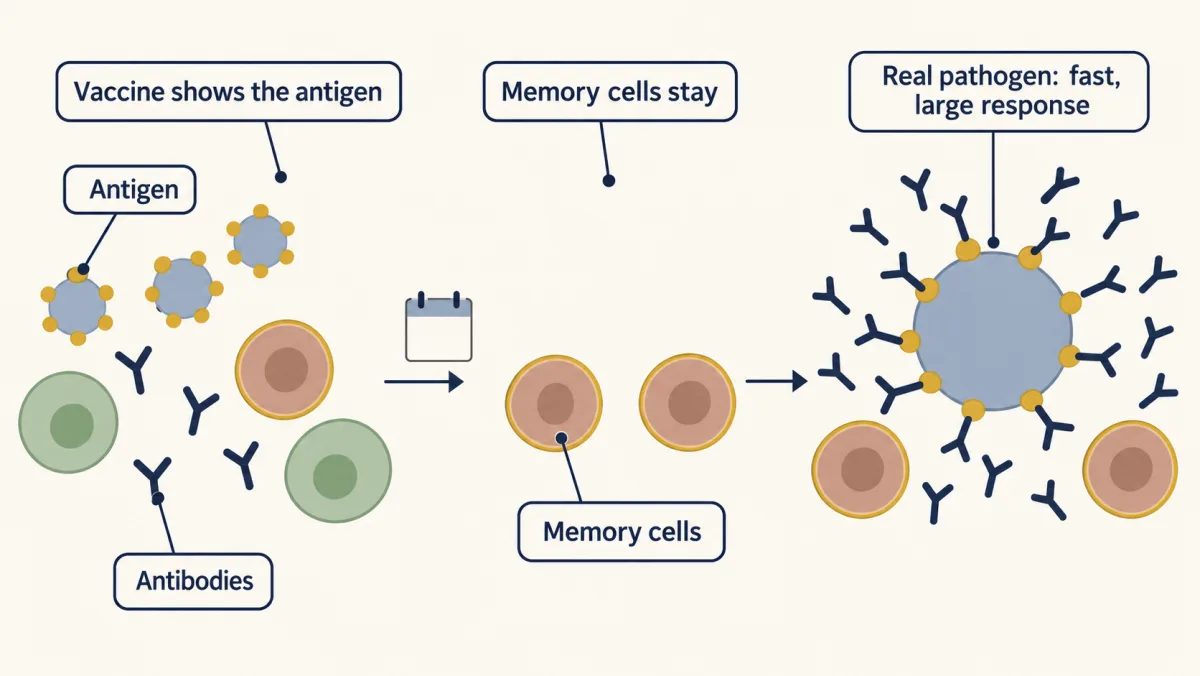
Microbes multiply, and defenses catch up. In this simple model, the microbes fall once the gold bar arrives. But by then they have climbed very high. In many infections, more microbes means a sicker person. There are two ways to get ahead. The first is to start the race with fewer microbes. Hand washing, clean water and sterile tools keep microbes out or leave fewer. Run the race again with a smaller start. The defense still arrives on the same day, but the peak is lower. The second way is to send the defense in early. A vaccine shows the immune system an antigen, or instructions to make one. The immune system learns to recognize a pathogen or its toxin without the full disease. During that first meeting, some immune cells become memory cells.
They stay in the body long after. Now the real pathogen arrives, carrying the same antigen. This is the body's second meeting. Will the gold defense arrive sooner or later than it did the first time? Sooner. Memory cells recognize the antigen quickly, and they lead to large amounts of antibody. The defense arrives days earlier. The microbes have had less time to double, so they never climb very high. Hygiene shrinks the start. A vaccine moves the defense earlier. They are two ways to win the same race. A smaller start or an earlier defense keeps the peak low.
From the film
- Germ theory says many diseases, the infectious ones, are caused by microbes that get into the body.
- Many infections are a race between microbes that multiply and the body's defenses that catch up.
- Hygiene, such as hand washing, keeps microbes out or shrinks the start of the race.
- A vaccine gives the immune system a first meeting without the disease, so memory cells bring the next defense days sooner.
- Days matter because a doubling population grows fast: a smaller start or an earlier defense keeps the peak low.
The first film left Semmelweis’s records for you to check. Childbed fever is a serious infection that can follow giving birth. In the 1840s, women at Vienna’s general hospital went to the First Clinic (doctors and medical students) or the Second (midwives) depending on the day of the week.
The one idea. Many infections are a race between microbes that multiply and defenses that catch up. Hygiene shrinks the start, a vaccine moves the defense earlier, and an antibiotic works only on bacteria that are sensitive to it, so resistant survivors can take over.
Scope: the race is a simple model of an infection by a microbe that multiplies in the body. It tracks how many microbes there are and when the defense arrives, not how sick a person feels. Most heart disease is not an infection at all. The race numbers below are made up; real times vary by microbe and by person.
Explain: germ theory, and the test in Vienna
- germ theory
- microbe
- pathogen
- sanitation
- aseptic technique
- pasteurization
- sterilization
- vaccine
- antigen
- memory cells
- antibiotic
- antibiotic resistance
The germ theory of disease says that many diseases are caused by microbes that get into the body. A microbe is a living thing too small to see without a microscope, such as a bacterium. A microbe or virus that causes disease is a pathogen. Germ theory explains infectious diseases, not every illness.
In mid-May 1847, Semmelweis had the First Clinic’s examiners wash their hands in chlorine. A death ratio is deaths divided by the number of women counted, times 100, so clinics of different sizes can be compared. The last three rows are single months, First Clinic only.
Predict. If the examiners’ hands carried the cause, which clinic’s ratio should fall once washing starts, and to about what level?
| Time | Clinic | Deaths | Women counted | Deaths per 100 women |
|---|---|---|---|---|
| 1841 | First | 237 | 3,036 | 7.81 |
| 1841 | Second | 86 | 2,442 | 3.52 |
| 1842 | First | 518 | 3,287 | 15.76 |
| 1842 | Second | 202 | 2,659 | 7.60 |
| 1846 | First | 459 | 4,010 | 11.45 |
| 1846 | Second | 105 | 3,754 | 2.80 |
| April 1847 | First | 57 | 312 | 18.27 |
| May 1847 (washing begins mid-month) | First | 36 | 294 | 12.24 |
| June 1847 | First | 6 | 268 | 2.24 |
Check your prediction
The First Clinic’s, toward the Second Clinic’s level of about 3 per 100. It fell from 18.27 in April to 2.24 in June. One month can mislead; in 1848, a full year of washing, the First Clinic recorded 45 deaths among 3,556 women, about 1.27 per 100.
- In every year shown before 1847, which clinic had the higher death ratio? Check the first film’s “about four times” against the 1846 rows.
Claim, evidence, reasoning
Make a claim about what the Vienna data show about examiners’ hands and childbed fever. Semmelweis did not know microbes were involved; he blamed matter from corpses carried on the hands.
Start with: The data show that blank.
Start with: Before washing, the First Clinic had blank deaths per 100 women in 1846, compared with blank in the Second Clinic. After washing began, the First Clinic fell to blank in June 1847.
Start with: This supports the idea that blank, because the main thing that changed was blank.
Compare with a model answer
The data show that something carried on the hands of the First Clinic’s examiners caused many deaths, and washing in chlorine removed it. In 1846 the First Clinic had 11.45 deaths per 100 women, about four times the Second Clinic’s 2.80. After washing began in mid-May 1847, the First Clinic fell to 2.24 in June, and in 1848, a full year of washing, it was about 1.27. Chlorine kills microbes, which fits germ theory. One limit: this was one hospital, women were not randomly assigned person by person, and other things may have changed in 1847. The records also counted women admitted, not a complete follow-up of each mother.
Saved in this browser only.
Later in the 1800s, Louis Pasteur, Robert Koch and others linked particular microbes to particular diseases, and germ theory gave a reason for practices that prevent or reduce exposure, destroy microbes, or prepare the body’s defenses before exposure:
- Sanitation: keeping places clean and removing sewage and waste, so pathogens do not reach water or food.
- Safe food and water: cooking, refrigeration and treating drinking water. Pasteurization heats a food such as milk for a set time to kill harmful bacteria.
- Aseptic technique: steps that keep microbes out of a wound or sterile area, such as clean hands, sterile gloves and sterile tools.
- Vaccination: preparing the immune system, the body’s set of defenses against pathogens, before a pathogen arrives (next section).
- Destroying microbes: disinfectants such as chlorine kill many microbes on surfaces, though some bacterial spores, tough resting forms of certain bacteria, survive. Sterilization removes all forms of microbial life from an object, often with high-pressure steam.
Explain: vaccines, a head start in the race
A vaccine teaches the immune system to recognize a pathogen without causing the full disease. It works through an antigen, a substance the immune system can recognize, often a protein on a pathogen’s surface. The response includes antibodies, proteins that stick to one antigen and help destroy or block it. Memory cells, left from a first meeting, carry receptors that fit one antigen. Later, memory B cells recognize the antigen quickly, multiply, and turn into cells that make large amounts of antibody.
| Kind of vaccine | What is in it | Example |
|---|---|---|
| Live weakened | A weakened form of the virus or bacterium | MMR (measles, mumps, rubella) |
| Killed (inactivated) | Whole microbes killed by heat or chemicals | Polio shot (IPV), hepatitis A |
| Toxoid | A bacterial toxin, a poison some bacteria make, made harmless | Tetanus, diphtheria |
| Subunit | One piece, such as a protein or sugar | Hepatitis B (a protein); some pneumonia vaccines (sugars, some joined to a protein) |
| mRNA | Instructions your cells use to make one viral protein | COVID-19 mRNA vaccines |
What is a few days’ head start worth? In this made-up model, the microbes double every 12 hours (twice a day), starting from 1, until the defense arrives.
| The defense arrives on day | Doublings before then | Microbes at the peak |
|---|---|---|
| 7 (a first meeting) | 14 | about 16,000 |
| 3 (memory cells ready) | 6 | 64 |
Four days earlier means eight fewer doublings, and 2 multiplied by itself eight times is 256: a peak 256 times smaller. This model counts microbes, not symptoms: in many infections fewer microbes means a milder illness, but severity also depends on the microbe and the person.
Predict. Suppose unwashed hands pass on 100 microbes and washed hands pass on 1. About how many doublings is that 100-fold difference worth, and how many days at two doublings a day?
Check your prediction
About 6½ doublings, because 2 multiplied by itself 6 or 7 times gives 64 or 128. At two a day that is about 3 days, so in this model a 100-fold smaller start does the same as a defense arriving about 3 days earlier.
Memory is not the only head start. Some antibody-making cells live for years and keep making antibody, so a vaccinated person often has antibody waiting to block a microbe before it multiplies. Even so, a small share of vaccinated people still get measles.
Explore: run the race
The resistance panel gives an antibiotic, a drug that kills bacteria or stops them dividing, to a population with a few resistant cells, ones the drug does not kill.
Everything below is “in this sketch”: relative units, not to scale, and a model of the logic. It is not medical advice.
1. Antibody level after exposures
No exposure yet. Choose “No vaccine” or “Vaccine given”, then press Expose to pathogen.
2. Bacteria under an antibiotic course
Press Stop early or Run the full course to treat the population. The cells start with a few resistant ones.
Assumptions in this sketch: 40 cells; each starts resistant with a 5 in 100 chance (samples with no resistant cell are redrawn); each round kills a sensitive cell with a 65 in 100 chance and never kills a resistant cell; a full course is 6 rounds, stopping early is 2 rounds; no cell changes kind; survivors divide once. Panel 1: a first meeting peaks at 30 after 14, a later meeting at 100 after 5, in relative units; the curve shape is drawn, not measured.
Rule to keep: the first meeting with an antigen gives a slow response and leaves memory cells, so a later meeting is faster and larger; an antibiotic kills the sensitive bacteria it reaches, and the resistant ones are left to multiply (vaccines do not work perfectly in everyone, and how long a course should last is decided by doctors).
Try this.
- With “No vaccine”, press “Expose to pathogen” twice. Compare how fast and how high the antibody rises each time.
- Switch to “Vaccine given” and expose once. Which of your earlier two exposures does this one look like?
- Press “Stop early”. Predict which kind of cell is left, then let the survivors multiply.
- Reset and run the full course. Predict whether every cell is gone, then check which cells are left.
In the simulation, the antibiotic left some cells standing. The second film shows why.
Read the transcript of “The Few That Survive”
Film transcript: The Few That Survive
The first film raced microbes against the body's own defenses, but an antibiotic attacks the microbes directly. If it kills almost every bacterium, how can the infection come back? To answer that, start with what the drug needs. An antibiotic is a drug that kills bacteria or stops them growing and dividing. To work, it needs something to hit. Many antibiotics block the building of the bacterial cell wall. Others jam bacterial ribosomes, so the cell cannot make proteins. Now look at a virus. It has no cell wall and no ribosomes of its own. It works inside one of your cells and uses that cell's ribosomes. These drugs find no bacterial part there to hit.
So antibiotics do not treat colds or flu. Back to bacteria, now a large population of them in an infection. Most are sensitive, which means the drug kills or stops them. But a few may already carry a gene that lets them survive the drug. These are resistant. Antibiotic resistance is the ability of some bacteria to survive a drug that kills others of their kind.
Start the drug. Here it kills the sensitive cells. Round after round, the teal cells disappear. The orange ones survive, because they resist the drug. Now every teal cell is gone. Only the few orange cells remain, with empty space around them. When this population grows back, what will it be made of?
Resistant cells. With their competition gone, the orange cells divide and fill the space. The drug did not create them. In this example, they were there before the drug. It removed their competition. This is natural selection: individuals with a helpful trait survive and reproduce more. Here the trait is resistance, and the drug did the selecting. The bacteria did not choose to change. And the person did not become resistant. The bacteria did. There is one more route. A resistant bacterium can pass a resistance gene to another bacterium. That neighbour now survives the drug too. So resistance can spread to bacteria that never met the drug. Killing almost every bacterium is not a cure if resistant survivors grow back.
Using an antibiotic can favor any resistant bacteria present. An antibiotic spares resistant bacteria, and the survivors can take over.
From the film
- An antibiotic kills bacteria or stops them dividing by hitting parts bacteria have, such as the cell wall or bacterial ribosomes.
- A virus has no cell wall or ribosomes of its own, so antibiotics do not treat colds or flu.
- In a large population, a few bacteria may already carry a gene that lets them survive a drug.
- The drug kills the sensitive bacteria and the resistant survivors can multiply and take over: natural selection, with no choice by the bacteria.
- Resistance belongs to the bacteria, not the person, and resistance genes can pass between bacteria.
What the second film left out
The second film showed what an antibiotic hits in bacteria. Why does it spare you? Your cells have no cell wall. Their ribosomes, the machines that make proteins, differ enough that these drugs mostly leave them alone. (Why a virus has no target of its own is in Living or Not?.)
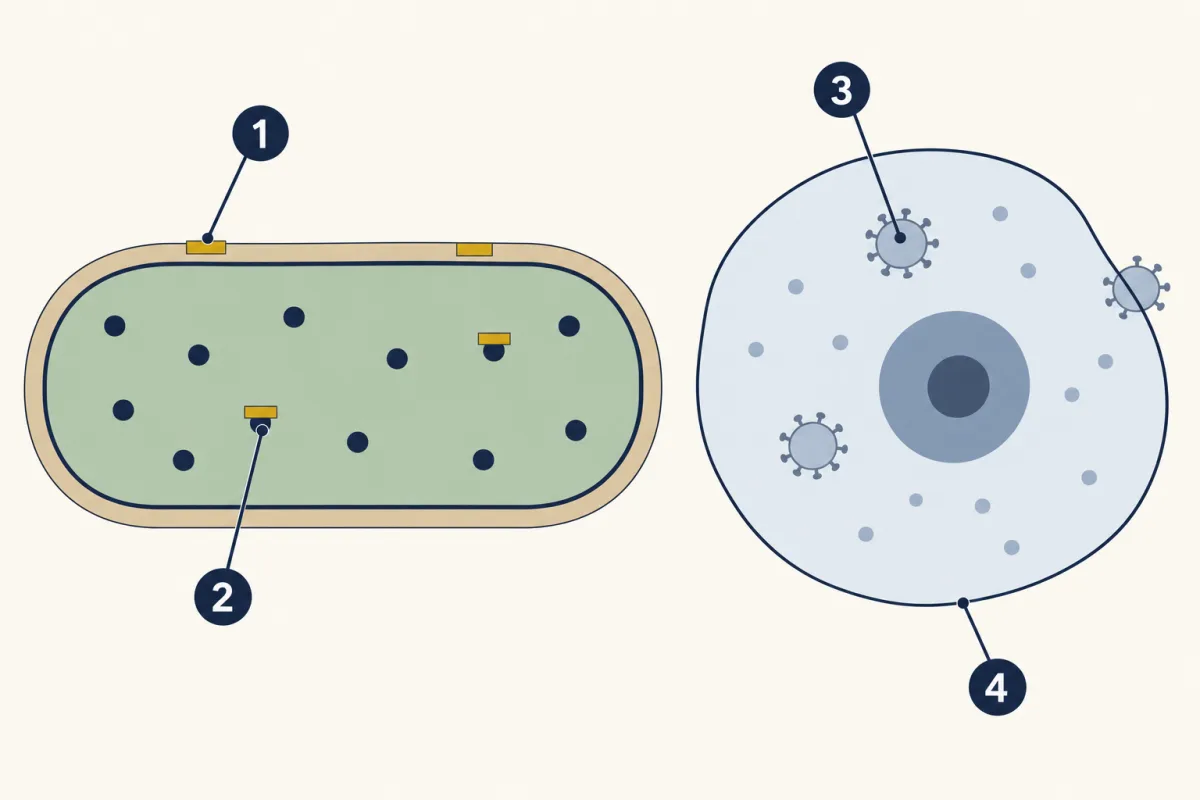
- cell wall
- bacterial ribosomes
- virus
- your cells
- cell wall
- blank
- virus
- blank
Word bank: bacterial ribosomes, your cells
- blank
- blank
- blank
- blank
Check your labels
- cell wall
- bacterial ribosomes
- virus
- your cells
Antibiotic resistance, surviving a drug that kills others of their kind, belongs to the bacteria, not the person. How do bacteria resist? A resistant bacterium often still has the drug’s target. The CDC lists four ways: letting less drug in, pumping it out, breaking it down, or changing or bypassing the target.
Predict. A drug kills every sensitive bacterium in an infection of 10 billion (10¹⁰), and 1 in 100 million (10⁸) is resistant. How many survive, and about how many doublings would they need to grow back to 10 billion?
Check your prediction
10¹⁰ ÷ 10⁸ = 100 survivors. Every 10 doublings multiply a number by about 1,000 (2 multiplied by itself 10 times is 1,024), so about 27 doublings bring 100 back to 10 billion. With 1 in a million resistant, 10,000 survive and need only about 20. Killing 99.9999 percent is no cure if resistant survivors grow back and nothing else clears them.
In the film the resistant cells were there first; resistance can also arise as a new DNA change or pass as a gene from another bacterium. Either way, the drug favors the survivors: natural selection (Variation and Survival).
Health agencies say misuse of antibiotics, such as using them for a cold, can add to resistance. The drug does nothing to the virus, but it still kills harmless sensitive bacteria in your body. That leaves room for resistant ones. Doctors decide how long a course should last; for some infections, studies have found that shorter courses work as well as longer ones. Take an antibiotic as your doctor says; the simulation’s “stop early” switch is a model of selection, not medical advice.
Elaborate: from two clinics to a nation
| Year | Reported U.S. measles cases |
|---|---|
| 1962 | 481,530 |
| 1968 | 22,231 |
| 2000 | 85 |
These are reported cases from the CDC’s historical measles dataset; a vaccine became available in 1963. Before then, the CDC estimates, 3 to 4 million people in the United States were infected each year, though only about 500,000 cases a year were reported. Measles was declared eliminated in 2000, meaning no continuous spread inside the country for at least 12 months, not zero cases. Cases have risen again as vaccine coverage fell (Going deeper has the recent counts).
- Reported measles cases fell from 1962 to 1968. Why might the true number of infections be higher than any number in the table?
Design problem
A company has a new vaccine against a made-up disease that spreads in schools. Plan a fair test of whether it reduces cases, and predict the result that would show it works. Name your groups, what you keep the same, what you count, how many people you need, and how you protect the volunteers.
Saved in this browser only.
One way to do it
- Groups and independent variable: chance assigns volunteers to the vaccine or a look-alike placebo shot, which tends to make the groups alike in age, health and habits.
- Dependent variable: the number of confirmed cases in each group, defined before the trial starts (for example, symptoms plus a positive lab test).
- Constants: same dose schedule, follow-up time and illness checks in both groups.
- Blinding: neither volunteers nor the people judging illness know who got which shot, so expectations do not change the count.
- Sample size: thousands of volunteers, because a small trial may see too few cases of an uncommon disease to tell the groups apart.
- Ethics and safety: informed consent, and anyone can leave at any time; for children, a parent gives permission and the child also agrees. An independent group watches for side effects and can stop the trial. Results are reported either way.
- What would mean what: far fewer cases in the vaccine group supports the vaccine; similar numbers mean no clear effect.
Evaluate: check your thinking
Hygiene shrinks the start, a vaccine moves the defense earlier, and an antibiotic works only on sensitive bacteria. In Vienna, chlorine washing shrank the start, and deaths fell sharply.
What do you think? Decide before you read.
-
Scientists disagree: Most vaccines contain no living microbe that can cause disease. Killed, toxin-based, protein and mRNA vaccines cannot multiply and cause the infection. Live weakened vaccines, such as MMR, are the exception to watch: in healthy people they usually cause no illness or only a mild one, but they can cause serious infection in some people whose immune systems are weak.
What scientists think
Scientists disagree: Most vaccines contain no living microbe that can cause disease. Killed, toxin-based, protein and mRNA vaccines cannot multiply and cause the infection. Live weakened vaccines, such as MMR, are the exception to watch: in healthy people they usually cause no illness or only a mild one, but they can cause serious infection in some people whose immune systems are weak.
-
Scientists disagree: An antibiotic hits a part that bacteria have, such as the cell wall or bacterial ribosomes. Each one works only on bacteria that are sensitive to it. Viruses have no cell wall and no ribosomes of their own, so health agencies such as the CDC note that antibiotics do not treat colds or flu.
What scientists think
Scientists disagree: An antibiotic hits a part that bacteria have, such as the cell wall or bacterial ribosomes. Each one works only on bacteria that are sensitive to it. Viruses have no cell wall and no ribosomes of their own, so health agencies such as the CDC note that antibiotics do not treat colds or flu.
-
Scientists disagree: Every vaccine prepares the immune system to recognize a pathogen, but the material differs. Some contain weakened microbes, some killed ones, some an inactivated toxin, some a single protein or sugar, and some mRNA instructions that let your cells make one protein from the virus.
What scientists think
Scientists disagree: Every vaccine prepares the immune system to recognize a pathogen, but the material differs. Some contain weakened microbes, some killed ones, some an inactivated toxin, some a single protein or sugar, and some mRNA instructions that let your cells make one protein from the virus.
Science practices you used: making predictions and testing them in a model, reading data tables and calculating ratios, comparing groups fairly, planning a blinded trial with a control group, and naming the limits of historical data.
Going deeper
Where the Vienna numbers come from
Counts for 1841, 1842 and 1846 are from Semmelweis’s 1861 book (English translated excerpt, Table 1); the April and May 1847 counts are in Semmelweis’s book, and the June count is from Broemeling’s tabulation of his records (Broemeling prints 2.38 per 100 for June, but 6 ÷ 268 is 2.24). The last column was calculated here as deaths ÷ women counted × 100. Single months varied: Semmelweis’s monthly table shows the First Clinic at about 2 to 5 per 100 from December 1846 to March 1847, before the April rise, so the full year 1848 is a fairer after-washing comparison than any one month.
Where the race model stops
Real infections are messier: some harm comes from a toxin or from the immune response itself, some infections last for years, and clearing one takes more than antibody (Adaptive Immunity). Antibody already in the blood can stop some microbes before any race begins.
Some habits came before the theory
Edward Jenner’s smallpox vaccine (1796) and many sanitation reforms came before germ theory, as did Semmelweis’s washing. Germ theory explained why they worked and led to new practices, such as vaccines made in the laboratory.
Measles since elimination
As of late October 2026, the same CDC dataset lists 2,289 cases in 2025 and 4,852 in 2026, as MMR coverage among kindergartners fell below the 95 percent target. These counts will change as the year goes on.
Your notes
Select any text in the lesson to highlight it or add a note to it. Your highlights and notes are saved in this browser and collected in your notebook.
This browser is not letting the site save anything (a private window or strict privacy settings), so highlights and notes will be lost when you leave the page.
How we measure it
Comparing death ratios from hospital records
Deaths are divided by the number of patients counted in the same place and time, then multiplied by 100. Comparing ratios, not raw counts, lets you compare clinics or years with different numbers of patients.
Randomized placebo-controlled trial
Volunteers are assigned by chance to a vaccine or a look-alike shot with no vaccine, and the people judging the outcome do not know who got which. Counting a defined disease outcome in both groups shows whether the vaccine made a difference.
Public-health case surveillance
Doctors and laboratories report confirmed cases of certain diseases to state and local health departments, which pass them to national agencies. Yearly counts show whether a disease is rising or falling over time.
Where this lesson fits
Before thisReview first
- How Microbes MultiplyThis course · Lesson 13
The race model uses doubling bacteria and viruses that multiply only inside cells, which that lesson explains.
- Living or Not? Viruses and BacteriaThis course · Lesson 12
You need to know a virus has no cell wall or ribosomes to see why antibiotics miss it.
- The Cell Cycle and MitosisThis course · Lesson 10
Bacteria doubling and memory cells multiplying rest on cells dividing into copies.
After thisStudy next
- Natural Selection and New SpeciesThis course · Lesson 28
Resistant bacteria taking over is natural selection acting on existing variation, taken further here.
- Variation and SurvivalThis course · Lesson 27
Resistant survivors spreading is selection on variation that was already there before the drug.
- Adaptive ImmunityOne level up · Organismal Biology
This takes the idea further: how memory B and T cells give the faster second response.
Elsewhere on the siteFilms, simulations and method films in other courses
- Beetles and new coloursSimulation · Life Science
A chance mutation can give a few bacteria a trait that later lets them survive a drug.
- Who Makes It Through the Change?Film · Life Science
After an environmental change only members with a helpful trait survive and reproduce, as resistant bacteria do under a drug.
Suggested by an AI model from the lessons themselves, then checked. How we use AI
Finish line
Test yourself
8 questions
Practice and MCAT-style, with explained answers.
Next · Lesson 16
DNA: Structure and Copying
If you kept only one strand of a DNA molecule and threw the other away, could you rebuild the whole thing, letter for letter?
Continue →