Biology · Unit 4: DNA and inheritance
DNA: Structure and Copying
Rewritten on : new text, flashcards and film. Your notes and highlights stay, but the text around them may have moved.
If you kept only one strand of a DNA molecule and threw the other away, could you rebuild the whole thing, letter for letter?
Pause when the reading reaches a film, and offer to play it. Saved on this device.
Watch the film now, or keep listening
Builds on:What Am I Made Of?Enzymes at WorkWhy these?
Where this lesson sits
- Virginia SOL BIO.5a
- Practices BIO.1c, BIO.1d, BIO.1e, BIO.1f
Essential question: How does the structure of DNA let it store information and copy itself almost perfectly?
-
Life Science (grade 7) LS.10 a
Review it at grade 7 level
In Life Science you learned that DNA is shaped like a twisted ladder called a double helix. The sides of the ladder are made of sugar and phosphate, and they are the same in all living things. The rungs are pairs of bases, written A, T, C and G. The order of the bases forms a code for making proteins, and a gene is a section of a chromosome that carries the code for a protein or for an RNA with a job of its own. Chromosomes are strands of tightly wound DNA. Biology adds how the cell copies DNA before it divides, and why copying is so accurate.
-
Biology BIO.5a You are here
This lesson
-
Biology II Biology II: Genetics, GEN.2 a
Preview where it goes next
The Biology II Genetics course names the ends of each strand: one is the 5′ end and the other the 3′ end, and the two strands are antiparallel. DNA polymerase can only add a nucleotide to the 3′ end of a growing strand, so new DNA always grows 5′ to 3′. Helicase unwinds the helix at the replication fork, and an RNA primer gives polymerase a starting end. One new strand, the leading strand, grows smoothly toward the fork. The other, the lagging strand, is made in short Okazaki fragments that DNA ligase seals together. Replication is called semiconservative because each daughter molecule keeps one parent strand. The course also asks how a system this accurate still leaves room for the rare changes that evolution acts on.
-
College
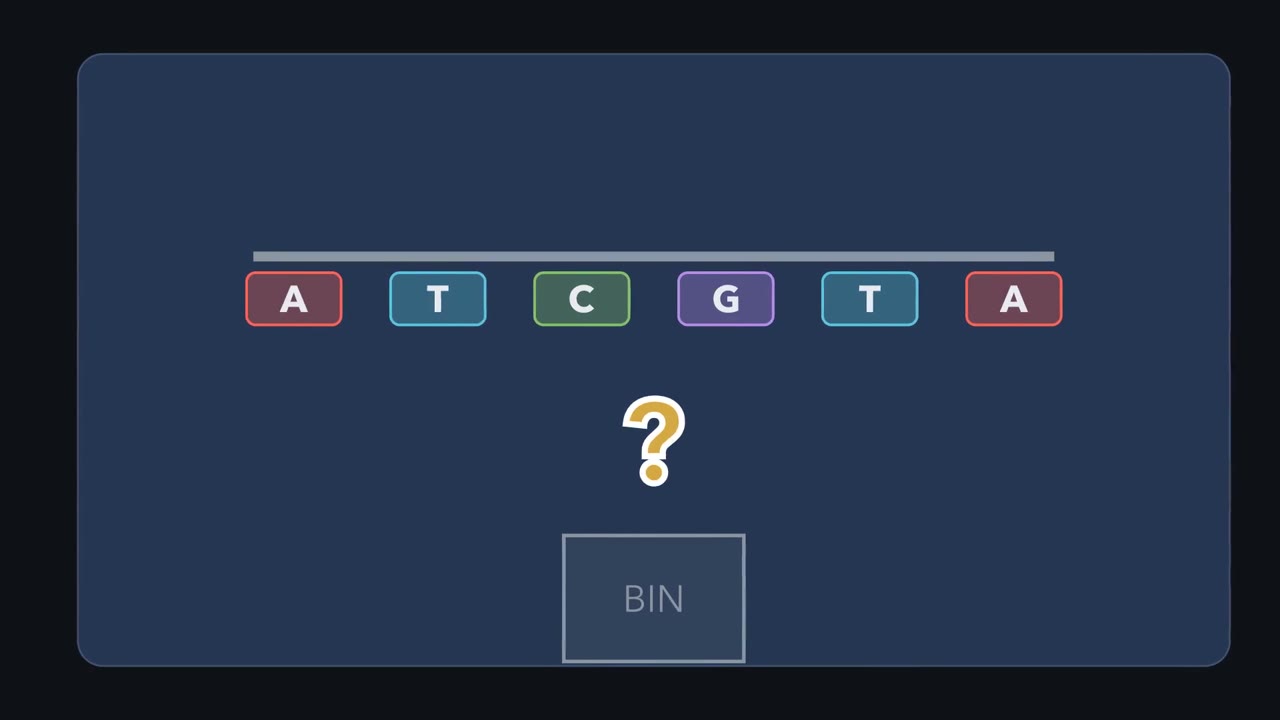 ▶ Watch One Strand Is Enough · 3:06
Read the transcript of “One Strand Is Enough”
Film transcript: One Strand Is Enough
Suppose I tore a DNA molecule down the middle and threw one half away. Could you rebuild the half I threw away, letter for letter? By the end of this film, you can. Start with one building block, a nucleotide. It has three parts: a sugar called deoxyribose, a phosphate group, and a base. The base carries the information.
DNA uses four bases: adenine, thymine, cytosine and guanine. We write them A, T, C and G. Nucleotides join into a chain called a strand. The sugar of one nucleotide bonds to the phosphate of the next. That is a covalent bond, a strong bond in which atoms share electrons. The bases stick out to one side. Now a second strand lines up, bases facing bases. Weak attractions called hydrogen bonds hold each facing pair together. But only two kinds of pair fit well. A fits with T. C fits with G. Watch what happens when A meets C. Their edges do not match, so they fit badly. That is the base-pairing rule. A always pairs with T, and C always pairs with G.
Notice the two arrowheads. Each strand has a direction, and the two strands point opposite ways. Finally the ladder twists along its length into a double helix. The backbones are the sides, and the base pairs are the rungs. Here is one strand on its own. It reads G, A, T, T, C, A. Before I fill in its partner, write the partner strand yourself.
Across from G goes C. Across from A goes T. So the partner reads C, T, A, A, G, T. Not one letter was a choice. One strand fixed every letter of the other. So here is how a cell copies DNA. Enzymes unzip the helix, and each old strand becomes a template. A template is a pattern that sets the order of a new strand. New nucleotides line up on each template, each one matching the base it faces. When copying ends, there are two molecules. Each has one old grey strand and one new gold strand. Both carry the same base order as the original. So pairing tells the cell what goes where. Because A pairs only with T, and C only with G, each strand fixes its partner.
Pairing does not yet explain how the cell gets almost every letter right.
From the film
- DNA is two strands of nucleotides, each a sugar, a phosphate and one of four bases: A, T, C or G.
- Covalent bonds join each strand's backbone; weak hydrogen bonds hold A to T and C to G across the strands.
- The two strands point opposite ways, like two arrows side by side.
- Because A pairs only with T and C only with G, each strand sets the base order of its partner.
- Copying unzips the helix and builds a new partner on each old strand, giving two molecules with the same base order, each one old strand and one new.
A typical human cell with a nucleus holds about 2 metres of DNA, packed into a nucleus only about 0.005 to 0.010 millimetres across. Before a typical cell divides, it copies roughly 6 billion base pairs of that DNA and gets almost every one right. Two metres is taller than most adults, yet the nucleus is too small to see without a microscope. It fits because the molecule is extremely thin and wound tightly around proteins. Watch the first film at the top of the page, then read on for what it leaves open: who does the copying, how a cell copies a molecule it never opens all at once, and what stops the copy slipping.
The one idea. Because A pairs only with T and C only with G, each strand fixes the base order of its partner. So when the helix is unzipped and each old strand is used as a template, a pattern for a new partner, the cell gets two copies with the same base order, each made of one old strand and one new one. Pairing makes the copy possible. Checking makes it accurate.
Scope: double-stranded DNA in cells. “Only” names the pairs that fit; a wrong base occasionally slips in while copying. Pairing sets which base sits opposite which, not how much of each pair a species has. On its own, it does not make copying nearly perfect: the copying enzyme’s checks and separate repair enzymes bring errors down to about one in a billion bases copied.
What do you think? Decide before you read.
-
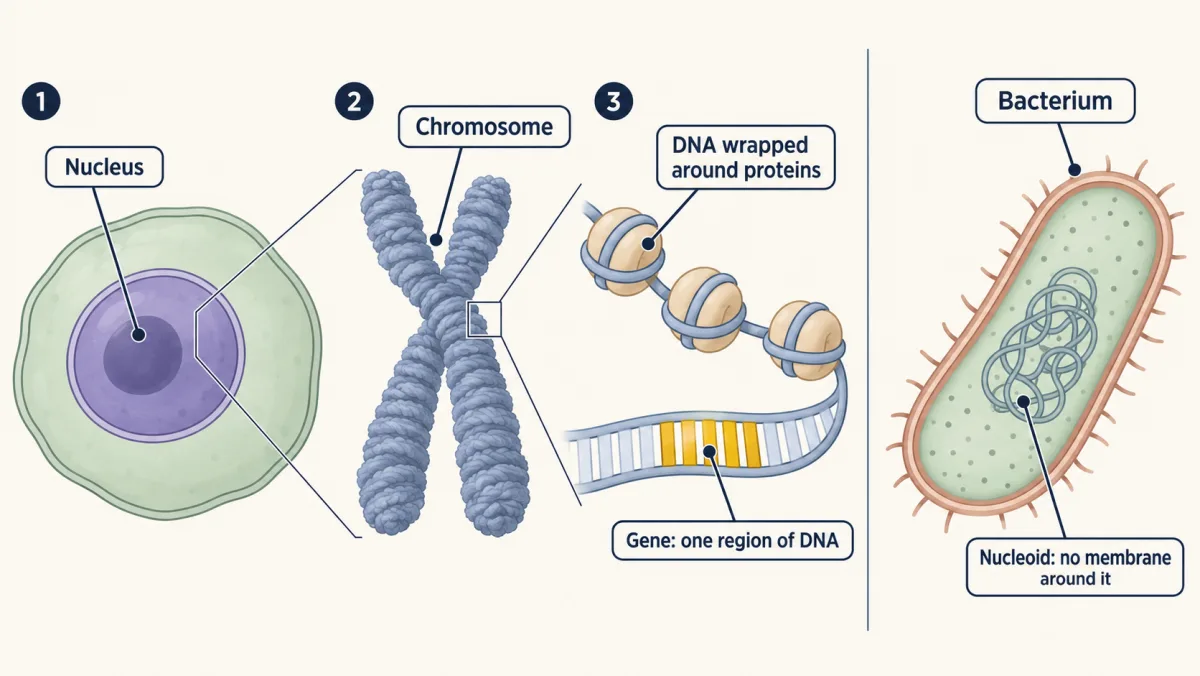
Scientists disagree: Bacteria have DNA too. In a bacterium such as E. coli, the DNA sits in a region called the nucleoid, with no membrane around it. Microscopes and chemical tests find DNA in every kind of cell that grows and divides. A few specialized cells, such as mature human red blood cells, lose their nucleus as they mature.
What scientists think
Scientists disagree: Bacteria have DNA too. In a bacterium such as E. coli, the DNA sits in a region called the nucleoid, with no membrane around it. Microscopes and chemical tests find DNA in every kind of cell that grows and divides. A few specialized cells, such as mature human red blood cells, lose their nucleus as they mature.
-
Scientists disagree: A chromosome is one very long DNA molecule wrapped with proteins. A gene is one region along that DNA. Scientists who read the order of bases along human chromosomes find that each chromosome carries many genes, often hundreds or more, with other DNA between them.
What scientists think
Scientists disagree: A chromosome is one very long DNA molecule wrapped with proteins. A gene is one region along that DNA. Scientists who read the order of bases along human chromosomes find that each chromosome carries many genes, often hundreds or more, with other DNA between them.
-
Scientists disagree: When scientists read the whole human genome (all of a person’s DNA), only about 1 to 2 percent of it turned out to code for proteins. Some of the rest controls when and where genes are switched on. Some codes for RNA molecules that do jobs of their own. For much of it, nobody knows whether it has a job at all.
What scientists think
Scientists disagree: When scientists read the whole human genome (all of a person’s DNA), only about 1 to 2 percent of it turned out to code for proteins. Some of the rest controls when and where genes are switched on. Some codes for RNA molecules that do jobs of their own. For much of it, nobody knows whether it has a job at all.
Explore: unzip and copy a DNA molecule
In the simulation, DNA is two rows of labelled blocks, one per base. Unzip it, drop matching nucleotides onto each open strand, and slip in a wrong base with the “mistake” button.
Solid block = old strand. Outlined block = new strand. Short line = a base pair. ✕ = a mismatch.
In this sketch: 6 base pairs stand in for the roughly 6 billion a cell copies. Flat blocks stand for the twisted double helix. Real DNA strands run in opposite directions and one new strand is built in short pieces; here both are filled in left to right to keep the sketch simple. Proofread always removes a wrong base.
Rule to keep: A pairs with T and C pairs with G, so each old strand sets the order of its new partner. The copy is two identical molecules, each with one old strand and one new strand. In a cell, proofreading removes most wrong bases, and a textbook estimate is about one uncorrected mistake for every billion bases copied.
Try this.
- Predict: if you copy the piece, then copy both new molecules again (a second round), how many molecules will you have, and how many will still contain an original strand? Copy once, then check your reasoning.
- On one open strand, predict the partner of each block before you drop it in.
- Press the mistake button. Predict whether the finished molecules will still match, then watch what happens to the mismatch.
- If the mistake stayed in, predict which base of the finished molecules will differ from the original, then check every pair.
Check your two-round prediction
Four molecules, and exactly two still contain an original strand. Each round keeps every old strand whole and gives it a new partner, so the two originals end up in two molecules, however many rounds follow.
Explain: a twisted ladder of four bases
- nucleotide
- base
- double helix
- covalent bond
- hydrogen bond
- base pairing
- gene
- chromosome
- replication
- template
- enzyme
- nucleoid
The first film’s parts, as definitions: DNA is a polymer, a long chain of repeating units called nucleotides. Each is a sugar called deoxyribose, a phosphate group and a base, the part that carries information: adenine (A), thymine (T), cytosine (C) or guanine (G). Nucleotides are named by their base, so you will hear about “an A” or “a G.” A covalent bond, a strong bond in which atoms share electrons, joins each sugar to the next phosphate along a strand. A hydrogen bond is a weak attraction between molecules or parts of molecules; hydrogen bonds hold each facing pair of bases together across the strands. A double helix is a ladder twisted along its length, and base pairing is the rule that A always pairs with T and C always pairs with G.
Picture a zipper whose teeth only close with the right partner. The analogy breaks in two places: a zipper’s teeth carry no message, while the order of DNA’s bases does, and a wrong base can occasionally slip in.
Why a strand has a direction. The first film drew strands as arrows without saying why. Along a strand, every nucleotide is bonded to the next the same way round, so the backbone has a direction. The arrowhead marks the end where the last sugar is free to bond to another nucleotide. In a double helix, the two arrows point opposite ways.
Predict. To copy DNA, a cell must pull the two strands apart. Which bonds should break: the covalent bonds along each backbone, or the hydrogen bonds across the rungs? Why does the answer matter for copying?
Check your prediction
The weak hydrogen bonds across the rungs break, and the covalent backbones stay whole. So each old strand comes away unbroken, its base order intact, ready to serve as a template.
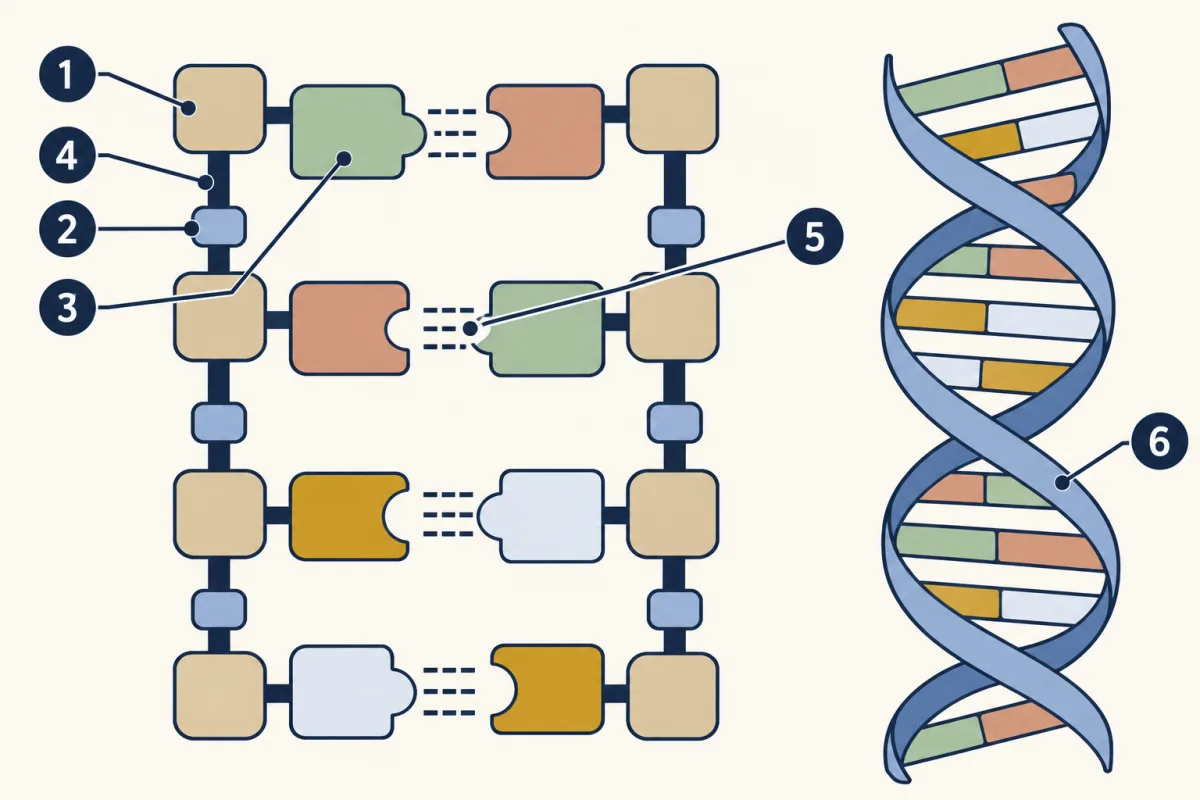
- sugar
- phosphate
- base
- covalent bond
- hydrogen bond
- double helix
- sugar
- blank
- blank
- blank
- blank
- double helix
Word bank: base, covalent bond, hydrogen bond, phosphate
- blank
- blank
- blank
- blank
- blank
- blank
Check your labels
- sugar
- phosphate
- base
- covalent bond
- hydrogen bond
- double helix
The order of the bases is the information. A gene is a region of DNA whose base order codes for a protein or for an RNA molecule that does a job of its own. A chromosome is one very long DNA molecule wrapped around proteins, and it carries many genes. Only about 1 to 2 percent of human DNA codes for proteins. Other stretches control genes or help hold chromosomes in shape. For much of the rest, scientists still debate whether it has any job. From DNA to protein shows how the code is read.
Every cell that grows and divides carries DNA. In plants, animals and fungi most of it sits inside the nucleus, with small extra pieces in organelles such as mitochondria. Bacteria keep their DNA in a nucleoid, a region of the cell with no membrane around it.
Explain: copying DNA one strand at a time
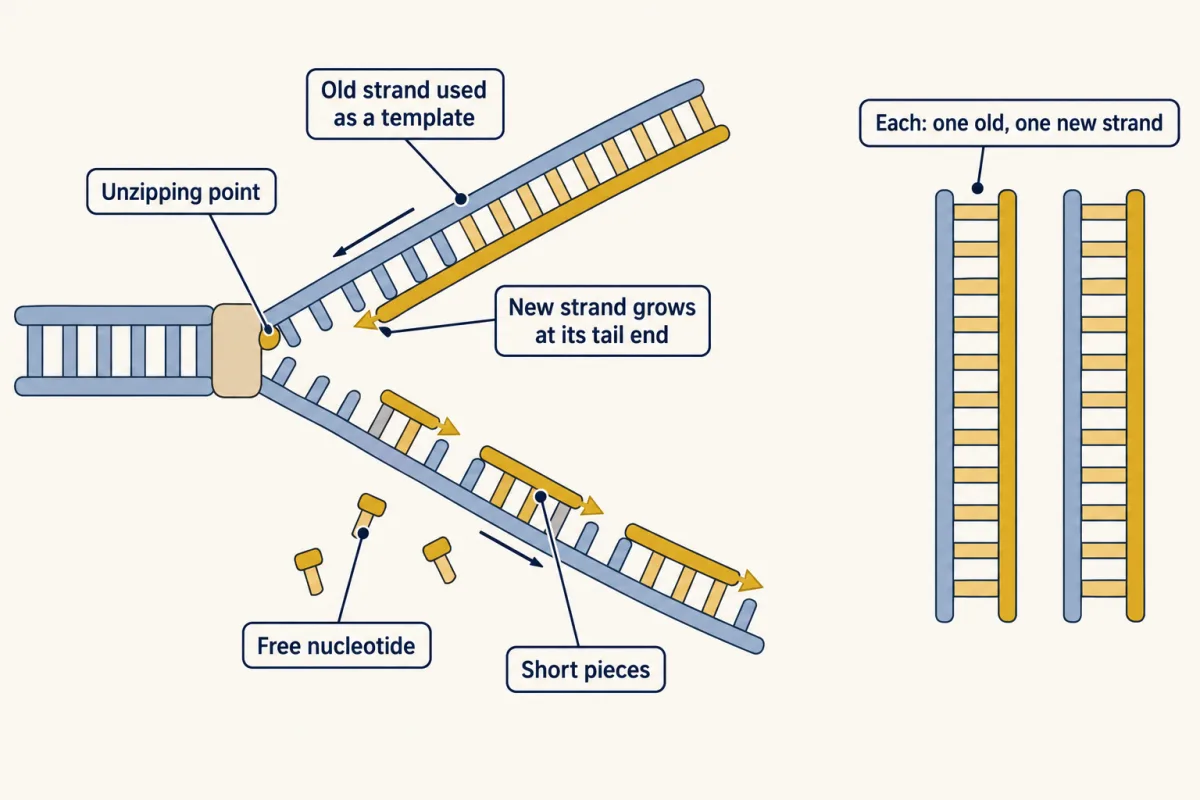
Replication is the copying of a DNA molecule before a cell divides. The first film showed each old strand becoming a template, a pattern that sets the order of a new strand. It did not show who does the work: enzymes. An enzyme is a molecule, usually a protein, that speeds up a chemical reaction without being used up. One enzyme unzips the helix, breaking only the hydrogen bonds. Free nucleotides float nearby in the cell. Another enzyme, DNA polymerase, picks the free nucleotide that pairs with each template base, so a wrong one almost never gets in. It joins that nucleotide to the new strand with a covalent bond.
A real cell never opens the whole molecule at once, as the first film did. It opens a moving Y called a fork, and the fork’s two templates point opposite ways. Can polymerase build both new strands the same way? The second film asks.
Read the transcript of “Inside the Fork”
Film transcript: Inside the Fork
In the first film, each old strand fixed its new partner. But how does a cell actually build those two new strands, one letter at a time? A real cell does not open the whole molecule at once. It opens the DNA at a moving Y, called the fork. The fork moves along, opening fresh template as it goes. Both old strands carry arrowheads, and they point opposite ways. The enzyme that builds new DNA is DNA polymerase. At each base, it picks the nucleotide that pairs with it. A wrong one almost never gets in. Then it joins that nucleotide to the growing strand with a covalent bond. Polymerase has one strict habit. It adds nucleotides only at the arrowhead end of a new strand.
So every new strand grows arrowhead first, pointing the opposite way to its template. On the upper template, the new strand's arrowhead points the way the fork moves. So polymerase simply follows the fork, adding nucleotide after nucleotide in one long run. Now look at the lower template. Its new strand must point the other way, back away from the fork. If polymerase only adds at the arrowhead, how can it copy this strand?
It builds in short pieces, because the fork opens only a little template at a time. Each piece starts near the fork and grows away from it. When the fork opens more template, a fresh piece starts near the fork and grows back toward the last one. Another enzyme joins the pieces into one strand. Now zoom in on one step, because copying must also be accurate. Polymerase tests each incoming nucleotide against the template. A nucleotide that does not pair is usually turned away. Sometimes a wrong base slips in anyway. Polymerase checks each new base and removes most wrong ones. This step is called proofreading.
Repair enzymes then catch many of the mistakes that slip past. Put the checks together: the matching check, proofreading, then repair. Each later check catches many mistakes the earlier ones missed. A textbook estimate is about one uncorrected mistake for every billion bases copied. So copying has two jobs. Pairing makes the copy possible, because it tells polymerase which base goes where. Checking makes the copy accurate, because it removes almost every slip.
From the film
- DNA polymerase adds nucleotides only at the arrowhead end of a new strand, so each new strand points opposite to its template.
- The fork opens only a little template at a time, so one new strand grows smoothly in the direction the fork moves and the other is built in short pieces that another enzyme joins.
- Polymerase picks the matching nucleotide, so a wrong one almost never gets in, and it proofreads, removing most wrong ones that do; repair enzymes catch many of the rest.
- A textbook estimate is about one uncorrected mistake for every billion bases copied.
- Pairing makes the copy possible; checking makes it accurate.
The second film’s rule: DNA polymerase adds nucleotides only at the arrowhead end of a new strand. The pieces need three facts at once: that rule, templates pointing opposite ways, and a fork that opens template a little at a time.
Predict. Suppose a cell unzipped the whole molecule before copying, as the first film drew it. Would either new strand still have to be built in pieces?
Check your prediction
No. With both templates fully open, polymerase could copy each one in one long run. The pieces come from the moving fork.
What one in a billion means for one cell
The second film ended at a textbook estimate: about one uncorrected mistake per billion bases copied. A human cell copies roughly 6 billion base pairs, so polymerase adds about 12 billion nucleotides, one across from every base on both old strands. At one per billion, that is about 12 uncorrected mistakes per copy. Real rates vary with the kind of cell and how they are measured, and can be lower, so treat 12 as a rough size, not an exact count.
Predict. Suppose a wrong A is placed opposite a C on the template, and nothing catches it. The cell divides, and in the next round each strand of this molecule is copied separately. What do the two molecules made from it look like at that spot?
Check your prediction
The strand with the C gets a G, keeping the original C-G pair. The strand with the wrong A gets a T, so that molecule now has an A-T pair where the original had C-G. Its strands now form a normal pair, so nothing marks the spot as a mistake, and later copies inherit it unless another change happens there. That is a mutation, a change in the base order, and mutations can change proteins.
Elaborate: do the bases really pair up?
Base counts test the pairing rule. If every A on one strand sits across from a T on the other, a sample of double-stranded DNA should hold as much A as T, and as much G as C. The rule says nothing about whether A plus T is the same in every species.
Here is base-composition data in the style of Erwin Chargaff’s measurements from around 1950.
| Organism (label as printed) | A (% of bases) | T (% of bases) | G (% of bases) | C (% of bases) |
|---|---|---|---|---|
| Human | 29.3 | 30.0 | 20.7 | 20.0 |
| Chicken | 28.0 | 28.4 | 22.0 | 21.6 |
| Grasshopper | 29.3 | 29.3 | 20.5 | 20.7 |
| Sea urchin | 32.8 | 32.1 | 17.7 | 17.3 |
| Wheat | 27.3 | 27.1 | 22.7 | 22.8 |
| Yeast | 31.3 | 32.9 | 18.7 | 17.1 |
| E. coli | 24.7 | 23.6 | 26.0 | 25.7 |
A teaching table credited to Chargaff’s measurements; treat each row as an example (the source is under Going deeper). Because of rounding and measurement error, some rows do not add to exactly 100.
- In each row, how far apart are A and T? How far apart are G and C? Which row has the biggest gap?
- Add A and T for the E. coli row and for the sea urchin row. How different are they?
- Does any organism have all four bases at 25 percent?
Claim, evidence, reasoning
Make a claim that answers the essential question: does this base data support the rule that A pairs with T and C pairs with G across the two strands of DNA?
Start with: The data blank the base-pairing rule, because in every organism blank.
Start with: In the blank row, A is blank % and T is blank %, and G is blank % and C is blank %. A plus T ranges from blank % in blank to blank % in blank.
Start with: If every A on one strand sits across from a T on the other, then blank. The mix of pairs can still differ between species because blank.
Compare with a model answer
The data support the base-pairing rule. In every row, A is within about 1.6 percentage points of T, and G is within about 1.6 points of C. In humans, A is 29.3 % and T is 30.0 %; G is 20.7 % and C is 20.0 %. If every A sits across from a T, a double strand must hold equal amounts of the two. The total of A plus T still changes, from about 48 % in the E. coli row to about 65 % in the sea urchin, because the rule fixes the partners, not how many of each pair a species has. But this is one teaching table with unknown samples, and base counts cannot show the helix.
Saved in this browser only.
Design problem
Every cell in an animal’s body grows from one fertilized egg by copying DNA. Plan an investigation to test whether DNA from different tissues of one animal has the same base composition, and whether it differs from another species.
Saved in this browser only.
One way to do it
- Question and hypothesis: If cells copy their DNA accurately, then liver and muscle DNA from the same chicken will have the same percentages of A, T, G and C, while wheat DNA will differ.
- Independent variable: the tissue (chicken liver, chicken muscle) and the species (chicken, wheat).
- Dependent variable: the percentage of each base, measured by a lab that sequences the DNA and counts every base.
- Constants: the same DNA extraction method, the same lab and machine, the same counting software.
- Control: a DNA sample whose base percentages are already known, run alongside to check the method.
- Repeated trials and sample size: tissue from at least three chickens and three wheat plants, each measured twice, then a mean for each tissue and species.
- Ethics and safety: use tissue from chickens already sold for food, so no animal is harmed for the study, and wear gloves around raw meat.
The hypothesis is supported if the two chicken tissues differ no more than repeat measurements of one sample do, while wheat differs by more. A large difference between chicken tissues would point to a problem with the samples or the method before anything else.
Evaluate: check your thinking
Back to the opening question: yes, one strand is enough. Each strand fixes its partner, and the checks in the second film remove almost every slip from the copy.
Science practices you used: making predictions and testing them with a model, naming where a model or analogy breaks, reading a data table and comparing values, making a claim from evidence with reasoning, and planning an investigation with controls and repeated trials.
Going deeper
Names for the arrow ends
In Biology II the arrowhead is the 3′ end, where the last sugar has a free 3′ hydroxyl (–OH) group, and the tail is the 5′ end; strands pointing opposite ways are antiparallel, so new DNA grows 5′ to 3′. Helicase unwinds the helix, an RNA primer gives polymerase a starting end, the strand that follows the fork is the leading strand, and the lagging strand’s pieces (Okazaki fragments) are sealed by DNA ligase.
Where the table comes from
All seven rows are as printed in Table 1 of a review (Rekvig, Frontiers in Immunology 10:1104, 2019), which credits Chargaff’s data by way of an earlier table (Bansal, Current Science 85:1556-1563, 2003). The human and chicken rows match Bansal’s table; the other five do not appear there. We could not open Chargaff’s original papers, so treat each row as an example.
One code for nearly all life
The genetic code that turns base order into protein is almost the same in every living thing, which is why bacteria can be engineered to make some human proteins, such as insulin.
Your notes
Select any text in the lesson to highlight it or add a note to it. Your highlights and notes are saved in this browser and collected in your notebook.
This browser is not letting the site save anything (a private window or strict privacy settings), so highlights and notes will be lost when you leave the page.
How we measure it
Base-composition analysis
DNA is purified from a sample and broken down into its bases, and the amount of each base is measured as a percentage of all the bases. Comparing those percentages across species is how scientists found that A and T come in nearly equal amounts, and so do G and C.
DNA sequencing
A sequencing machine reads the order of bases along DNA, and computers join the short stretches it reads into whole chromosomes. Sequencing is how we know the size of the human genome and how much of it codes for protein.
Where this lesson fits
Before thisReview first
- What Am I Made Of?This course · Lesson 2
You need to know nucleic acids are long chains of nucleotides, and what covalent bonds are, from there.
- Enzymes at WorkThis course · Lesson 3
Unzipping and copying are done by enzymes, so you need to know what an enzyme does.
After thisStudy next
- From DNA to ProteinThis course · Lesson 18
The base order you copied here is the code that is read to build a protein.
- Meiosis and VariationThis course · Lesson 19
Copied chromosomes are then shuffled and divided into gametes, so you use the copying idea there.
- How the DNA Model Was BuiltThis course · Lesson 17
It shows how evidence like base-pair counts was used to build and test the double helix model.
Suggested by an AI model from the lessons themselves, then checked. How we use AI
Finish line
Test yourself
8 questions
Practice and MCAT-style, with explained answers.
Next · Lesson 17
How the DNA Model Was Built
Four pictures can all represent the same DNA. Which one should you trust?
Continue →