Biology · Skim version
Germs, Vaccines and Antibiotics
Read the full lesson → Skim the whole course →
The guiding idea
In 1846, mothers in one Vienna clinic died about four times as often as mothers in the clinic next door. What could the doctors have been carrying?
Many infections are a race between microbes that multiply and defenses that catch up: hygiene shrinks the start, a vaccine moves the defense earlier, and an antibiotic works only on bacteria that are sensitive to it, so resistant survivors can take over.
From the film: A Race Inside the Body
- Germ theory says many diseases, the infectious ones, are caused by microbes that get into the body.
- Many infections are a race between microbes that multiply and the body's defenses that catch up.
- Hygiene, such as hand washing, keeps microbes out or shrinks the start of the race.
- A vaccine gives the immune system a first meeting without the disease, so memory cells bring the next defense days sooner.
- Days matter because a doubling population grows fast: a smaller start or an earlier defense keeps the peak low.
From the film: The Few That Survive
- An antibiotic kills bacteria or stops them dividing by hitting parts bacteria have, such as the cell wall or bacterial ribosomes.
- A virus has no cell wall or ribosomes of its own, so antibiotics do not treat colds or flu.
- In a large population, a few bacteria may already carry a gene that lets them survive a drug.
- The drug kills the sensitive bacteria and the resistant survivors can multiply and take over: natural selection, with no choice by the bacteria.
- Resistance belongs to the bacteria, not the person, and resistance genes can pass between bacteria.
-
Explain: germ theory, and the test in Vienna
-
Explain: vaccines, a head start in the race
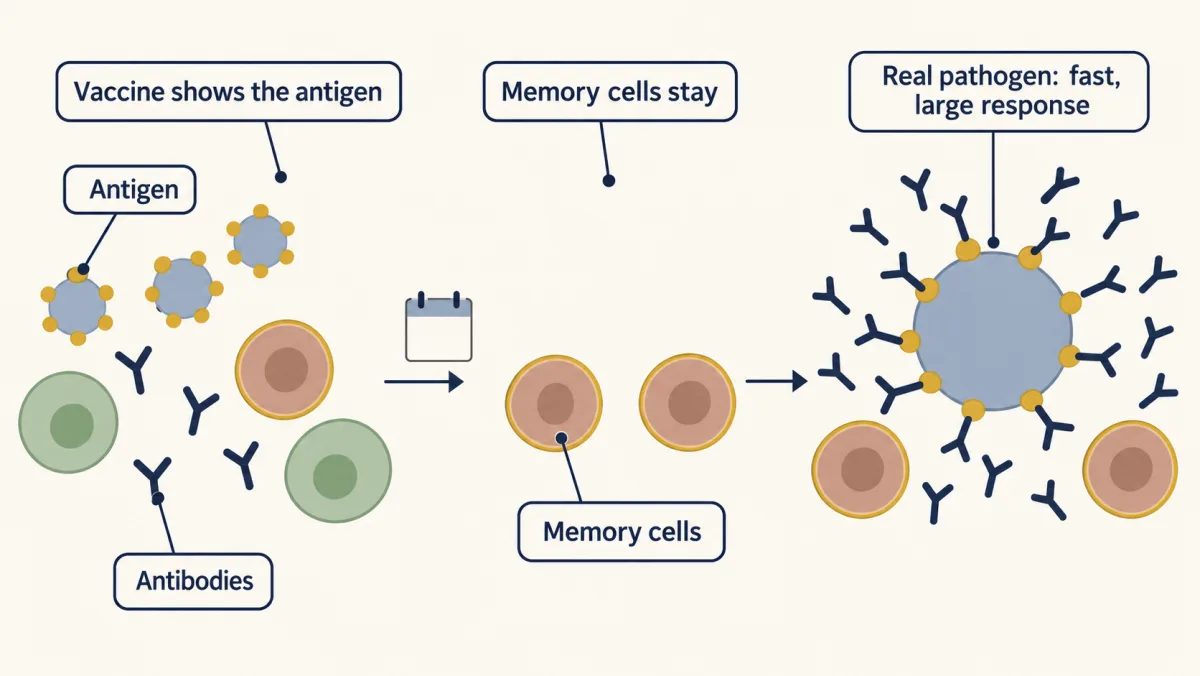
A vaccine gives the immune system its first meeting with an antigen without the disease. The memory cells it leaves make the response to the real pathogen faster and larger. AI-generated illustration -
Explore: run the race
-
What the second film left out
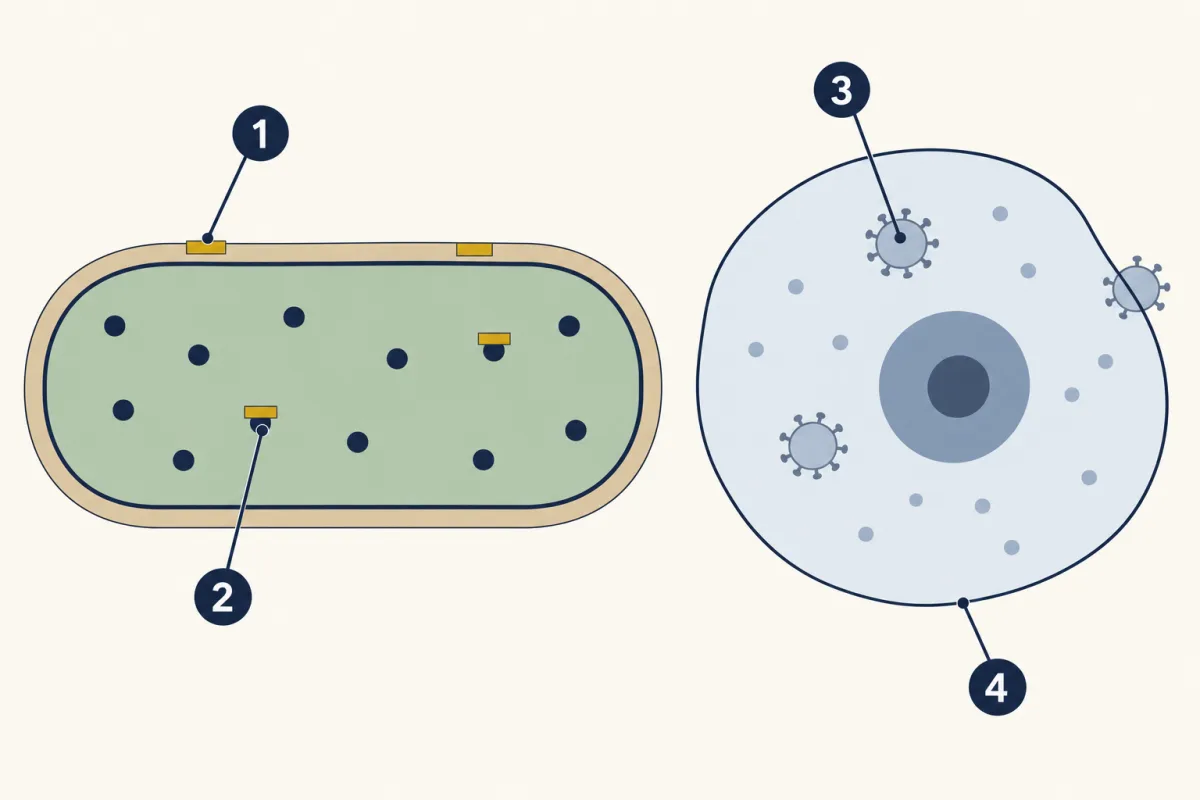
- cell wall
- bacterial ribosomes
- virus
- your cells
-
Elaborate: from two clinics to a nation
-
Evaluate: check your thinking
-
Going deeper
Where this lesson fits
Before thisReview first
- How Microbes MultiplyThis course · Lesson 13
The race model uses doubling bacteria and viruses that multiply only inside cells, which that lesson explains.
- Living or Not? Viruses and BacteriaThis course · Lesson 12
You need to know a virus has no cell wall or ribosomes to see why antibiotics miss it.
- The Cell Cycle and MitosisThis course · Lesson 10
Bacteria doubling and memory cells multiplying rest on cells dividing into copies.
After thisStudy next
- Natural Selection and New SpeciesThis course · Lesson 28
Resistant bacteria taking over is natural selection acting on existing variation, taken further here.
- Variation and SurvivalThis course · Lesson 27
Resistant survivors spreading is selection on variation that was already there before the drug.
- Adaptive ImmunityOne level up · Organismal Biology
This takes the idea further: how memory B and T cells give the faster second response.
Elsewhere on the siteFilms, simulations and method films in other courses
- Beetles and new coloursSimulation · Life Science
A chance mutation can give a few bacteria a trait that later lets them survive a drug.
- Who Makes It Through the Change?Film · Life Science
After an environmental change only members with a helpful trait survive and reproduce, as resistant bacteria do under a drug.
Suggested by an AI model from the lessons themselves, then checked. How we use AI