Where the Bay's Oxygen Goes
Read the transcript of “Where the Bay's Oxygen Goes”
Film transcript: Where the Bay's Oxygen Goes
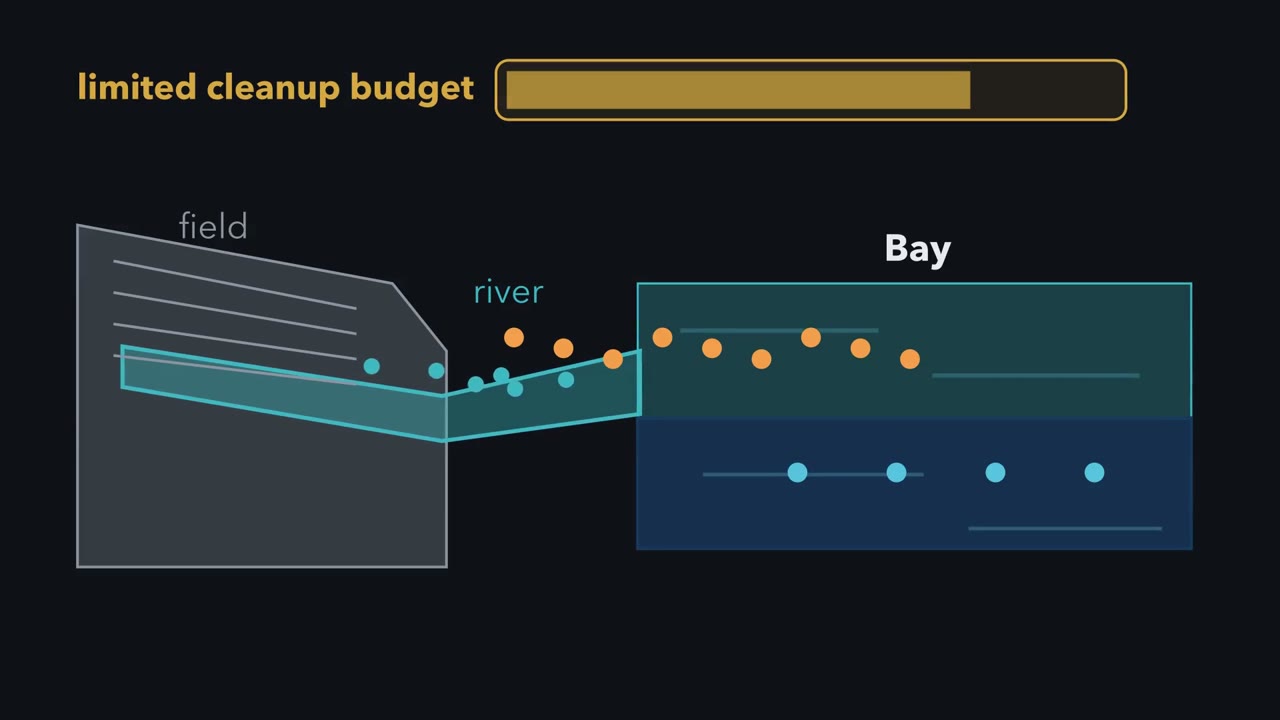
How can fertilizer spread far upstream leave the Bay's bottom short of oxygen? The fertilizer never grabs oxygen itself. Follow this cross-section from a field to the Bay's deep channel. The missing oxygen comes from a living chain, helped by summer water.
A watershed is all the land that drains into one river, lake, or bay. Rain becomes runoff when it flows over the ground. Orange nutrient markers join that water from fields, lawns, wastewater, and the air. Here, nutrients mean nitrogen and phosphorus. The orange markers reach sunlit surface water. Green algae multiply, turning a thin layer into a thick bloom. The bloom shades the gold grass below. Some algae also grow on grass blades. Less light reaches the leaves, while dead algae begin sinking. At the bottom, bacteria break down the dead algae. Bacteria are decomposers, living things that break down dead matter. They use blue dissolved oxygen while they work.
Dissolved oxygen is oxygen gas mixed into water. Fish, crabs, and oysters need it. Now split the Bay into a cyan surface layer and a navy bottom layer. Both begin with oxygen. If the layers barely mix, which oxygen gauge will fall first?
The bottom gauge falls first. Fresh river water floats above saltier, heavier seawater in summer. The boundary slows mixing. Surface water still exchanges oxygen with the air. Below, decomposition keeps using oxygen, but replacement is slow. Water this low in oxygen is hypoxia. Warm water holds less dissolved oxygen, and bacteria decompose faster when it is warm. That strengthens the summer shortage. So the deep channel runs shortest on oxygen in summer, not winter. The chain also has a delay. Much nitrogen arrives with high river flow in late winter and spring. Algae grow, die, and sink over time. Decomposition can continue into summer, so scientists use spring nutrient inputs when forecasting summer hypoxia.
This process is eutrophication: nutrient enrichment feeds too much algae and can lead to oxygen loss. Animals that can leave low oxygen move away. Others may sicken or die. Follow the cause carefully. Nutrients start the chain, while living things use the oxygen. Low oxygen is not the only effect. The surface bloom and algae on grass blades block sunlight. That can weaken underwater grass habitat, a second harm that does not depend on low oxygen. Weather changes the outcome, but human nutrient inputs remain a pressure people can reduce.
How can fertilizer spread on a field far upstream leave crabs and fish short of oxygen at the bottom of the Chesapeake Bay?
Continue in the lesson: The Chesapeake Under Pressure →
3:29 · Free, with captions and a transcript. The lesson has the full text, the questions and the sources.
More films from this lesson
How this film was made. Narration: written from this lesson's text and read by an AI narrator voice (Kokoro, af_heart). Animation: AI-generated in code (Manim) by Claude, a schematic with no drawn molecular structures. Captions come from the narration script. See something wrong? Report it.