Life Science · Unit 4: Matter and energy in ecosystems
Producers, Consumers and Decomposers
Rewritten on : new text, flashcards and film. Your notes and highlights stay, but the text around them may have moved.
Leaves fall in the forest every autumn, so why don’t the old ones just keep piling up?
Pause when the reading reaches a film, and offer to play it. Saved on this device.
Watch the film now, or keep listening
Builds on:Photosynthesis Feeds the WorldReleasing Energy from FoodFood Webs and EnergyWhy these?
Where this lesson sits
- Virginia SOL LS.5 c
- Practices LS.1 b, LS.1 c, LS.1 d, LS.1 e
Essential question: Where do all the fallen leaves go, and what would happen if nothing broke them down?
-
Life Science (grade 7) LS.5 c You are here
This lesson
-
Biology
Preview it at high school level
In Biology you will look more closely at bacteria. You will learn that many bacteria help living things. Some break down dead matter. Some live in plant roots and turn nitrogen from the air into a form plants can use. Others live in your gut and help break down food. You will also learn that some bacteria and viruses cause disease in plants, animals and people. The same kind of microbe can help in one place and cause harm in another. Whether a microbe helps or harms depends on where it lives.
-
Biology II Biology II: Ecology, EC.4 a
Preview where it goes next
In Virginia’s Biology II Ecology course (EC.4 a), you follow nitrogen step by step and name each process: fixation, nitrification, assimilation, ammonification and denitrification. Many of these steps are carried out by microbes. You learn that a shortage of one nutrient can limit how much producers grow. You also study eutrophication, when too many nutrients enter water and cause large blooms of algae.
-
College
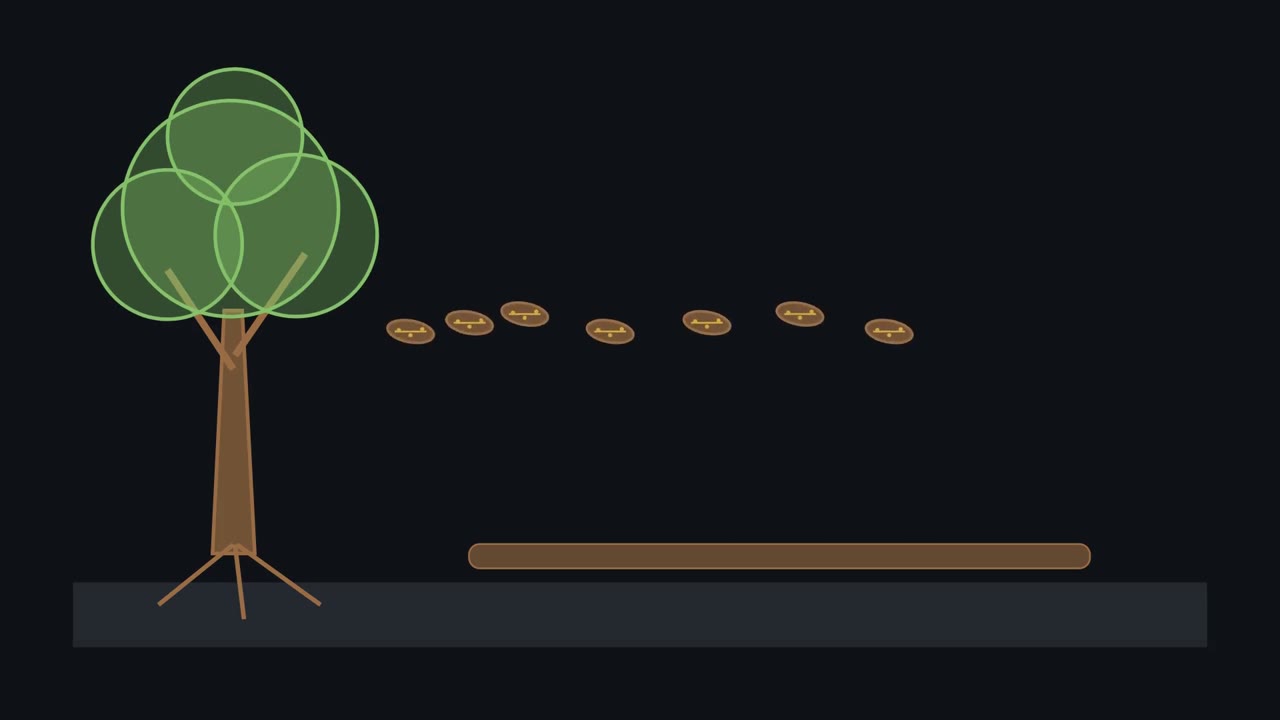 ▶ Watch The Leaf Pile That Stops Growing · 3:19
Read the transcript of “The Leaf Pile That Stops Growing”
Film transcript: The Leaf Pile That Stops Growing
Every autumn, an oak drops its leaves onto the forest floor. New leaves land on the old ones, year after year. So why isn't the forest floor buried? Think of the leaf pile as a bathtub. Each autumn, a new layer of leaves pours in. But the pile stays low, year after year. Something must be draining it. Start with the tap. The oak is a producer. It captures energy from sunlight and stores it in sugar. It builds its leaves from carbon dioxide water and nutrients from the soil. A deer eats acorns. It eats a producer, so it is a first-order consumer. A mouse eats seeds, and a fox eats the mouse. That makes the fox a second-order consumer. Consumers carry some matter along from the tap toward the drain.
But sooner or later, every animal dies too. Its body joins the dead leaves in the pile. Now look down into the pile. Fungus threads spread through the dead leaves. Bacteria, far too small to see, work beside them. These are decomposers. They break down dead plants, dead animals and wastes. A fungus has no mouth. It releases chemicals that break the leaf down outside its body. Then it takes in the small pieces. Here is a puzzle. In one forest study, fallen leaves lost close to half their mass in a year. When decomposers use a leaf, where does much of it end up? Into the soil, or into the air?
Much of it goes into the air. Decomposers use the leaf as food. Like you, they release its energy by respiration. That gives off carbon dioxide and water. Some matter stays in their bodies, and rain washes some into the soil. A smaller part matters a lot. Nutrients, such as nitrogen, go into the soil. The oak's roots take them up and build new leaves. The matter has gone all the way around. Energy does something different. It comes in as sunlight. Every living thing here gives some of it off as heat. Energy does not go around. Now watch the pile in a simple model. The same leaf fall comes each autumn.
Decomposers drain the same share of the pile each year. The pile grows until the drain takes out as much as falls in. Then it stops growing. A real forest floor levels off only when it reaches that balance. Producers fill the pile.
Consumers carry matter along. Decomposers drain the leaf pile, so the matter goes around again.
From the film
- Producers like the oak build leaves using energy from sunlight; consumers eat producers or other consumers.
- Decomposers such as fungi and bacteria break down dead leaves, dead animals and wastes.
- Decomposers send much of a dead leaf into the air as carbon dioxide and water; its nutrients go into the soil.
- In a simple model, the pile stops growing when the drain takes out as much as falls in each year, and the matter goes around again.
In autumn, many Virginia trees drop their leaves onto the forest floor. Turn over the top layer and the older leaves below are often dark, soft and full of holes.
The first film shows who takes the old leaves away and where they go. This lesson does the counting: how tall the pile gets, and how fast real leaves lose mass. First, decide what you think now.
What do you think? Decide before you read.
-
Scientists disagree: Hawks depend on others. Producers such as trees and algae capture the energy that almost every other living thing uses. Decomposers such as fungi and bacteria return the nutrients that producers need to grow. Each role is needed. Some predators do have large effects on the rest of a food web, but no forest runs without producers and decomposers.
What scientists think
Scientists disagree: Hawks depend on others. Producers such as trees and algae capture the energy that almost every other living thing uses. Decomposers such as fungi and bacteria return the nutrients that producers need to grow. Each role is needed. Some predators do have large effects on the rest of a food web, but no forest runs without producers and decomposers.
-
Scientists disagree: Real ecosystems are webs. Every living thing dies, and decomposers break it down. In a model with no outside supply of nutrients, losing decomposers would leave producers short of nutrients, and that would reach the animals that eat them.
What scientists think
Scientists disagree: Real ecosystems are webs. Every living thing dies, and decomposers break it down. In a model with no outside supply of nutrients, losing decomposers would leave producers short of nutrients, and that would reach the animals that eat them.
-
Scientists disagree: Researchers who weigh bags of leaves left in a forest see the mass drop over many months. Fungi, bacteria and small animals do most of that work. The matter does not vanish. It goes back into the air, water and soil.
What scientists think
Scientists disagree: Researchers who weigh bags of leaves left in a forest see the mass drop over many months. Fungi, bacteria and small animals do most of that work. The matter does not vanish. It goes back into the air, water and soil.
The one idea: the leaf pile is a bathtub. Producers pour new leaves in each autumn, and consumers carry some matter along. Decomposers drain the pile back into carbon dioxide, water and nutrients that producers use again. The pile stops growing when the drain takes out as much as falls in each year.
Where it applies: this is a simple model of matter (the stuff living things are made of), such as carbon and nutrients. It assumes about the same leaf fall each year and decomposers that keep removing a share of the pile. In peat bogs, cold or waterlogged ground nearly stops the drain, and dead plants keep piling up. Energy does not go around: it enters as sunlight and leaves as heat (Food Webs and Energy).
Explain: three jobs in an ecosystem
- producer
- consumer
- decomposer
- nutrient
- fungi
- bacteria
- respiration
A producer captures energy from sunlight and stores it in sugar (glucose) built from carbon dioxide and water (Photosynthesis Feeds the World). Trees, grasses, mosses and algae are producers.
A consumer is an organism that gets energy by eating other organisms. The “order” counts steps from the producer. A deer eating acorns is a first-order consumer. A fox eating a seed-eating mouse is a second-order consumer.
A decomposer breaks down dead plants, dead animals and wastes. The main decomposers are fungi and bacteria. Fungi include mushrooms and molds; most of a fungus is a mass of thin threads hidden in the leaves or soil. Bacteria are single cells, far too small to see without a microscope.
| Job | Gets energy from | Forest example | In the bathtub |
|---|---|---|---|
| Producer | sunlight | oak tree, moss | the tap |
| Consumer | eating other organisms | deer, fox, hawk | carries matter along |
| Decomposer | dead matter and wastes | fungi, bacteria | the drain |
Explain: the drain in the bathtub
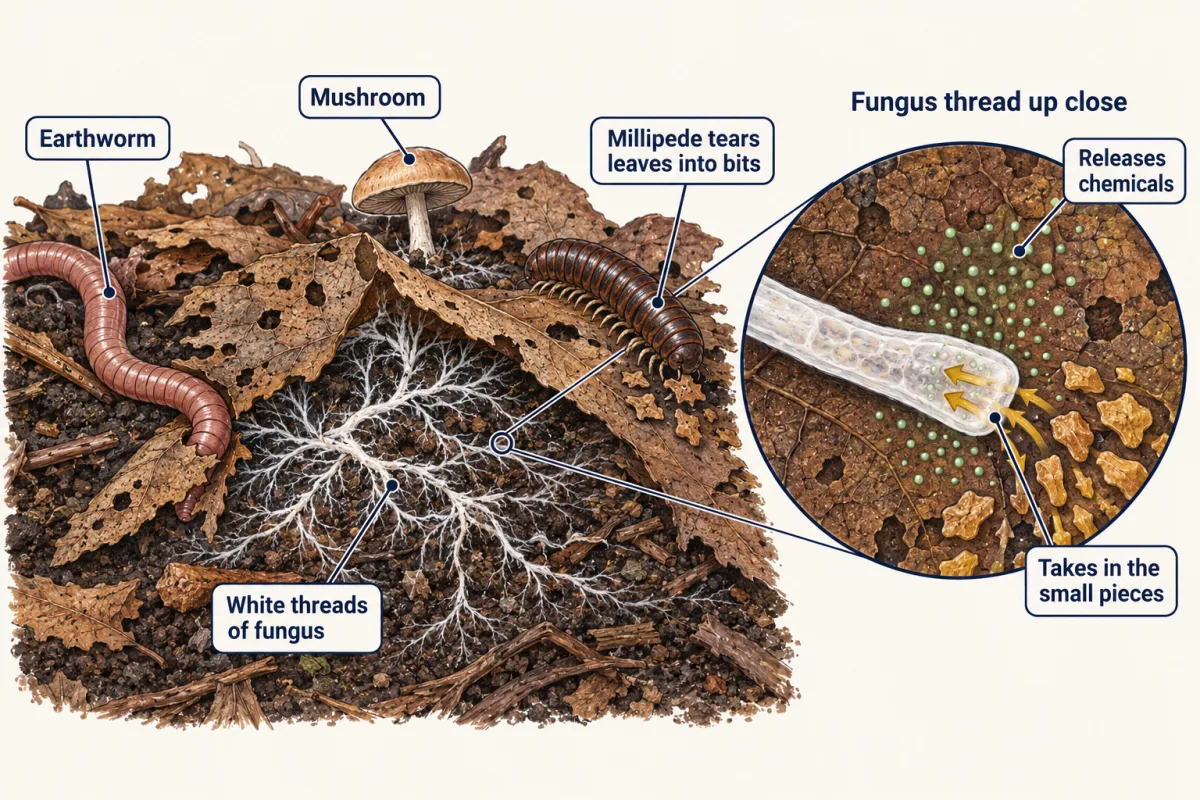
Respiration is not breathing. It is how cells release the energy in food, and in you and most forest decomposers it uses oxygen. Carbon is a large share of a dry leaf, so, as the first film showed, much of it leaves as invisible gas (The Carbon and Water Cycles).
A nutrient is a substance, such as nitrogen, that living things need to grow. Nutrients are a small part of a leaf’s mass. Decomposers return them to the soil, or to the water in a stream. Some of the broken-down leaf becomes the dark part of the soil. Name each numbered part of the loop below, from the oak back to its own roots.
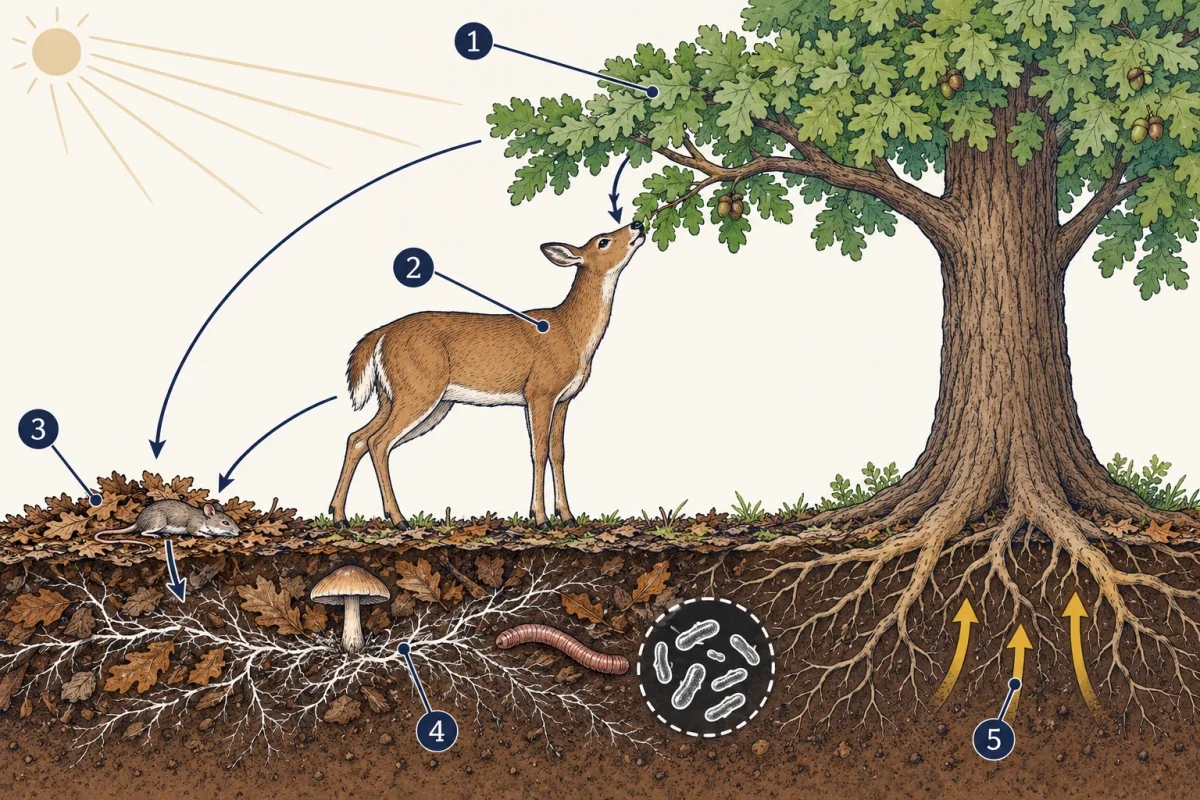
- producer
- consumer
- dead leaves and a dead animal
- decomposers
- nutrients
- producer
- consumer
- blank
- blank
- blank
Word bank: dead leaves and a dead animal, decomposers, nutrients
- blank
- blank
- blank
- blank
- blank
Check your labels
- producer
- consumer
- dead leaves and a dead animal
- decomposers
- nutrients
How tall does the pile get?
In a simple model, one autumn’s worth of leaves falls each year, and decomposers remove half the pile over the next year. Each new pile is half the old one plus 1. In year 2, half of 1 is 0.5, plus 1 makes 1.5:
| Year | 1 | 2 | 3 | 4 | 5 |
|---|---|---|---|---|---|
| Pile just after leaf fall (autumns of leaves) | 1 | 1.5 | 1.75 | about 1.9 | almost 2 |
The pile stops near 2, because half of 2 is 1. Real leaves do not lose the same share every year, so this model cannot tell us how big a real pile gets (Going deeper).
Abiotic factors, nonliving conditions such as temperature and moisture, help set how fast the drain runs; leaf type and the decomposers matter too. In many forests, warm and damp weather speeds decomposers up, and cold or very dry weather slows them down.
Predict. In a second simple model of cold, dry years, suppose decomposers remove only a quarter of the pile each year. Does the pile still stop growing? If so, at about how many autumns’ worth? (Hint: look for the pile size where the drain takes out exactly 1 autumn’s worth.)
Check your prediction
It still levels off, but higher: near 4 autumns’ worth, because a quarter of 4 is 1. Getting there takes more than ten years in this model. A slower drain means a taller pile, not an endless one.
Explore: run a forest floor for five years
Set the decomposers (none, few or many), the season, and a soil poison or compost. Bars show the leaf pile, soil nutrients and plant growth each year. The rates are made up, and all decomposers are one group.
Start here: choose how many decomposers live in the soil, then change the season or the human action.
Dashed outline: the run before your last change. Bars use relative units, not to scale. The dashed line marks where the pile and the soil nutrients started.
In this sketch, the leaf pile and the plants change over five years.
Made up for this sketch: one kind of leaf; decomposers drawn as one group; none removes all of the breakdown and few is half of many; warm and wet is fastest, mild in between and cold and dry slowest, as an invented setting (real results can differ); the poison leaves a tenth; compost adds a little extra food once, in year 1; plants take up a fixed share of the soil nutrients each year and drop it as leaves; no carbon leaves as carbon dioxide. All rates and sizes are invented, in relative units.
Decomposers break down dead leaves and return nutrients to the soil, where plants use them again; with few decomposers, leaves pile up and plants may grow less. Warm, damp conditions often help decomposers, but it is not a simple rule.
Try this.
- Turn the drain off. Predict the leaf pile and the plants after five years with no decomposers, then test it.
- Set decomposers to many. Predict how a cold, dry season will change the leaf pile compared with a warm, wet one. Then test it.
- Spray the soil poison, then add compost instead. Predict which choice gives more plant growth by year five, and check.
Explain: when one group changes
Many changes act on the tap, the drain or both, and can reach the other groups.
- Fewer producers (a weaker tap): plant eaters have less food, and so may the animals that eat them. Fewer new leaves fall.
- Fewer decomposers (a clogged drain): dead leaves pile up. Fewer nutrients return to the soil, so plants may grow less over time.
- More decomposers (a faster drain): leaves break down faster, but only while dead leaves remain.
People change both sides. Clearing a forest removes producers and the new leaf litter that feeds decomposers. Planting trees adds producers. Pesticides and pollution can kill soil life and clog the drain. Raking away every leaf removes nutrients. Leaving leaves in a yard corner, or composting, feeds decomposers and shelters small animals.
- If the decomposers disappeared, the dead leaves would blank.
- Plants would then get blank nutrients, because blank.
The model needs a removal rate. The second film follows researchers who weighed yellow birch leaves in fine mesh bags. That gives a useful rate for leaves in bags, not for a whole forest floor.
Read the transcript of “Weighing the Drain”
Film transcript: Weighing the Drain
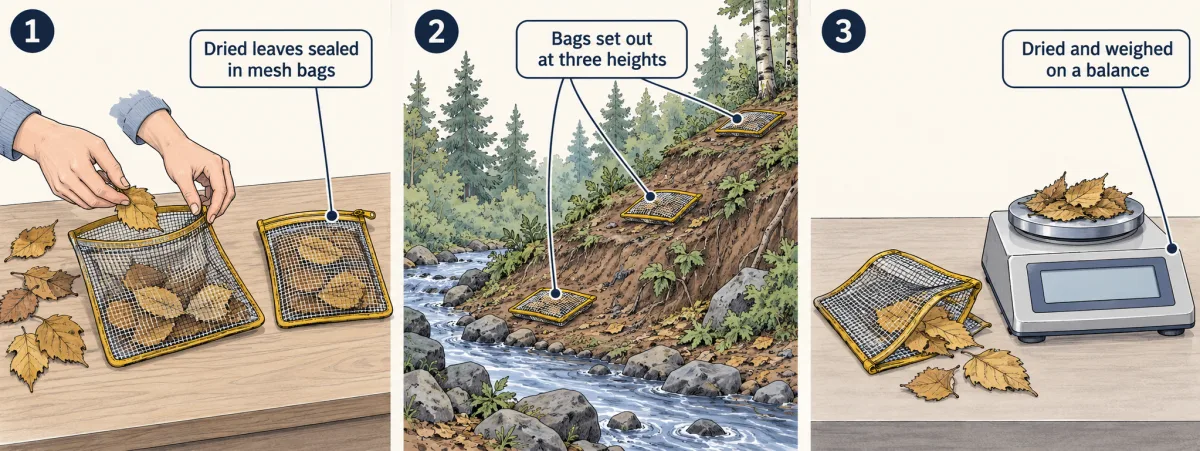
The first film showed decomposers draining the leaf pile. But how fast does a real forest's drain run? How could you measure matter you cannot see leaving? Researchers in West Virginia found a way. In October 2011, they worked in the Weimer Run watershed, near the town of Davis. They sealed dried yellow birch leaves in mesh bags, and weighed the leaves first. Then they set the bags on the forest floor, at three heights above the stream. Five times over two years, they brought some bags back. Different bags came back each time. They dried the leaves and weighed them again. Why dry the leaves before weighing?
Wet leaves are heavier. Drying them means that water in the leaves does not change the result. Let's follow the higher site. The graph shows the percent of the starting mass left. Every bag started at 100 percent. Each later dot is an average of 8 or 9 bags. After one month, about 72 percent was left. That first drop was fast. Part of it was probably rain washing sugars and other substances out of the fresh leaves. This is called leaching. It does not need decomposers. Now jump to 12 months. About 60 percent of the mass was left. So about 40 percent was gone in one year. At 24 months, a little under half was left. The bags were still losing mass, but more slowly than in the first year.
One more thing. The mesh kept earthworms and millipedes out. On an open forest floor, would leaves break down faster or slower than in the bags? Probably faster. Worms and millipedes tear dead leaves into smaller bits. Smaller bits give fungi and bacteria more surface to work on. So the bags probably show the drain running slower than it really does. In these bags, about 40 percent drained away in a year, and about half in two. Suppose a model drain took 40 percent of the whole pile every year. The pile would level off near 2.5 autumns' worth. But these bags lost mass more slowly in year two. So two years cannot tell us how big a real pile gets.
Some early loss was probably leaching, and decomposers did some too. Weighing measures all the loss together. It cannot split decomposers from leaching or bits lost through the mesh. And it shows one kind of leaf in bags, not a whole forest floor. Weighing leaf bags measures how fast leaves lose mass.
From the film
- Researchers weighed sealed bags of dried leaves left on a West Virginia forest floor for two years.
- At the higher site, about 40 percent of the leaf mass was gone after one year and about half after two; year two was slower, so two years cannot tell how big a real pile gets.
- Part of the first month's loss was probably leaching, rain washing material out of fresh leaves, which needs no decomposers.
- Weighing measures all the mass loss together: it cannot split decomposers from leaching or bits lost through the mesh.
- The mesh kept worms out, so leaves on an open forest floor probably break down faster.
Elaborate: two years in a bag of leaves
Here the second film’s higher site sits beside the lower site, further down the same hillside.
Predict. By month 24, did leaves at the lower site keep more of their mass than at the higher site, less, or about the same?
Check your prediction: dots sit at the months bags came back, so they are unevenly spaced. Find month 12 on the bottom axis, go up to each line, then across to the left axis. Repeat at month 24.
- At month 12, the lower site had about blank percent of its mass left.
- At month 24, the line that is lower belongs to the blank site.
- Between months 1 and 8, the lower site’s line goes blank.
| Time after setting out (months) | Lower site: mass left (%) | Higher site: mass left (%) |
|---|---|---|
| 0 (October 2011) | 100 | 100 |
| 1 (November 2011) | 68.9 | 72.0 |
| 8 (June 2012) | 70.9 | 68.9 |
| 12 (October 2012) | 54.4 | 59.7 |
| 20 (June 2013) | 51.6 | 55.8 |
| 24 (October 2013) | 41.2 | 47.8 |
Source: Atkins, Epstein and Welsch, Ecosphere, 2017, Weimer Run, West Virginia, 2011 to 2013. Two of the three sites are shown. Different bags were weighed each time, so values bounce around; more in Going deeper.
- Describe the trend at the lower site from month 0 to month 24.
- At month 24, how much higher is the higher site’s number, 47.8, than the lower site’s, 41.2? Subtract.
- The lower site went from 68.9 to 70.9 percent between months 1 and 8. Why might that happen when different bags are weighed each time?
Claim, evidence, reasoning
Make a claim that answers the essential question: where do fallen leaves go? Use the Weimer Run data.
Start with: Fallen leaves blank over time because blank.
Start with: At the lower site, blank percent of the mass was left after 12 months and blank percent after 24 months.
Start with: The mass dropped because blank broke the leaves down and rain washed some material out. The lost matter went into the blank and the blank.
Compare with a model answer
Fallen leaves are broken down by decomposers, and their matter returns to the ecosystem. At the lower Weimer Run site, 54.4 percent of the leaf mass was left after 12 months and only 41.2 percent after 24 months. The higher site also lost mass. Fungi, bacteria and tiny animals small enough to get through the mesh probably did much of this work. In the first month, rain probably also washed dissolved material out of the fresh leaves. The lost matter went back to the soil, water and air, partly as nutrients and carbon dioxide. One limit: weighing does not show which of these caused the loss or where the lost mass went, since some bits may also have fallen out of the bags. This was also one leaf type in one West Virginia forest watershed.
Saved in this browser only.
Design problem
Plan an investigation to test whether moist soil makes leaves break down faster than dry soil. Use leaves, cups of soil and a balance.
Saved in this browser only.
One way to do it
- Question: Do leaves lose mass faster in moist soil than in dry soil?
- Independent variable: moist soil or dry soil.
- Dependent variable: the dry leaf mass left after 4 weeks, in grams, and the percent of the starting mass.
- Constants: the same kind of leaf, 2.0 grams of leaves per cup, dried until their mass stops changing, the same soil, cup size and room temperature.
- Control: cups of dry soil with no water added.
- Trials: five cups of each. Find the mean for each group.
- Measuring: after 4 weeks, rinse the leaves gently. Dry them the same way as the starting leaves, and weigh them each day until the mass stops changing.
- Safety: wear gloves, keep cups covered with a lid that has small holes, do not sniff moldy cups, and wash your hands. Students with mold allergies should not handle the cups.
If the moist cups keep less leaf mass, moisture increased mass loss in this setup. Water can also wash material out of leaves without any decomposers, so this test alone cannot show how much of the loss came from decomposers.
Evaluate: check your thinking
In the simple model, the pile stops growing when the drain takes out as much as falls in each year. The leaf bags show how fast one kind of leaf lost mass in mesh bags over two years.
Science practices you used: predicting and testing with a model, reading a line graph and a data table and finding a difference, making a claim from evidence, and planning a fair test.
Going deeper
Jobs, not kinds
These are jobs, not kinds of living things. An earthworm helps break down dead leaves and is also food for robins. Some do not fit any job neatly: root fungi trade nutrients with living trees.
Decomposers or detritivores?
Some textbooks call earthworms and millipedes decomposers, others detritivores. Either way, they shred the leaves.
Why a real pile is not exactly 2 autumns
In the leaf bags, about 40 to 46 percent of the mass was gone after one year, but only about 12 to 13 percent more in the second. That fits breakdown slowing down once the easy parts of a leaf are used up. The weather also differed between years, though. If 40 to 46 percent of the pile vanished every year, the model pile would stop near 2.2 to 2.5 autumns’ worth. Older leaves drain more slowly, so a real pile probably holds more, and two years of bags cannot say how much. Worms, kept out by the mesh, would probably speed things up. Warmth does not always speed the drain either: see the story “Warmer did not mean faster.”
About the leaf-bag data
The leaves were yellow birch. The 100 percent at month 0 is the starting value, not a weighing of recovered bags. This is the closest real data we found; it is not from Virginia. Each later value is a mean of 8 or 9 bags, from the authors’ shared data, rounded to one decimal. The mesh holes were about 1 millimeter wide, so earthworms and millipedes could not get in.
Your notes
Select any text in the lesson to highlight it or add a note to it. Your highlights and notes are saved in this browser and collected in your notebook.
This browser is not letting the site save anything (a private window or strict privacy settings), so highlights and notes will be lost when you leave the page.
How we measure it
Leaf litter bags
Researchers seal a weighed amount of dried leaves in a mesh bag and leave many bags on the forest floor. They bring back a few bags at a time, dry and weigh the leaves, and work out the percent of the starting mass that is left.
Electronic balance
A balance measures mass in grams. Weighing leaves only after they are fully dry means that water in the leaves does not change the result.
Where this lesson fits
Before thisReview first
- Photosynthesis Feeds the WorldThis course · Lesson 9
You need to know producers build sugar from carbon dioxide and water using sunlight before you treat them as the tap.
- Releasing Energy from FoodThis course · Lesson 10
Decomposers send leaf carbon into the air through respiration, which this lesson uses without teaching again.
- Food Webs and EnergyThis course · Lesson 12
You need to know what consumers are and how they eat producers or other consumers before adding decomposers.
After thisStudy next
- The Carbon and Water CyclesThis course · Lesson 14
It follows the carbon that decomposers release from dead leaves as it moves through air, living things and soil.
- Nitrogen for LifeThis course · Lesson 15
It shows how nutrients returned by decomposers become nitrogen that producers can use again.
- Microbes in Bodies and EcosystemsOne level up · Biology
It takes the idea further by showing how bacteria and fungi do the breakdown and nutrient work in ecosystems.
Elsewhere on the siteFilms, simulations and method films in other courses
- Set Up: Rot DetectivesFilm · Biology Together
Sealed jars let you watch decomposers break down a rotting apple, the same job they do on leaves.
- Set Up: Soil ShakeFilm · Biology Together
Soil layers show the dead plant matter and nutrients that decomposers add back to the ground.
- Follow an atomSimulation · Biology
Following atoms between living things and the soil shows where decomposed matter goes next.
- Ecosystem mass and energy budgetsMethod film
The pile that stops growing is an ecosystem budget: matter falling in each year against matter drained out.
Suggested by an AI model from the lessons themselves, then checked. How we use AI
Finish line
Test yourself
8 questions
Practice and MCAT-style, with explained answers.
Next · Lesson 14
The Carbon and Water Cycles
Why does the air over a Hawaiian volcano lose carbon dioxide every summer and win it back every fall and winter?
Continue →