Life Science · Unit 4: Matter and energy in ecosystems
The Carbon and Water Cycles
Rewritten on : new text, flashcards and film. Your notes and highlights stay, but the text around them may have moved.
Why does the air over a Hawaiian volcano lose carbon dioxide every summer and win it back every fall and winter?
Pause when the reading reaches a film, and offer to play it. Saved on this device.
Watch the film now, or keep listening
Builds on:Partners in EnergyProducers, Consumers and DecomposersPhotosynthesis Feeds the WorldWhy these?
Where this lesson sits
- Virginia SOL LS.5 a
- Practices LS.1 c, LS.1 d, LS.1 e, LS.1 f
Essential question: Where does the carbon in my body and the water in my glass go next, and why does the air's carbon dioxide go up and down every year?
-
Life Science (grade 7) LS.5 a You are here
This lesson
-
Biology
Preview it at high school level
In Biology you will treat each cycle as atoms moving between places that store them, called reservoirs. You will add the ocean’s role, since seawater both takes in and gives off carbon dioxide. You will learn how carbon dioxide in the air traps heat and helps set Earth’s temperature. You will read yearly averages from Mauna Loa, which hide the summer dip and show the long rise. You will also read Chesapeake Bay nitrogen data and learn the names of the steps that bacteria carry out in the nitrogen cycle.
-
Biology II Biology II: Ecology, EC.4 a; Advanced Topics, BIOII.6 c
Preview where it goes next
In Virginia’s Biology II: Ecology course, you follow the carbon, nitrogen, water and phosphorus cycles with every process named. You ask which places act as sources and which act as sinks, and how a missing nutrient can limit growth. Advanced Survey of Biology Topics adds the phosphorus cycle, which has no important gas in the air, and links the cycles to how much new plant matter an ecosystem builds each year.
-
College
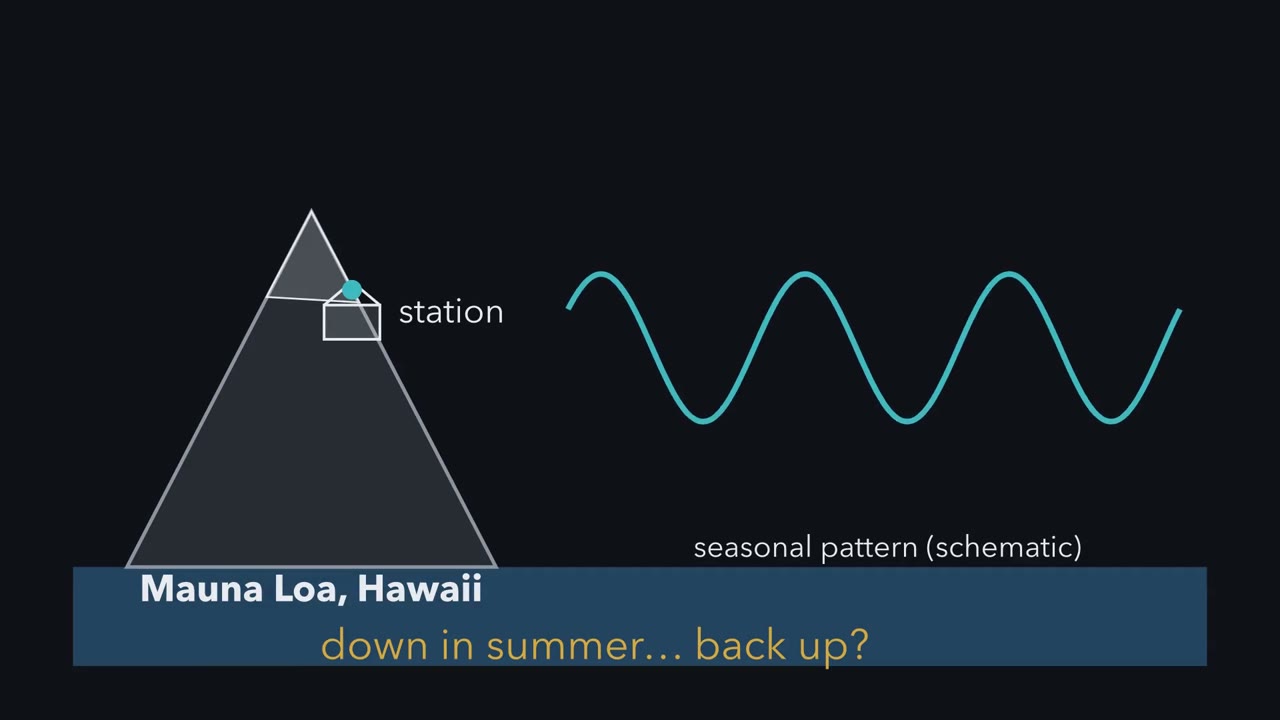 ▶ Watch The Air Is a Tub · 3:20
Read the transcript of “The Air Is a Tub”
Film transcript: The Air Is a Tub
What pulls the carbon dioxide in the air down every summer, and what pushes it back up? Scientists on a Hawaiian volcano, Mauna Loa, have watched it happen every year since 1958. They count carbon dioxide in parts per million. Four hundred parts per million means four hundred carbon dioxide molecules in every million molecules of air. So it is only a tiny part of the air. Here is a way to think about it. Picture the air as a tub that holds carbon. A marker on the side shows the level, in parts per million. One process drains the tub. Photosynthesis takes carbon dioxide out of the air. The oak in a Virginia yard builds that carbon into sugar. Other processes fill it.
The oak and the deer both respire, day and night. Decomposers in the rotting log do too. Burning fuel adds more, and the ocean takes some in and gives some back. Now the rule. The level goes up only when more flows in than flows out. It goes down only when more flows out than flows in. Watch one year. In spring the oak's leaves open, and photosynthesis speeds up. The oak still respires, and the log still rots. But out beats in, so the tub's level falls, month after month. In fall, photosynthesis slows and the oak drops its leaves.
Respiration and decomposition keep going. Now in beats out, so the level rises through fall, winter and spring. Real air shows the same pattern. The line beside the tub is the record from Mauna Loa, for 2025. The station measures the air itself, not each flow. The highest month is May. After that, the level falls all summer. From July to August, the monthly average dropped the most. So is August the lowest month? Pause and decide.
No. The monthly average kept falling into September, the lowest month. In October it was higher again. A tub keeps draining as long as out beats in, so the bottom comes after the biggest drop. Now step back to many years. Burning coal, oil and gas adds old carbon from underground.
Each year, a little more flows in than flows out. So the whole record climbs. To see the climb, compare the same month across the years, May with May. May against September only shows the yearly swing. One tub, two patterns. The yearly swing comes from plants taking out more, then less, than is put back. The long climb comes mostly from burning.
From the film
- Picture the air as a tub of carbon: its carbon dioxide goes up only when more flows in than flows out, and down only when more flows out than flows in.
- Photosynthesis takes carbon dioxide out of the air. Respiration, decomposition and burning put it back, and the ocean takes some in and gives some back.
- In the northern summer, plants take out more than is put back, so the level at Mauna Loa falls; from fall through spring it rises.
- In 2025 the biggest monthly drop was July to August, but the lowest month was September. A tub keeps draining as long as out beats in.
- Burning fossil fuels adds a little more than is taken out, so the whole record climbs. Compare the same month across years to see the climb.
High on Mauna Loa, a volcano in Hawaii, scientists have measured the carbon dioxide in the air since 1958. Every year it falls through summer into early fall and rises from fall through spring, while the whole record slowly climbs.
Closer to home, a big oak in a Virginia yard pulls water from the soil and lets it out of its leaves as an invisible gas. Where do the oak’s carbon and water go next?
What do you think? Decide before you read.
-
Scientists disagree: Plants use water and carbon dioxide together to make sugar. In dry weather they close the tiny openings in their leaves to save water, so less carbon dioxide gets in. The cycles are linked.
What scientists think
Scientists disagree: Plants use water and carbon dioxide together to make sugar. In dry weather they close the tiny openings in their leaves to save water, so less carbon dioxide gets in. The cycles are linked.
-
Scientists disagree: Carbon atoms and water are used again and again. Energy is different. It comes in as sunlight and leaves as heat, so plants need new sunlight every day. Scientists follow energy and matter separately to see this.
What scientists think
Scientists disagree: Carbon atoms and water are used again and again. Energy is different. It comes in as sunlight and leaves as heat, so plants need new sunlight every day. Scientists follow energy and matter separately to see this.
-
Scientists disagree: Plants pull water from the soil and release it as vapor through tiny openings in their leaves. The second film shows how big that share may be.
What scientists think
Scientists disagree: Plants pull water from the soil and release it as vapor through tiny openings in their leaves. The second film shows how big that share may be.
The one idea: the air is a tub of carbon. The carbon dioxide in the air goes up only when more flows in than flows out, and down only when more flows out than flows in.
Where it applies: the whole air as one store (a place that holds carbon), over one year and over many years. Mauna Loa measures moving, mixed air. Its record shows the pattern the flows make, mostly from northern land plants. It does not count each flow, and its monthly averages do not show the exact day the level turns. The water cycle runs alongside and meets the carbon cycle at the tiny openings in leaves.
Explain: the flows in and out of the tub
- carbon cycle
- photosynthesis
- respiration
- combustion
- decomposition
- evaporation
- condensation
- precipitation
- transpiration
- runoff
The first film named the flows; here is what each one does. Living things need carbon: it is in their sugar, fat and protein. Carbon atoms join in chains and rings that form the frame of these molecules.
The carbon cycle is the movement of carbon among the air, living things, the ocean and the soil. Carbon is also stored in rocks and in fossil fuels underground. Four key processes move it.
- Photosynthesis is the process in which plants, algae and some bacteria use radiant energy (light energy, such as sunlight) to make sugar (glucose) from carbon dioxide and water. It takes carbon out of the air.
- Respiration is the process in which cells break down sugar and release carbon dioxide and water. Plants, animals and decomposers all do it, day and night.
- Decomposition is the breakdown of dead organisms and wastes by decomposers such as bacteria and fungi. It returns carbon to the air and the soil.
- Combustion is burning. Burning coal, oil or natural gas releases carbon dioxide quickly.
photosynthesis: carbon dioxide + water + radiant energy → sugar (glucose) + oxygen
respiration: sugar + oxygen → carbon dioxide + water + energy the cell can use
You met both in Partners in Energy.
Coal, oil and natural gas formed from living things that died long ago, so burning them adds carbon that sat underground for millions of years. The ocean takes in carbon dioxide at its surface and gives some back. This cycle keeps carbon available to living things.
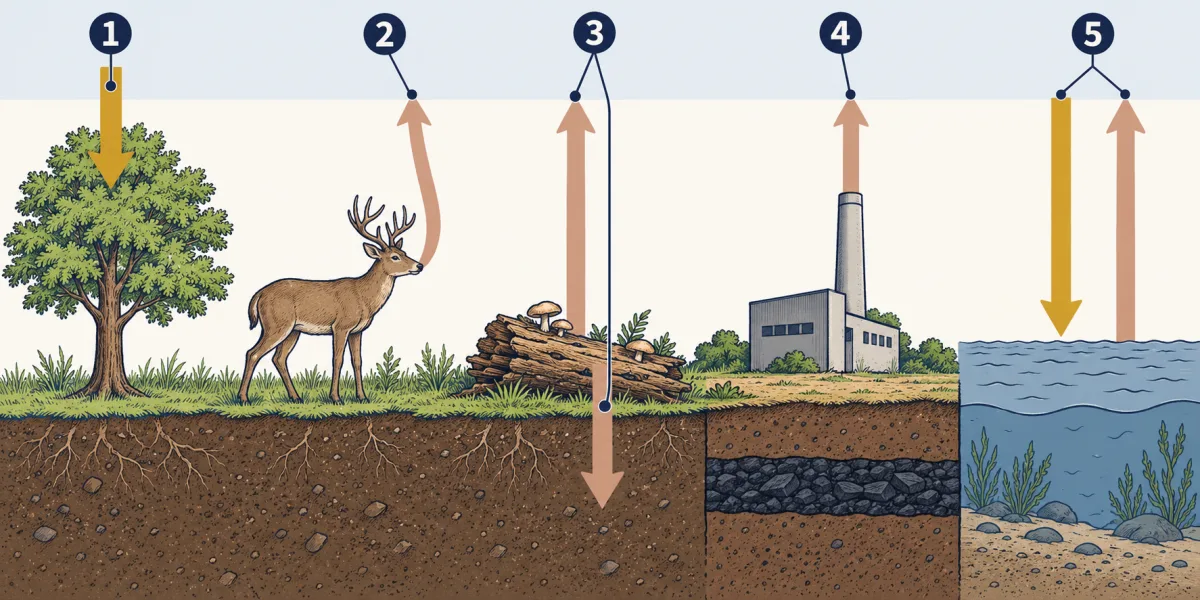
- photosynthesis
- respiration
- decomposition
- combustion
- ocean
- photosynthesis
- blank
- blank
- combustion
- blank
Word bank: decomposition, ocean, respiration
- blank
- blank
- blank
- blank
- blank
Check your labels
- photosynthesis
- respiration
- decomposition
- combustion
- ocean
Explore: run the tub
Counters stand for carbon moving among four boxes: air, plants and animals, soil, and ocean. A line graph tracks the air box; a side panel shows water moving through a tree.
- 1 Photosynthesis: carbon goes from the air into plants.
- 2 Respiration: carbon goes from plants and animals to the air.
- 3 Decomposition: dead things and wastes go to the soil, and decomposers return carbon to the air.
- 4 Combustion: burning fuel puts old carbon from underground into the air.
- 5 Ocean: it takes in some carbon from the air and gives some back.
Press “Run the months”. Counters stand for carbon moving between four boxes.
- In this sketch, over the last 12 months the air box was fullest at the
- Run a full year to see
- In this sketch, over the last 12 months the air box was emptiest at the
- Run a full year to see
- In this sketch, this year’s average air carbon, compared with last year’s, is
- Run two years to see
In this sketch, leaves are off. Very little water vapor leaves the trees.
In this sketch, one forest that drops its leaves in fall stands for the land plants of the Northern Hemisphere, where the lesson says most land plants are. One counter is one made-up chunk of carbon. Box sizes, the monthly rates, how much water vapor trees release in each month, the April-to-October window when leaves are out, the ocean’s share, the three burning levels, cutting to about 60 percent of the trees and planting up to about 140 percent are all made up. The yearly swing is drawn much bigger than the real one: the lesson’s data swing about 6 ppm out of more than 420 ppm. Carbon in rocks, and water shortage changing how much carbon plants take in, are left out.
Rule to keep: photosynthesis takes carbon out of the air, and respiration, decomposition and combustion put it back, so the air box empties in the northern summer, fills in winter, and climbs when burning adds old carbon faster than plants and the ocean take it up.
Try this.
- Cut the trees down. Predict whether the summer dip gets bigger or smaller and whether the lowest month for carbon dioxide moves. Run a year and check. Watch the water panel too.
- Turn burning up. Predict whether the line will end ten years higher than it started. Then test it.
- Set burning to None and run ten years. Does the line still rise and fall? Does it still climb?
Explain: why Hawaii’s air follows the northern seasons
The first film left out where Mauna Loa is.
Predict. Mauna Loa is in the middle of the Pacific Ocean. Why would its air follow the seasons of plants on faraway land?
Check your prediction
Mauna Loa is in the northern half of Earth, the Northern Hemisphere, like most of Earth’s land and land plants. Air moves and mixes across the north, so northern plants set the beat.
Each row is one month’s change at Mauna Loa in 2025, worked out from the monthly values in Elaborate, in ppm (parts per million: carbon dioxide molecules in every million molecules of air). Each triangle is about half a ppm: up means the level rose that month, down means it fell.
| 2025 | Change (ppm) | Picture |
|---|---|---|
| Jan → Feb | +0.44 | ▲ |
| Feb → Mar | +1.06 | ▲▲ |
| Mar → Apr | +1.49 | ▲▲▲ |
| Apr → May | +0.87 | ▲▲ |
| May → Jun | −0.90 | ▼▼ |
| Jun → Jul | −1.74 | ▼▼▼ |
| Jul → Aug | −2.39 | ▼▼▼▼▼ |
| Aug → Sep | −1.11 | ▼▼ |
| Sep → Oct | +0.50 | ▲ |
| Oct → Nov | +1.59 | ▲▲▲ |
| Nov → Dec | +1.03 | ▲▲ |
The table also shows the top of the year. The rise slows from April to May, then turns into a fall as northern leaves open.
Reminder: the level goes up only when more flows in than out. When people add carbon faster than plants and the ocean take it up, the amount in the air rises. Scientists link that rise to climate change, a long-term shift in Earth’s temperatures and weather. Climate change can affect the health of ecosystems. You will study it in Big Changes.
Explain: water moves, and plants help move it
You learned the water cycle in grade 6. Here are six important processes in it.
- Evaporation is liquid water changing into water vapor, a gas, driven by heat from the Sun. Most of the water vapor in the air evaporates from the ocean.
- Condensation is water vapor cooling into tiny droplets that form clouds.
- Precipitation is water falling from clouds as rain, snow, sleet or hail.
- Infiltration is water soaking into the ground.
- Runoff is water flowing over the land into streams and rivers. Gravity pulls it downhill.
- Transpiration is the release of water vapor from plant leaves, through tiny openings; the water comes up from the roots.
The water cycle keeps renewing the fresh water that living things on land and in lakes and streams need. It also shapes the weather, because water vapor condenses into the clouds that bring rain.
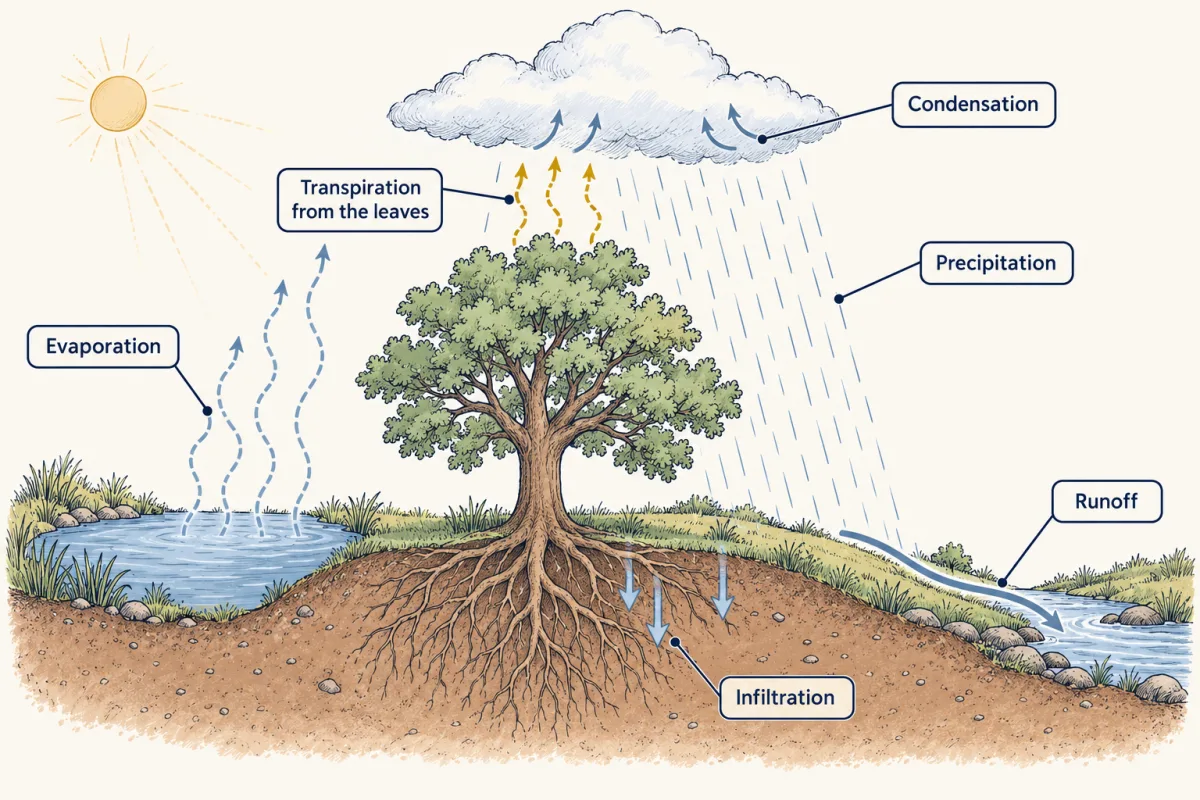
The oak’s leaves let water out, and the same leaves let carbon dioxide in. The second film shows what happens when one door serves both cycles.
Read the transcript of “One Door for Two Cycles”
Film transcript: One Door for Two Cycles
Can a dry summer change the carbon dioxide in the air? To answer that, we have to follow water, not carbon. The first film showed the air as a tub of carbon. The oak's green arrow drained it every summer. Now follow the oak's water instead. Rain falls on the yard. That is precipitation. Some of it soaks into the ground, which is infiltration.
Some flows downhill to a stream. That is runoff. The oak's roots take water from the soil. It moves up the stem to the leaves. Then it leaves through tiny openings in the leaves, as water vapor. That is transpiration. Water also evaporates from the pond, and most of all from the ocean. High up, the vapor cools into tiny droplets that form clouds. That is condensation. Then rain falls again. Plants move a lot of this water. One study estimated that nearly two thirds of the water moving from land into the air goes through plants. The estimate has a wide range. Now zoom into one leaf.
Carbon dioxide comes in through the same tiny openings that water vapor goes out of. One door serves both cycles. Inside the leaf, photosynthesis uses water and carbon dioxide together to make sugar. The water came up from the roots. The carbon dioxide came in through the door. Now a hot, dry summer. The soil dries out, and the oak closes its tiny openings to save water. What happens to the green arrow on the air tub? Pause and predict.
It gets thinner. With the openings nearly closed, less carbon dioxide gets in. So the oak takes less carbon out of the air. This happens in real forests. In 2003, Europe had a very hot, dry summer. One study estimated that plants there took in about 30 percent less carbon than usual. One thing in this picture does not cycle.
Carbon and water go around and around, used again and again. Energy does not. It comes in as sunlight and leaves as heat, so plants need new sunlight every day. The two cycles are linked at the leaf. Water going out and carbon dioxide coming in pass through the same tiny openings. So a change in one cycle can change the other.
From the film
- Water moves by evaporation, condensation, precipitation, infiltration and runoff, and plants send it back to the air by transpiration.
- One study estimated that nearly two thirds of the water moving from land into the air goes through plants. The estimate has a wide range.
- Carbon dioxide comes into a leaf through the same tiny openings that water vapor goes out of.
- In dry weather plants close those openings to save water, so they take in less carbon dioxide. One study estimated about 30 percent less across Europe in the hot, dry summer of 2003. So a change in one cycle can change the other.
- Carbon and water are used again and again; energy comes in as sunlight and leaves as heat.
Explain: how the cycles connect
Beyond the leaf’s one door, the cycles also meet here:
| Process | What happens to carbon | What happens to water |
|---|---|---|
| Photosynthesis | Taken from the air and built into sugar | A little is used in the leaf. Most of the water roots take up leaves by transpiration |
| Respiration | Carbon in sugar becomes carbon dioxide, which is released | Water is made in cells |
| Transpiration | Carries no carbon, but uses the same tiny openings that let carbon dioxide in | Released to the air as vapor |
| Runoff | Carried to streams | Flows to streams |
Water flowing off a Virginia field can carry soil, nutrients and carbon into a stream that flows to the Chesapeake Bay.
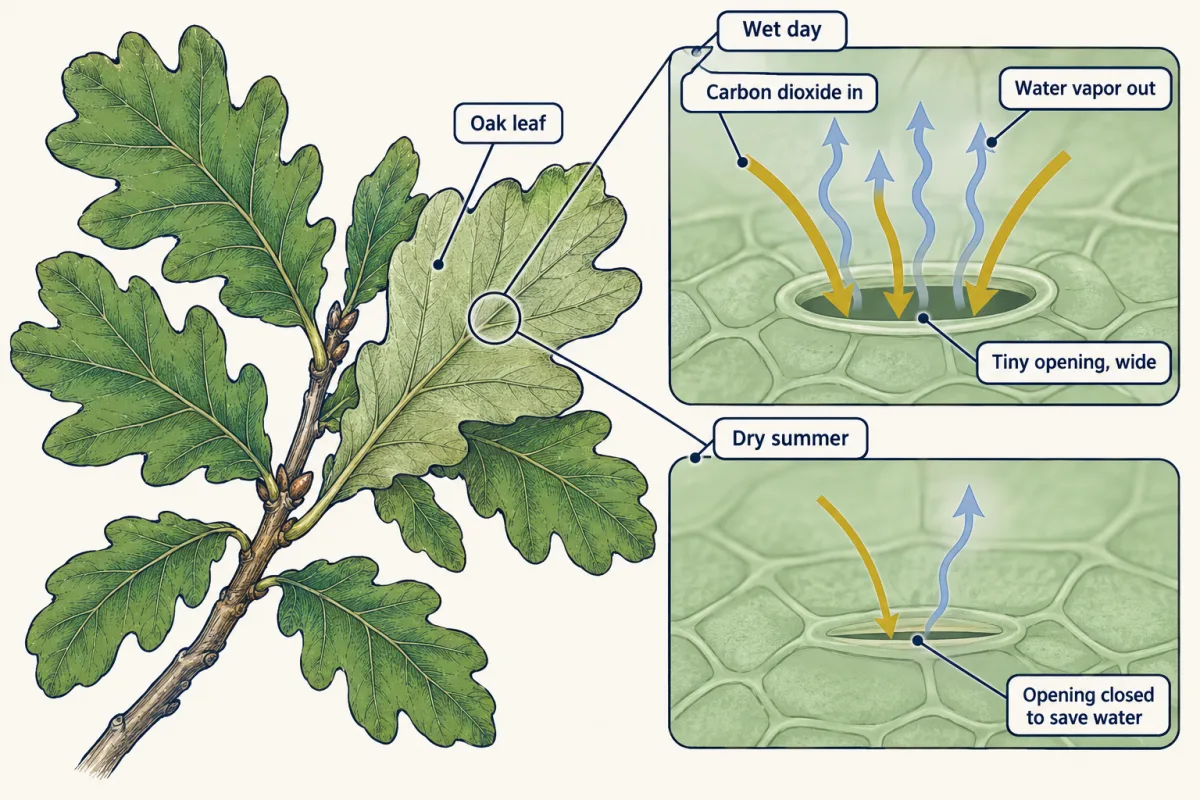
Energy is the one thing that does not cycle; you traced its flow in Food Webs and Energy.
Elaborate: a year of air at Mauna Loa
The monthly values behind the change table: average carbon dioxide in clean, dry air, 2025.
| Month (2025) | Carbon dioxide (ppm) | Month (2025) | Carbon dioxide (ppm) |
|---|---|---|---|
| January | 426.65 | July | 427.87 |
| February | 427.09 | August | 425.48 |
| March | 428.15 | September | 424.37 |
| April | 429.64 | October | 424.87 |
| May | 430.51 | November | 426.46 |
| June | 429.61 | December | 427.49 |
Source: NOAA Global Monitoring Laboratory and Scripps Institution of Oceanography, monthly averages at Mauna Loa Observatory, Hawaii, about 3,400 meters up (file co2_mm_mlo.txt, created October 9, 2026). The same file gives 317.51 ppm for May 1958.
-
How many ppm apart are the highest and lowest months? Describe the trend from September to December.
-
Jordan subtracts January 2025 from December 2025, gets 0.84 ppm, and says the record climbs less than 1 ppm a year. But those months sit at different points of the yearly swing. Compare May 2025 with May 1958 instead: subtract, then divide by the years between. About how much did the record climb each year?
Check your work
430.51 − 317.51 = 113 ppm over 67 years, about 1.7 ppm a year on average.
Claim, evidence, reasoning
Make a claim that answers the essential question: why does the air’s carbon dioxide go up and down every year? Use the 2025 Mauna Loa data.
Start with: The carbon dioxide at Mauna Loa goes down in summer because blank.
Start with: It fell from blank ppm in blank to blank ppm in blank, a drop of blank ppm.
Start with: In the northern summer, plants take in more carbon dioxide than blank and blank release, and in fall and winter blank.
Compare with a model answer
The carbon dioxide at Mauna Loa falls in summer because northern plants take in more carbon dioxide by photosynthesis than respiration and decomposition release. It fell from 430.51 ppm in May to 424.37 ppm in September 2025, a drop of 6.14 ppm. In fall and winter, photosynthesis slows and many leaves drop, but respiration and decomposition continue, so it rose again to 427.49 ppm by December. One limit: this is one station and one year, and the numbers alone do not prove the cause. Other evidence about plants supports it.
Saved in this browser only.
Design problem
Does light change how much water a plant releases through its leaves? Plan an investigation with potted plants.
Saved in this browser only.
One way to do it
- Question: Do plants in bright light lose more water by transpiration than plants in shade?
- Independent variable (what you change): light, either under a bright lamp or on a shaded shelf.
- Dependent variable (what you measure): the loss in mass of each pot, in grams, after 48 hours.
- Constants (what you keep the same): same kind and size of plant, same pot and soil, same watering, same room temperature.
- Control: a pot of wet soil with no plant in each place. It shows any water lost some other way.
- Setup: so water can leave only through the plant, wrap the soil surface in plastic.
- Repeated trials: three plants in each place. Find the mean loss.
- Safety: use a common, nontoxic houseplant, wash your hands after handling soil, and wipe up spills.
If the plants in light lose more mass than those in shade, the data support the idea that light speeds up transpiration.
Evaluate: check your thinking
Your CER explained the yearly swing. Compare May with May across the years, and the record also climbs, mostly because burning fossil fuels adds old carbon. The oak’s water is now in the air and may form a cloud. Some of the carbon in your body can someday return to the air.
Science practices you used: reading a data table, subtracting with data, using a model and naming its limits, making a claim with evidence and reasoning, and planning a fair test.
Going deeper
This part is optional.
- Ocean photosynthesis. Tiny algae and bacteria floating in the ocean do about half of all the photosynthesis on Earth.
- A name for the openings. Scientists call the tiny openings in leaves stomata.
- Another cycle joins in. Nitrogen cycles through living things too, as you will see in Nitrogen for Life.
Your notes
Select any text in the lesson to highlight it or add a note to it. Your highlights and notes are saved in this browser and collected in your notebook.
This browser is not letting the site save anything (a private window or strict privacy settings), so highlights and notes will be lost when you leave the page.
How we measure it
Carbon dioxide analyzer
The analyzer passes light through a sample of dried air, and carbon dioxide absorbs some of that light. It is checked often against gases with a known amount of carbon dioxide, so it can report the amount in parts per million (ppm).
Monthly averages of clean air
Scientists keep only the hours when the air at the station is clean, background air, average them into daily values, and then average the days into one value for each month. Monthly averages make the seasonal rise and fall easy to see.
Where this lesson fits
Before thisReview first
- Partners in EnergyThis course · Lesson 11
You use both processes here as the flows that take carbon out of the air and put it back.
- Producers, Consumers and DecomposersThis course · Lesson 13
Decomposers returning carbon to the air and soil is one of the four flows in this lesson.
- Photosynthesis Feeds the WorldThis course · Lesson 9
Plants building sugar from carbon dioxide and water is the flow that drains the air tub.
After thisStudy next
- Big Changes: Dead Zones, Storms and ClimateThis course · Lesson 24
Extra carbon in the air and runoff carrying nutrients into water are used to explain big ecosystem changes.
- People Change HabitatsThis course · Lesson 25
People change the cycles you studied here, for example by burning fuel and changing land.
Elsewhere on the siteFilms, simulations and method films in other courses
- Follow an atomSimulation · Biology
It lets you follow a carbon atom through air, living things, soil and ocean, as the box model here does.
- Set Up: Thirsty CeleryFilm · Biology Together
It shows water travelling up a plant, the path water takes before leaving leaves as transpiration.
- We All Live DownstreamFilm · Biology Together
It shows rain running downhill, which is the runoff part of the water cycle.
Suggested by an AI model from the lessons themselves, then checked. How we use AI
Finish line
Test yourself
8 questions
Practice and MCAT-style, with explained answers.
Next · Lesson 15
Nitrogen for Life
If the air is mostly nitrogen, why does a cornfield need nitrogen added while the soybeans next door often do not?
Continue →