Life Science · Unit 8: Change over time
Extinction and Survival
Rewritten on : new text, flashcards and film. Your notes and highlights stay, but the text around them may have moved.
American chestnut trees were once common in Virginia’s Blue Ridge. Why did a fungus nearly wipe them out, while their roots still send up sprouts today?
Pause when the reading reaches a film, and offer to play it. Saved on this device.
Watch the film now, or keep listening
Builds on:Natural Selection in ActionMutations and VariationPeople Change HabitatsWhy these?
Where this lesson sits
- Virginia SOL LS.11 a
- Virginia SOL LS.11 c
- Practices LS.1 a, LS.1 c, LS.1 d, LS.1 e
Essential question: Why do some species survive big changes while others disappear?
-
Life Science (grade 7) LS.11 a, LS.11 c You are here
This lesson
-
Biology
Preview it at high school level
In Biology you will learn how scientists measure natural selection with survival data, such as the share of animals with a trait before and after a strong pressure. You will see why populations make far more young than can ever survive, so that only some of them live to reproduce. You will also learn where new variations come from: mutations, the mixing of chromosomes when sex cells form, and animals or pollen moving between populations. This explains why a population with more genetic variety is more likely to have survivors when a new disease or a big change arrives.
-
Biology II Biology II: Advanced Survey of Biology Topics, BIOII.5 a and b; Ecology, EC.5 c
Preview where it goes next
In Biology II: Advanced Survey of Biology Topics, you name selective pressures such as disease, predators and climate, and measure relative fitness, which compares how many offspring different variants leave. You see why genetically diverse populations are more resilient to new diseases. The Ecology course adds life history patterns: some species make many young with little care, others few young with much care, and survivorship curves show at what ages most members die. These patterns help predict which species recover after a disturbance.
-
College
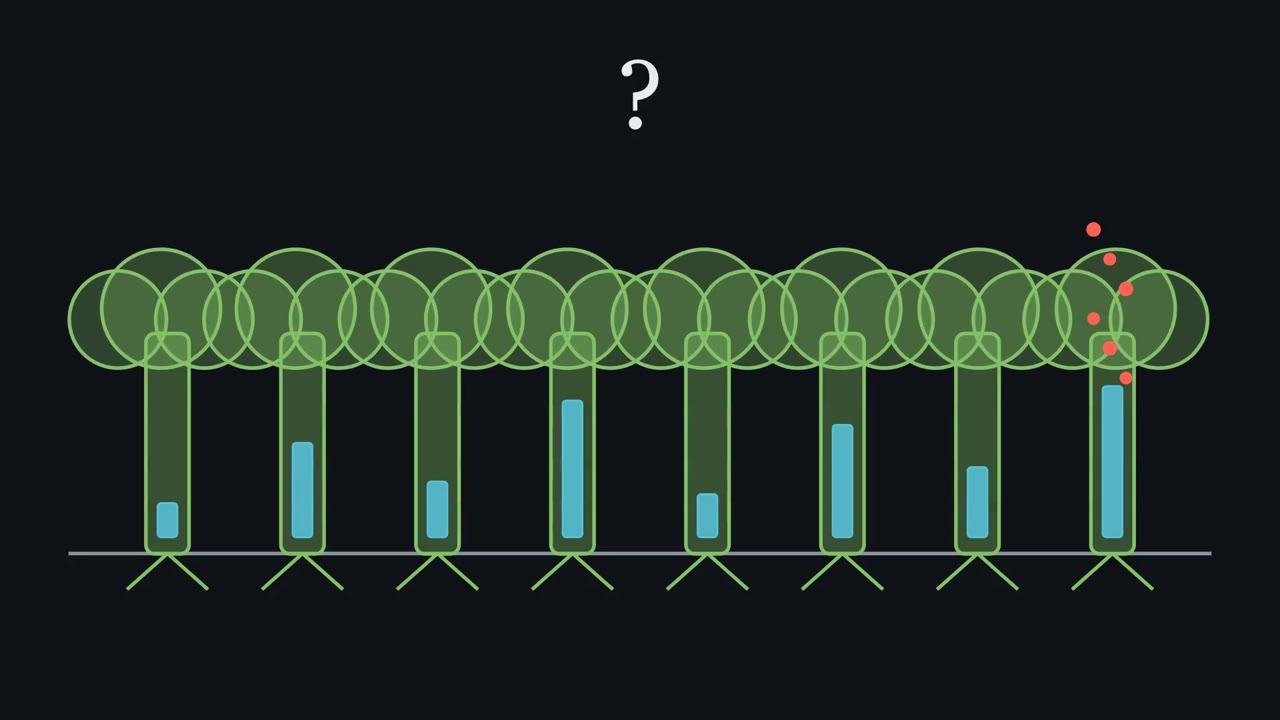 ▶ Watch Who Makes It Through the Change? · 3:28
Read the transcript of “Who Makes It Through the Change?”
Film transcript: Who Makes It Through the Change?
A red blight moves into a forest where the trees look alike. What decides whether this population continues or disappears? Watch the trees, their blue resistance bars, and the yellow seeds that mark a next generation. After a change, some members of a population die and some live.
Living members may reproduce. Some migrate, meaning they move elsewhere, where they must still survive. A species is extinct only when no living members remain anywhere. Losing a species from one forest is not the same thing. Now look inside each tree. The blue bar represents inherited resistance, the ability to hold off the blight. Different bar heights show genetic variation in this useful trait. The tree cannot raise its bar because danger arrives. It begins with traits inherited from its parents. Red cankers spread through the bark.
Trees with shorter blue bars are more likely to fade. A taller bar does not promise survival. It only changes the chance. Survivors that make yellow seeds can pass inherited traits into the next generation. Compare these forests. Every tree in the narrow forest has a short resistance bar. The varied forest includes short, middle, and taller bars. Which forest is more likely to leave seed-making survivors after the blight?
The varied forest has a better chance because some helpful differences were already present. Yet it could still lose every tree. Variation in leaf shape or height would not solve this problem. The difference must help with this change. Helpful differences can appear later or arrive from elsewhere, but a fast change may leave too little time. Green trees remain after the blight. If they never make seeds, their population still has no next generation.
Now yellow seeds fall and seedlings rise. Here is the rule. When environments change, populations survive only if some members survive and reproduce. A bird can leave a changed place. A rooted chestnut cannot, though seeds may spread its kind over time. Habitat loss, pollution, climate change, and invasive species create different challenges. The same test remains: can any members survive and reproduce? Follow the forest once more. Red blight arrives. Blue resistance differs. Some trees remain, and yellow seeds start another generation. A population continues only when living members make a next generation. This rule names a requirement, not a guarantee.
A model forest is not a real forest. Next, test the rule in a model forest. Then read the real American chestnut data below.
From the film
- When environments change, populations survive only if some members survive and reproduce.
- After a change, some members die and some live; living members may reproduce, and some migrate.
- Genetic variation helps only when some inherited differences fit the change.
- Variation can improve the chance of survivors, but it cannot guarantee survival.
Now use the first film’s rule on American chestnuts, once common in Virginia’s Blue Ridge. People ate their nuts. Then a fungus arrived from Asia and, by about 1950, killed billions. Old roots still send up sprouts. Why did this tree nearly disappear when others did not? What could help it return?
The one idea: When environments change, populations survive only if some members survive and reproduce.
Scope: This rule is about populations facing environmental change. Variation can improve the chance of survivors, but it cannot guarantee survival.
What do you think? Decide before you read.
-
Scientists disagree: A chestnut tree cannot grow resistance because it needs it. Its inherited traits come from its parents. When scientists test young chestnut trees in forests, some groups resist the blight much better than others. When a change comes fast, survival depends mostly on inherited differences already in the population.
What scientists think
Scientists disagree: A chestnut tree cannot grow resistance because it needs it. Its inherited traits come from its parents. When scientists test young chestnut trees in forests, some groups resist the blight much better than others. When a change comes fast, survival depends mostly on inherited differences already in the population.
-
Scientists disagree: Species still go extinct. In 2023 the U.S. Fish and Wildlife Service took 21 species off its list of endangered and threatened wildlife because they were judged extinct. Most had not been seen for decades, so 2023 is when the decision was made, not when they died out. Habitat loss, pollution, climate change and invasive species put many living species at risk today.
What scientists think
Scientists disagree: Species still go extinct. In 2023 the U.S. Fish and Wildlife Service took 21 species off its list of endangered and threatened wildlife because they were judged extinct. Most had not been seen for decades, so 2023 is when the decision was made, not when they died out. Habitat loss, pollution, climate change and invasive species put many living species at risk today.
-
Scientists disagree: Forest surveys estimate that millions of small chestnut stems are still alive. But most are sprouts from old roots. Blight keeps killing them back, and few make seeds in the wild. A species is safe only if enough members survive and reproduce.
What scientists think
Scientists disagree: Forest surveys estimate that millions of small chestnut stems are still alive. But most are sprouts from old roots. Blight keeps killing them back, and few make seeds in the wild. A species is safe only if enough members survive and reproduce.
Explore: send a change through a forest
In this model, a forest has 50 trees. Each tree has a hidden level of resistance to harm. Choose how much variation the forest has, which change arrives (a blight, habitat loss or a warmer climate), and how many years to run. Surviving trees make seedlings with their own resistance. A line graph shows how many trees remain.
none some strong resistance (shown after year 0) died this year cleared ground small tree = new seedling
Solid line = trees in the run you see. Dashed line = average of many sketch runs with these settings.
Made up for this sketch (not measurements): resistance is one trait with three levels, none, some and strong. Low variation: 2 trees have some resistance. High variation: 12 have some and 6 have strong. A tree lives through one year of the blight with a chance of 2, 30 or 80 in 100 (none, some, strong), and through the warmer climate with 30, 70 or 95 in 100. Habitat loss clears one strip of 5 places a year, up to 10 strips, and cleared ground stays empty, whatever a tree’s resistance. Each empty place next to a survivor has a 50 in 100 chance of a seedling that copies that parent and counts as a tree at once. No migration, no new traits, no other species. The forest stands for the whole species.
Rule to keep: a population with more genetic variation is more likely to have survivors that pass on a helpful trait, but only if that trait is already present. This is a sketch of the logic, not a prediction for real chestnuts.
Try this.
- The first film’s narrow forest lost every tree in one schematic run. Set low variation, send in the blight, and see whether your run matches.
- Keep the blight, but switch to high variation. Compare your line with the film’s varied forest.
- Keep the blight and high variation. Run the same settings three times.
- Send in habitat loss with high variation. Predict whether more variation saves the forest, then explain what you see.
Predict. Will three runs with the same settings give exactly the same line? Why?
Check your prediction
They may differ because the model includes chance. Repeated runs show possible outcomes, not one certain future.
Explain: survive, move or die
- migrate
- extinct
- extinction
- habitat loss
- pollution
- climate change
- invasive species
- genetic variation
- resistance
As the first film showed, after a change some members die, some live and may reproduce, and some migrate (move to a new place).
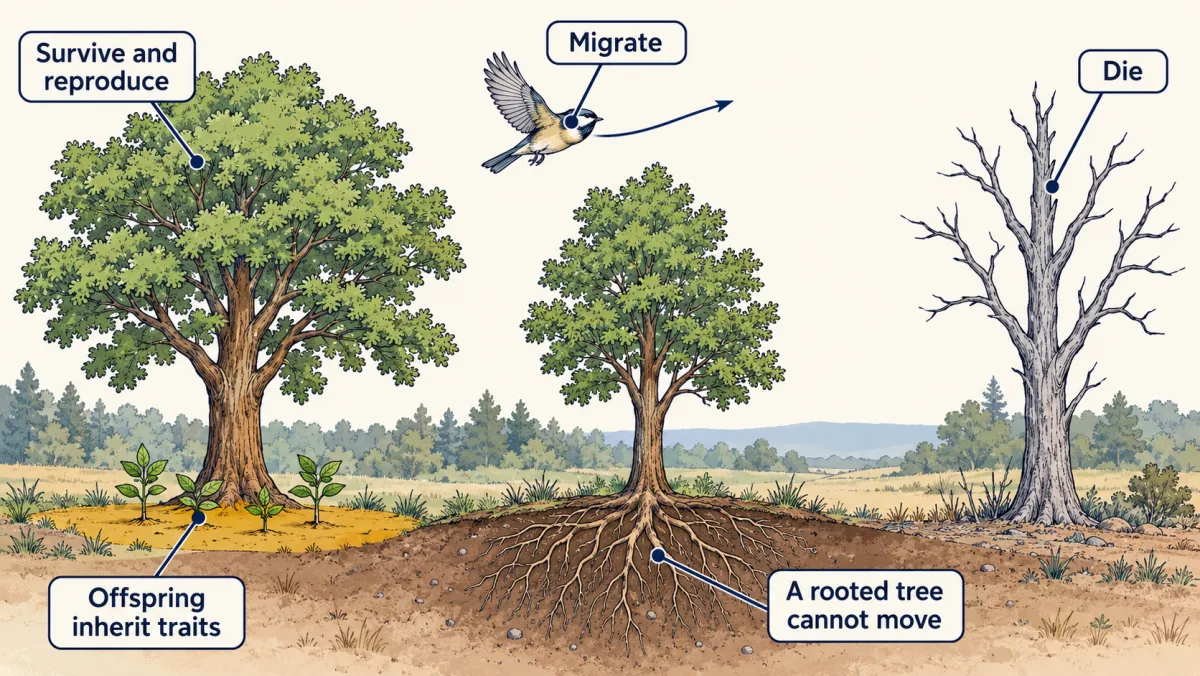
A species is extinct when no living members are left anywhere. Extinction is the dying out of a whole species.
If no member has traits that let it survive a change, the species may become extinct. Natural selection explains why helpful inherited traits can become more common, as you saw in that lesson. Fossils show that many species went extinct long before people lived, which that lesson explores.
The American chestnut is not extinct. Millions of sprouts still grow from old roots. But the big nut-making trees are gone from most of the canopy, the top layer of leaves in a forest.
Explain: four changes that challenge populations
Hunting, fishing or harvesting too much puts species at risk. This lesson looks at four other changes.
- Habitat loss is the destruction of the place where an organism lives. Clearing a forest for houses removes homes for animals that nest in old trees.
- Pollution is harmful material added to air, water or soil. Too much fertilizer washing into a bay can feed algae, and low oxygen for fish can follow.
- Climate change is a long shift in the usual weather of a region, such as warmer average temperatures. Fish that need cold streams may lose places to live as water warms.
- An invasive species is a living thing brought to a new place, where it spreads and causes harm. Blue catfish in Virginia’s rivers are one, as that lesson shows. The chestnut blight fungus is another.
Predict. A forest loses old nesting trees, but no harmful material is added. Which kind of change is this?
Check your prediction
It is habitat loss: the organisms lost part of the place they need.
The blight fungus reached North America on chestnut trees brought from Asia. It grows into the bark of an American chestnut and makes a sore called a canker. The canker can kill the whole trunk above the ground. The roots, safe in the soil, often live and send up new sprouts. Those sprouts get infected and die back too, a cycle that can go on for decades.
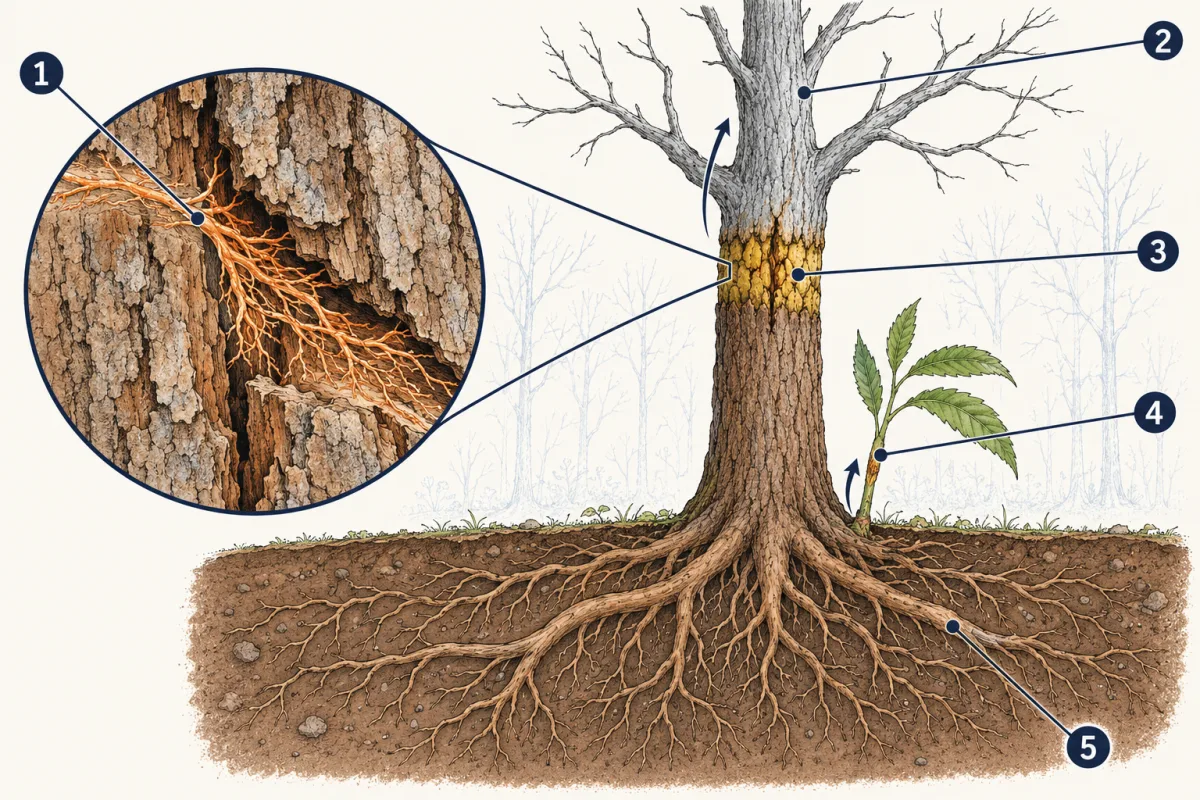
- blight fungus
- dead trunk
- canker
- sprout
- roots
- blank
- blank
- blank
- sprout
- roots
Word bank: blight fungus, canker, dead trunk
- blank
- blank
- blank
- blank
- blank
Check your labels
- blight fungus
- dead trunk
- canker
- sprout
- roots
Explain: why variation matters
Genetic variation means inherited differences among members of a population. One inherited difference can be resistance, the ability to hold off a disease or another threat better than other members can.
When a new disease arrives, a population with more variation in resistance is more likely to have some members that resist it. Variation in other traits cannot stand in for resistance. When a change comes fast, the helpful trait usually has to be there already. New helpful differences can appear or arrive from other populations, but often too slowly to save a species from a fast change.
American chestnuts had very little resistance to this fungus, so almost all of the big trees died. Surviving chestnuts still carry plenty of genetic variation, including some differences in blight resistance between families. Yet as a group, they resist the blight far less than Chinese chestnuts do. A few survivors do not make a species safe; they must also reproduce.
Elaborate: read the chestnut data
| When | What was measured | Value | Unit |
|---|---|---|---|
| Before 1930 | Chestnut share of 719 canopy trees, White Oak Canyon | 15.2 | percent |
| August 1977 | Chestnut share of canopy trees, 10 sites, 100 trees each | 0 | percent |
| June 2021 | Chestnut share of canopy trees, same 10 sites | 0 | percent |
| 1977 | Sampling points with a chestnut sprout nearby, found in 20 person-hours of searching | 176 | points |
| 2021 | Chestnut sprouts found in 40 person-hours of searching | 42 | sprouts |
| 2002 to 2012 | Live chestnut stems, eastern U.S. forests (estimate) | 431 | million stems |
Canopy and sprout values: Richard Karban and Claire C. Karban, PLOS ONE (2024), for White Oak Canyon in Shenandoah National Park, Virginia. The first survey’s exact year is unknown. The later canopy surveys returned to the same 10 sites, but they did not count the same marked trees. The sprout searches used the same sites but different methods. In 1977 researchers checked 400 sampling points, and 176 of them had a sprout nearby. In 2021 they counted the sprouts they found. Stem estimate: Dalgleish and colleagues, Forests (2016), using USDA Forest Service plots measured from 2002 to 2012.
Predict. How many percentage points did the chestnut share of the canopy change from before 1930 to 1977?
Check your prediction
It fell 15.2 percentage points. The sample shows local canopy loss, not extinction everywhere.
Predict. One person-hour is one person searching for one hour. Divide each count by its person-hours. Which year had fewer sprout finds per person-hour? Why is this only a rough comparison?
Check your prediction
1977: 176 ÷ 20 = 8.8 points with a sprout per person-hour. 2021: 42 ÷ 40 = 1.05 sprouts per person-hour. Finds per hour were lower in 2021. The comparison is rough because 1977 counted points, not sprouts.
Chestnuts were gone from the later canopy samples, yet sprouts and millions of small stems remained. What could turn survival below the canopy into seed-making trees above it?
Read the transcript of “From Sprouts to Seed-Making Trees”
Film transcript: From Sprouts to Seed-Making Trees
The first film showed that a population needs survivors that reproduce. American chestnut roots still send up living sprouts. Why has that population not recovered? Keep the same colors. Green marks living chestnut tissue, red marks blight, blue marks inherited resistance, and yellow marks seeds. A green root remains underground. It sends a leafy sprout upward. Red fungus grows into a crack in the bark. A canker widens around the young trunk. The trunk above it fades grey, while the protected root stays green. Soon that root sends up another sprout. The cycle repeats. The forest contains living chestnut stems, but the sprouts rarely become seed-making canopy trees. Living stems alone do not show that the population is recovering.
Freeze the cycle after a new sprout appears. No yellow seeds are present. If every sprout dies before making seeds, can these sprouts rebuild a lasting population? No. Each green sprout proves that living tissue remains, so the species is not extinct. But if sprouts die before making seeds, no new generation replaces the old roots. In the wild, few sprouts make seeds.
Survival requires survivors to reproduce, not merely remain alive. How might people change that path? Breeders begin with American chestnuts and Chinese chestnuts that resist blight better. They cross the trees. Then they expose the offspring to blight. Blue resistance bars differ among the offspring. People choose the most resistant young trees. Then they cross those back to American chestnuts and test again. That is artificial selection. People choose which trees reproduce, instead of letting the environment alone decide. The goal is not simply more differences. It is inherited resistance strong enough to help trees survive, make seeds, and grow a next generation.
Other traits still matter, but they cannot replace resistance to this fungus. Crossing does not promise recovery. Breeders need repeated tests across many families and sites. These tests ask how well young trees survive and resist blight. Some scientists have also tried adding one gene from wheat. In tests, it helped American chestnuts resist blight. That work is still being checked. Both paths ask one question. Will enough trees survive, reproduce, and keep reproducing? Return to the underground root. A sprout alone keeps the past alive. Seed-making trees can begin the future. For this forest, recovery means living through blight and producing the next generation.
That is why the chestnut can remain alive yet fail to recover. The rule for this film is narrower: survival requires survivors to reproduce, not merely remain alive.
From the film
- Survival requires survivors to reproduce, not merely remain alive.
- Living chestnut roots can send up sprouts even when canopy trees are gone.
- Repeated blight can kill sprouts before they make seeds.
- Breeders cross American and Chinese chestnuts, test the young trees with blight, then cross the most resistant ones back to American chestnuts.
- When environments change, populations survive only if some members survive and reproduce.
Test whether breeding helped
The second film showed breeders crossing American and Chinese chestnuts, testing the young trees and crossing the most resistant back to American chestnuts. In the real program, scientists with The American Chestnut Foundation repeat these steps over several generations. They work at research farms in Meadowview, in southwest Virginia. So the new trees are mostly American but carry some resistance from the Chinese parent. This is artificial selection: people, not the environment, choose which trees breed. Some scientists have also tried adding one gene from wheat. It helped American chestnut trees resist blight in tests, but this work is still being checked.
Did breeding help? Look at two test forests.
| Tree group | Mean rating, North Carolina site (1 to 4 scale) | Mean rating, Virginia site (1 to 4 scale) |
|---|---|---|
| American chestnut, family GMNEW | 2.5 | 2.9 |
| Chinese chestnut | 3.9 | 3.9 |
| Hybrid, family D2 | 3.7 | 3.4 |
These ratings come from Clark and colleagues, Forest Ecology and Management (2019). Young trees were planted in forests in 2009 and rated from 2013 to 2016. A score of 1 means the tree was assumed dead from blight, and 4 means no visible disease. The hybrid seedlings came from the Meadowview farms. Each row is one family of seedlings, not a whole species, and D2 was one of the best hybrid families.
Predict. At the Virginia site, the hybrid family rated 3.4 and American family GMNEW rated 2.9. Does that difference prove hybrids always resist blight better?
Check your prediction
No. The difference is 0.5, but it was not clear at that site. One family cannot represent all chestnuts.
Claim, evidence, reasoning
Make a claim that answers the question: why did the American chestnut nearly disappear, and what could help it survive? Use these data.
Start with: The American chestnut nearly disappeared because blank, and blank could help it survive.
Start with: In White Oak Canyon, chestnut made up blank percent of canopy trees before 1930 and blank percent in 1977. At the North Carolina test site, American chestnut rated blank and the hybrid rated blank.
Start with: Trees with little resistance blank, so blank. Breeding can help because blank.
Compare with a model answer
The American chestnut nearly disappeared from the canopy because an invasive fungus killed trees that had little resistance. In White Oak Canyon, chestnut made up 15.2 percent of canopy trees before 1930 and 0 percent in 1977 and 2021. Breeding for resistance could help: at the North Carolina site, where blight was heaviest, the hybrid family rated 3.7 and American chestnut 2.5 on a 1 to 4 scale. The data have limits. The canopy data come from one canyon. Each row of the ratings table is a single family, rated only in years 5 to 8 after planting. At the Virginia site the American and hybrid ratings (2.9 and 3.4) were not clearly different.
Saved in this browser only.
Design problem
Plan a test of whether plants with more variation have more survivors after a hard change. Use garden seeds, not chestnuts.
Saved in this browser only.
One way to do it
- Question: After a dry spell, do more seedlings survive in a pot with three radish varieties than in pots that each hold just one of those varieties?
- Independent variable: the number of varieties in a pot (one or three). Also grow each variety alone, so one hardy variety cannot explain the result.
- Dependent variable: the number of seedlings still alive after 14 days.
- Constants: 30 seeds per pot, the same soil, pot size, light, and 50 mL of water each time.
- Control: a pot of each kind watered every two days, with no dry spell.
- The change: after the seedlings sprout, water the test pots only once a week.
- Repeated trials: three pots of each kind.
- Also measure: seedling height in centimetres.
- Safety: wash your hands after handling soil, and never taste seeds, since some are coated with chemicals.
More survivors in the mixed pots, on average, would support the claim. Different varieties of one plant are only a model of variation.
Evaluate: check your thinking
The American chestnut nearly disappeared because an invasive fungus met trees with little resistance. Its roots still sprout, but few make seeds. Breeding with Chinese chestnuts can add some of the missing resistance. But the best hybrids still resist less well than Chinese chestnuts at some sites.
Science practices you used: testing predictions with a model, reading data tables, calculating a rate, making a claim with evidence and reasoning, and naming the limits of a model and of data from one place.
Going deeper
Small populations and chance
In a very small population, a trait can disappear by chance if the few members that carry it die before they reproduce.
More about the chestnut ratings
A second American family at the Virginia site rated 2.4. About 40 percent of the Virginia trees were also hurt by an accidental weed-killer spray in year 5.
Your notes
Select any text in the lesson to highlight it or add a note to it. Your highlights and notes are saved in this browser and collected in your notebook.
This browser is not letting the site save anything (a private window or strict privacy settings), so highlights and notes will be lost when you leave the page.
How we measure it
Canopy tree survey
Researchers walk to marked sites and name the species of each tall tree whose leaves reach the top layer of the forest. Counting each species gives its percent of the canopy, and repeating the survey years later shows what changed.
Forest inventory plots
The USDA Forest Service measures trees in many sample plots spread across the country. Scientists use these samples to estimate how many stems of a species grow across a whole region, and how big they are.
Blight rating
Each year, researchers look at every young tree in a test planting and give it a score from 1 (assumed dead from blight) to 4 (no visible signs of disease). Comparing mean scores shows which groups of trees resist the blight better.
Where this lesson fits
Before thisReview first
- Natural Selection in ActionThis course · Lesson 32
The lesson says helpful inherited traits become more common, as shown there, and uses that idea for survivors.
- Mutations and VariationThis course · Lesson 31
You need to know where inherited differences come from to see why a varied population is more likely to have survivors.
- People Change HabitatsThis course · Lesson 25
Habitat loss and invasive species, like blue catfish, are two of the four changes used here.
After thisStudy next
- Variation and SurvivalOne level up · Biology
It takes the idea further by showing how variation lets a population change when conditions shift.
Elsewhere on the siteFilms, simulations and method films in other courses
- The Drought Sorts a PopulationFilm · Biology
It shows a drought sorting a population so that carriers of helpful inherited traits leave more offspring.
Suggested by an AI model from the lessons themselves, then checked. How we use AI
Finish line
Test yourself
8 questions
Practice and MCAT-style, with explained answers.
That's the last lesson · Next course
Biology
High school Biology, aligned to the Virginia Standards of Learning, with supports for every reader.
Start the next course →Before you move on: review the questions you missed , or go back to all lessons in this course.