Genetics and Molecular Biology · Unit 4: From gene to protein, and its control
The lac Operon: How Bacteria Regulate Genes
Rewritten on : new text, flashcards and film. Your notes and highlights stay, but the text around them may have moved.
Give E. coli glucose and lactose together and it uses the glucose first, pauses, then starts on lactose. How does one cell choose which genes to express, and when?
Pause when the reading reaches a film, and offer to play it. Saved on this device.
Watch the film now, or keep listening
Builds on:Transcription: From DNA to RNAComplementation and Gene Function: From Beadle and Tatum to BenzerBacterial and Phage Genetics: Conjugation, Transduction and TransformationWhy these?
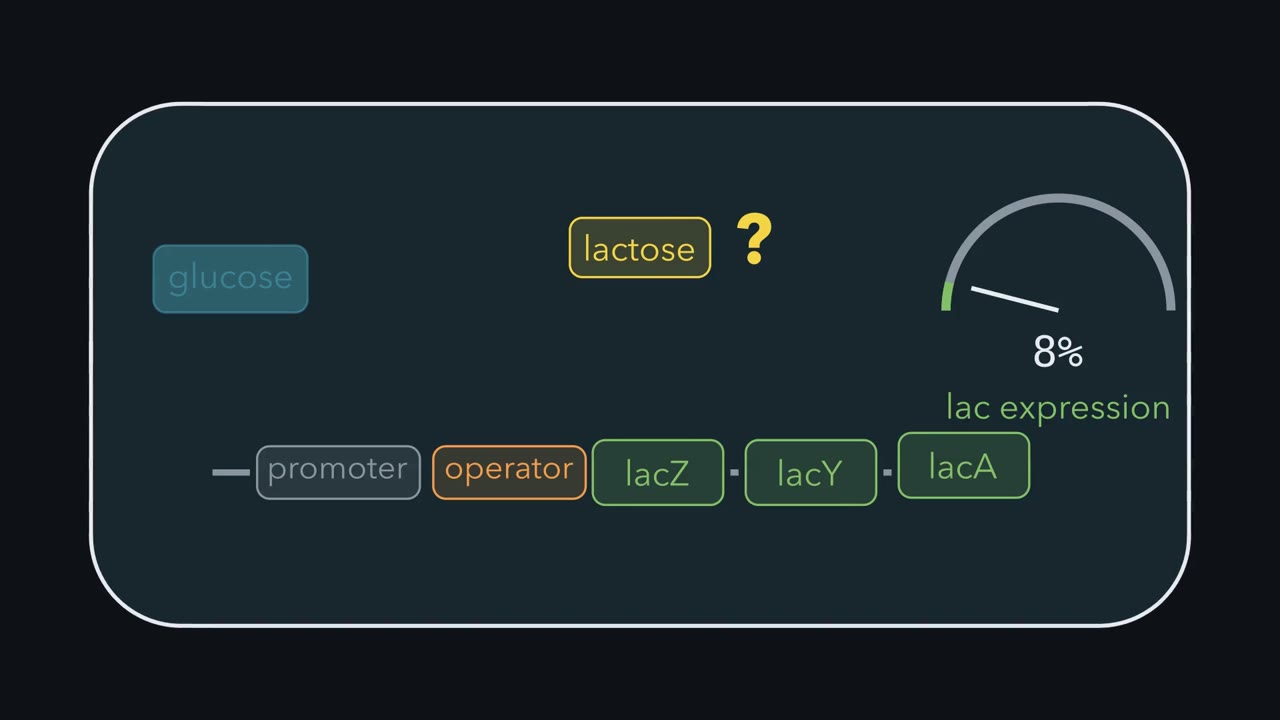 ▶ Watch When Are the lac Genes High? · 3:41
Read the transcript of “When Are the lac Genes High?”
Film transcript: When Are the lac Genes High?
Why does a bacterium offered glucose and lactose postpone the lactose genes? Follow one promoter inside a single cell. Two signals must line up before its output becomes high. The rail carries the lacZ, lacY, and lacA genes after one promoter. Polymerase can copy them into one messenger RNA. Together, these genes form one operon and produce one messenger with three coding regions. But a red repressor clamp grips the operator beside that promoter. The clamp blocks transcription. Yellow lactose crosses the membrane through permease. β-Galactosidase turns a little lactose into allolactose, the natural inducer. Lactose itself is not the inducer; conversion matters.
Allolactose reshapes the clamp and lowers its affinity for the operator. The clamp loosens, so polymerase can move. This creates a loop. Permease and β-galactosidase help produce the signal that increases their own production. The loop can amplify a small beginning into stronger production when conditions allow. Basal leak supplies a few starting proteins. So the switch is not perfectly binary. Removing the brake is only one input. The promoter is weak by itself. Teal CAP, carrying cyclic AMP, docks upstream. It contacts polymerase and helps transcription start. The activator does not remove repressor. Each regulator has a different job. This is positive control.
Glucose changes both inputs. In the classic account, cyclic AMP is lower when glucose is plentiful. How much this matters in living cells is debated. Glucose uptake also makes a transport protein block permease. Less lactose enters, so less allolactose releases the repressor. Now predict one case. Lactose is present, but glucose is also plentiful.
Will the expression meter reach high, or stop below it? Hold both signals in view. The output is reduced, not high and not necessarily absent. Some inducer may release the brake, but activation is weaker and lactose entry is inhibited. The two controls combine without becoming a perfect switch. Without lactose, the repressor keeps expression very low, even when glucose is scarce. With both sugars, expression is reduced. Only lactose with scarce glucose releases the brake and supplies strong activation together. This table predicts expression levels, not whether every cell behaves identically. The promoter is reading two conditions, not naming a preferred food by itself.
Keep the scope clear: this rule describes high expression in wild-type E. coli under the lesson's standard model. In the lab, a synthetic inducer can stand in for lactose.
From the film
- In wild-type E. coli, high lac expression requires lactose and scarce glucose.
- Allolactose lowers the lac repressor's affinity for the operator.
- CAP bound to cAMP helps RNA polymerase start at the weak lac promoter.
- Glucose also reduces lactose entry through inducer exclusion.
The first film followed two inputs to one promoter; this text adds the history and exceptions it skipped.
Jacques Monod, studying bacterial growth around 1940, saw that E. coli given glucose and lactose uses the glucose first, pauses, then grows on lactose. He called this two-step growth diauxie. During the pause, cells make the proteins that handle lactose in quantity, after making only a trickle while glucose lasted.
The one idea. In wild-type E. coli, high lac expression requires lactose and scarce glucose.
Scope: This rule predicts high expression, not a perfectly binary switch. Repression leaks, lactose plus glucose gives reduced expression, and the contribution of cAMP regulation in living cells is debated. “Lactose” here stands for the inducer signal: in the laboratory, a gratuitous inducer such as IPTG (defined below) can stand in for it.
The switch: a repressor that lets go
Three lac genes sit side by side on the E. coli chromosome. lacZ encodes β-galactosidase, which splits lactose into glucose and galactose. lacY encodes the permease that carries lactose in. lacA encodes a transacetylase that is not needed to use lactose and whose role is less clear.
All three are transcribed from one promoter into one polycistronic mRNA (an mRNA carrying several genes), read into three separate proteins. A set of genes transcribed together under one control is an operon. Promoters and RNA polymerase are introduced in the lesson on transcription.
Next to the operon, lacI has its own promoter and encodes the lac repressor. The repressor binds the operator, a short DNA site at the start of transcription, and keeps RNA polymerase from transcribing the genes: negative control, where the regulator stops expression.
The natural inducer is allolactose, which β-galactosidase makes from a little incoming lactose by joining the same sugars with a different bond; lactose itself is not the inducer. It binds the repressor and changes its shape, lowering its affinity for the operator. A molecule that changes a protein’s shape by binding at a separate site is an allosteric effector (protein binding and allostery). In the laboratory, geneticists often use IPTG, a synthetic compound that binds the repressor but is not broken down by β-galactosidase, so the cell does not use it up. Such an inducer is called gratuitous.
The first film’s loop: lactose needs the permease and β-galactosidase, yet both come from the operon it switches on; repression leaks, so an uninduced cell can hold a few copies of each protein.
One repressor on one operator is a useful simplification. The repressor is a tetramer, and the lac region has three operators, O1, O2 and O3. One tetramer can hold two operators at once, looping the DNA between them. One operator is enough for the genetics below; repression-factor measurements are under Going deeper.
CAP and cAMP: the glucose-sensitive input
The repressor reports whether lactose is present. The lac promoter is weak on its own, and high transcription needs an activator, catabolite activator protein (CAP), also called CRP, the cAMP receptor protein. CAP with cyclic AMP bound attaches just upstream of the promoter and contacts the C-terminal part of RNA polymerase’s α subunit, helping polymerase bind and start: positive control.
In the classic account, cAMP is higher when glucose is scarce and lower when glucose is plentiful; how much this change matters in living cells is debated. Glucose does not bind CAP. While glucose is taken up, a protein of the glucose transport system also binds the lac permease and blocks lactose entry. This inducer exclusion is a major glucose effect in E. coli: less lactose enters, less allolactose forms, and more repressor remains on the operator.
For a wild-type cell, the cases are:
| Lactose | Glucose | lac transcription | Why |
|---|---|---|---|
| Absent | Present | Very low | Repressor bound; little active CAP |
| Absent | Absent | Very low | CAP cannot overcome a bound repressor |
| Present | Present | Reduced | Less active CAP, and inducer exclusion |
| Present | Absent | High | Repressor off and CAP–cAMP on |
Only the last row is high: the one idea, in table form.
Predict. The CAP-binding site is mutated so CAP–cAMP cannot attach. With lactose present and glucose absent, should expression match the wild-type high level?
Check your prediction
No. Allolactose can release the repressor, but the weak promoter has lost CAP’s help, so expression remains well below the wild-type induced level.
In your own cells, cAMP acts mainly through protein kinase A (cAMP and PKA), not through CAP.
The partial diploid: telling a site from a product
Some mutants made β-galactosidase with or without inducer; they are constitutive. Some mapped in lacI (I⁻), and some in the operator (Oᶜ, operator-constitutive). In a haploid cell, the two look the same. How can a broken repressor gene be distinguished from a broken binding site?
Read the transcript of “Does the Mutation Stay or Travel?”
Film transcript: Does the Mutation Stay or Travel?
The first film showed a repressor moving on and off its operator. A broken repressor and broken operator can both look constitutive, so how can another lac copy tell them apart? Geneticists place a chromosomal lac region and an F′ lac copy in one cell. This partial diploid is diploid only for that region. Each rail carries its own operator and lacZ reporter. Both DNA copies share the same pool of regulatory proteins. Read the reporter before judging the mutation. Find the working lacZ. Then check the operator beside it. Finally ask which repressor proteins anywhere in the cell can reach that operator. This order prevents a broken reporter from misleading you.
Start with a lacI− allele that makes no working repressor. A normal lacI on the other rail makes red repressor protein. That protein diffuses through the shared cell and binds either normal operator. The missing product arrives from the other copy, so the defect is complemented. lacI− is recessive. Inducer can still release the repressor. Now change an operator itself. The altered orange block never leaves its rail. No other copy can supply a working site. The site cannot diffuse, so its effect stays beside linked genes. A linked working reporter escapes repression. A reporter beside the normal operator remains inducible. Predict this arrangement.
The only working reporter sits beside a normal operator. Normal repressor comes from the other DNA rail. Will the reporter remain controllable by inducer? Yes. The normal repressor reaches the normal operator beside the working reporter. Without inducer, it holds transcription at a low basal level. With inducer, the clamp opens and the reporter turns on. The cell is inducible for active enzyme. The altered operator is linked only to a broken reporter. Swap the reporters while leaving both operators fixed. Now the working reporter sits beside the altered operator. It glows with or without inducer. The phenotype follows the reporter's linkage to the DNA site, not a signal travelling across the cell.
Notice what this test never needed: a purified repressor. Geneticists mapped a travelling product before anyone knew what it was made of. Biochemists later isolated it and found a protein. The genetic rules did not change. Partial diploids turn location into evidence. If an effect stays linked to one rail, suspect a control site. If it reaches both rails, suspect a diffusible regulator. This logic separates a local DNA defect from a shared cellular product. Always read the working reporter first.
From the film
- DNA sites act in cis; diffusible regulators can act in trans.
- A partial diploid carries a chromosomal lac region and a second copy on F′ lac.
- Find the working lacZ reporter, check the operator beside it, then ask which repressors can reach it.
- Normal LacI can reach normal operators on both DNA copies.
The second film answered with a second copy of the region in one cell.
The F factor, the plasmid that lets E. coli mate (bacterial and phage genetics), can carry the lac region; this plasmid is F′ lac. A cell with chromosomal lac plus F′ lac is a partial diploid, or merodiploid: diploid only for those genes.
In 1959 Arthur Pardee, François Jacob and Monod brought lac genes into recipient cells by mating. Jacob, Monod and colleagues then used F′ lac partial diploids to compare mutations on the same DNA molecule (in cis) with mutations on different molecules (in trans). This is the cis–trans logic of complementation and pathways. Its rule: DNA sites act in cis; diffusible regulators can act in trans.
Worked problem: read the reporter first
Genotypes are written chromosome / F′; unlisted lac genes are wild type. Cells lack glucose, so cAMP and catabolite activator protein (CAP) are available. Z⁻ makes no active enzyme, I⁻ makes no working repressor, and Oᶜ binds no repressor. The second film’s method and cases, in notation (“basal” means repressed but not zero, since repression leaks):
| Genotype | No IPTG | IPTG | Why |
|---|---|---|---|
| (a) I⁻ Z⁺ / F′ I⁺ Z⁻ | Basal | Induced | Inducible. The only Z⁺ is beside a normal chromosomal operator, and F′ repressor diffuses to it. I⁻ is recessive. |
| (b) Oᶜ Z⁻ / F′ O⁺ Z⁺ | Basal | Induced | Inducible. The Oᶜ copy is transcribed all the time, but its Z⁻ makes nothing active. The working Z⁺ sits beside O⁺. |
| (c) Oᶜ Z⁺ / F′ O⁺ Z⁻ | Constitutive | Constitutive | Constitutive. The working Z⁺ is linked in cis to Oᶜ. |
Both copies are I⁺ in (b) and (c); swapping the same two mutations between copies changes the answer, the mark of a cis-acting site. Oᶜ is cis-dominant: it affects linked genes, not the other DNA copy.
Iˢ, a superrepressor, makes a repressor that binds the operator but cannot respond normally to inducer. Real Iˢ alleles either bind inducer poorly or bind it without the shape change.
Predict. What phenotype should Iˢ Z⁻ / F′ I⁺ Z⁺ show without and with IPTG?
Check your prediction
It is uninducible. The Iˢ protein diffuses to the normal operator beside F′ Z⁺ and remains bound when IPTG is added. Iˢ is dominant to I⁺.
- No IPTG
- With IPTG
- Behaviour
An operator acts only on its own DNA molecule; a repressor acts on every operator in the cell. Every lac gene not listed is wild type, and “little or none” allows for the leak the lesson describes. This is a sketch of the logic.
Some I⁻ mutations are dominant. Written I⁻ᵈ, they make subunits that assemble with normal subunits but bind DNA poorly or not at all. Each operator is gripped by a pair of subunits, and a pair mixing a defective subunit with a normal one binds poorly. How strongly I⁻ᵈ spoils normal repressor varies by allele. Such a mutation is dominant-negative.
Predict. In I⁻ᵈ Z⁻ / F′ I⁺ O⁺ Z⁺, can placing the working reporter on the F′ protect it from I⁻ᵈ?
Check your prediction
No. The defective subunits are products that act in trans. They can mix with normal subunits and impair repression at the F′ operator, so the defect does not stay with Z⁻.
The trp operon: a repressor that needs a partner, and a brake on the ribosome
The trp operon of E. coli encodes enzymes that make tryptophan, so its logic runs the other way: the genes should be off when tryptophan is plentiful. The trp repressor alone binds the operator poorly; tryptophan binds it and enables operator binding, so the end product shuts down its pathway. The lac operon is inducible; the trp operon is repressible.
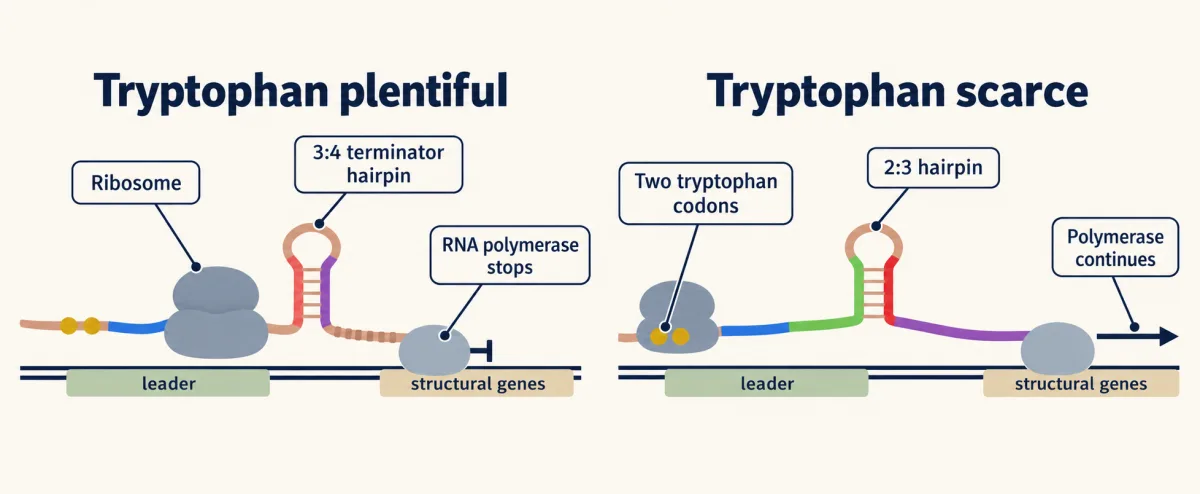
A second control, worked out mostly in Charles Yanofsky’s laboratory, acts after transcription starts. Transcription can stop in a leader before the first structural gene, at the attenuator. The leader encodes a peptide of 14 amino acids with two adjacent tryptophan codons.
Bacteria have no nucleus, so a ribosome translates the leader while RNA polymerase transcribes just ahead (the genetic code and translation). The ribosome’s position decides which RNA regions remain free to pair.
The leader RNA can form alternative hairpins. A 3:4 hairpin followed by a run of U’s is a terminator. Pairing 2:3 prevents 3:4 and permits transcription to continue. A 1:2 hairpin forms first and pauses RNA polymerase, giving a ribosome time to begin. The moving ribosome releases polymerase, and the two travel together.
- Tryptophan plentiful. Charged tryptophan tRNA is easy to find, and the ribosome moves past the two tryptophan codons onto region 2. With region 2 covered, regions 3 and 4 pair, the terminator forms, and polymerase stops.
- Tryptophan scarce. The ribosome stalls at the tryptophan codons, short of region 2. Region 2 pairs with region 3, the terminator cannot form, and polymerase continues into the structural genes.
Predict. Replace the two tryptophan codons with codons for another amino acid, then starve cells only of tryptophan. Does readthrough rise?
Check your prediction
No. The ribosome does not stall at the replacement codons during tryptophan starvation. It covers region 2, allowing the 3:4 terminator to form, so readthrough stays low.
In this model the ribosome is the sensor, turning charged-tRNA supply into a choice of RNA fold; that needs translation coupled to transcription. In a eukaryotic nucleus the two processes are separated, so attenuation of this kind does not work there; eukaryotic gene regulation covers other controls.
Putting the rules to work: classifying a new mutant
Design problem
You isolate a new constitutive lac mutant, m. Design partial diploids that tell whether it is a recessive I⁻, a dominant-negative I⁻ᵈ, or an operator Oᶜ.
Saved in this browser only.
One way to do it
Start with m Z⁺ / F′ I⁺ O⁺ Z⁻: the only working Z⁺ is beside m, and the F′ supplies a normal repressor gene.
- If expression becomes inducible, m is a recessive I⁻: the normal repressor from the F′ diffuses to the chromosomal operator.
- If it stays constitutive, m is either I⁻ᵈ or Oᶜ. An Oᶜ ignores the repressor in cis, and an I⁻ᵈ poisons repressor that mixes its subunits with F′ subunits.
To separate those two, move the working Z⁺ to the other copy: m Z⁻ / F′ I⁺ O⁺ Z⁺.
- If m is Oᶜ, expression is inducible: the Oᶜ copy’s Z⁻ makes nothing active, and the F′ Z⁺ sits beside a normal operator.
- If m is I⁻ᵈ, expression stays constitutive: the defective subunits act in trans and spoil repressor at the F′ operator too.
The logic: move the reporter and ask whether the effect moves with it.
Going deeper
Auxiliary operators and repression factor
Geneticists measure the strength of repression as a ratio:
repression factor = enzyme activity with inducer ÷ enzyme activity without inducer
In chromosomal reporter strains, O1 alone gave a repression factor of about 20, and removing both auxiliary operators reduced repression more than 50-fold (Oehler and colleagues, 1990).
How the repressor was found
What was the repressor made of? In 1961 Jacob and Monod did not know; Monod later wrote that it had seemed logical to assume a polyribonucleotide. In 1966 Walter Gilbert and Benno Müller-Hill isolated it, following its binding of radioactive IPTG, and it was a protein; in 1967 they showed it binds DNA carrying the lac operator.
Attenuation in a test tube
In a test tube with no ribosomes, only about 5 percent of transcripts read through the E. coli trp attenuator (Lee and Yanofsky, 1977).
Your notes
Select any text in the lesson to highlight it or add a note to it. Your highlights and notes are saved in this browser and collected in your notebook.
This browser is not letting the site save anything (a private window or strict privacy settings), so highlights and notes will be lost when you leave the page.
How we measure it
Partial-diploid (F′) cis-trans test
An F′ plasmid carrying the lac region is put into a cell that has its own lac region, so the cell has two copies. Mutations are placed on the same copy (cis) or on different copies (trans), and enzyme activity is measured. A product that diffuses acts in trans; a site acts only on genes on its own DNA.
β-Galactosidase assay with ONPG
Cells are opened and given ONPG, a colourless compound that β-galactosidase splits to release a yellow product. The rate of colour change measures active enzyme, so it reads out how much the lac genes are expressed with and without inducer.
Equilibrium dialysis with a radioactive ligand
A protein sample sits inside a membrane bag that small molecules cross but proteins do not, bathed in a radioactive ligand. Extra radioactivity inside the bag shows that something there binds the ligand. Gilbert and Müller-Hill followed the lac repressor this way, by its binding of IPTG.
In vitro transcription of a leader region
Purified RNA polymerase transcribes a defined DNA fragment in a test tube, and the RNA products are sized. The fraction that stops at the leader terminator, and the fraction that reads through, measure the attenuator with no ribosomes present.
Practice questions on this lesson (4) → MCAT-style, original, each with an explanation
Where this lesson fits
Before thisReview first
- Transcription: From DNA to RNAThis course · Lesson 16
You need promoters and RNA polymerase from there to see how a repressor and CAP change the start of transcription.
- Complementation and Gene Function: From Beadle and Tatum to BenzerThis course · Lesson 10
The cis–trans logic used there is what lets partial diploids separate an operator site from a repressor product.
- Bacterial and Phage Genetics: Conjugation, Transduction and TransformationThis course · Lesson 11
F′ plasmids made by conjugation are how the partial diploids here are built.
After thisStudy next
- Eukaryotic Gene Regulation and EpigeneticsThis course · Lesson 20
It takes gene control further, from bacterial repressors and activators to accessible DNA and combinations of regulators in eukaryotes.
- Cancer as a Genetic DiseaseThis course · Lesson 21
It uses regulator logic, such as dominant versus recessive loss, to explain how gene control fails in tumors.
Suggested by an AI model from the lessons themselves, then checked. How we use AI
Finish line
Test yourself
9 questions
Practice and MCAT-style, with explained answers.
Next · Lesson 20
Eukaryotic Gene Regulation and Epigenetics
A liver cell and a kidney cell share one genome. How does each read a different part of it, and remember which part after it divides?
Continue →