Genetics and Molecular Biology · Skim version
Eukaryotic Gene Regulation and Epigenetics
Read the full lesson → Skim the whole course →
The guiding idea
A liver cell and a kidney cell share one genome. How does each read a different part of it, and remember which part after it divides?
Gene output depends on accessible DNA and the regulators present; cell memory requires regulatory states to be propagated or restored after replication.
From the film: Access, Then Assembly
- Gene output depends on accessible DNA and the regulators present.
- Nucleosomes make access conditional rather than impossible.
- Factor combinations bound at enhancers recruit coactivators and Mediator to raise transcription.
- Reporter assays test a DNA fragment outside its native genomic setting.
From the film: Rebuilding the Memory
- Cell memory requires regulatory states to be propagated or restored after replication.
- After replication, DNMT1 copies the methylation pattern from the old strand onto the new one.
- Mitotic epigenetic inheritance is established, but mammalian transgenerational claims are limited and contested.
-
Chromatin makes access conditional
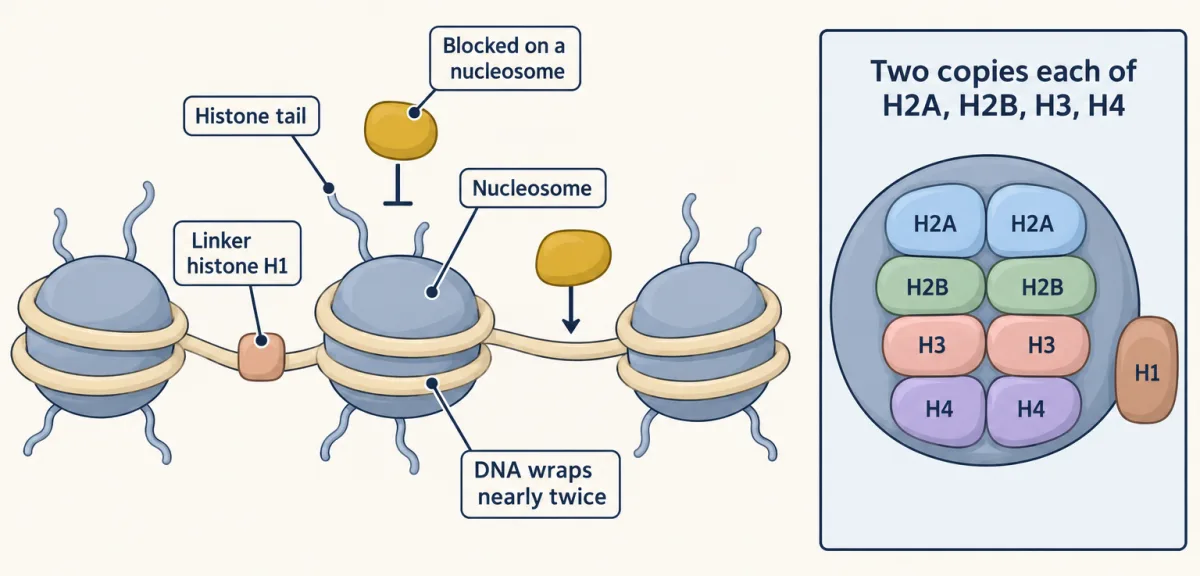
DNA wraps around histone octamers, so moving or loosening a promoter nucleosome can change whether transcription proteins reach the DNA. AI-generated illustration -
Enhancers: control from a distance, by combination
-
Small RNAs control messages after transcription
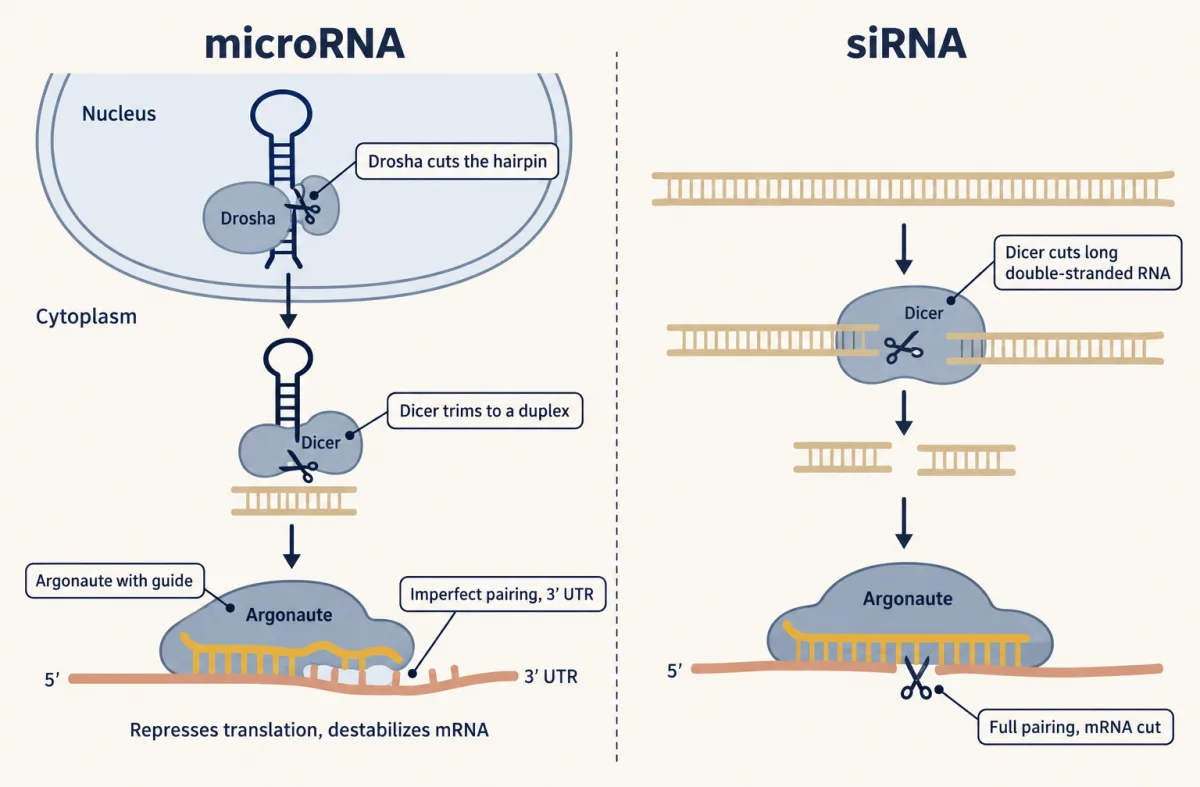
Animal microRNAs usually guide Argonaute to imperfect sites and mostly lower mRNA abundance, whereas fully paired siRNAs direct Argonaute to cut. AI-generated illustration -
Marks on histones and on DNA
-
What “epigenetic” does and does not mean
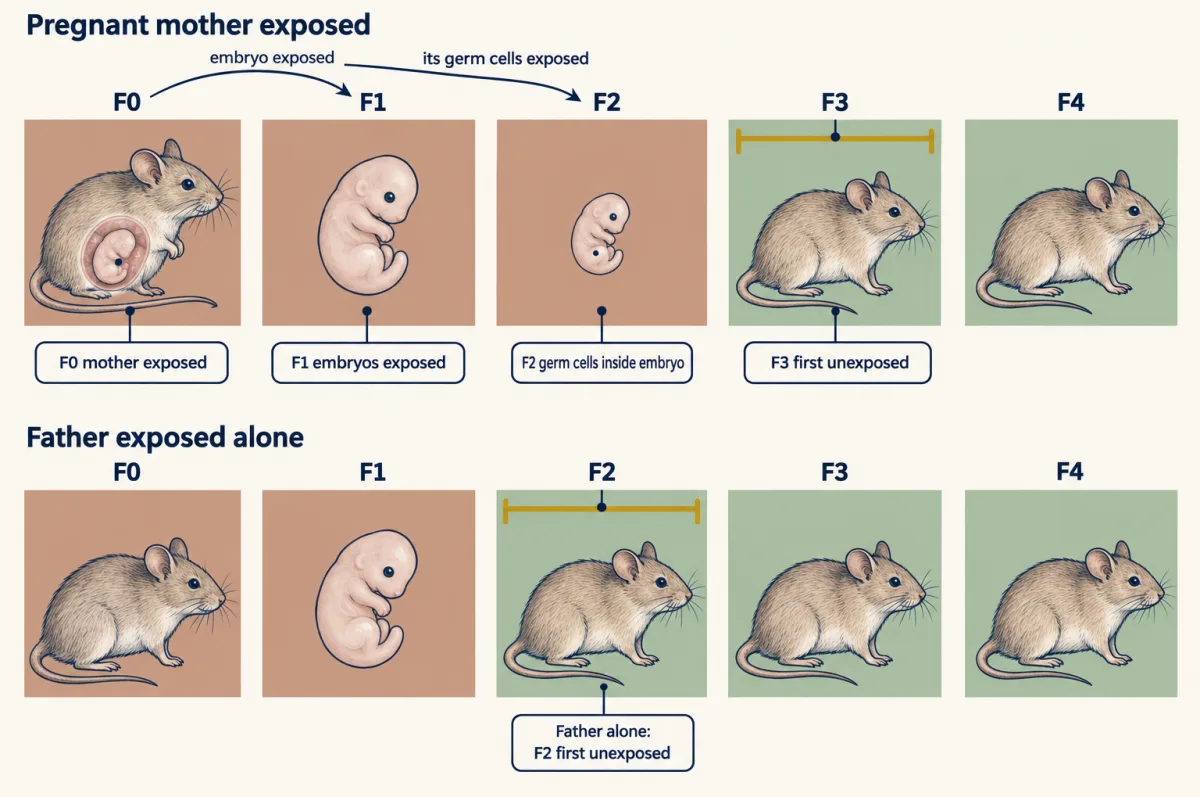
After exposure during pregnancy, F3 is the first unexposed generation; after exposure of a father alone, F2 is first. AI-generated illustration -
Going deeper
Where this lesson fits
Before thisReview first
- The lac Operon: How Bacteria Regulate GenesThis course · Lesson 19
You need the bacterial repressor-operator logic from there to see how eukaryotic regulation starts from a packed, closed state instead.
- DNA Replication: Semiconservative Copying and Its MachineryThis course · Lesson 13
You need semiconservative copying from there to see why marks on old strands must be restored on new ones.
- Transcription: From DNA to RNAThis course · Lesson 16
You need RNA polymerase and promoter basics from there to understand what enhancers and accessible DNA help start.
After thisStudy next
- Cancer as a Genetic DiseaseThis course · Lesson 21
This lesson takes regulatory states further: cancer involves lost control of gene expression and changes in regulators.
- Forward and Reverse Genetics: Screens, RNAi and CRISPRThis course · Lesson 24
This lesson's RNAi and enhancer-deletion logic is used there to test what a gene or element does.
- Complex Traits, Heritability and GWASThis course · Lesson 26
Most trait-linked variants sit in regulatory DNA like enhancers, which this lesson explains.
Suggested by an AI model from the lessons themselves, then checked. How we use AI