Genetics and Molecular Biology · Unit 4: From gene to protein, and its control
New to this? Review it at high school level: From DNA to Protein
Transcription: From DNA to RNA
Rewritten on : new text, flashcards and film. Your notes and highlights stay, but the text around them may have moved.
A gene has two DNA strands. What chooses which one the polymerase reads?
Pause when the reading reaches a film, and offer to play it. Saved on this device.
Watch the film now, or keep listening
Builds on:DNA Replication: Semiconservative Copying and Its MachineryDNA Is the Genetic MaterialWhy these?
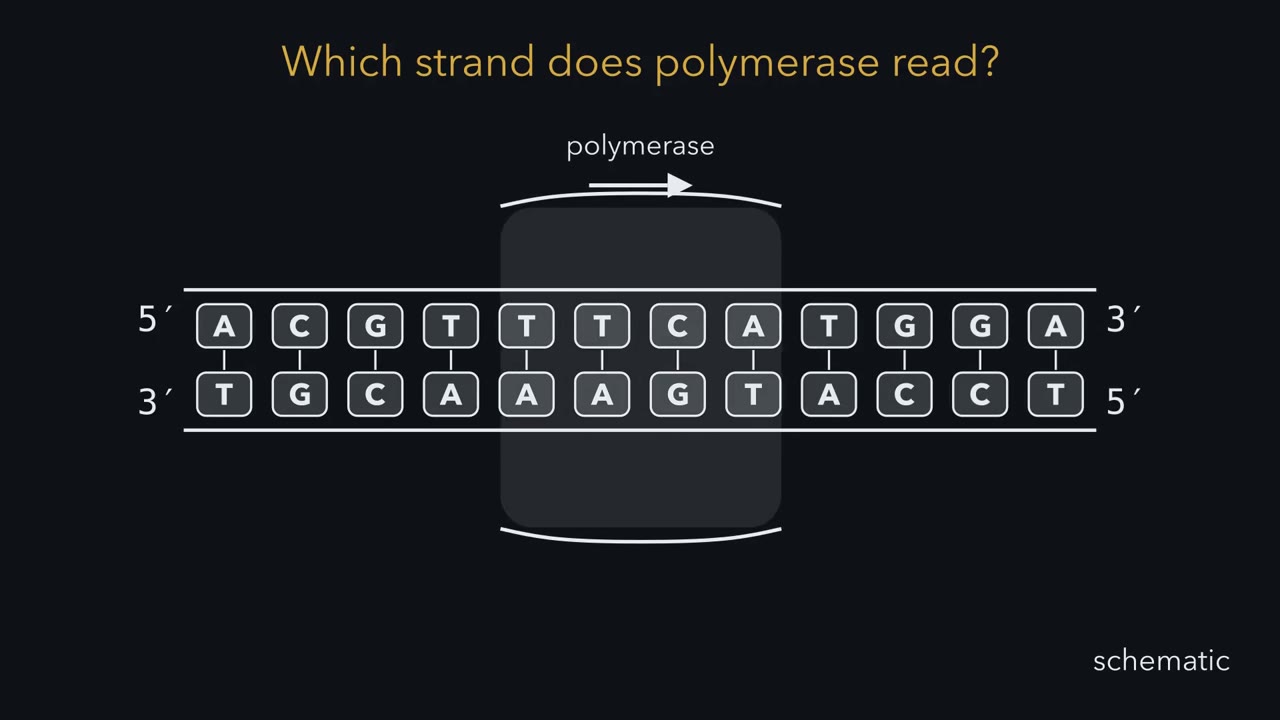 ▶ Watch The Strand Is Chosen at the Start · 3:29
Read the transcript of “The Strand Is Chosen at the Start”
Film transcript: The Strand Is Chosen at the Start
Both DNA strands carry complementary information. How does a cell choose which strand the polymerase reads? Watch the same polymerase approach a stretch of duplex with no promoter marked. It could face either way, so these base pairs alone give us no answer.
A promoter changes that. It is a DNA site where initiation machinery assembles. Its orientation places polymerase at a start site, facing downstream. The polymerase opens a short bubble. One strand enters the active site as the template. RNA polymerase now matches RNA letters to the template. It joins each new letter to the growing end. That growing end is the 3′ end. RNA therefore extends from 5′ to 3′. The polymerase moves along the template from 3′ to 5′. Suppose the promoter points the other way on the same duplex. Which strand will enter the active site, and which way will RNA grow?
The whole arrangement reverses. The other DNA strand becomes the template, and the polymerase travels in the opposite direction. Chemistry has not changed. RNA still grows 5′ to 3′. Flipping the start's orientation changed both the strand read and the direction of travel. The DNA strand not used as the template is the coding strand. Read in the same direction as RNA, its sequence matches the RNA. RNA uses U where DNA uses T. The RNA pairs with the template instead, so those strands are complementary and antiparallel. Now remove the promoter and RNA, leaving only the duplex. The template label becomes uncertain again. An RNA product can restore the answer because it matches coding DNA and pairs with template DNA.
DNA opens ahead of polymerase and closes behind it. The growing RNA peels away through a separate path. Polymerase reads one strand while preserving the other strand's sequence in RNA. Use these checks on any sequence. Write both DNA strands 5′ to 3′. Match RNA to coding DNA after swapping U for T. Then confirm that RNA pairs antiparallel to the template. Together, these checks give the direction of travel. The polymerase moves toward the template's 5′ end. This rule applies whenever RNA is copied from double-stranded DNA. Promoters vary, and different cells use different initiation proteins.
Yet once a start and its direction are set, RNA grows by adding to its 3′ end. Antiparallel pairing then makes the polymerase read the template 3′ to 5′.
From the film
- The start site and its orientation determine which strand is read.
- RNA polymerase reads the template strand from 3′ to 5′ while RNA grows from 5′ to 3′.
- The RNA matches the coding strand, with U in place of T, and pairs with the template.
- A bare duplex does not identify its template strand without a promoter or an RNA product.
The first film showed a promoter choosing the template; here is the chemistry behind it.
The one idea. The start site and its orientation determine which strand is read.
Scope: transcription from double-stranded DNA. A promoter and its initiation machinery set a start site and the direction the polymerase faces there; RNA polymerase then reads that one template 3′ to 5′ while extending RNA 5′ to 3′. Promoter sequence alone does not determine how often initiation occurs, and where the RNA ends is set separately, by termination.
The reaction fixes the direction
Transcription is the copying of a stretch of DNA into RNA. RNA polymerase opens a short stretch of the double helix and uses one DNA strand, the template strand (antisense or noncoding strand), to line up the ribonucleoside triphosphates ATP, GTP, CTP and UTP by base pairing: RNA A opposite DNA T, U opposite A, G opposite C and C opposite G. It joins each nucleotide to the 3′ hydroxyl of the growing RNA, releasing pyrophosphate. That chemistry fixes the directions:
- RNA grows 5′ to 3′, as DNA does in DNA replication.
- The polymerase therefore reads its antiparallel template 3′ to 5′.
- RNA matches the other DNA strand, the coding strand (nontemplate strand), with U in place of T.
Unlike DNA polymerase, RNA polymerase needs no primer; it can join the first two nucleotides itself. A promoter is the DNA site where polymerase and its helpers assemble. The first transcribed base is +1. On the coding strand, bases toward its 5′ end before +1 are upstream and have negative numbers; positions after +1 are downstream. A terminator is a signal that ends transcription. Each gene uses one strand as its template, but neighbouring genes can face opposite ways and use opposite strands.
Use the rule on a sequence
top:     5′-TACGGATCCATGAAACGT-3′
bottom:  3′-ATGCCTAGGTACTTTGCA-5′
RNA:     5′-ACGUUUCAUGG-3′
Predict. Which DNA strand is coding, which is template, and which way does the polymerase move on the page? Write both DNA strands 5′ to 3′ before opening the answer.
Work it through
First check all 18 base pairs; the strands are complementary. The top is already written 5′ to 3′. Reverse the bottom to get 5′-ACGTTTCATGGATCCGTA-3′.
Change U to T in the RNA and compare sequences. ACGTTTCATGG matches the first 11 bases of the reversed bottom and does not occur in the top, so the bottom is the coding strand. The top is the template; the RNA pairs with it antiparallel. At the right end, the RNA’s A pairs with the top strand’s T, then C with G.
The polymerase reads the top template 3′ to 5′. Its 3′ end is on the right, so the polymerase moves right to left.
In the reader below, flip the promoter and name the new template before you look.
Rule to keep: a bare duplex does not tell you the template; the promoter, or the RNA, does. The polymerase reads the template 3′ to 5′, builds RNA 5′ to 3′, and the RNA matches the coding strand with U for T. The picture shows only the stretch drawn and is a sketch of the logic; the lesson does not draw a promoter, so its placement beside +1 here is not to scale.
You can now follow any correctly oriented polymerase; the second film asks how cells place one and release it.
Read the transcript of “Two Ways to Start, Several Ways to Stop”
Film transcript: Two Ways to Start, Several Ways to Stop
The first film followed strand choice into a growing RNA. Why do bacteria and nuclei use different teams to start that same reaction? Keep watching the promoter. The team assembled there decides where polymerase begins, and in the nucleus, which polymerase.
Both systems must solve the same physical jobs. They must recognize a promoter, place polymerase, open DNA, and start RNA. After productive synthesis, they must release the RNA and polymerase. The parts differ, but those jobs remain. In E. coli, core polymerase performs nearly all cellular transcription.
Core can join RNA nucleotides, but it finds promoters poorly. A sigma factor docks onto core, forming holoenzyme. Sigma recognizes promoter elements and positions the active site over the start. Imagine removing sigma while leaving core intact. Which ability fails most directly: joining RNA nucleotides, or starting accurately at promoters?
Accurate starting fails. Core remains catalytically capable, yet it chooses promoter starts poorly. Restore sigma, and the holoenzyme forms a closed complex. DNA then opens around the start. Short RNAs may be released before polymerase escapes into elongation. A eukaryotic nucleus divides transcription among its main polymerases. Pol I makes the large rRNA precursor.
Pol II makes mRNA precursors, most snRNAs, and microRNA precursors. Pol III makes tRNAs, a separate rRNA, and other small RNAs. Follow Pol II, the enzyme that makes mRNA precursors. General transcription factors assemble at its core promoter. Some recognize promoter DNA. Others position polymerase and help open the template. The classic sequence is useful, although living complexes exchange parts rapidly. Both lanes now converge on the same motion.
DNA opens, a green RNA begins, and polymerase escapes the promoter. The first film's direction rule still applies. Different proteins chose the start, but chemistry fixes how the RNA grows. Bacteria can end transcription through different routes. In one, the RNA folds into a hairpin followed by a U-rich tract.
Together they destabilize the complex. In another, Rho binds the RNA, advances toward polymerase, and promotes release. Pol II couples termination to RNA processing. After it copies a poly(A) signal, the RNA is cut. A following enzyme degrades the attached RNA toward polymerase. Evidence supports this pursuit working with changes that make polymerase ready to stop. Starting and stopping are therefore separate control problems. Initiation machinery chooses a usable start and places the enzyme. Termination signals and factors destabilize or remodel the elongation complex.
Between them, polymerase carries out the same directional chemistry.
From the film
- Different initiation teams place polymerase; termination releases RNA and enzyme.
- In E. coli, a sigma factor directs the core enzyme to promoters.
- In the nucleus, three main polymerases divide the work, and Pol II starts with general factors.
- Bacteria end transcription with RNA hairpins or Rho; Pol II termination is coupled to cutting the RNA at the poly(A) site.
Bacteria: sigma places one core enzyme
The second film showed sigma docking onto core. In E. coli, one kind of core enzyme, two alpha subunits, one beta, one beta prime and one omega, makes nearly all cellular RNA. Bound to a sigma factor, it becomes the holoenzyme.
The housekeeping factor sigma 70 recognizes two coding-strand elements. A consensus gives the most common base at each position across many promoters:
−35 element: 5′-TTGACA-3′ … about 17 bp … −10 element: 5′-TATAAT-3′
Real promoters differ from that sequence.
Predict. A mutation makes one −10 element closer to consensus. Does that guarantee more transcription?
Check your prediction
No. A closer match usually raises sigma-dependent initiation, but the promoter’s spacing, other elements and bound proteins can outweigh that one change.
Holoenzyme bound to still double-stranded promoter DNA is the closed complex. Melting about a turn of the helix around the −10 element and +1 makes the open complex, with template DNA in the active site. Making and releasing short RNAs at the promoter is abortive initiation; once one RNA grows long enough, the polymerase leaves for productive elongation, promoter escape. Sigma commonly leaves at escape, but in single-molecule work with purified E. coli enzyme, a substantial share of elongating complexes kept sigma 70.
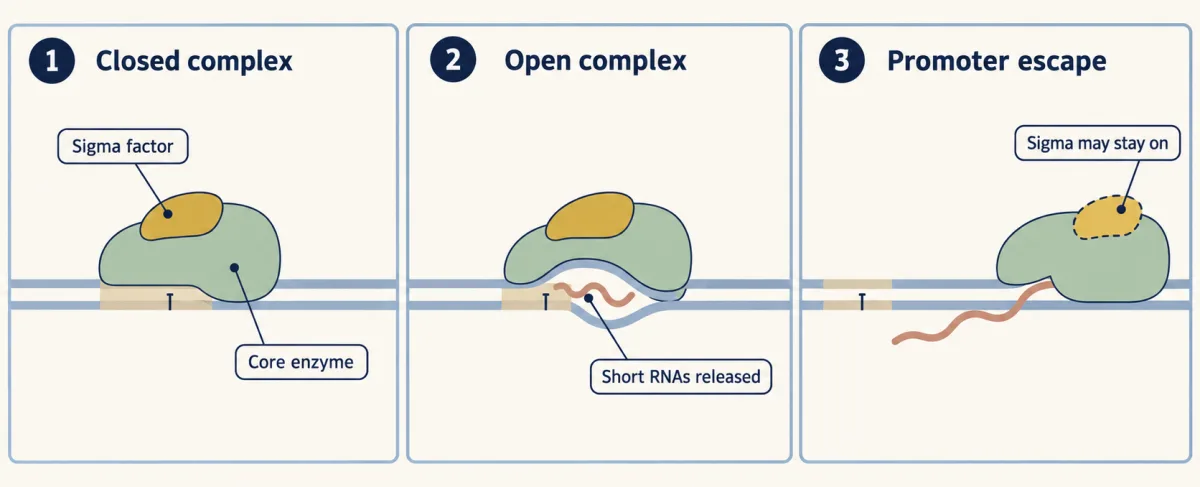
Other sigmas redirect the same core. In E. coli, sigma 32 directs transcription of heat-shock genes, so a temperature rise changes which promoters are used.
Predict. If sigma 32 rises while the amount of core enzyme stays fixed, which promoter set should gain access to core?
Check your prediction
Promoters recognized by sigma 32 should gain access, increasing transcription of heat-shock genes. The catalytic core has not changed; its promoter-selecting partner has.
Because bacteria have no nucleus, ribosomes can translate an mRNA while its 3′ end is still being made. Many bacterial mRNAs are polycistronic, carrying several coding sequences from one promoter in an operon, though not all are (the lac operon).
Eukaryotic nuclei divide the work
All eukaryotes share three main nuclear RNA polymerases; plants have two more, Pol IV and Pol V. In mammalian cells:
- Pol I makes the large 45S or 47S rRNA precursor, later cut into 28S, 18S and 5.8S rRNA.
- Pol II makes pre-mRNAs, most small nuclear RNAs and microRNA precursors.
- Pol III makes tRNAs, 5S rRNA, U6 snRNA and other small RNAs.
The death-cap toxin alpha-amanitin separates their activities: very low doses block Pol II while the other two keep working, and much higher doses inhibit Pol III.
Placing Pol II
The second film’s Pol II platform is built from the general transcription factors, which assemble with Pol II into the preinitiation complex. In the classic stepwise picture, TFIID recognizes the core promoter first. It contains TBP, the TATA-binding protein, and other subunits. TFIIA and TFIIB stabilize TBP on the DNA; TFIIB also helps position the start and bridge to Pol II. TFIIF brings Pol II, TFIIE helps recruit TFIIH, and TFIIH’s XPB translocase helps open DNA. In living cells these factors exchange rapidly, so the order is less fixed.
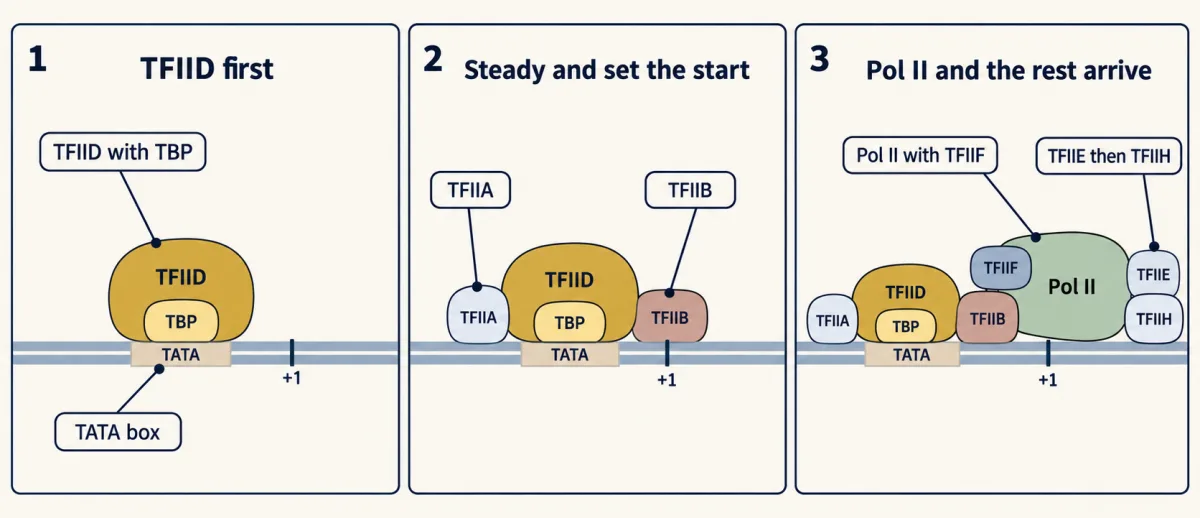
In animal promoters that have one, a TATA box with consensus TATAAA lies about 25 to 30 bp upstream of +1. Most human promoters lack one. At those promoters, other TFIID subunits recognize other core elements, including an initiator spanning the start site.
TFIIH also contains the kinase CDK7. The largest Pol II subunit ends in the CTD, a carboxy-terminal tail of repeated seven-amino-acid units, YSPTSPS. As Pol II starts, CDK7 phosphorylates serine 5; other kinases phosphorylate serine 2 during elongation. The phosphorylated CTD recruits enzymes that cap the RNA and later those that splice and cut its 3′ end (RNA processing).
Predict. Suppose XPB remains active but CDK7 kinase activity is inhibited. Which listed task can still occur: DNA opening or CTD serine-5 phosphorylation?
Check your prediction
XPB can still help open DNA; inhibited CDK7 cannot phosphorylate CTD serine 5.
Regulators at the ends of signaling pathways to the nucleus and nuclear receptor pathways help or hinder assembly and alter promoter chromatin. Their specific contacts follow the principles in protein binding and allostery. Many animal genes also pause Pol II just beyond the start; CDK9-triggered release into the gene is another regulated step.
Elongation as a rate problem
In one study of long genes in cultured human cells, Pol II averaged about 3.8 kb per minute. Treat that as constant and ignore pauses.
Predict. When should new RNA first reach a point 114 kb from the start?
Check your calculation
time = length / rate = 114 kb / 3.8 kb per min = 30 min
This is elongation time, not time to a finished mRNA. Rates differ among genes and cell types.
Stopping transcription
The start site and its orientation chose the strand; a stop only has to release the RNA and the enzyme.
An intrinsic terminator encodes a GC-rich RNA hairpin followed by a U tract. The hairpin forms near the RNA exit channel while weak A-U pairs hold the RNA to the DNA template in that tract, and together they destabilize the complex. A Rho-dependent terminator needs Rho, an ATP-driven protein that binds the nascent RNA at a Rho utilization (rut) site. These classes are useful, but in Bacillus subtilis Rho can assist some intrinsic terminators.
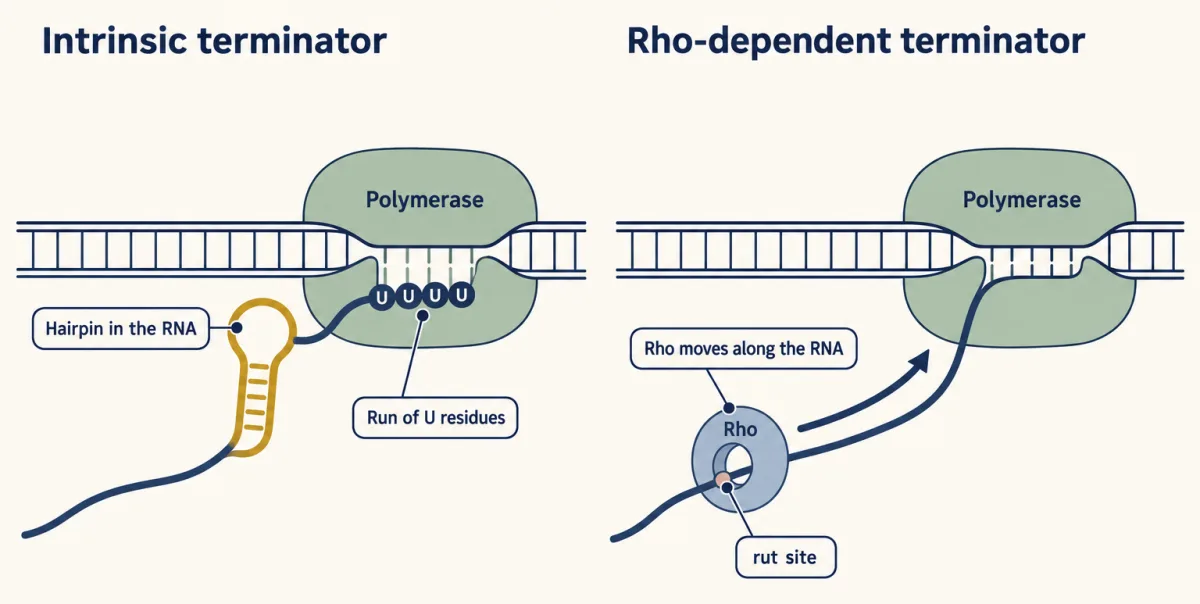
Eukaryotic polymerases do not share one termination pathway. At the second film’s Pol II stop, CPSF73 cuts the RNA and XRN2 follows, degrading the RNA still attached to Pol II from 5′ to 3′. In the torpedo model, XRN2 catches the polymerase and knocks it off the DNA; in the allosteric model, copying the signal changes the complex so it is ready to stop. Rapid factor-removal experiments in cultured human cells support a combination: slowing beyond the poly(A) site lets XRN2 catch up. Pol III stops at a T run in the nontemplate strand, although other features can assist in budding yeast.
Design problem: identify the polymerase
A newly found mammalian gene makes an RNA of unknown type. Design an experiment to decide which nuclear RNA polymerase transcribes it.
One way to do it
Run a nuclear run-on assay: isolate nuclei, supply labeled nucleotides and measure extension by polymerases already on genes. Titrate alpha-amanitin from none through roughly 1 µg/mL to a few hundred µg/mL; these are orders of magnitude for mammalian cells and must be checked for the cell type.
Measure labeled RNA from the unknown gene beside an rRNA control for Pol I, a protein-coding control such as actin for Pol II, and a tRNA or 5S rRNA control for Pol III. The Pol II control should fall around 1 µg/mL or less, the Pol III control only at roughly 100 to 1000 times more, and the Pol I control should resist across the range. Match the unknown curve to a control. The same titration can be done by in vitro transcription in nuclear extract with the gene as template. Then confirm it independently (Going deeper: Confirming a polymerase assignment). Measure RNA, not protein, because Pol I and Pol III products are not translated.
Going deeper
Confirming a polymerase assignment
Map the start with a method designed for 5′ ends of newly made RNA; ordinary RNA-seq is not precise enough, and mature tRNA and rRNA ends may have been trimmed. Inspect upstream DNA, and the gene body for a suspected Pol III gene, for matching promoter elements. Then place a tagged copy with its upstream region and any internal promoter elements into cells and test whether its RNA has the same alpha-amanitin response.
Initiation details and exceptions
The −10 element is the Pribnow box, named for David Pribnow, who in 1975 reported the sequence of a polymerase-binding site at an early phage T7 promoter. Budding-yeast start sites lie farther from a TATA box than animal start sites, about 40 to 120 bp downstream. Human Pol II has 52 CTD repeats and budding yeast 26.
Termination details and overlap
In an atlas of Bacillus subtilis terminators, Rho stimulated about 10% of intrinsic terminators. In budding yeast, a T run is not always sufficient for Pol III termination; RNA structure and the helicase Sen1 can assist.
Your notes
Select any text in the lesson to highlight it or add a note to it. Your highlights and notes are saved in this browser and collected in your notebook.
This browser is not letting the site save anything (a private window or strict privacy settings), so highlights and notes will be lost when you leave the page.
How we measure it
In vitro transcription with purified components
You mix a DNA template, purified polymerase, chosen factors and labeled nucleotides, then measure the RNA made. Adding or removing one component tells you what it is needed for, as when sigma restored transcription of phage DNA or general factors let Pol II start at a promoter.
Column chromatography of enzyme activity
A cell extract is passed through a resin that holds proteins by charge, and fractions are collected and assayed. Separate peaks of activity show separate enzymes or separable parts, which is how sigma was split from core and how Pol I, II and III were first resolved.
Nuclear run-on assay
Nuclei are isolated and given labeled nucleotides, so polymerases already engaged on genes extend their RNAs a short distance. Measuring labeled RNA from a given gene reports how much it was being transcribed, and adding inhibitors such as alpha-amanitin shows which polymerase does it.
X-ray crystallography and cryo-EM
Crystals or frozen particles of a polymerase complex are imaged to build an atomic model. The models show where the template, the RNA and each factor sit, which turns a list of steps into a physical mechanism.
Practice questions on this lesson (4) → MCAT-style, original, each with an explanation
Where this lesson fits
Before thisReview first
- DNA Replication: Semiconservative Copying and Its MachineryThis course · Lesson 13
You need 5′-to-3′ synthesis and antiparallel strands from there to see why RNA grows 5′ to 3′ here.
- DNA Is the Genetic MaterialThis course · Lesson 12
It establishes that DNA carries the information that transcription copies into RNA.
After thisStudy next
- RNA Processing: Caps, Tails and SplicingThis course · Lesson 17
The capped, spliced and tailed RNA is made from the Pol II transcript, using the CTD-recruited enzymes introduced here.
- The lac Operon: How Bacteria Regulate GenesThis course · Lesson 19
It applies bacterial promoters, sigma-directed initiation and operon transcription to regulate genes with repressors and activators.
- Eukaryotic Gene Regulation and EpigeneticsThis course · Lesson 20
It takes Pol II assembly at promoters further, showing how enhancers and chromatin control where initiation happens.
Elsewhere on the siteFilms, simulations and method films in other courses
- Transcribe, translate, mutateSimulation · Biology
It lets you transcribe a gene into mRNA and then see how codons are read.
- Reporter gene assaysMethod film
Testing what a promoter does by placing it before a measurable gene matches the promoter test in the design problem.
- From Gene Copy to Protein ChainFilm · Biology
It shows transcription making an mRNA copy of the gene before translation reads it.
Suggested by an AI model from the lessons themselves, then checked. How we use AI
Finish line
Test yourself
9 questions
Practice and MCAT-style, with explained answers.
Next · Lesson 17
RNA Processing: Caps, Tails and Splicing
Why is a message copied from more than 5,000 nucleotides of DNA only 737 nucleotides long?
Continue →