Genetics and Molecular Biology · Unit 5: Tools and genomes
New to this? Review it at high school level: Engineering Genes
Forward and Reverse Genetics: Screens, RNAi and CRISPR
Rewritten on : new text, flashcards and film. Your notes and highlights stay, but the text around them may have moved.
How do you find what a gene does: start from a trait and hunt for the gene, or start from a gene you name and see whether the cell cares?
Pause when the reading reaches a film, and offer to play it. Saved on this device.
Watch the film now, or keep listening
Builds on:Complementation and Gene Function: From Beadle and Tatum to BenzerDNA Repair and RecombinationRecombinant DNA, Cloning and PCRWhy these?
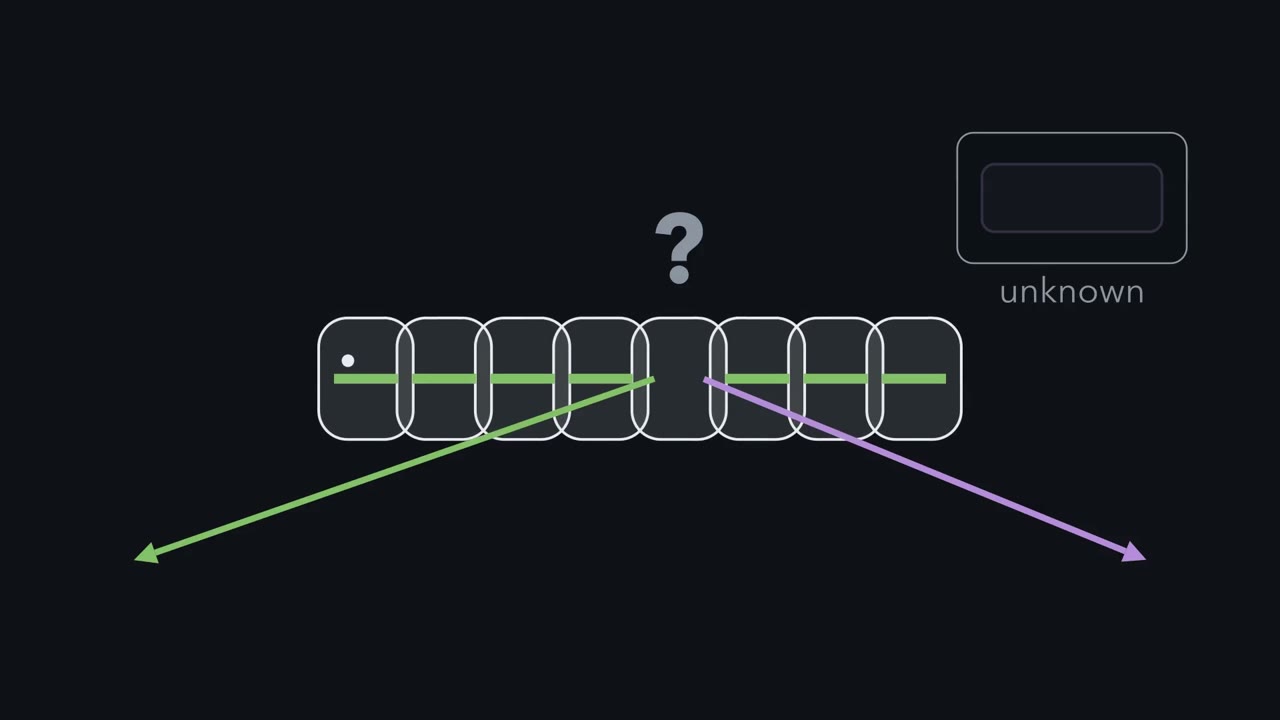 ▶ Watch Which Way Do You Run Genetics? · 3:34
Read the transcript of “Which Way Do You Run Genetics?”
Film transcript: Which Way Do You Run Genetics?
A larva has lost part of its body pattern, but nobody knows the gene. Which end of the problem should we start from? Genetics can run from a visible phenotype toward a gene, or from a chosen gene toward a phenotype. Keep the laboratory bench in view. On its left, organisms with varied phenotypes move toward an assay gate. On its right, a named gene enters before any phenotype appears. These are not different toolkits. They are different directions of reasoning. In the phenotype-first lane, random mutations enter before the assay. The gate keeps individuals with the chosen trait. Researchers recover lines, map each lesion, and test a candidate gene.
This forward path can uncover genes nobody expected. But only visible outcomes reach the gate. Now imagine a mutation that changes meiosis but never changes the trait scored at the gate. Will this forward screen recover it? Watch the unaffected-looking individuals pass beyond the assay while the hidden mutation stays inside them.
No. The screen cannot select a difference its assay never records. Forward genetics is open to unexpected mechanisms, yet bounded by phenotype. A different assay might reveal the same mutation. The blind spot belongs to the measurement, not to the gene. In the gene-first lane, begin with a named gene. Lower its output with RNA interference, or alter its DNA with Cas9. Then measure what changes. This reverse path asks a focused question. It stays silent about genes nobody chose to perturb. The approaches therefore miss different things.
Forward screens miss phenotypes outside their assay. Reverse experiments miss genes outside their chosen list. Neither direction turns one changed trait into a complete mechanism. That requires a separate causal test. A pooled Cas9 screen combines the directions. Researchers choose many guides gene by gene, then usually give each cell a single guide. A selection keeps cells with a phenotype. Sequencing identifies guides that became enriched or depleted. Those guide counts nominate candidates. Follow the bench from question to claim. A phenotype-first screen may discover an unimagined gene. A gene-first experiment may test a precise hypothesis.
A pooled screen may survey many chosen genes together. In every case, the assay defines what becomes visible. So ask these questions before interpreting any genetic result. What did the experiment choose first? What could its assay actually detect? Those questions reveal both its reach and its blind spot. The direction is part of the evidence.
From the film
- What you choose first determines what a genetic experiment can find.
- Forward genetics starts with a phenotype and searches for its gene.
- Reverse genetics starts with a chosen gene and asks what phenotype changes.
- A screen finds only what its assay can see.
- A pooled CRISPR screen chooses guides first, then selects cells by phenotype.
Genetics runs from a phenotype toward a gene, or from a chosen gene toward a phenotype. One decision governs both directions.
The one idea. What you choose first determines what genetics can find; validation determines what it can claim.
Scope: loss-of-function experiments here—phenotype-first screens, gene-first RNAi or Cas9 perturbations, and pooled Cas9 screens. Other genetic designs can ask different questions, and no single validation test proves a complete mechanism.
Phenotype first: the forward screen
A forward screen begins with a phenotype, an observable or measurable trait, and works back toward its genetic cause: mutagenize at random, score the phenotype, recover mutant lines, map each lesion, then test whether a candidate gene causes it. Insertional tagging and natural variants run in the same direction. A locus is a position in the genome where a gene sits; a screen can locate it before anyone knows what its product does.
The classic example is the 1980 Drosophila screen by Nüsslein-Volhard and Wieschaus. They looked through embryonic-lethal mutants for changes in larval segmentation and reported 15 loci. The phenotypes sorted into classes acting at different scales, which indicated at least three levels of spatial organization in segmentation. Earlier screens in the nematode Caenorhabditis elegans and in budding yeast worked the same way; in yeast, temperature-sensitive mutants were sorted into complementation groups. A complementation group is a set of mutations that fail to restore function in combination, which under the standard assumptions marks them as hits in one gene. That logic is the subject of complementation and pathways, and the mapping step is three-point mapping scaled up with sequencing.
Predict. Two recessive mutants have the same phenotype, and offspring carrying one mutant allele from each are normal. Under the standard complementation assumptions, same gene or different genes?
Check your prediction
Different genes. Each offspring still has one working copy of each gene, so the mutations complement. Had the offspring shown the mutant phenotype, they would fall in the same complementation group under those assumptions.
The strength of this direction is that it is unbiased about mechanism. The first film showed its blind spot, and published screens qualify their reach the same way: zebrafish screeners limited their coverage estimate to what their screen could discover, and an Arabidopsis study noted that meiotic defects could fall below a screen’s fruit-length threshold. Mutagenized backgrounds also carry extra variants, so backcrossing and a causal test—complementation, rescue by restoring the candidate gene, or a second independent allele—are part of the method. Mutation covers how the mutagens act.
Gene first: knockdown and knockout
Reverse genetics starts from a chosen gene and asks what changing its sequence or expression does. Thomas and Capecchi disrupted endogenous mouse Hprt in embryonic stem cells by homologous recombination, and only a small fraction of drug-resistant colonies had lost Hprt function. Germline transmission of a targeted allele came later.
RNA interference, or RNAi, lowers how much protein a gene makes without changing the gene’s DNA. In 1998 Fire, Mello and colleagues injected RNA into C. elegans: double-stranded RNA produced substantially stronger, specific interference than either single strand, and the small effective amount suggested a catalytic or amplifying step. A companion study found evidence that the effect was post-transcriptional, acting on endogenous messenger RNA, with no evidence of a change in primary DNA sequence. By 2001, 21-nucleotide small interfering RNA, or siRNA, duplexes were suppressing expression in cultured human HEK293 and HeLa cells. The mechanism belongs to eukaryotic regulation.
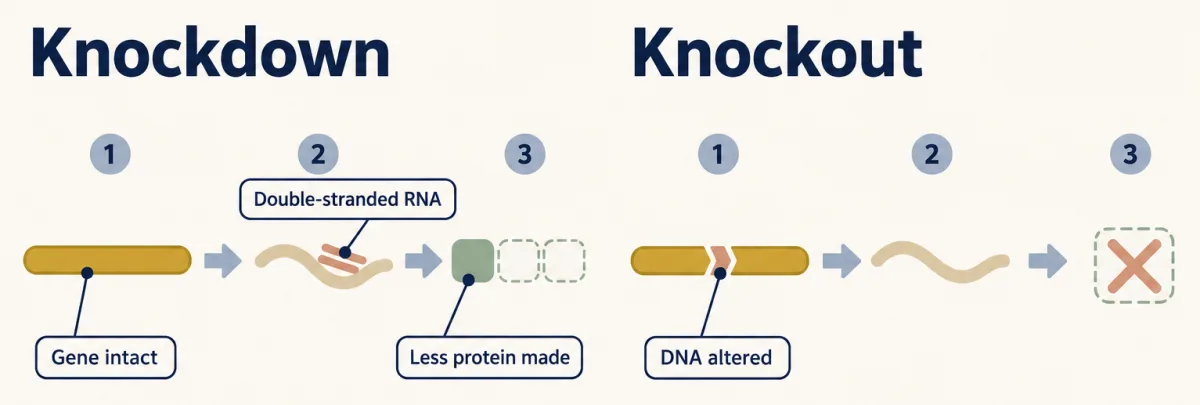
That difference sets the controls. A knockdown needs a measurement of the perturbation itself—immunoblotting or immunofluorescence for the target protein—two non-overlapping reagents against the same gene, and rescue with a transgene engineered to resist the reagent. Agreement between two reagents does not measure the protein, and even successful rescue does not formally exclude a phenotype that also requires an off-target effect.
CRISPR came from a bacterial immune system
CRISPR spacers, the variable sequences between repeats, were first seen to match transmissible genetic elements, suggesting immunity against foreign DNA. Barrangou and colleagues tested that in Streptococcus thermophilus in 2007: phage challenge added phage-derived spacers, and adding or removing particular spacers changed resistance, with specificity tracking spacer-phage sequence similarity. The native Streptococcus pyogenes type II system uses two RNAs: a crRNA that carries the guide sequence and a tracrRNA that Cas9 requires alongside it.
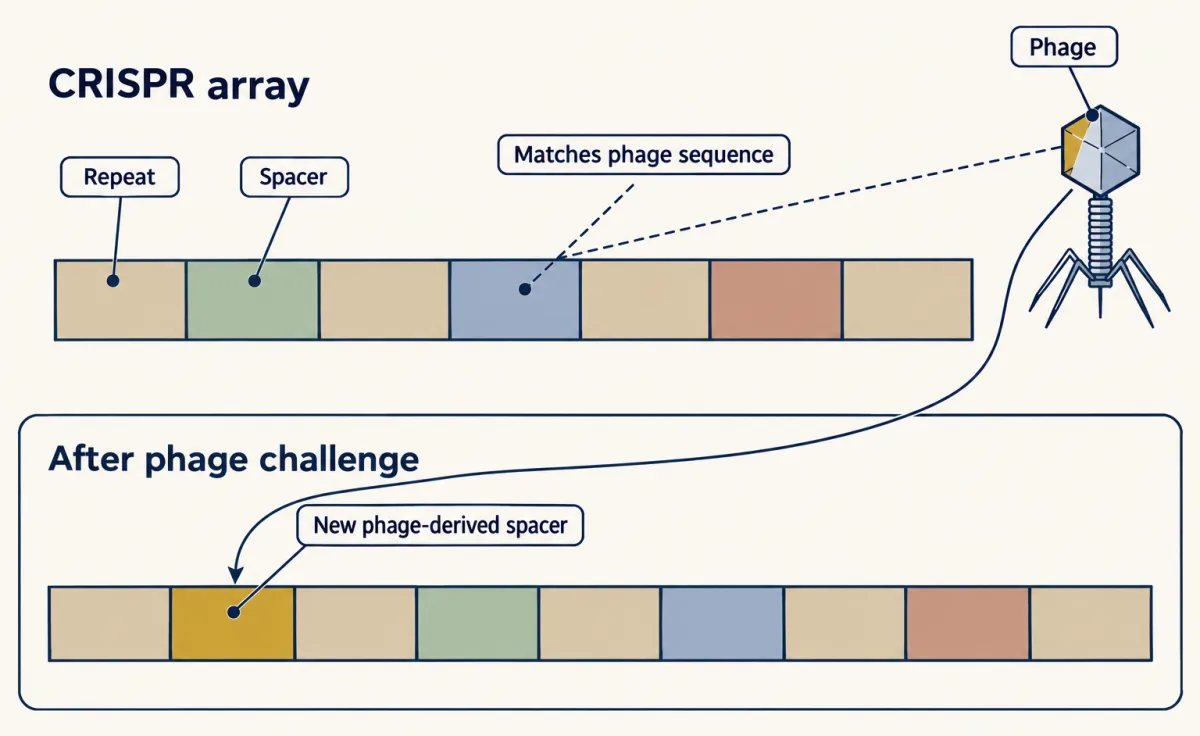
In 2012 the Jinek study fused those RNAs into one chimeric RNA that sent purified Cas9 to cut DNA where the RNA specified, beside a short motif: the 2012 work was biochemistry, not genome editing. Editing inside cells came in 2013, in cultured human and mouse cells.
Editing means choosing a site; the cell decides the allele. The second film follows that handoff.
Read the transcript of “From a Programmed Cut to a Tested Knockout”
Film transcript: From a Programmed Cut to a Tested Knockout
The first film showed that what you choose first sets what genetics can find. If Cas9 cuts the chosen gene, have you made a knockout? A blue guide carries gold Cas9 to a matching purple gene region. A nearby orange PAM licenses binding and cleavage. Without a PAM beside it, a fully matching site is effectively ignored. With it, the complex makes a double-strand break at the chosen site. The cut is only a handoff. One repair route rejoins ends without a supplied template. It may restore the sequence or leave an insertion or deletion. Another route copies a supplied template. One programmed site can therefore produce several repaired alleles. Their frequencies depend on local sequence and cell context.
Follow an allele card through each checkpoint. Targeting means Cas9 reached the intended site. A cut means DNA broke. An edited allele carries a sequence change after repair. A functional knockout has lost gene function. These states require different evidence. Now the dish contains several repaired allele cards. Some are unchanged, some shortened, and some lengthened. Must every cell in this dish have lost gene function? Look closely before you decide.
No. Cells can carry different pairs of alleles, because a diploid cell carries a pair. Some pairs contain an unchanged or in-frame allele. Others carry frameshifts in both copies. The dish is a mixed population, and an allele count is not a cell count.
Even frameshifts in both copies are still sequence predictions. A frameshift always shifts the reading frame downstream of the indel. Whether the protein's function is gone needs its own measurement. An in-frame change can retain partial function. Genotype narrows the claim; it does not finish it. Derive single-cell clones and identify both alleles separately. Look beyond a short amplicon when large changes could be missed. Measure the gene product or activity. Then ask whether the phenotype follows the genotype. Each step moves the claim forward. Use independent guides that alter the same gene at different sites. If they reproduce the phenotype, a guide-specific effect becomes less likely.
Restore the gene in a way that resists the perturbation. If the phenotype reverses, the causal link becomes stronger. Still, no single control proves everything. Return to the pipeline. Cas9 can program a cut, but repair determines the allele. Sequencing can identify that allele, but function needs a phenotype or molecular readout. When genotype and phenotype agree across independent tests, the claim earns support.
From the film
- A genetic change supports function only when genotype and phenotype agree.
- A guide finds the match; a nearby PAM licenses binding and cleavage.
- Cellular repair can leave several alleles after one targeted cut.
- An allele count is not a cell count.
- Independent perturbations and rescue test whether the phenotype follows the gene.
Programming the cut, and what the cell does next
The second film showed a guide and a PAM licensing a cut; the measured details follow. For S. pyogenes Cas9, the target-binding segment of the guide is 20 nucleotides, and the target must sit beside a PAM, a protospacer-adjacent motif, preferably NGG. In the original plasmid assay, cleavage fell three base pairs upstream of that motif. Cas9 also cuts beside N-acetylglutamate (NAG), but far less efficiently, at about one fifth of NGG activity. A single mismatch is not a clean off switch either: tolerance in human cells depended on the number, position and distribution of mismatches.
The second film’s two branches have names. A Cas9 double-strand break is repaired mainly by end joining, which needs no supplied template, or, for a designed edit, by homology-directed repair, which copies a supplied template and is more efficient in dividing cells; alternative end-joining routes also contribute. Canonical non-homologous end joining can leave an insertion or deletion, an indel, or rejoin the ends accurately, and accurate rejoining at one cut restores the original sequence, so sequencing that final site cannot distinguish it from uncut DNA. Repair spectra depended reproducibly on local sequence and cell line. DNA repair and recombination covers the pathways.
Amplicon sequencing counts sequence variants in one amplified window: allele frequencies, not function. A functional knockout has lost the gene’s function.
You cut exon 2 in a diploid line with one guide, and sequencing gives unedited 10%, minus 1 base pair 35%, plus 1 base pair 25%, minus 3 base pairs 15%, minus 6 base pairs 5%, and minus 7 base pairs 10%.
- alleles frameshifted, simulated
- –
- alleles frameshifted, expected
- –
- cells with both alleles frameshifted, simulated
- –
- cells with both alleles frameshifted, expected
- –
Rule to keep: a cut is not a mutation and a mutation is not a knockout. Only indels whose length is not a multiple of 3 shift the frame, and with the two alleles edited independently the cells with both frameshifted are the frameshift fraction squared. The picture is a sketch of the logic: the allele table is the lesson’s worked example, other guides give other spectra, and the template share is an assumption, not a measured value.
Predict. What fraction of alleles is frameshifted?
Check your prediction
A frameshift has an indel length that is not a multiple of three. The minus 1, plus 1 and minus 7 classes qualify:
frameshifted alleles = 35 + 25 + 10 = 70%
In-frame edits are 15 + 5 = 20%, and 10% is unedited, which accounts for all 100%. Now assume the two alleles in a cell are edited independently.
Predict. If any one allele has a 0.70 chance of being frameshifted, what fraction of cells has two frameshifted alleles?
Check your prediction
Both independent events must occur, so multiply their probabilities:
fraction of cells with both alleles frameshifted = 0.70 x 0.70 = 0.49
That is 49% of cells under the independence assumption, not 70%: an allele count is not a cell count. About half carry at least one in-frame or unedited allele. Frameshifts often trigger nonsense-mediated decay and in-frame deletions can leave partial function, so a mixed pool is a mosaic, not a null population with no functional product. The second film’s checklist follows: clones, both alleles, a measurement of product or activity, then independent guides.
Two caveats: amplicon sequencing sees only its amplified window, and long-range assays have revealed large on-target deletions and rearrangements in mouse and human preparations. Editing also provoked a p53-associated damage response and arrest in immortalized human retinal pigment epithelial cells.
A pooled CRISPR screen uses both directions
The first film ran this hybrid lane, with most transduced cells carrying one guide; reading the counts is what it left out. Enrichment marks candidates whose perturbation may help under that selection, depletion those whose perturbation may hurt, through the selected condition or a general fitness cost. A guide count is not an allele sequence or a function test, so before calling an enriched hit a resistance gene, test independent guides, identify alleles in derived clones, and attempt rescue. Repeating the same screen tests reproducibility, not specificity or causality.
Direction limits discovery; validation limits the claim.
Design problem
An siRNA against gene X reduces cell migration. A CRISPR knockout clone of X migrates normally. Design experiments to decide which result reflects X’s function.
Saved in this browser only.
One way to do it
Challenge both reagents before believing either phenotype.
On the knockdown side, repeat it with two or more independent, non-overlapping siRNAs against X and confirm by immunoblot that X protein is actually reduced in each case. Then the test that matters for off-target effects: rescue the knockdown by expressing an siRNA-resistant X cDNA, with silent changes in the target site. If migration returns, the phenotype tracks X. If it does not, an off-target effect is one explanation, although a construct that fails to match normal expression can also fail to rescue.
On the knockout side, genotype the clone properly. Sequence both alleles separately rather than a pooled amplicon, and look for an in-frame indel that leaves a partially functional product. Add a long-range assay, since a short amplicon can look clean while a large deletion sits outside it. Blot for the protein, including with an antibody to a region downstream of the cut, to look for a truncated product or re-initiation. Make and test several independent clones with different guides, because one clone is an n of 1 with its own history.
Then test compensation. A mutant line can upregulate related genes in a way an acute knockdown does not, as reported for zebrafish morphants compared with mutants. Measure paralogue expression in the knockout clone, and ask whether acute degradation of X protein in that clone’s parental cell line reproduces the knockdown phenotype.
Somatic, germline, and who decides
A somatic edit changes cells in one person. A germline edit in an embryo can be passed to descendants, which is why the two sit in different places in the major governance documents. In November 2018, He Jiankui announced that twin girls had been born after editing aimed at CCR5 in human embryos, work carried out without the review such an application would require.
The published guidance draws the line at reproduction rather than at embryos. The 2021 ISSCR guidelines placed reproductive heritable genome editing in a prohibited category because the methods were not sufficiently safe or efficient, allowed non-reproductive human embryo editing research under robust review and oversight, and required meaningful public engagement before any clinical heritable application. The same year, WHO recommendations emphasized oversight, registries, and equitable access to the benefits of genome editing. Those are questions about consent, access and who speaks for future generations, and no efficiency measurement answers them.
Somatic editing has reached the clinic. In the first reported patients, a person’s own CD34-positive blood stem cells were edited at the BCL11A erythroid enhancer and returned after myeloablation, which clears the patient’s existing bone marrow, and fetal haemoglobin rose in both; that approach has since been approved for sickle cell disease and transfusion-dependent beta thalassaemia. It is a transplant procedure with an editing step inside it, and nothing here is clinical advice. For the sequencing and library methods these screens use, see recombinant DNA and PCR and sequencing and genomes.
Going deeper
Forward-genetics and targeting tallies
Brenner’s 1974 work in Caenorhabditis elegans characterized about 300 mutants from chemical mutagenesis and defined about 100 genes; in budding yeast, Hartwell and colleagues organized 148 temperature-sensitive mutants into 32 complementation groups. In Thomas and Capecchi’s mouse targeting, about one in a thousand drug-resistant colonies had also lost Hprt function, and germline transmission of a targeted allele came in 1989, for a repaired Hprt allele and a disrupted c-abl allele.
CRISPR origins, step by step
In 2005 Mojica and colleagues noticed that some spacers matched transmissible genetic elements. In 2011 the Charpentier laboratory found tracrRNA and showed that mature crRNA in the native Streptococcus pyogenes system is made with ribonuclease (RNase) III and the Cas protein Csn1. A separate 2012 study from Siksnys and colleagues, with Barrangou and Horvath, showed S. thermophilus Cas9 cleaving DNA in vitro, and that the RuvC and HNH active sites nick opposite strands. Both were biochemistry with purified components. Editing inside cells came in 2013, when Cong and colleagues directed Cas9 to endogenous loci in cultured human and mouse cells, and Mali and colleagues independently did the same in human cells.
Repair-outcome surveys
In a study of paired cuts at 71 sites in mouse and human cells, about 50% of the scored end-joining events had rejoined the two distal ends with no insertion or deletion. Outcomes are also not random: a survey of more than 40,000 guides on synthetic targets found repair spectra that depended reproducibly on local sequence and on cell line.
Your notes
Select any text in the lesson to highlight it or add a note to it. Your highlights and notes are saved in this browser and collected in your notebook.
This browser is not letting the site save anything (a private window or strict privacy settings), so highlights and notes will be lost when you leave the page.
How we measure it
Mutagenesis screen with mapping by sequencing
Mutagenize a population, score a defined phenotype, and recover mutant lines. Cross each mutant to a polymorphic strain, select mutant recombinants, and sequence the pool; the allele-frequency pattern points at an interval. A candidate still needs causal follow-up by complementation or rescue.
RNAi knockdown with rescue
Deliver a double-stranded or small interfering RNA against a target transcript, then measure how much target protein is left by immunoblotting or immunofluorescence. The specificity test is a rescue with a transgene engineered to resist the RNAi reagent, plus a second, non-overlapping reagent against the same gene.
Amplicon sequencing of edited alleles
Amplify a short window around the cut site from an edited population and sequence it to count insertions and deletions. It gives allele frequencies, not function, and it only reports on the interval you amplified.
Pooled CRISPR screening
Deliver a library of guide RNAs at a low multiplicity, so that most transduced cells carry one, apply a selection, then sequence the guides in the survivors. Enrichment marks genes whose loss helps under that selection; depletion marks genes whose loss hurts. The reagents are chosen gene by gene, but the readout runs phenotype first, so a pooled screen sits between the two directions.
Practice questions on this lesson (3) → MCAT-style, original, each with an explanation
Where this lesson fits
Before thisReview first
- Complementation and Gene Function: From Beadle and Tatum to BenzerThis course · Lesson 10
Forward screens sort mutants into genes by complementation, which this lesson uses without re-teaching it.
- DNA Repair and RecombinationThis course · Lesson 15
You need end joining and homology-directed repair from there to predict what a Cas9 break leaves behind.
- Recombinant DNA, Cloning and PCRThis course · Lesson 22
Amplicon sequencing and screen libraries here rely on PCR and cloning methods taught there.
After thisStudy next
- Population Genetics: Hardy-Weinberg and Evolutionary ForcesThis course · Lesson 25
It treats allele frequencies in a pool, the same kind of count as the edited-allele table here.
Elsewhere on the siteFilms, simulations and method films in other courses
- Complementation (cis-trans) testMethod film
The lesson uses complementation to show whether two screen mutants hit the same gene.
- Fluctuation test and replica platingMethod film
It shows how mutations arise at random before selection, the idea behind random mutagenesis in a forward screen.
Suggested by an AI model from the lessons themselves, then checked. How we use AI
Finish line
Test yourself
8 questions
Practice and MCAT-style, with explained answers.
Next · Lesson 25
Population Genetics: Hardy-Weinberg and Evolutionary Forces
If a trait is dominant, why does it not take over a population?
Continue →