Life Science · Unit 1: Cells
Diffusion and Osmosis
Rewritten on : new text, figures, flashcards and film. Your notes and highlights stay, but the text around them may have moved.
Why does salted cucumber get wet, while limp lettuce in plain cold water turns crisp?
The main idea, the figures and what the films show. Under each heading, "Read this part" opens it.
Three real-life stories behind this lesson, about 4 minutes aloud, or read them below.
Both films, 6 minutes, then three short stories told aloud, 4 minutes more.
The whole lesson: about 40 minutes, the length of a class.
Pause when the reading reaches a film, and offer to play it. Saved on this device.
Watch the film now, or keep listening
That is the end of the reading
This idea at other levels
This lesson teaches osmosis at grade 7 level. Deeper: Crossing the Membrane (high school).
See every levelHide the levels
This lesson also teaches one more idea; its ladder is below.
Osmosis
Water moves across a membrane toward the side with more dissolved stuff.
Taught at four levels: grade 7, high school, a first college course and upper-level college.
College, upper level · the level you chose
Body Water and Its Compartments
Where a litre of water goes in your body, and why saline differs.
Physiology · about 34 min · film 3:16 · 3 practice questions
College, a first course · the level you chose
Osmoregulation and Nitrogenous Waste
Count dissolved particles, then ask how a sea fish keeps its water.
Organismal Biology · about 23 min · film 3:09 · 3 practice questions
Moving Water and Sugar in Plants
Water potential: one number that says which way water will cross.
Organismal Biology · about 18 min · 3 practice questions
High school · the level you chose
In distilled water a red blood cell may burst; a plant cell's wall holds.
Biology · about 40 min · film 3:22 · Virginia BIO.3d
Grade 7 · the level you chose
Diffusion and Osmosis · this lesson
Water drifts to the saltier side: weigh cucumber slices and see.
Life Science · about 40 min · film 3:16 · Virginia LS.2 e
Play the ladder · 4 films, about 13 min, from grade 7 to upper-level college. Each film waits for you to press play.
Next door to osmosis
- DiffusionThe same random motion, without the membrane's rule about who may cross.Nearest lesson: Size, Scale and Surface (a first college course)
- How water moves through a plantOsmosis fills a plant's cells; a different pull lifts water up the stem.Nearest lesson: Thirsty Celery (ages 5 to 10)
Diffusion
Particles spread from where they are crowded to where they are not, with no push needed.
Taught at four levels: grade 7, a first college course, college core and graduate level.
Graduate · the level you chose
Signals and How Far They Travel
How far a signal reaches before it is cleared: distance, lifetime and dilution.
Cell Signaling · about 27 min · film 2:38 · 3 practice questions
College, the core · the level you chose
Gases cross the bilayer alone; ions need a channel, and voltage counts too.
Cell Biology · about 30 min · 3 practice questions
College, a first course · the level you chose
Fast across a cell, hopeless across a body: time grows with distance squared.
Organismal Biology · about 18 min · film 3:16 · 3 practice questions
Fick's law: why lungs and gills are large, thin and moist.
Organismal Biology · about 21 min · film 3:15 · 4 practice questions
Grade 7 · the level you chose
Diffusion and Osmosis · this lesson
Random moves add up to a one-way drift from crowded to empty.
Life Science · about 40 min · film 2:55 · Virginia LS.2 e
Play the ladder · 4 films, about 12 min, from grade 7 to graduate level. Each film waits for you to press play.
Next door to diffusion
- OsmosisWater does the same thing when the dissolved particles cannot cross.Nearest lesson: Crossing the Membrane (high school)
- Why cells are smallDiffusion is quick only over short distances, which keeps cells small.Nearest lesson: From Cells to Organisms (grade 7)
Also at college: Membranes: The Impermeable Sheet That Builds Itself
Short versions inside this lesson
The high school version · about 1 minute to read
In Biology you will look closer at the cell membrane. It is a double layer of fatty molecules called phospholipids, with proteins set into it. Some of these proteins make channels, and some carry particles across. When particles use them to move from more concentrated to less concentrated, it is still passive, and it is called facilitated diffusion. You will also learn about active transport. In active transport, the cell spends energy. Many protein pumps use energy from a molecule called ATP. They move substances from low concentration to high concentration, the opposite of diffusion. You will also learn words for how salty a liquid is compared with a cell.
Where Biology II takes it · about 1 minute to read
In Biology II (BIOII.2 b), the membrane's selective permeability is explained by its parts. The phospholipids have water-loving heads and water-fearing tails, so most ions and large molecules cannot slip through the middle. Channel and carrier proteins let chosen substances across. Pumps use ATP to build up differences in concentration. Students also look at how organisms control their water and salt, and why the ratio of surface area to volume limits how big a cell can grow.
Find an idea: every idea, searchable
Which lessons teach an idea, and the notes on each level, were written by AI models from the lessons and checked by a second model. A person has not yet read every one. How we use AI
About this lesson goals, help with the tasks, standards, parts
What you'll learn
- You will explain diffusion and osmosis as passive transport: things move from where they are more concentrated to where they are less concentrated, the cell spends no energy moving them, and this helps keep conditions inside the cell steady (homeostasis).
- You will use a model of a selectively permeable cell membrane to show that substances such as oxygen and carbon dioxide diffuse across it, and that osmosis is the diffusion of water across it.
- You will read real mass changes of cucumber slices kept in salty water and in plain water, and make a claim with evidence about which way water moved and why.
Help with the tasks
Builds on:Plant Cells and Animal Cells (read)Inside a Cell (read)Why these?
Essential question: How do things get into and out of a cell without the cell pushing them?
Standards: Virginia SOL LS.2 e · Practices LS.1 b, LS.1 c, LS.1 d, LS.1 e
Biology II: Advanced Survey of Biology Topics, BIOII.2 b
Rewritten on : new text, figures, flashcards and film. Notes and highlights stay, but the text around them may have moved.
The main idea. Particles move at random, so on average more of them leave a crowded side than come back: a substance drifts from more concentrated to less concentrated, and when dissolved particles cannot cross, water drifts toward the side with more of them, with no energy from the cell.
The films
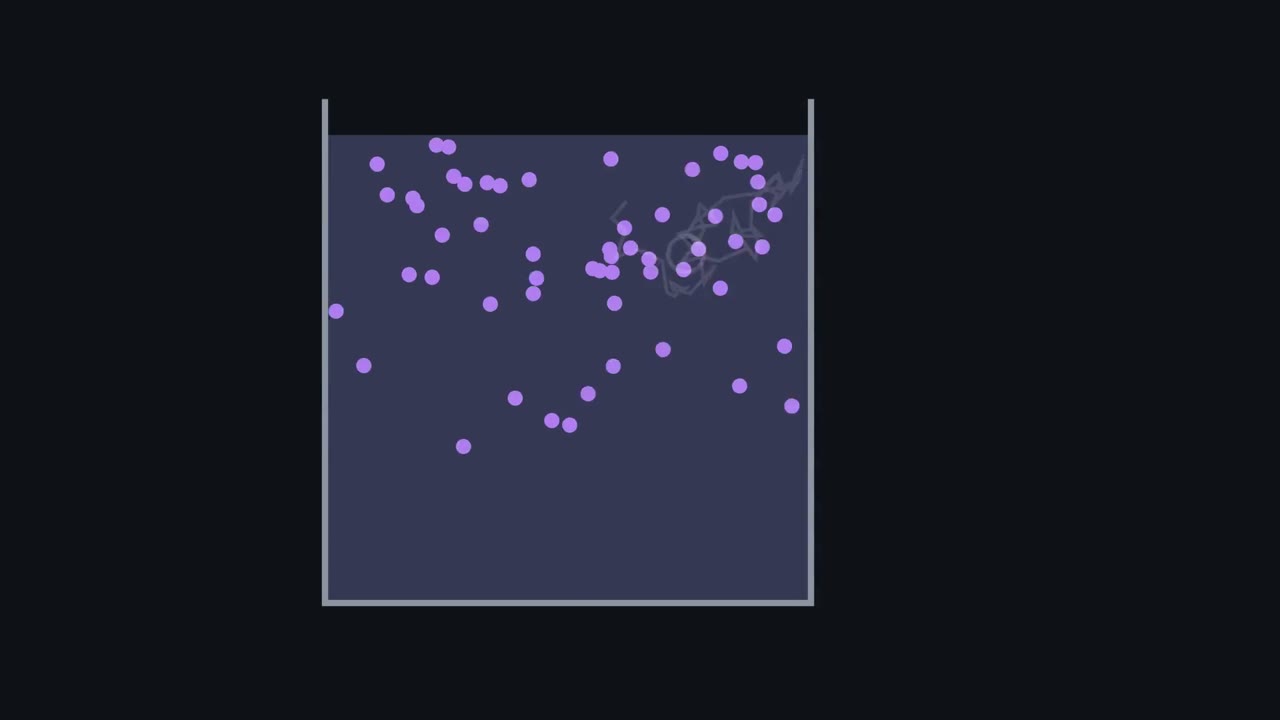 ▶ Watch Random Moves, One-Way Drift · 2:55
Read the transcript of “Random Moves, One-Way Drift”
Film transcript: Random Moves, One-Way Drift
Every dye particle in this glass moves at random. None of them has a direction. So why does a drop of colour always spread out, and almost never gather back into a drop? Let's zoom in and build a model. Picture a tank split down the middle by an open line. Most of the purple dots start on the left. Only a few start on the right. Each dot jiggles along its own path. Any dot that reaches the line may hop across, either way. No dot knows where the crowd is. And nothing pushes any of them. So over many seconds, which way will more dots cross on average? From left to right, or from right to left? Pause and decide.
On average, more cross from left to right. No dot chose that. There are simply more dots on the left to make the hop. A few still hop back. In a short count, luck can make a tie, or even tip it the other way. How crowded a substance is in a space has a name.
Concentration is how much of a substance is in a given space. At the start, the left side is more concentrated. Keep the hops running. The crowd thins on the left and grows on the right. This drift, from more concentrated to less concentrated, is called diffusion. Now the two sides are about even. Dots still cross, and over time just as many go each way. The colour stops changing, yet the dots never stop moving. Now swap the open line for a cell membrane. On one side is the blood, crowded with oxygen. Inside a muscle cell, there is much less of it. The same random hops carry more oxygen into the cell than out of it. Carbon dioxide is more crowded inside the cell, so it drifts out, the other way.
The cell spent no energy on any of this. Movement across a cell membrane that needs no energy from the cell is called passive transport. So here is the rule. Particles move at random, so on average more leave a crowded side than come back. That makes a one-way drift, with no push needed. But what if the crowded particle is one the membrane will not let through? And what if water is the only thing that can cross? That is the next film.
From the film: four take-homes
- Particles are always moving at random, even when nothing seems to change.
- More particles leave a crowded side than come back, so on average a substance drifts from more concentrated to less concentrated. That is diffusion.
- When the two sides are even, particles still cross, and over time just as many go each way.
- Oxygen diffuses into a cell and carbon dioxide diffuses out with no energy from the cell: this is passive transport.
The first film left a puzzle about water.
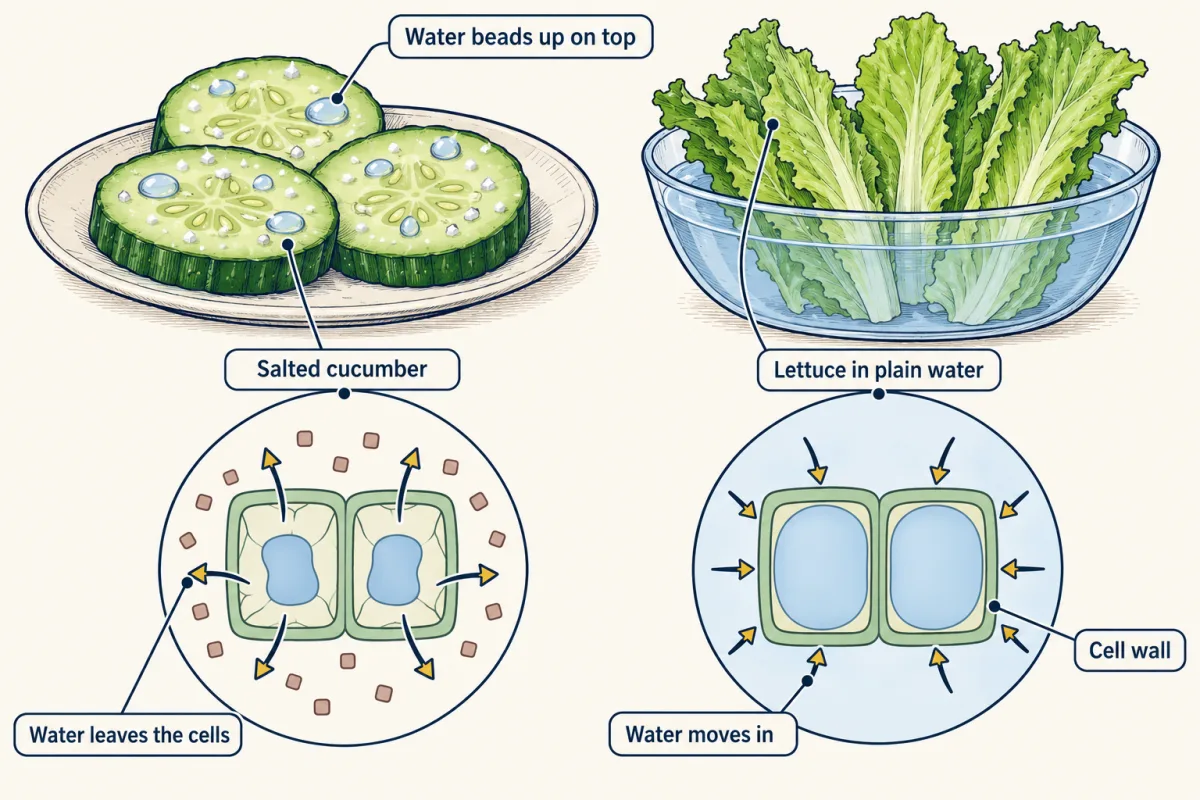
Sprinkle salt on cucumber slices, and within about 15 minutes drops of water bead up on top. Put limp lettuce leaves in a bowl of plain cold water, and in about 15 minutes they can turn crisp again.
Nobody pushed or pumped the water. So what decided which way it went?
What do you think? Decide before you read.
-
Scientists agree: Yes, with one key part added. Osmosis is water diffusing across a membrane that lets water through and holds back many dissolved particles. Without the membrane, the dissolved particles would just spread out and mix in.
What scientists think
Scientists agree: Yes, with one key part added. Osmosis is water diffusing across a membrane that lets water through and holds back many dissolved particles. Without the membrane, the dissolved particles would just spread out and mix in.
-
Scientists disagree: Osmosis and diffusion are passive. Particles move on their own, from where they are more concentrated to where they are less concentrated. Water even crosses tiny artificial bubbles of membrane, where no living cell is doing any work.
What scientists think
Scientists disagree: Osmosis and diffusion are passive. Particles move on their own, from where they are more concentrated to where they are less concentrated. Water even crosses tiny artificial bubbles of membrane, where no living cell is doing any work.
-
Scientists disagree: The membrane holds back much of the salt, and water leaves toward the saltier water outside, where water is less concentrated. A balance shows only the total mass change, so it cannot tell water leaving from salt entering; the osmosis model explains the loss.
What scientists think
Scientists disagree: The membrane holds back much of the salt, and water leaves toward the saltier water outside, where water is less concentrated. A balance shows only the total mass change, so it cannot tell water leaving from salt entering; the osmosis model explains the loss.
The one idea. Particles are always moving at random, so on average more of them leave a crowded side than come back. A substance that can cross drifts from where it is more concentrated (more crowded) to where it is less concentrated, with no push from the cell. Water does the same. Dissolved particles that cannot cross leave a little less water on their side, so water drifts toward the side with more of them.
Scope: the model’s dye and small uncharged particles such as oxygen, carbon dioxide and water, with nothing else pushing them. The rule gives the overall direction on average, not the speed; a short count can go either way. For water, it holds while the dissolved particles cannot cross easily. A push back, such as from a cell wall, can slow or stop the drift. Charged particles also feel electrical pulls (later courses).
Explore: change the salt on each side of a membrane
In this model, a dashed line stands for a cell membrane, with water on both sides. You set the salt on each side and whether the membrane lets through only water, or water and a small dye. The cell below the tank sits in whatever liquid you set on the left side.
Schematic, not to scale. salt, dye. Salt cannot cross the dashed line. Each dot is one particle.
- Dye dots on the left
- 0 (expected when even: 10)
- Dye dots on the right
- 0 (expected when even: 10)
- Dye crossings, last 5 s
- left to right 0, right to left 0
- Water level (relative units, start 10 each)
- left 10.0, right 10.0
- Which side has more salt per water
- about the same
- Water in the cell (relative units, start 10)
- 10.0
In this sketch the dashed membrane holds back all the salt. Real membranes let some salt through, but much more slowly than water. There is one kind of salt, drawn as squares. Each salt level adds 5 squares. Only salt sets which way water moves; the dye is just a marker. The cell is small, so the liquid around it keeps the left salt level you set. There is no pressure. Dye dots move at random, so the counts wobble around the expected value. In this sketch water keeps moving toward the side with more salt per water until the two sides match, then it moves about equally both ways. The water levels can end up different. The rates, the tank size and the cell size limits are made up. The water tank and the cell stop at the largest and smallest sizes drawn.
Rule to keep: particles spread from more concentrated to less concentrated, and water crosses toward the side with more dissolved salt; the cell spends no energy on either.
Try this.
- Add dye to the left with a water-only membrane. Does any dye cross? Now let dye through. Read the crossing count early on and again once the sides are even. What changed?
- Set the same salt level on both sides, with a water-only membrane. Predict: will either water level rise? Then test it.
- Turn the left-side salt all the way up. Predict: will the cell swell or shrink? Then set the left side to plain water and predict again.
Explain: particles spread from more to less
- concentration
- diffusion
- passive transport
- cell membrane
- selectively permeable
- osmosis
- homeostasis
Cells must move materials in, out and within to stay alive. The first film named two words. Concentration is how much of a substance is in a given space. Diffusion is the movement of a substance from where it is more concentrated to where it is less concentrated. Diffusion also happens inside cells, and water diffuses too.
In a glass, the drift ends once the dye is even. Across your cell membranes it does not. Your cells keep using oxygen, so oxygen stays scarce inside and keeps diffusing in. They keep making carbon dioxide, so it keeps diffusing out (that lesson). The film called this no-energy movement passive transport; osmosis is passive too.
Explain: water crosses a choosy membrane
The cell membrane is the thin layer around every cell (that lesson). It is selectively permeable: it lets some substances through and holds back others. In most cells, water, oxygen and carbon dioxide cross it easily. Many dissolved particles (tiny bits of a substance mixed into water), such as salt and sugar, cross much less easily.
Oxygen can cross, so it drifts toward the side with less oxygen. Salt is different: the membrane holds most of it back. A model where only water crosses is a good simple picture of the salted cucumber. Most real cell membranes let some salt through, but much more slowly than water. The second film follows the water.
Read the transcript of “Water Drifts to the Saltier Side”
Film transcript: Water Drifts to the Saltier Side
Remember the salted cucumber? Drops of water bead up on top, and nobody squeezed it. So where did that water come from, and what made it leave? The first film showed random hops making a one-way drift, from crowded to less crowded. This time, the crowded particle is salt, and the membrane holds it back. Here is the same tank and membrane. Blue water dots fill both sides. Grey salt squares sit only on the right. In this model, the membrane holds back all the salt. Real ones let a little through, much more slowly. Now take a spoonful from each side. On the left, every space holds water. On the right, some spaces hold salt instead. So the right side has less water.
This grid is only a cartoon. We drew far more salt than is real, so you can see it. Real salt water is still almost all water. The difference is small, but it is there. Water dots hop at random, both ways. So which way will more water dots cross?
Toward the side with more water, or toward the side with less? Pause and decide. On average, more water crosses from the left, where there is more water. Nothing pulls it. There is simply more water on the left to make the hop. This drift of water across a selectively permeable membrane is called osmosis.
Water moves from more water to less water. That is the side with more dissolved particles. Back to the cucumber. Zoom into one cell. Salt sits outside, and the membrane holds most of it back. The salty liquid has more dissolved particles than the cell does. So there is less water outside. Water drifts out of the cell, toward the salty side. The vacuole shrinks, and water beads up on the slice. A limp lettuce leaf sits in plain water. Its cells hold more dissolved particles than the water around them, so there is less water inside. So water drifts in. The vacuole fills, and the cell presses out against its stiff wall. The wall presses back. The cells firm up, and the leaf turns crisp.
In both cases, the cell spent no energy moving the water. Osmosis is passive transport. It is the same random drift from the first film. In our model, only water crosses. So follow the water. When the membrane holds the salt back, water drifts toward more dissolved particles. A push back, like a stiff wall, can slow or stop that drift.
From the film
- Osmosis is the diffusion of water across a selectively permeable membrane.
- Water drifts from more water to less water, toward the side with more dissolved particles, unless something pushes back.
- Salty liquid has more dissolved particles than a cucumber cell, and the membrane holds most salt back, so water drifts out of the cells.
- In plain water, water drifts into lettuce cells until their stiff walls push back, and the leaf turns crisp.
- The cell spends no energy on osmosis; it is passive transport.
When does the drift stop?
The film named the water drift osmosis, the diffusion of water across a selectively permeable membrane. Water molecules never stop crossing. The overall drift stops once as much water leaves as enters.
- In salty water, like the cucumber, water leaves. The inside gets more crowded and the outside a little less. In this simple model, the drift stops when the two sides match, or sooner if something pushes back.
- In plain water, like the lettuce, the swelling cell presses on its stiff cell wall (that lesson) long before the sides are even. The wall presses back. That push stops the drift and keeps the leaf crisp, even though the inside still has more dissolved particles.
Predict. An animal cell has no cell wall. What could happen to it in plain water?
Check your prediction
With no wall to push back, water keeps coming in: a red blood cell in plain water can swell until it bursts. Cells in your body sit in fluid with about the right amount of dissolved particles, and they have ways to control their water.
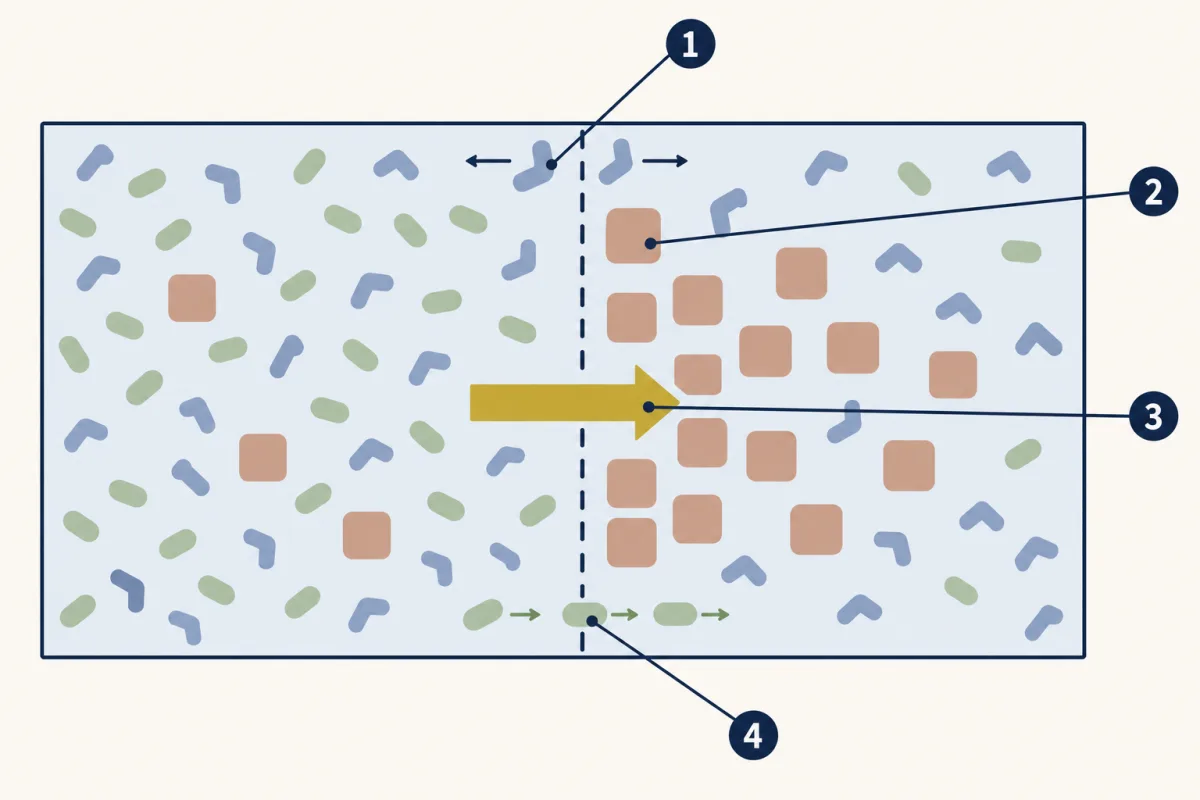
- water
- salt
- osmosis
- oxygen
- water
- salt
- blank
- blank
Word bank: osmosis, oxygen
- blank
- blank
- blank
- blank
Check your labels
- water
- salt
- osmosis
- oxygen
| What moves across the membrane | Example | |
|---|---|---|
| Diffusion | Any substance that can cross, including water | Oxygen into a cell |
| Osmosis | Water, across a selectively permeable membrane | Water out of a salted cucumber |
Osmosis can swell or shrink a cell in minutes, so the membrane matters for homeostasis, keeping conditions inside a living thing steady. By letting some things pass and holding others back, it helps keep the right amounts of water and other substances inside the cell.
Elaborate: weigh cucumber slices in salt and plain water
In a filmed Open University demonstration, one peeled cucumber slice went into salty water and one into distilled water (water with almost nothing dissolved in it). Each slice was patted dry and weighed several times. The graph shows every reading as a percent change.
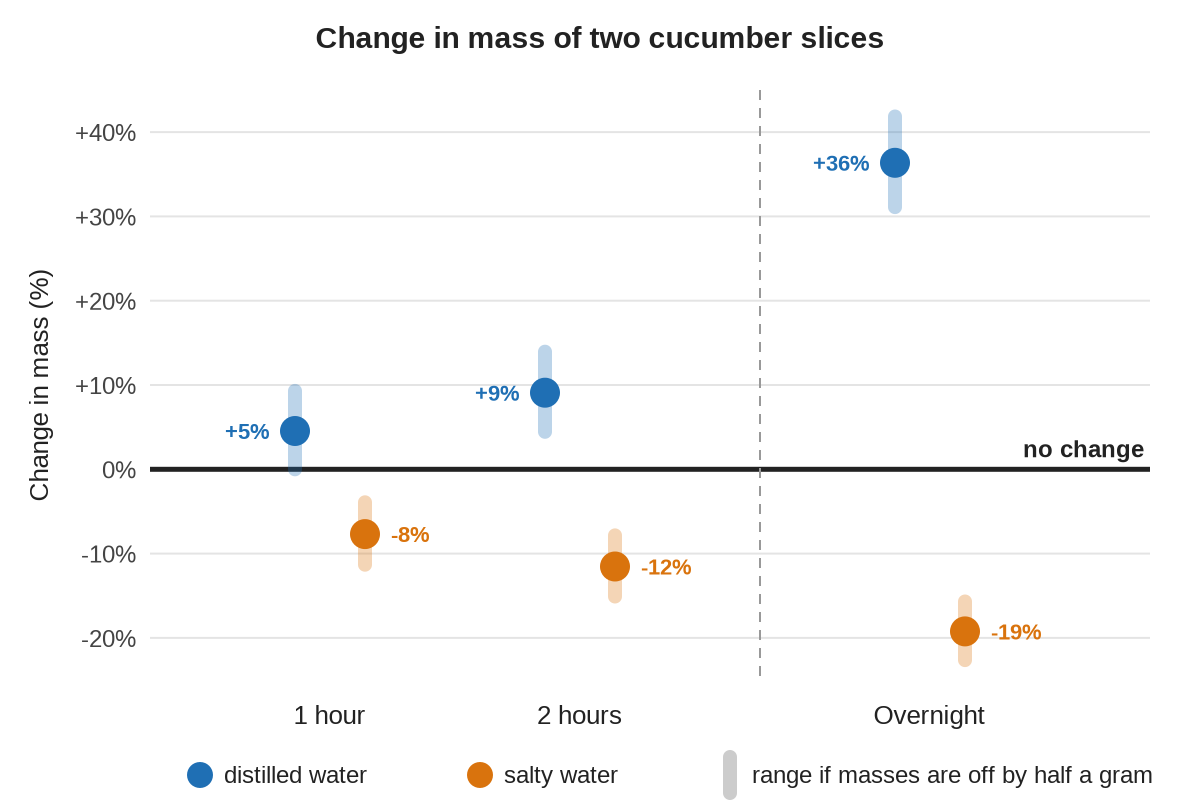
To read the graph:
- Dots above the bold “no change” line gained mass; dots below it lost mass. Blue is distilled water; orange is salty water.
- “Overnight” is not an exact time, so it sits apart from the timed readings.
- Masses were read to the nearest gram, so each pale band shows where the true change could be. A band that touches zero might mean no change at all.
- The dot above the zero line means the slice blank.
- The band touches zero, so blank.
percent change in mass = (final mass − starting mass) ÷ starting mass × 100
| Slice | Time in the liquid | Starting mass (g) | Mass then (g) | Change in mass (%) |
|---|---|---|---|---|
| Salty water | 1 hour | 26 | 24 | −8 |
| Salty water | 2 hours | 26 | 23 | −12 |
| Salty water | Overnight | 26 | 21 | −19 |
| Distilled water | 1 hour | 22 | 23 | +5 |
| Distilled water | 2 hours | 22 | 24 | +9 |
| Distilled water | Overnight | 22 | 30 | +36 |
About these data
Source: The Open University (OpenLearn), “Basic science: understanding experiments”, demonstration by Janet Sumner, accessed October 2026. No date or place is given. The salty water was tap water with two tablespoons of salt added; the volume of water was not stated, so the salt concentration is unknown. There was one slice in each liquid. The percent changes are calculated from the reported masses and rounded. The masses were read only to the nearest gram, so each percent change could be off by a few percent. The smallest one, the 1-hour gain in distilled water, could even be zero. The overnight changes are far larger than this rounding error.
- Describe the trend for each slice over time.
- Overnight, how many grams did each slice gain or lose?
- Why is percent change a fairer way to compare the two slices than grams?
- The slice in blank water lost mass because water moved blank.
- The change was blank percent, which shows blank.
- The data are limited because blank.
Claim, evidence, reasoning
Make a claim that answers this: how did water move into or out of the cucumber cells without the cells pushing it? Use the table.
Start with: Water moved blank the slice in salty water and blank the slice in distilled water.
Start with: Overnight, the salty slice changed by blank percent and the distilled-water slice changed by blank percent.
Start with: This happens because water moves by osmosis toward the side where blank, and the cell spends blank energy on it.
Compare with a model answer
Water left the slice in salty water and entered the slice in distilled water. Overnight, the salty slice went from 26 g to 21 g, about −19 percent. The distilled-water slice went from 22 g to 30 g, about +36 percent. By osmosis, water moves toward the side with more dissolved particles, with no energy from the cells. There was only one slice in each liquid, the salt concentration is unknown, a balance cannot tell water from salt, and the masses were read only to the nearest gram.
Saved in this browser only.
Design problem
Plan an investigation: how does the amount of salt in water change the mass of potato pieces? Name your variables, constants, control and number of trials, and say how you will stay safe.
Saved in this browser only.
One way to do it
- Question: How does the amount of salt change the percent change in mass of potato pieces?
- Independent variable: grams of salt in each 100 mL of water, for example 0, 1, 2, 4 and 6 g.
- Dependent variable: the percent change in mass of each piece after 30 minutes.
- Constants: one potato, same-size pieces, 100 mL of liquid per cup, the same time, temperature and patting method.
- Control: the cup with 0 g of salt, which is plain water.
- Trials: three pieces in each cup. Find each piece’s percent change, then the mean.
- Measure: mass in grams on a balance, before and after, patted dry each time.
- Safety: an adult cuts the potato. Label every cup, wipe up spills, and never taste anything.
If pieces gain mass in plain water and lose more as the salt goes up, that fits osmosis.
Evaluate: check your thinking
Check the table against the one idea: in both liquids, water drifted toward the side with more dissolved particles, with no energy from the cells.
Science practices you used: making and testing predictions with a model, calculating percent change from measured masses, reading a graph and a data table and naming their limits, and planning a fair test with a control and repeated trials.
Going deeper
How much less water? Very little. Salt water and the inside of a cell are both almost all water, so every drawing here, including the film’s grid, exaggerates the salt. College courses describe this with pressure and water potential instead of counting water.
The three stories, told aloud Side Hops: three stories that go with this lesson Side Hops
Three real-world stories about water on the move
3:49 · Narration: an AI narrator voice (ElevenLabs, Jessica).
Read the transcript
Let's take a quick trip through three real-world stories about water. Two of them show the same quiet rule at work. The third shows why it pays to check the evidence before you give that rule the credit.
Our first stop is Paris, almost three hundred years ago. A scientist named Jean Antoine Nollet has a vessel of alcohol, and he covers it with a very unusual lid. A piece of pig bladder. Yes, really! He sets the whole thing in a bigger container of water, and then he waits.
Nobody squeezes anything. Nobody pumps anything. And yet the bladder starts to puff up! Water from the outside gets through it more easily than the alcohol gets out. More water comes in, and more, and more. The bladder stretches tight. When Nollet pricks it with a pin, a jet of liquid shoots up more than a foot!
So the thin layer lets the water pass, and the difference between the two liquids sets the direction. More water crosses one way than the other, with no pump at all. Here is the best part. Every cell in your body is wrapped in a membrane that is choosy in its own way. That old pig bladder has a lot to do with you.
For our second stop, imagine a small boat on the open ocean. The people on board are very thirsty. There is water in every direction, and all of it is salty. Drinking it seems like it ought to help. It does not!
Here is the trouble. Human kidneys can only make urine that is less salty than seawater. So to get rid of the salt from seawater, the body has to pass more water than the person drank. The more seawater someone drinks, the further behind they fall.
Then comes a second problem. When the blood gets saltier than the liquid inside cells, and the cell membranes hold most of that salt back, water drifts out of the cells. Even cells in the brain can shrink. It is the same drift that pulls water out of a salted cucumber, only now it is happening inside a person. So the body loses water getting rid of the salt, and the cells lose water to the salty blood. That is how someone can be surrounded by water and still become dangerously dehydrated, even while feeling thirstier.
Our last stop is much closer to home. It is your bathtub! Stay in long enough and your fingertips go wrinkly. The answer seems easy. Water must be soaking into your skin and puffing it up. Good guess! But almost a hundred years ago, two researchers described something odd. When a nerve in the hand was damaged, the skin served by that nerve did not get those wrinkles.
Wait a minute. If wrinkles were only water soaking in, a damaged nerve should make no difference. So what was going on? Later studies found the answer. Your nervous system narrows the blood vessels in your fingertips. The soft pad of each finger gets pulled inward a little, and the skin on top folds. Your body is actively making those wrinkles!
What are they for? That is still an open question. One study found that people with wrinkled fingers moved wet objects faster. A later, larger study could not find that advantage. Scientists are still sorting it out. So the next time you look down at your fingers in the tub, give them a wiggle. You are looking at a question nobody has fully answered yet.
The idea underneath them. Particles move at random, so on average more of them leave a crowded side than come back: a substance drifts from more concentrated to less concentrated, and when dissolved particles cannot cross, water drifts toward the side with more of them, with no energy from the cell.
Your notes
Select any text in the lesson to highlight it or add a note to it. Your highlights and notes are saved in this browser and collected in your notebook.
This browser is not letting the site save anything (a private window or strict privacy settings), so highlights and notes will be lost when you leave the page.
Try the Predict question again
The Predict question from this lesson, on its own. Answer it first, then open the check.
An animal cell has no cell wall. What could happen to it in plain water?
From: Explain: water crosses a choosy membrane
Check your prediction
With no wall to push back, water keeps coming in: a red blood cell in plain water can swell until it bursts. Cells in your body sit in fluid with about the right amount of dissolved particles, and they have ways to control their water.
How we measure it
Blotting and weighing on a balance
A slice of plant tissue is patted dry and weighed, soaked in a liquid, then patted dry and weighed again. The percent change in mass shows whether the slice gained or lost mass overall. It is used as a sign that water moved in or out, though some dissolved particles can move too.
Testing a membrane protein in frog eggs
Scientists put the instructions for one membrane protein into frog egg cells, then compared how easily water crossed into those eggs and into eggs without the protein. A difference shows that the protein changes how water crosses. Tests with the purified protein are needed to show that the protein itself is the channel.
Where this lesson fits
Before thisReview first
- Plant Cells and Animal CellsThis course · Lesson 3
You need the cell wall and the cell membrane from there to see why a lettuce cell stays crisp.
- Inside a CellThis course · Lesson 2
It introduces the cell membrane as the boundary that decides what enters and leaves.
After thisStudy next
- From Cells to OrganismsThis course · Lesson 6
It uses cells keeping conditions steady, which passive water movement helps do, when cells share jobs in a body.
- Photosynthesis Feeds the WorldThis course · Lesson 9
It follows carbon dioxide and water moving into plant cells, where diffusion carries gases across membranes.
- Releasing Energy from FoodThis course · Lesson 10
Cells keep using oxygen and making carbon dioxide, so these gases keep diffusing in and out.
Suggested by an AI model from the lessons themselves, then checked. How we use AI
That is the skim: you have the shape of it.
Those are the stories. The idea under them is the one the lesson builds.
That is both films: the lesson in pictures.
The rest of the lesson is here when you want it.
Finish line
Test yourself
8 questions
Practice and MCAT-style, with explained answers.
Next · Lesson 6
From Cells to Organisms
A Paramecium is one cell and does every job of life. Why does your body need trillions of cells to do the same jobs?
Continue →Rewritten on : new text, figures, flashcards and film. Notes and highlights stay, but the text around them may have moved.