Biology Together · Unit 3: What plants need and how they work
Thirsty Celery
Rewritten on : new text and film. Your notes and highlights stay, but the text around them may have moved.
How does water get from the bottom of a plant to the top? Coloured water and a celery stalk make the path visible.
Three real-life stories behind this activity, about 2 minutes aloud, or read them below.
The film, 4 minutes, and the safety notes, for the grown-up to look at before the activity.
The hands-on part, done with a child: about 20 minutes, then a few quick looks later.
Pause when the reading reaches a film, and offer to play it. Saved on this device.
Watch the film now, or keep listening
That is the end of the reading
This idea at other levels
An activity for ages 5 to 10 about water in plants. Next, for an older child: Plant Cells and Animal Cells (grade 7).
See every levelHide the levels
How water moves through a plant
Water is pulled up thin tubes from roots to leaves as it evaporates from the leaves.
Four levels here: ages 5 to 10, grade 7, high school and a first college course. The lesson at grade 7 was picked by hand for this lesson.
College, a first course · the level you chose
Moving Water and Sugar in Plants
A redwood lifts water 100 metres with no pump: cohesion and tension.
Organismal Biology · about 18 min · film 3:16 · 3 practice questions
High school · the level you chose
Evaporating leaves pull the column up a tree; cohesion keeps it from breaking.
Biology · about 40 min · film 3:30 · Virginia BIO.2a
Grade 7 · the level you chose
Plant Cells and Animal Cells · also at this level, picked for this lesson
Life Science · about 40 min · Virginia LS.2 c
Ages 5 to 10 · the level you chose
Thirsty Celery · this lesson
Stand celery in blue water and watch the colour climb to the leaves.
Biology Together · about 20 min · film 3:46 · Virginia 1.4 b, 4.2 b
Play the ladder · 2 films, about 7 min, from high school to a first college course. Each film waits for you to press play.
Next door to water in plants
- OsmosisHow water gets into a root cell in the first place.Nearest lesson: Diffusion and Osmosis (grade 7)
- PhotosynthesisLeaves lose water through the pores that take in carbon dioxide.Nearest lesson: What Do Plants Need? (ages 5 to 10)
Also at grade 7: Diffusion and Osmosis
Short versions inside this lesson
The grade 7 version · about 1 minute to read
In grade 7 Life Science, children look at the cells that make up a plant. They learn why a limp celery stalk gets crisp again in water: water moves into its cells, which have stiff walls, and the cells push out against them. They also learn how water and other substances move into and out of cells by diffusion and osmosis.
The plainest version · about 1 minute to read
A plant drinks through its roots. Then the water has to travel all the way up to the leaves. It goes through tiny tubes, too thin to see one by one, that run up the stem. The coloured water lets us see which way the water went. When water dries off the leaves, more water moves up the tubes to take its place.
Find an idea: every idea, searchable
Which lessons teach an idea, and the notes on each level, were written by AI models from the lessons and checked by a second model. A person has not yet read every one. How we use AI
About this activity what is in it
Builds on:What Do Plants Need? (read)Plant Parts We Eat (read)Why these?
Rewritten on : new text and film. Notes and highlights stay, but the text around them may have moved.
Before you start
- Hands-on time
- About 20 minutes, plus short checks after about 1 hour, 4 hours and the next day
- Where
- Indoors
- Ages
- 5 to 10, with an easier and a harder version below
- Grown-up
- An adult does all the cutting. Stay nearby while the coloured water is out; the checks later are quick looks together.
What you need
- 3 celery stalks with leaves still on (the pale inner stalks often have the most leaves)
- 3 clear glasses or jars that won't tip easily
- Blue or red food colouring (yellow is hard to see)
- Water
- A knife and cutting board, for the adult
- A tray, paper towels, and old clothes
- A magnifying glass (optional)
- A white carnation or a leaf of napa cabbage (optional)
- Paper and a pencil, or the printed observation sheet below
Virginia science standards SOL 1.4 bSOL 4.2 b
In this activity. You stand celery stalks in strongly coloured water and check them over a day.
The film
 ▶ Watch Thirsty Celery: Parent Guide · 3:46
Read the transcript of “Thirsty Celery: Parent Guide”
Film transcript: Thirsty Celery: Parent Guide
How does water get to the top of a plant? A celery stalk and blue water make its path visible. You'll compare a stalk with leaves to one without. Setting up takes about twenty minutes, plus a few short checks over a day. Your child makes a guess, waits, and checks it. They practice looking closely at something slow. And they see a path inside a plant that is normally hidden. If anyone is allergic to celery, leave it out for everyone. Use the guide's napa cabbage option instead. Keep all experiment plants out of mouths. The setup that follows is for celery. Choose food coloring everyone can use safely. If no coloring is suitable, skip the activity.
You need three celery stalks with leaves, three sturdy clear glasses, and blue or red food coloring. Yellow is hard to see. Add water, a tray, paper towels, and old clothes, because the coloring stains. Fill each glass with about five centimeters of water. Stir in fifteen to twenty drops of coloring per glass. Dark color is much easier to see. You do all the cutting. Keep celery pieces and small dye caps away from children under four. Call nine one one if choking. Trim about two centimeters from each base just before setup. Cut all the leaves off one stalk. Before they go in, hold up both stalks. Ask, 'Where do you think the blue will go?' Then ask, 'Which one will change first, the one with leaves or the one without?'
Write down the guesses. Stand the leafy stalk and the leafless stalk in two glasses of the same color. Keep the third stalk as a spare. Find a bright spot out of direct sun. Stay nearby while the colored water is out. Now a question for you. Tomorrow you will cut across the leafy stalk, above the water. What do you think the cut end will look like? Blue all over, or something else?
Check after about one hour. Little may show yet. After about four hours, blue lines most often climb the ribs, and the leaf edges start to color. Compare the two stalks. Ask, 'Was your guess right?' The next day usually gives the clearest result, with blue veins in the leaves. Cut across the stalk about three centimeters above the water. Look for a curved row of blue dots. Each dot marks a bundle that contains water tubes. Here is why the leaves matter. Water dries off through tiny pores in the leaves. As it leaves, it pulls more water up the tubes behind it. So the stalk with leaves usually colors faster. Stay nearby while the colored water is out.
Use sturdy glasses that won't tip, kept away from toddlers and pets. Nobody eats the celery or drinks the colored water. Throw both away, and wash hands with soap. To finish, ask, 'Where did the water go in, and where did it go?' The color only made the path visible. With clear water, it still climbs. We just can't see it.
Before you start
- Hands-on time
- About 20 minutes, plus short checks after about 1 hour, 4 hours and the next day
- Where
- Indoors
- Ages
- 5 to 10, with an easier and a harder version below
- Grown-up
- An adult does all the cutting. Stay nearby while the coloured water is out; the checks later are quick looks together.
What you need
- 3 celery stalks with leaves still on (the pale inner stalks often have the most leaves)
- 3 clear glasses or jars that won't tip easily
- Blue or red food colouring (yellow is hard to see)
- Water
- A knife and cutting board, for the adult
- A tray, paper towels, and old clothes
- A magnifying glass (optional)
- A white carnation or a leaf of napa cabbage (optional)
- Paper and a pencil, or the printed observation sheet below
Virginia science standards SOL 1.4 bSOL 4.2 b
The big idea
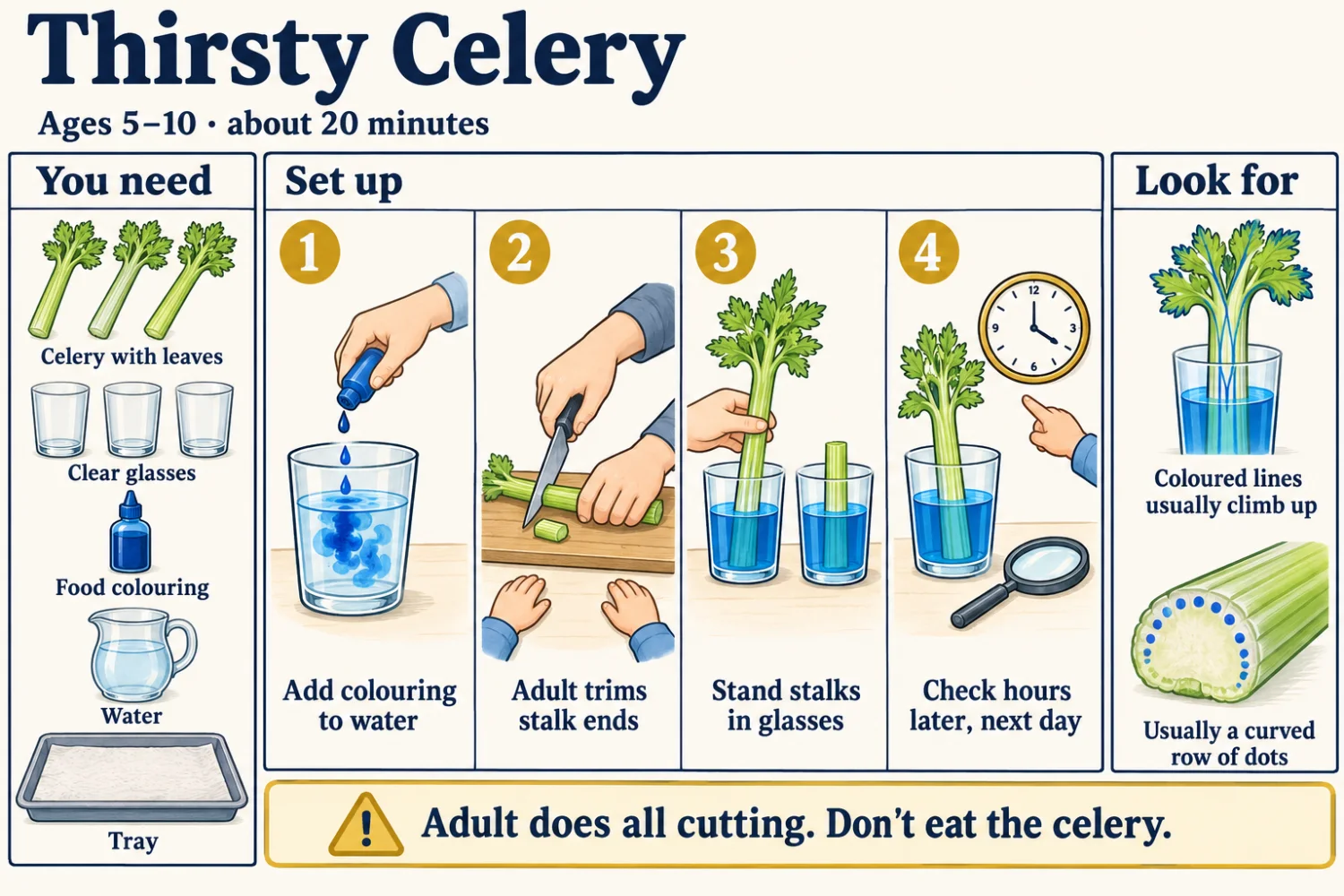
Stand a celery stalk in blue water and wait. After a few hours, thin blue lines creep up the stalk and the leaves start to turn blue at the edges. The colour shows a path your child can’t normally see: the water tubes inside a plant. Along the way your child practises making a guess, checking it, and waiting for a slow result.
Say it together (read aloud): “Water goes into a plant at the bottom. It climbs up tiny tubes to the leaves. The colour lets us see the path.”
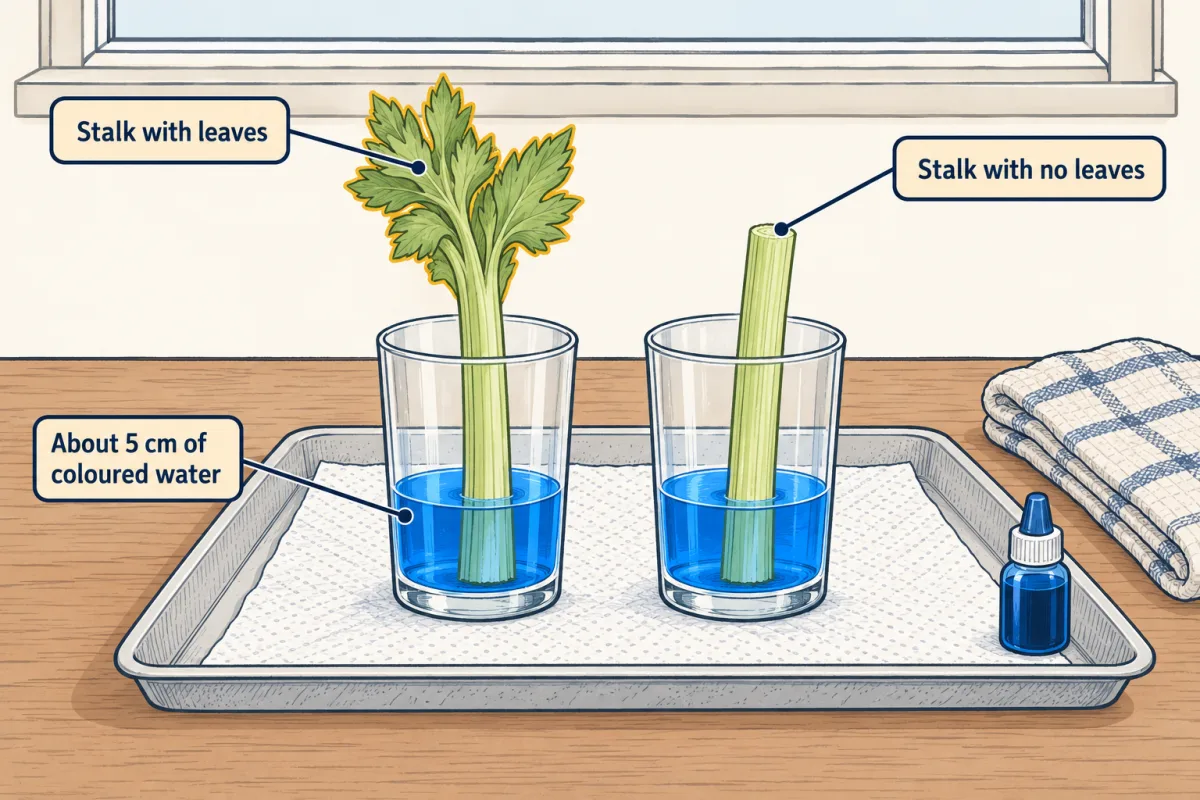
Roots take in water, and the stem carries it up to the leaves. Inside are bundles of tiny tubes, too thin to see one by one. Water moves up them, and food colouring rides along. The celery stalk we buy is really the long stalk of a leaf, but it carries water the same way a stem does.
Leaves matter here. Water evaporates from tiny pores in the leaves, and as it leaves, it pulls more water up the tubes behind it. That is why a stalk with leaves usually takes up colour faster than one without.
For teachers (Virginia standards)
Virginia’s grade 1 standard asks what stems and leaves do; grade 4 adds how roots, stems and leaves work together.
What to do
- Mix the colour. Fill each glass with about 5 cm of water. Stir in 15 to 20 drops of food colouring per glass. A dark colour is much easier to see.
- Fresh cut. You trim about 2 cm off the bottom of each stalk just before it goes in the water. A fresh cut takes up water well; a dried-out end is slow. From one stalk, also cut off all the leaves.
- Predict. Before the stalks go in, ask, “Where do you think the blue will go? How long will it take?” Then hold up both stalks: “Which one will change first, the one with leaves or the one without?” Write or draw the guesses.
- Stand them up. Put one leafy stalk and the leafless stalk in two glasses of the same colour. Keep the third leafy stalk for the two-colour test in “Ages 8 to 10”, or add it as a spare. Put the glasses in a bright spot out of direct sun.
- Check after about 1 hour. Little may show yet. Look at the bottom of the stalk and the leaf edges, using the magnifying glass. Ask, “Anything yet? Where would you look first?”
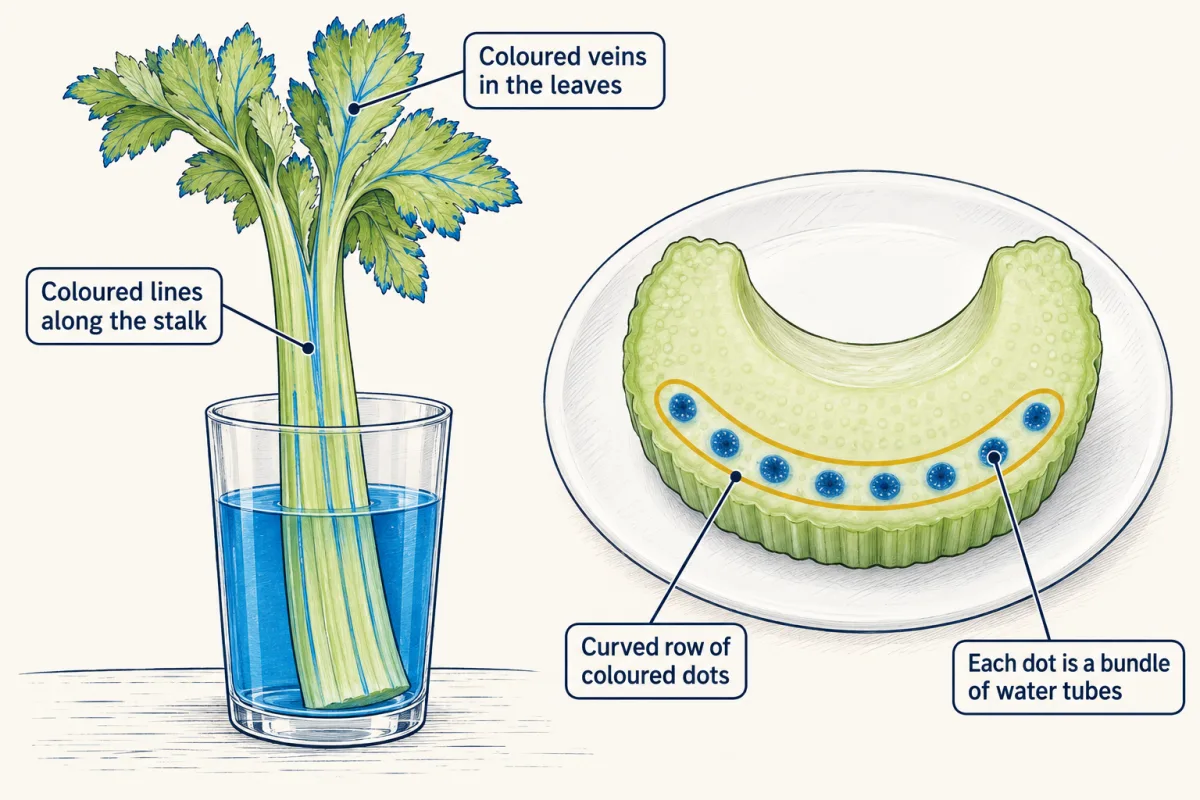
- Check after about 4 hours. Most often, coloured lines show along the ribs of the stalk and the leaf edges begin to colour. Compare the two stalks: “Was your guess right?” Times vary with the room’s warmth, the light, how strong the dye is and how fresh the celery is.
- Check the next day. Overnight usually gives the clearest result, with coloured veins in the leaves. Ask, “What do you think the cut end will look like?” Then you cut across the stalk about 3 cm above the water. Look for a curved row of coloured dots. Each dot marks a bundle that holds water tubes.
- Peel a string. Snap a short piece of stalk and pull out one of the stringy strands. These strings are mostly tough support tissue that holds the stalk firm. A string may show colour where a bundle of water tubes came away with it; support tissue on its own usually stays paler.
- Debrief. Ask two closing questions:
- “Where did the water go in, and where did it go?”
- “Which stalk changed faster, if either? What might explain what we saw?” Read Say it together aloud again.
Questions to ask while you do it
Ask your child to guess first, then check.
- “Where do you think the blue will show up first?”
- “I wonder if the stalk with no leaves will change as fast. Why or why not?”
- “What do you think we will see when we cut across the stalk?”
- “Where does a real celery plant get its water?”
- “What do you think would happen if we used two colours on one stalk?”
- “I wonder if a flower would do the same thing.”
What children often think
-
A child might say “The celery drinks with its leaves.”
You could try Ask where the colour is touching the plant. Only the cut bottom is in the water, and the colour shows there first. Water goes in at the bottom. The leaves are where water leaves the plant, as it dries off into the air.
-
A child might say “The stalk sucks it up like a straw.”
You could try Ask who does the sucking when you use a straw. Then compare the stalk with leaves to the one without. Most of the pull comes from water drying off the leaves, which tugs the water in the tubes upward.
-
A child might say “The colour will spread all through the stalk.”
You could try Cut across the stalk the next day and look. The colour sits in dots, not everywhere. Water travels in its own tubes, and the rest of the stalk stays mostly pale.
-
A child might say “Real plants don’t drink blue water, so this is a trick.”
You could try Agree that plants usually drink clear water. Ask what would happen if the water were clear. The water would still climb, but we could not see it. The colour just makes the path visible.
Why it works
The water tubes are part of a tissue called xylem. Many of its cells are long and hollow, and they die when mature, leaving open pipes joined end to end.
The pull comes mostly from the leaves. Water evaporates from inside the leaf and escapes through tiny pores called stomata. Water molecules cling to each other, so as some leave at the top, the whole thin column is drawn up behind them. This loss of water from leaves is called transpiration. Water also climbs a short way up very narrow tubes by itself, but that cannot explain how it reaches the top of a tall tree.
A stalk with no leaves has far fewer pores, so it usually colours more slowly. Celery varies, so treat this as a test, not a sure thing. The dots in a curved row are the stalk’s vascular bundles, which also carry sugar from the leaves in a second set of tubes. The tough “strings” of celery are mostly collenchyma, a living support tissue that runs in strands just under the skin, along the ribs.
Easier and harder
Ages 5 to 7
Use one leafy stalk in one colour and skip the leafless comparison. Check twice, after about 4 hours and the next morning. Your child draws the stalk each time and colours in where the blue has reached. Let them use the magnifying glass on the cut end and count the dots.
Ages 8 to 10
Keep the leaf comparison and add a split stalk. You cut up the middle of the bottom 8 to 10 cm of a leafy stalk. Stand one half in blue and the other in red, in two glasses side by side. Predict what the leaves will look like. Measure in centimetres how far the colour has climbed at each check and record it in a table.
If it doesn’t go as planned
If nothing shows after several hours, the dye may be too weak or the cut end may have dried. Add more colouring and have the adult trim a fresh 2 cm off the bottom. Old, limp celery can be slow, so use a crisp bunch. Yellow and green dyes are hard to see; blue and red work best. A cool room slows everything, so give it until the next day.
Observation sheet
Here is what a filled-in row can look like:
| When | Stalk with leaves | Stalk with no leaves |
|---|---|---|
| About 4 hours | Blue lines up the ribs, leaf edges turning blue | Less colour so far |
Observation sheet
Thirsty celery
NameDate
Look at each stalk. Draw or write where the colour has reached.
| When | Stalk with leaves | Stalk with no leaves |
|---|---|---|
| About 1 hour | ||
| About 4 hours | ||
| Next day |
I think the colour will go:
What we saw:
stemhop.com · Biology Together
The three stories, told aloud Side Hops: three stories that go with this lesson Side Hops
Three playful ways to talk about thirsty celery
1:32 · Narration: an AI narrator voice (Kokoro, af_heart).
Read the transcript
The celery activity is mostly waiting, and waiting is a lovely time to chat. Here are three easy things to say or ask while the blue creeps up.
First, a phrase to save for the end, once the colour has climbed. Try saying, "A tree drinks through its roots, and its leaves let the water go into the air, where we can't see it." Then look out the window together. A tree can take up ten to one hundred fifty gallons of water in a day, and about ninety-five percent of it goes back into the air. If your child asks how fast, share these rough speeds: water climbs about ninety-two feet an hour through a red oak, and about six feet an hour through a pine.
Second, after you have compared the stalk with leaves and the stalk without, grab a pop-up tissue box. Let your child pull one tissue out and watch the next one rise right behind it. Water in a plant's tiny tubes clings to itself in much the same way, so when some dries off a leaf, it tugs the next bit up.
Third, a question for later in the day. Ask, "The tallest coast redwoods grow over three hundred fifty feet high, and trees have no heart to pump water. So how does water get all the way to the top?" You may hear rain, giant straws, or squirrels with buckets. Enjoy every guess. Then point at your leafy celery and wonder together what those leaves have been up to all day.
The idea underneath them. You stand celery stalks in strongly coloured water and check them over a day.
Your notes
Select any text in the lesson to highlight it or add a note to it. Your highlights and notes are saved in this browser and collected in your notebook.
This browser is not letting the site save anything (a private window or strict privacy settings), so highlights and notes will be lost when you leave the page.
Where this lesson fits
Before thisReview first
- What Do Plants Need?This course · Lesson 7
Your child has already seen that plants need water, so here they can follow where that water travels.
- Plant Parts We EatThis course · Lesson 8
Knowing that celery is a stalk, and what stems and leaves do, helps your child read the coloured lines.
After thisStudy next
- Leaf DetectivesThis course · Lesson 10
Your child studies leaves more closely, the same part that pulls water up the stalk.
- Hidden Leaf ColorsThis course · Lesson 27
Another colour trick in leaves, using a coffee filter to show what is hidden inside them.
- Roots Hold the SoilThis course · Lesson 29
Your child looks at roots, where the water that climbs the stalk first comes in.
Suggested by an AI model from the lessons themselves, then checked. How we use AI
Those are the stories. The idea under them is the one the lesson builds.
That is the film. The rest of the activity is the fun part.
The rest of the activity is here when you want it.
Finish line
Test yourself
4 questions
Questions to talk over together.
Next · Lesson 10
Leaf Detectives
How can you tell an oak from a maple without a label? A pile of fallen leaves and a few yes-or-no questions can do it.
Continue →Rewritten on : new text and film. Notes and highlights stay, but the text around them may have moved.