Downhill for Free
Read the transcript of “Downhill for Free”
Film transcript: Downhill for Free
There is water inside a cell and water all around it. So how does water know which way to go? To find out, start with something you can see: a drop of dye. Drop dye into still water. Each dye molecule jiggles and bumps at random. Now draw a line down the middle, and count the crossings each way. At first, far more cross from the crowded side, simply because more are there to cross. Later the dye is even. Crossings still happen, equally both ways. The molecules never stopped moving. There is just no net movement. A difference in concentration from one place to another is a concentration gradient. In open water, with no energy spent, a substance moves on balance down its gradient, from more concentrated to less.
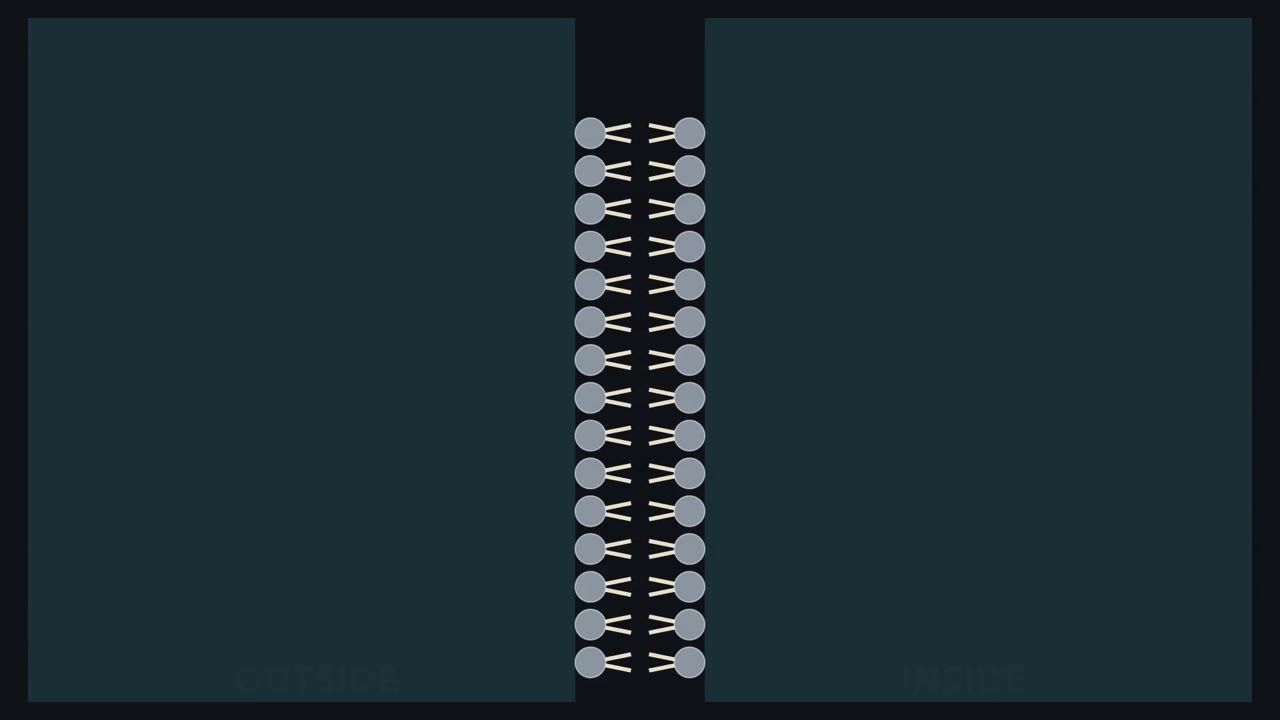
That spreading is diffusion. Now put a cell membrane in the way. It is two rows of phospholipids, heads facing the water, oily tails tucked inside. Small oxygen molecules slip straight through the oily middle. Charged ions, such as sodium and chloride bounce off the oily middle. They cross mainly through proteins. Water crosses too, much of it through protein water channels. A membrane like this is selectively permeable. Now join two tanks with this membrane. Both hold pure water, at the same level. Water crosses both ways, equally. Then stir salt into the left tank only. The salt cannot cross. Water can cross. Salt cannot. Which tank's water level will rise, the salty one or the pure one?
Pause the film and decide. The left tank rises, the salty side. Look closely at one drop from each side. On the left, some particles in each drop are salt, not water. So each drop holds fewer water molecules. So more water molecules reach the membrane from the right each second, and more cross to the left. Water is running down its own gradient. That net movement of water is osmosis. Does the left tank rise forever? No. The taller column of water presses back on the membrane. The rise stops when that push balances the difference in water. Nothing in this film spent any energy.
Dye, oxygen and water all ran downhill on their own. The salt never crossed at all. Moving anything uphill would cost energy, and that is the second film's story. So here is the rule. With no energy spent, whatever can cross runs down its own gradient. And water runs toward the dissolved particles that cannot cross.
Why does a slice of cucumber left in salty water get lighter and go limp, while a slice in plain water gets heavier?
Continue in the lesson: Crossing the Membrane →
3:22 · Free, with captions and a transcript. The lesson has the full text, the questions and the sources.
More films from this lesson
How this film was made. Narration: written from this lesson's text and read by an AI narrator voice (Kokoro, af_heart). Animation: AI-generated in code (Manim) by Claude, a schematic with no drawn molecular structures. Captions come from the narration script. See something wrong? Report it.