Life Science · Skim version
Diffusion and Osmosis
Read the full lesson → Skim the whole course →
The guiding idea
Why does salted cucumber get wet, while limp lettuce in plain cold water turns crisp?
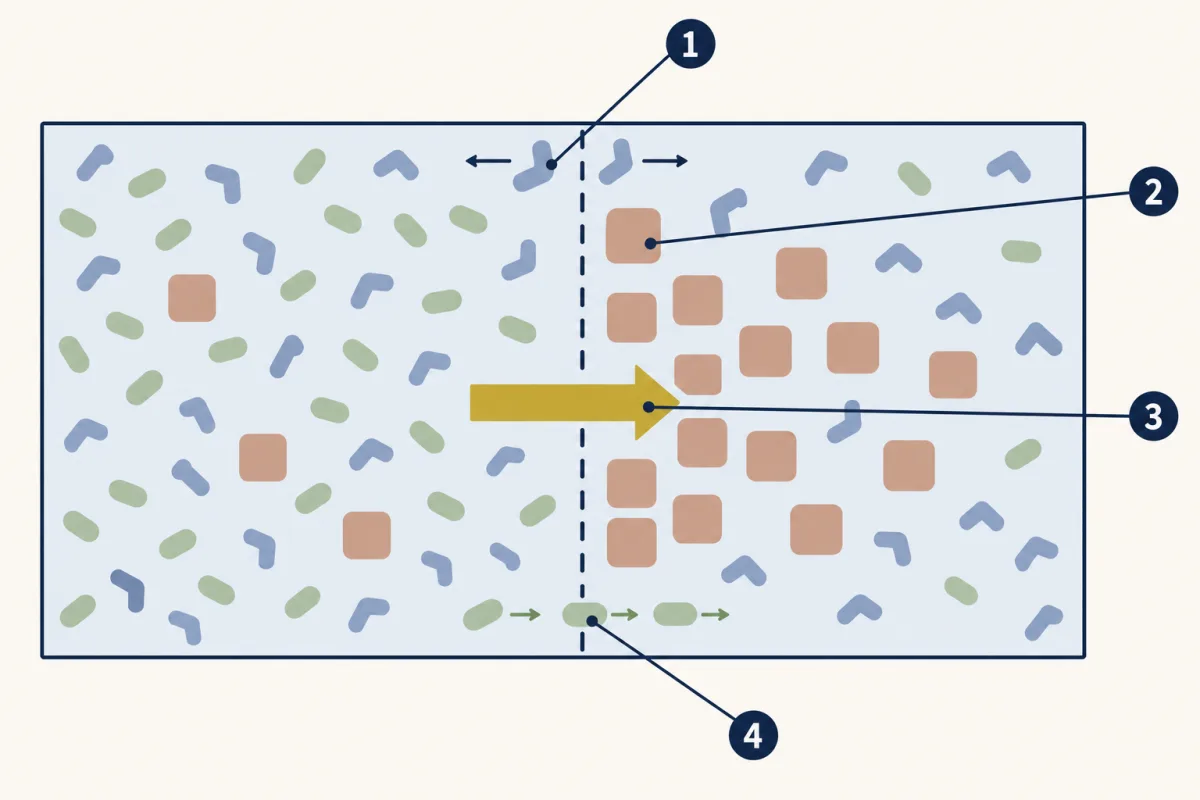
Particles move at random, so on average more of them leave a crowded side than come back: a substance drifts from more concentrated to less concentrated, and when dissolved particles cannot cross, water drifts toward the side with more of them, with no energy from the cell.
From the film: Random Moves, One-Way Drift
- Particles are always moving at random, even when nothing seems to change.
- More particles leave a crowded side than come back, so on average a substance drifts from more concentrated to less concentrated. That is diffusion.
- When the two sides are even, particles still cross, and over time just as many go each way.
- Oxygen diffuses into a cell and carbon dioxide diffuses out with no energy from the cell: this is passive transport.
From the film: Water Drifts to the Saltier Side
- Osmosis is the diffusion of water across a selectively permeable membrane.
- Water drifts from more water to less water, toward the side with more dissolved particles, unless something pushes back.
- Salty liquid has more dissolved particles than a cucumber cell, and the membrane holds most salt back, so water drifts out of the cells.
- In plain water, water drifts into lettuce cells until their stiff walls push back, and the leaf turns crisp.
- The cell spends no energy on osmosis; it is passive transport.
-
Explore: change the salt on each side of a membrane
-
Explain: particles spread from more to less
-
Explain: water crosses a choosy membrane
- water
- salt
- osmosis
- oxygen
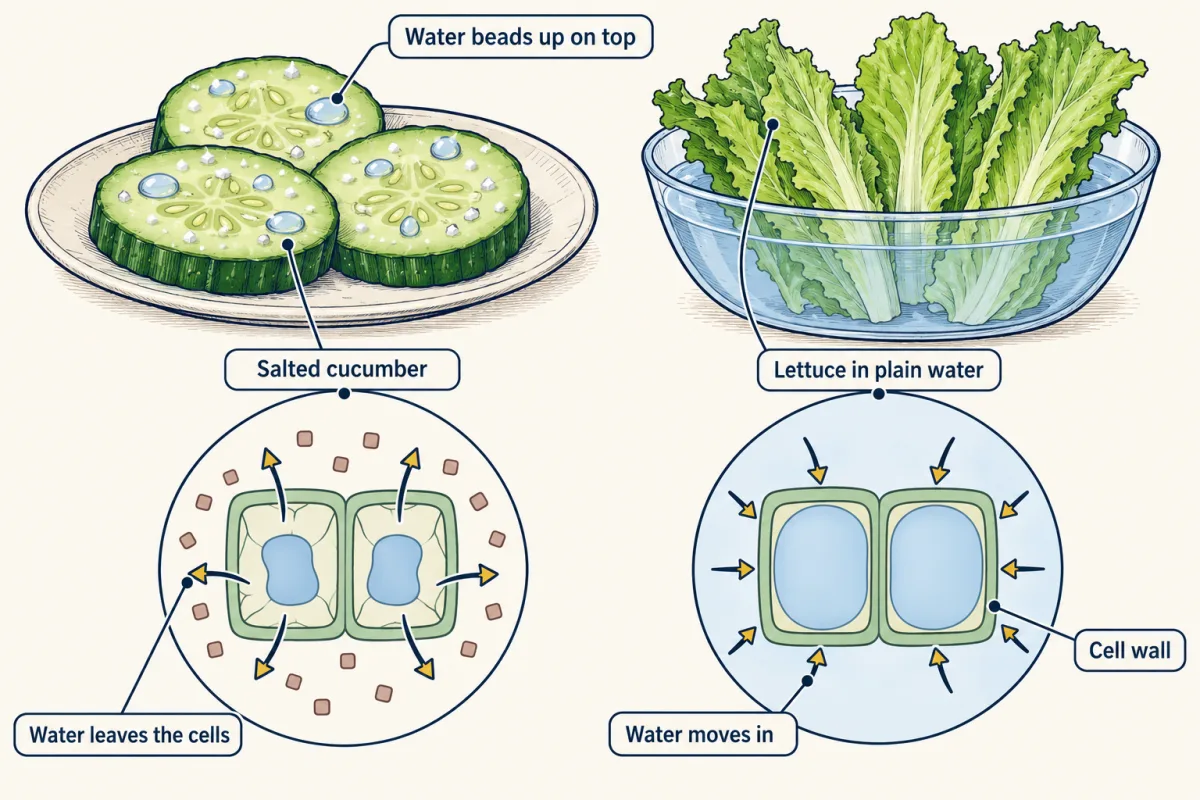
One rule, two directions: cucumber cells lose water toward the salt outside, and lettuce cells take water in until their walls push back. AI-generated illustration -
Elaborate: weigh cucumber slices in salt and plain water
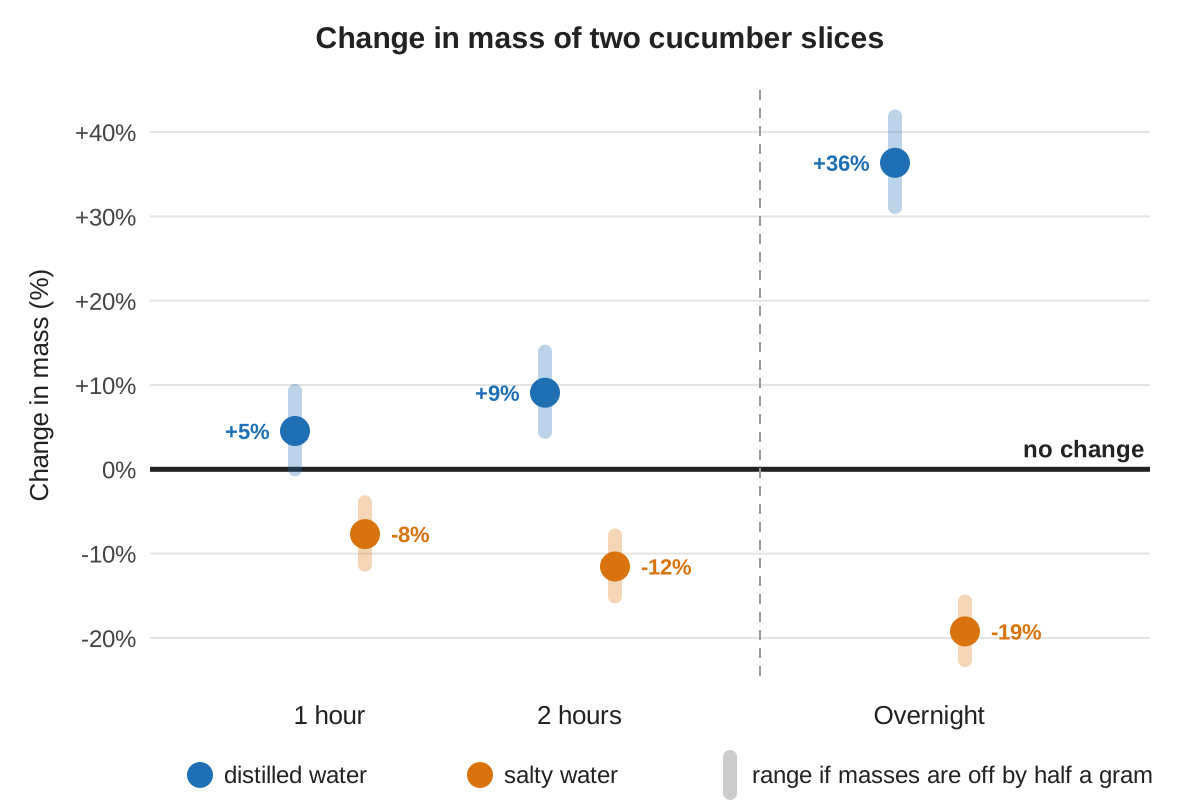
The slice in distilled water gained mass and the slice in salty water lost it, and both changes grew with time; the 1-hour gain is too small to be sure of. AI-generated illustration -
Evaluate: check your thinking
-
Going deeper
Where this lesson fits
Before thisReview first
- Plant Cells and Animal CellsThis course · Lesson 3
You need the cell wall and the cell membrane from there to see why a lettuce cell stays crisp.
- Inside a CellThis course · Lesson 2
It introduces the cell membrane as the boundary that decides what enters and leaves.
After thisStudy next
- From Cells to OrganismsThis course · Lesson 6
It uses cells keeping conditions steady, which passive water movement helps do, when cells share jobs in a body.
- Photosynthesis Feeds the WorldThis course · Lesson 9
It follows carbon dioxide and water moving into plant cells, where diffusion carries gases across membranes.
- Releasing Energy from FoodThis course · Lesson 10
Cells keep using oxygen and making carbon dioxide, so these gases keep diffusing in and out.
Suggested by an AI model from the lessons themselves, then checked. How we use AI