Water Drifts to the Saltier Side
Read the transcript of “Water Drifts to the Saltier Side”
Film transcript: Water Drifts to the Saltier Side
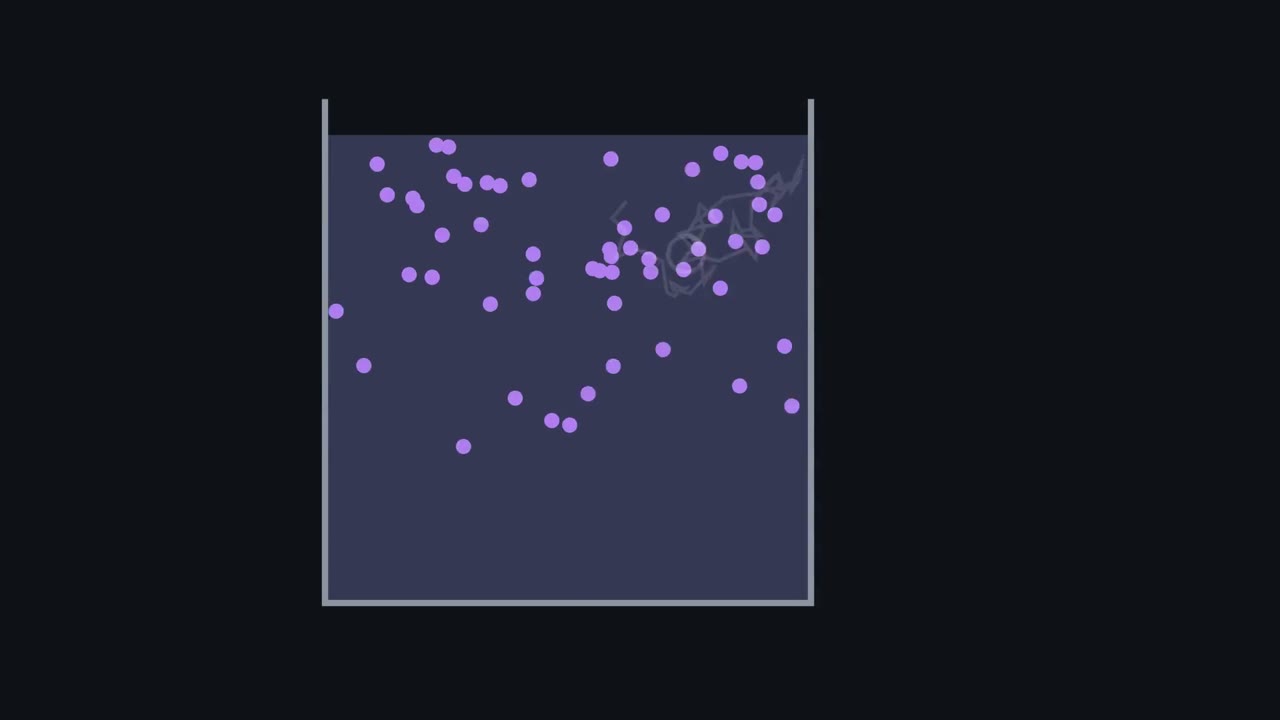
Remember the salted cucumber? Drops of water bead up on top, and nobody squeezed it. So where did that water come from, and what made it leave? The first film showed random hops making a one-way drift, from crowded to less crowded. This time, the crowded particle is salt, and the membrane holds it back. Here is the same tank and membrane. Blue water dots fill both sides. Grey salt squares sit only on the right. In this model, the membrane holds back all the salt. Real ones let a little through, much more slowly. Now take a spoonful from each side. On the left, every space holds water. On the right, some spaces hold salt instead. So the right side has less water.
This grid is only a cartoon. We drew far more salt than is real, so you can see it. Real salt water is still almost all water. The difference is small, but it is there. Water dots hop at random, both ways. So which way will more water dots cross?
Toward the side with more water, or toward the side with less? Pause and decide. On average, more water crosses from the left, where there is more water. Nothing pulls it. There is simply more water on the left to make the hop. This drift of water across a selectively permeable membrane is called osmosis.
Water moves from more water to less water. That is the side with more dissolved particles. Back to the cucumber. Zoom into one cell. Salt sits outside, and the membrane holds most of it back. The salty liquid has more dissolved particles than the cell does. So there is less water outside. Water drifts out of the cell, toward the salty side. The vacuole shrinks, and water beads up on the slice. A limp lettuce leaf sits in plain water. Its cells hold more dissolved particles than the water around them, so there is less water inside. So water drifts in. The vacuole fills, and the cell presses out against its stiff wall. The wall presses back. The cells firm up, and the leaf turns crisp.
In both cases, the cell spent no energy moving the water. Osmosis is passive transport. It is the same random drift from the first film. In our model, only water crosses. So follow the water. When the membrane holds the salt back, water drifts toward more dissolved particles. A push back, like a stiff wall, can slow or stop that drift.
Why does salted cucumber get wet, while limp lettuce in plain cold water turns crisp?
Continue in the lesson: Diffusion and Osmosis →
3:16 · Free, with captions and a transcript. The lesson has the full text, the questions and the sources.
More films from this lesson
How this film was made. Narration: an AI narrator voice (Kokoro, af_heart) reading narration written from this lesson's text. Animation: AI-generated in code (Manim) by Claude, a schematic with no drawn molecular structures. Captions come from the narration script. See something wrong? Report it.