Which Way Does the Water Go?
Read the transcript of “Which Way Does the Water Go?”
Film transcript: Which Way Does the Water Go?
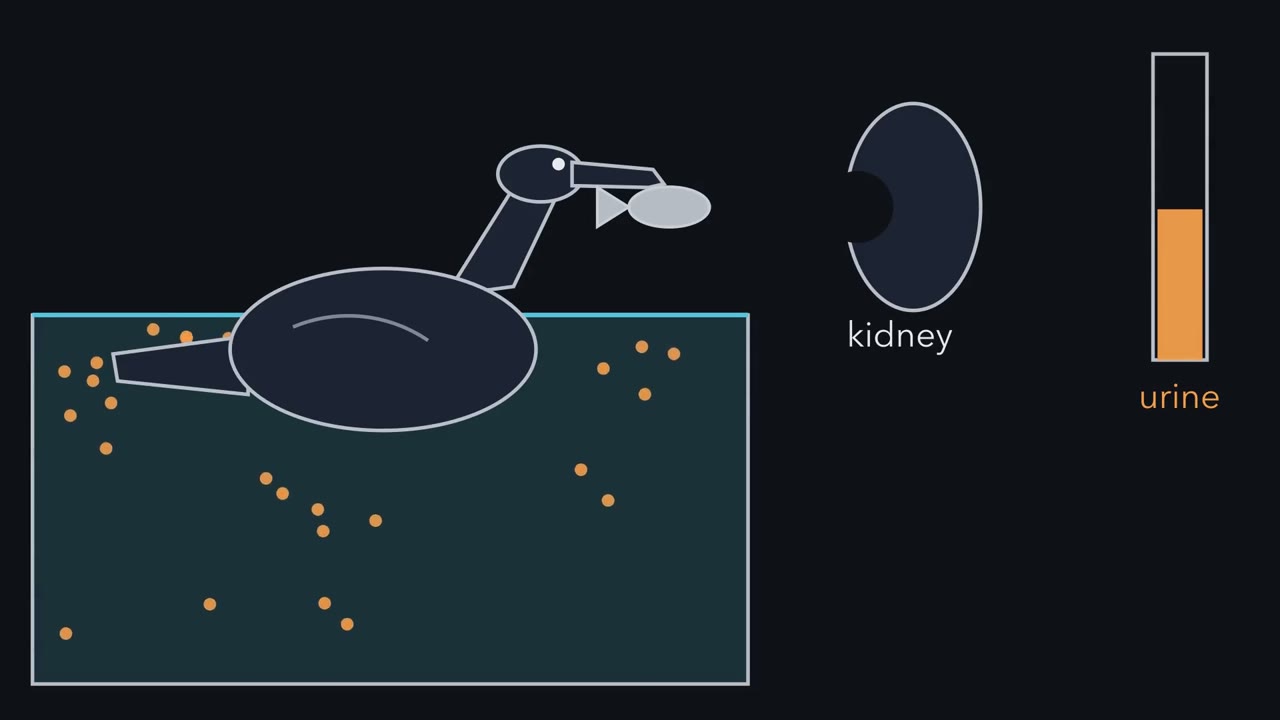
A goldfish in a bowl soaks up water all day, and a cod in the sea loses it. How does each one stay the same size? Start with one rule, for a surface water can cross. With nothing pushing back, water moves on its own toward the side with more dissolved particles. That count is called osmolality. In these fish, each salt leaks toward the side where it is scarcer. Watch the bar in the corner of every tank. One mark shows the body's osmolality, and one shows the water outside.
Water drifts toward the higher mark. Now give the fish a ledger: one column for what comes in, one for what goes out. If its water and salts hold steady, the columns must match, for water and for each salt separately. Drop a bony fish into the sea. Its blood holds far fewer dissolved particles than seawater. So water leaks out across its gills, and salt leaks in. Water is short, so the fish drinks seawater. Its gut absorbs the water, but the salt comes in with it. Now salt is the problem.
Cells in the gills send sodium and chloride back out into the sea. That runs against the leak, so it costs ATP. Now move a bony fish to river. The bar flips. Its blood is far saltier than fresh water. So water pours in across the gills, and salt leaks out. The water is easy to fix. The kidney makes a large volume of dilute urine, and the extra water leaves that way. But that urine carries a little salt away, and salt keeps leaking out across the gills. What must the gills now do with salt?
Take it in. Gill cells pull sodium and chloride from the river water, against the leak. Again, that costs ATP. One more tank. A shark lives in the same sea as the cod, and its blood holds less salt than seawater. Yet it does not lose water. Why not? Its blood also carries a large load of urea, which the shark makes itself and holds on to. A little TMAO rides along. Both count as dissolved particles. With them, the blood sits just above seawater. So the water leak runs the other way, as a slow trickle inward. The shark need not drink seawater. Three tanks, one budget. The gap between body and water sets which way the leaks run.
Drinking, urine and paid salt transport close each gap.
A goldfish in a bowl is soaking up water all day, and a cod in the sea is losing it. How does each one stay the same size?
Continue in the lesson: Osmoregulation and Nitrogenous Waste →
3:09 · Free, with captions and a transcript. The lesson has the full text, the questions and the sources.
More films from this lesson
How this film was made. Narration: written from this lesson's text and read by an AI narrator voice (Kokoro, af_heart). Animation: AI-generated in code (Manim) by Claude, a schematic with no drawn molecular structures. Captions come from the narration script. See something wrong? Report it.