Life Science · Unit 2: Organizing and classifying life
From Cells to Organisms
Rewritten on : new text, flashcards and film. Your notes and highlights stay, but the text around them may have moved.
A Paramecium is one cell and does every job of life. Why does your body need trillions of cells to do the same jobs?
Pause when the reading reaches a film, and offer to play it. Saved on this device.
Watch the film now, or keep listening
Builds on:Cells Are EverywhereInside a CellDiffusion and OsmosisWhy these?
Where this lesson sits
- Virginia SOL LS.3 a
- Virginia SOL LS.3 b
- Practices LS.1 c, LS.1 d, LS.1 e
Essential question: How can one cell do everything a whole body does, and why do I need trillions of them?
-
Life Science (grade 7) LS.3 a, LS.3 b You are here
This lesson
-
Biology
Preview it at high school level
In Biology you will ask a new question: if nearly all your body cells came from one first cell and the ones with a nucleus carry the same DNA, why do they look so different? The answer is that each kind of cell uses a different set of its genes. You will also learn the names of the main kinds of animal tissue and the tissue systems of plants. And you will look more closely at how each cell's shape fits its job, from a nerve cell about a metre long to a root hair cell that reaches into soil and guard cells that open and close pores in a leaf.
-
Biology II Biology II: Advanced Survey of Biology Topics, BIOII.2 c
Preview where it goes next
Virginia's Biology II: Advanced Survey of Biology Topics course (BIOII.2 c) returns to the idea that form fits function. Students compare many specialized cells and the tissues they build. Plants have dermal, vascular and ground tissues. Animals have epithelial, connective, muscle and nerve tissues. For each one, students explain how its structure helps the organism survive, and they plan their own investigations.
-
College
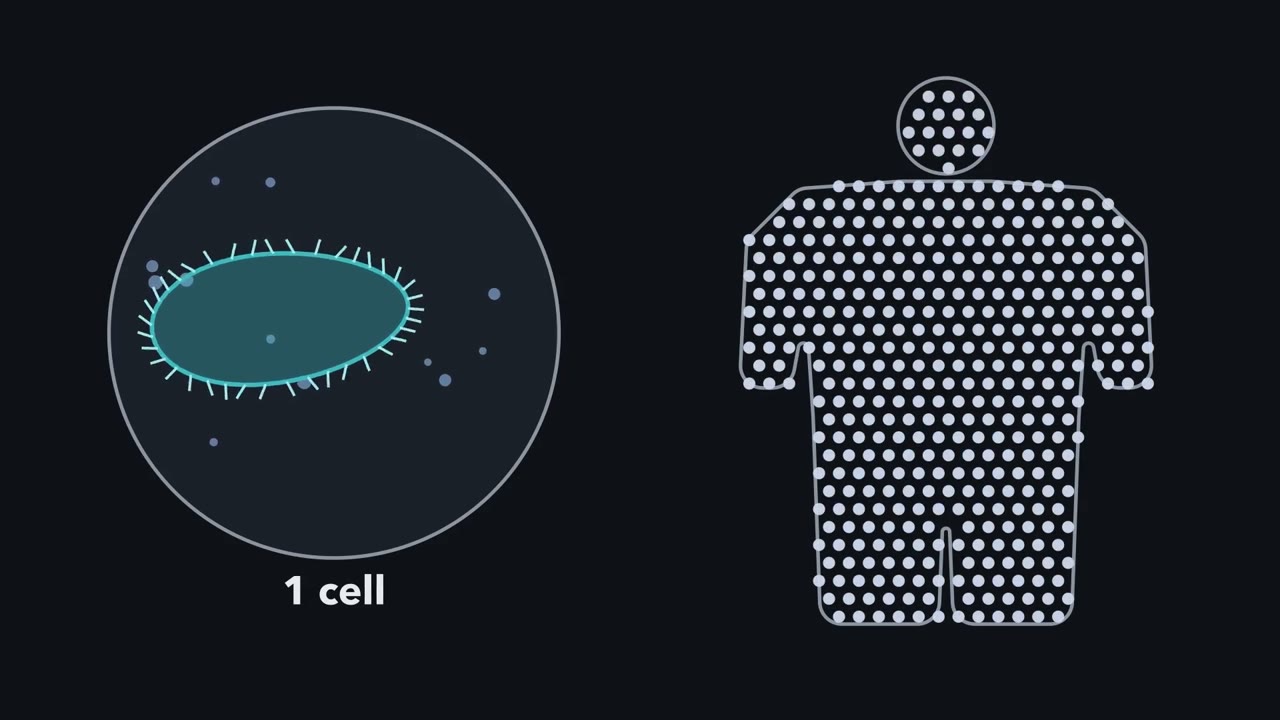 ▶ Watch One Cell, Every Job · 3:01
Read the transcript of “One Cell, Every Job”
Film transcript: One Cell, Every Job
A Paramecium is one cell. You are made of about 30 trillion. You both do the same jobs, so why do you need so many cells? Both of you share one list of life jobs. You move, get food and exchange gases. You get rid of wastes and extra water. You respond to the world, and you reproduce. Watch one Paramecium do every job on that list.
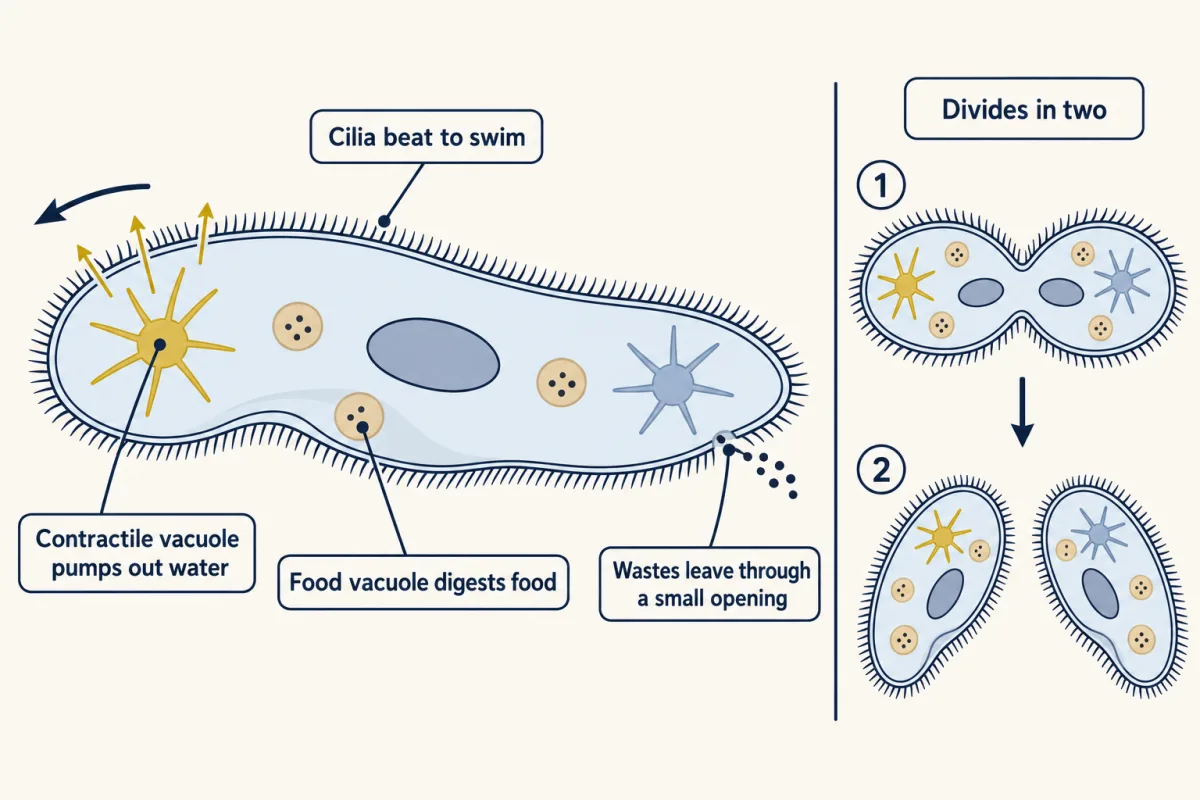
Short, hair-like parts called cilia cover the whole cell. They beat together and push it through the water. It sweeps bacteria into a groove on one side. They end up in small sacs called food vacuoles, where the food is digested. Oxygen passes in across its outer membrane. Carbon dioxide passes out the same way. No lungs, no gills, just the surface of one cell. Pond water keeps moving into the cell. A sac called a contractile vacuole fills with the extra water and squeezes it out. Bits of food it cannot digest leave through a small opening. When it bumps into something, it backs up, turns, and swims off another way. That is a response. And it can divide.
It pinches in the middle and becomes two cells. Every job is done inside one cell, with different parts helping. So why not keep one cell and make it bigger? Could one cell grow as big as you and still do every job? Pause and decide.
Not by just growing bigger in every direction. Food and oxygen must cross the cell’s surface, its outer membrane, to get in. Carbon dioxide and many wastes pass out across it. Now let the cell grow, but keep its shape. Its inside grows faster than its surface, and its middle gets farther away. Without special features, a big enough cell may not get food and oxygen to its middle fast enough. So your big body is not one giant cell. It is made of many small cells. Each one sits close to the watery fluid that brings it food and oxygen. Many cells bring a second gain. They can split up the job list. Different groups of cells can take on different jobs.
Sharing the work this way is called division of labor. A Paramecium does the whole list in one small cell. You do the same list with trillions of small cells that share it.
From the film
- A Paramecium and you share one job list: moving, getting food, gas exchange, getting rid of wastes and extra water, responding and reproducing.
- A Paramecium does every job inside one cell, using different parts of that cell.
- Food and oxygen enter a cell through its surface. If a cell grows in every direction, its surface falls behind its inside, and its middle gets farther away.
- So most big bodies, like yours, are many small cells, and many cells can share the jobs.
The first film showed one Paramecium doing every job, and a growing cell’s surface falling behind its inside. Two puzzles are left. How does a body of about 30 trillion cells share the jobs? And does a body with more cells also have more kinds of cells?
The one idea. One small cell can do every life job. But if a cell grows in every direction, its surface falls behind its inside, and its middle gets farther away. So most big bodies, like yours, are many small cells, and many cells can share the jobs. (This is about a cell that keeps its shape; the cube section names the exceptions.)
What do you think? Decide before you read.
-
Scientists disagree: Under a microscope, a Paramecium has hair-like cilia for swimming, sacs that digest food and a sac that pumps out water, all in one cell. Biologists also find that evolution is not a ladder from worse to better. One-celled life is complex in its own way.
What scientists think
Scientists disagree: Under a microscope, a Paramecium has hair-like cilia for swimming, sacs that digest food and a sac that pumps out water, all in one cell. Biologists also find that evolution is not a ladder from worse to better. One-celled life is complex in its own way.
-
Scientists disagree: Microscope studies show very different cells. A muscle cell is long, a nerve cell has long branches, and a red blood cell is a small disc dented on both sides. Scientists who measured human cells found big differences in size between kinds.
What scientists think
Scientists disagree: Microscope studies show very different cells. A muscle cell is long, a nerve cell has long branches, and a red blood cell is a small disc dented on both sides. Scientists who measured human cells found big differences in size between kinds.
-
Scientists disagree: When scientists compare mammals, a larger animal generally has more cells, not much larger cells of the same kind. An elephant simply has far more of them than a mouse.
What scientists think
Scientists disagree: When scientists compare mammals, a larger animal generally has more cells, not much larger cells of the same kind. An elephant simply has far more of them than a mouse.
Explain: why not one giant cell?
Here are the numbers behind the first film’s growing cell. Pretend the cell is a cube built from small cubes. A cube has 6 faces, so its surface is 6 × width × width squares, and its inside is width × width × width small cubes.
| Width of the cube | Surface (squares on the outside) | Inside (small cubes) | Surface for each small cube of inside |
|---|---|---|---|
| 1 | 6 | 1 | 6 |
| 2 | 24 | 8 | 3 |
| 4 | 96 | 64 | 1.5 |
For these same-shaped cubes, doubling the width makes the surface 4 times bigger but the inside 8 times bigger, so the surface for each small cube of inside is halved. The middle also ends up farther from the surface.
Predict. Grow the cube once more, to a width of 8. How much surface does each small cube of inside get now?
Check your prediction
0.75: 6 × 8 × 8 = 384 squares of surface for 8 × 8 × 8 = 512 small cubes of inside, less than one square each.
The cube grows in every direction. Without special features, a big enough cell like that may not move materials to its middle fast enough. A cell can grow long instead: some nerve cells reach about a metre but stay thin, so no part of the inside is far from the surface. A few unusual single cells, such as certain algae, grow large by using special shapes and ways of moving materials inside.
Explain: one cell does every job
- unicellular
- multicellular
- cilia
- contractile vacuole
- specialized cell
- kind of cell
- tissue
- organ
- organ system
- division of labor
A unicellular organism, such as most bacteria and Paramecium, is just one cell. A multicellular organism, such as you or an oak tree, is many cells (Cells Are Everywhere).
The first film showed the contractile vacuole bailing out pond water; Diffusion and Osmosis shows why the water keeps coming in. A Paramecium has no tissues or organs, yet its one cell is not simple: its parts work as a system (Inside a Cell).
Explore: share the jobs
The model tracks five jobs: moving, getting food, gas exchange (oxygen in, carbon dioxide out), response and reproduction. It leaves out getting rid of wastes and extra water. Choose 1, 10, 100 or 1,000 cells, alike or split into jobs. Five bars show how well each job keeps up; a side strip names the levels reached.
Made up for this sketch, not measured: the bars are relative units. A bigger body of alike cells strains gas exchange and getting food the most, and reproduction the least. Five or more cells can be split into five job groups. Tissues, organs and organ systems appear at 10, 100 and 1,000 cells when cells are split into jobs. Real organisms do not follow cell-count cut-offs: the lesson lists Trichoplax (about 320 cells, a rough estimate) and Volvox carteri (about 2,000 cells) with no organs. No real organism is a ball of alike cells that fails: Volvox carteri has about 2,000 cells and only 2 kinds. Blocks are not to scale; at 1,000 cells one block stands for 10 cells.
Rule to keep: a bigger organism has more cells, and it tends to have more kinds of cells that share the work. This is a sketch of the logic, not a measurement of any real organism.
Try this.
- Start with 1 cell. Predict whether all five bars keep up, then test it.
- Grow to 1,000 cells, all alike. Use the cube: should the jobs that pass through the surface fall behind first, or the others? Test it.
- Split the 1,000 cells into jobs. Predict what happens to the bars and the side strip, then compare with step 2.
Once the cells split up, the side strip named tissues, organs and organ systems. The second film follows one job, getting oxygen to your toes, up those levels.
Read the transcript of “One Job, Five Levels”
Film transcript: One Job, Five Levels
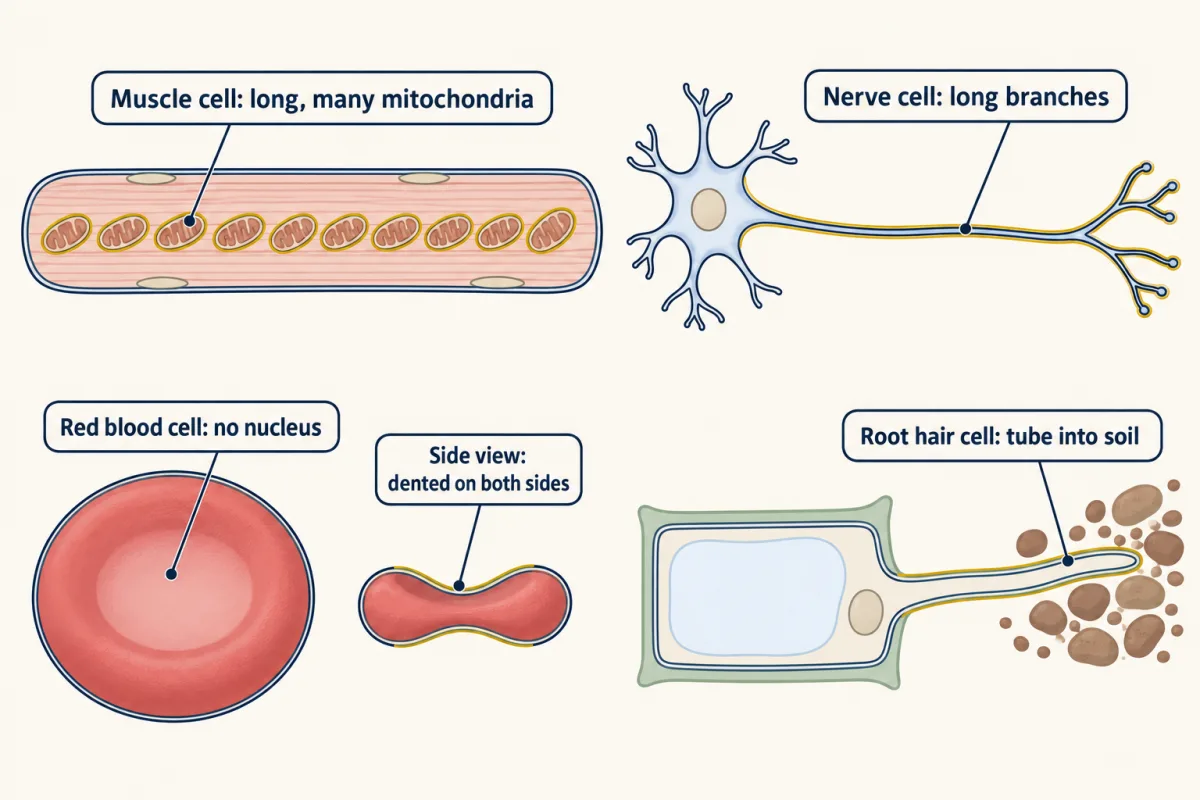
The first film ended with many small cells sharing the job list. So who gets oxygen to the cells in your toes, far from your lungs? Those toe cells need it right now. Follow that one job. It starts with one kind of cell. A red blood cell is a small, flexible disc, dented on both sides. It carries oxygen. A cell whose shape and parts suit it to one kind of job is called a specialized cell. In mammals, including humans, a mature red blood cell has no nucleus. Here is a blood vessel narrower than the red blood cell. What would let the cell get through? Pause and decide.
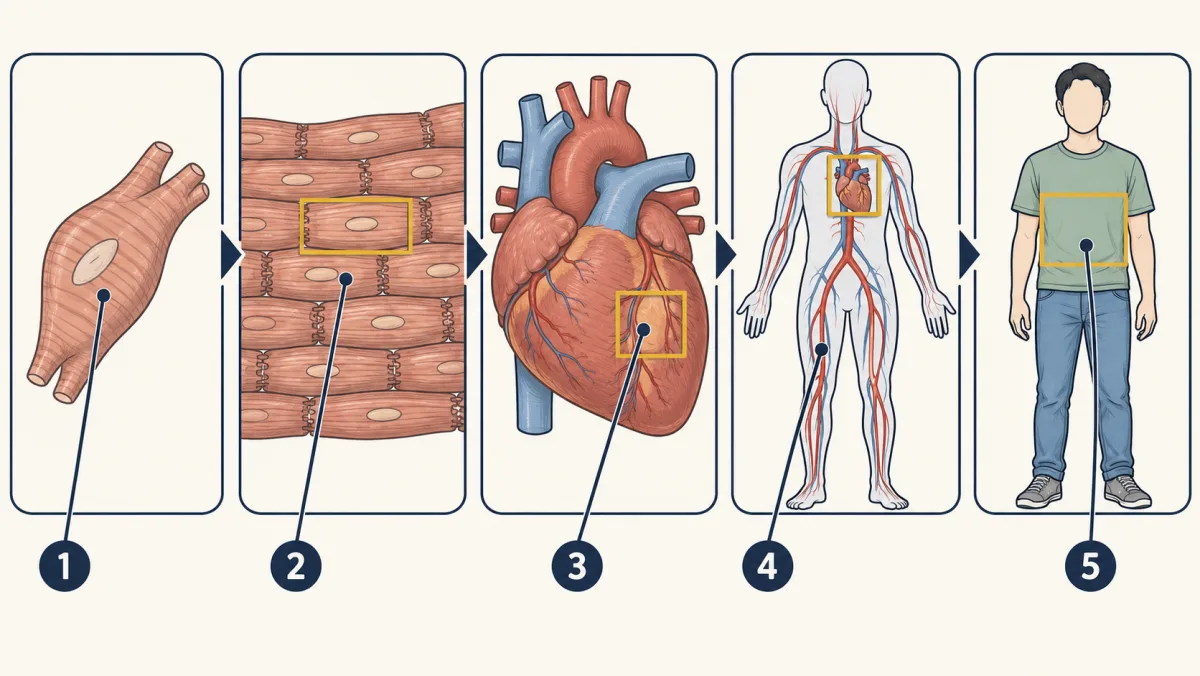
Its shape. The flexible disc bends and folds, squeezes through the very narrow vessel, and springs back on the other side. But blood has to be pushed. That job belongs to heart muscle cells. Each one is striped, and it shortens to squeeze. Many heart muscle cells link up into a network.
Similar cells doing one job form a tissue. This one is heart muscle tissue, and its cells shorten together. Heart muscle tissue works together with other kinds of tissue. Different tissues working together form an organ, the heart. The heart pushes blood, fresh from the lungs, through a branching set of blood vessels. Organs working together form an organ system. The heart and blood vessels are one. All the systems together make the organism, you. Now the oxygen reaches the cells in your toes. That one job took every level, from one cell to the whole body. Other cells have other shapes for other jobs. A nerve cell has long branches. It carries signals over long distances, in some cases about a metre.
A muscle cell in your arm is long and thin. It shortens to pull on bones. Three cells, three shapes, each fitting its job. Now zoom back down the levels. That heart muscle cell is still a cell. But it sits inside every level above it: a tissue, the heart, the circulatory system and you. Sharing the work like this is division of labor. Each level does part of the job, and the levels depend on each other.
From the film
- A specialized cell has a shape and parts that suit it to one kind of job.
- Similar cells doing one job form a tissue, such as heart muscle tissue. Each cell stays a cell inside every level above it.
- Different tissues form an organ, such as the heart, and organs working together form an organ system, such as the heart and blood vessels.
- A small, flexible red blood cell carries oxygen and bends through very narrow vessels.
- A long nerve cell carries signals far, and a long muscle cell shortens to pull.
Explain: cells, tissues, organs, systems
cell → tissue → organ → organ system → organism
- cell
- tissue
- organ
- organ system
- organism
- cell
- blank
- blank
- blank
- organism
Word bank: organ, organ system, tissue
- blank
- blank
- blank
- blank
- blank
Check your labels
- cell
- tissue
- organ
- organ system
- organism
Predict. Plants have levels too. A leaf is built from several different tissues working together. Which level is a leaf?
Check your prediction
An organ, like your heart. In a plant the levels run cells → tissues → leaf → shoot system.
The levels also help the organism grow, repair itself and carry out metabolism, the chemical work that keeps it alive. And they depend on each other: if heart tissue is damaged, the whole body can suffer.
A body works like a school play’s crew: the show needs sets, lights and actors, and a bigger cast can split the work finer. Where the comparison breaks: no cell chooses its job or plans the show.
Not every multicellular animal has all these levels. Trichoplax, a tiny ocean animal, has several kinds of cells but no organs.
Explain: a shape for every job
The second film matched red blood, nerve and muscle cells to their jobs. Each is a specialized cell: its shape and parts suit it to one kind of job. Sharing the work this way is division of labor. That film skipped one detail: an arm muscle cell is packed with mitochondria. These cell parts release energy from food, which powers the cell’s pulling. Plants have specialized cells too.
Predict. A root hair cell takes in water from the soil. Short and round, or long and thin? Why?
Check your prediction
Long and thin: a tube growing between soil grains puts more surface against the soil, where water comes in.
- A blank cell has a blank shape, which helps it blank.
- A Paramecium can live alone because blank.
Elaborate: more cells, more kinds of cells?
Among mammals, a bigger body mostly has more cells, not bigger ones. Red blood cells and liver cells, for example, are not much bigger in an elephant than in a mouse. A few kinds, such as nerve cells and fat cells, do grow larger: a nerve cell reaching from the spine to the foot must be longer in a longer animal.
So what happens to the number of kinds of cells? A kind of cell (scientists say cell type) is a group of cells that share a shape, parts and job, such as red blood cells.
Predict. If every new cell were a new kind, how many kinds would a human, with about 30 trillion cells, have?
Check your prediction
About 30 trillion. The table below shows about 400: kinds tend to rise with cells, but far more slowly.
| Organism | Number of cells | Kinds of cells | How the numbers were found |
|---|---|---|---|
| A bacterium | 1 | not counted | One cell by definition |
| Paramecium | 1 | not counted | One cell by definition |
| Trichoplax adhaerens | a few hundred (rough guess from body size, not a count) | 4 | 1997 table; later studies found more kinds |
| Volvox aureus | several hundred (rough guess from body size) | 2 | 1997 table |
| C. elegans worm, adult hermaphrodite (one worm makes both eggs and sperm) | 959 body cell nuclei | 24 | Every cell division traced (1977 and 1983); kinds from 1997 table |
| Volvox carteri | about 2,000 plus about 16 large cells | 2 | 2018 study |
| Hydra | tens of thousands (rough guess from body size) | 15 | 1997 table |
| Human, reference adult man | about 30 trillion | about 400 | Cells: 2016 estimate; kinds: 2023 classification |
These are lab and reference values, not samples from Virginia, and the rows use different methods. A rough guess from body size can be off by up to about ten times, too high or too low. The number of kinds depends on how finely cells are sorted. So treat each number as rough.
- As you read down the table, the number of cells goes up. What happens to the number of kinds?
- Compare the two Volvox rows. Does adding cells always add new kinds of cells?
- How many times more kinds of cells does Hydra have than Volvox carteri?
- Find a row with fewer cells but more kinds than a row below it. Is “more cells, more kinds” a rule or a trend?
Claim, evidence, reasoning
Make a claim about the pattern in the table: how is the number of cells linked to the number of kinds of cells? Then explain how this helps a large body.
Start with: The data show that organisms with more cells tend to have blank.
Start with: Volvox carteri has about blank cells and blank kinds, while blank has about blank cells and blank kinds.
Start with: More kinds of cells means blank, which helps a large body because blank.
Compare with a model answer
Organisms with more cells tend to have more kinds of cells. Volvox carteri has about 2,000 cells and 2 kinds, Hydra tens of thousands and 15 kinds, and a human about 30 trillion and about 400 kinds. More kinds means more division of labor, so a large body can share out many jobs. The trend is not perfect. The C. elegans worm has fewer cells than Hydra but more kinds. Some very large fungi and algae have few kinds of cells. One limit: the rows come from different studies that used different methods. Some cell numbers are guesses from body size, not counts.
Saved in this browser only.
Design problem
Does adding a little salt to a Paramecium’s water change how often its contractile vacuole empties? Plan an investigation with a Paramecium culture from a science supply company.
Saved in this browser only.
One way to do it
- Question: Does the amount of salt in the water change how often the contractile vacuole empties?
- Independent variable: salt added, such as 0 g, 0.1 g and 0.2 g per 100 mL of spring water.
- Dependent variable: number of times the vacuole empties in 60 seconds.
- Constants: same culture, same temperature, same microscope, and the same wait (10 minutes) before counting.
- Control: spring water with no salt added.
- Repeated trials: count 5 paramecia in each kind of water, and find the mean (the average).
- Safety: wash your hands, handle glass slides with care, never taste anything, and give the culture back to your teacher.
- What it means: if the mean counts differ clearly and the difference shows up again in repeated trials, salt likely changes how often the vacuole empties.
Evaluate: check your thinking
One small cell can do every life job, but if a cell grows in every direction, its surface falls behind its inside. Check yourself: use the cube numbers to explain why your body is trillions of small cells, grouped into levels and shaped for their jobs.
Science practices you used: using a model and naming its limits, reading a data table and comparing rows, and planning a fair test with a control and repeated trials.
Going deeper
Volvox and the history of many-celled life
Volvox, a green alga, is a ball of many cells with only a few kinds of cells. It is not a step between a Paramecium and you: many-celled life arose separately in several groups, including algae like Volvox and animals.
How many cells in a person?
The 2016 estimate gives about 30 trillion cells for a reference man; the 2023 study behind the 400 kinds estimated about 36 trillion. So you will see 30 to 36 trillion, depending on the estimate.
Sources for the cell-count table
Bell and Mooers, 1997, a table built from older studies, which turned body size into a rough cell number that can be off by up to about ten times; Matt and Umen, 2018 (Volvox carteri, lab strain); Sulston and Horvitz, 1977, Sulston and colleagues, 1983, and WormAtlas, 2009 (worm nuclei); Sender and colleagues, 2016, and Hatton and colleagues, 2023 (human).
Your notes
Select any text in the lesson to highlight it or add a note to it. Your highlights and notes are saved in this browser and collected in your notebook.
This browser is not letting the site save anything (a private window or strict privacy settings), so highlights and notes will be lost when you leave the page.
How we measure it
Light microscope
A light microscope magnifies living cells, such as a Paramecium in pond water, so you can watch its parts at work. Scientists use what they see to sort cells into kinds by shape and job.
Estimating cells from measurements
No one counts 30 trillion cells one by one. Scientists count the cells in a small, measured sample, such as a drop of blood. From that count they work out how many cells are in one litre. Then they multiply by how many litres of that blood (or other material) the whole body holds. Adding up many such estimates gives a whole-body total.
Where this lesson fits
Before thisReview first
- Cells Are EverywhereThis course · Lesson 1
You need to know that living things are made of cells, one or many, before comparing one-celled and many-celled bodies.
- Inside a CellThis course · Lesson 2
You use cell parts such as mitochondria and the idea of parts working as a system to explain specialized cells.
- Diffusion and OsmosisThis course · Lesson 5
Materials entering through the surface and the contractile vacuole's water bailing depend on how substances move across a membrane.
After thisStudy next
- Sorting Living ThingsThis course · Lesson 7
You can now sort organisms, and a key splits one-celled from many-celled kinds using traits like these.
- Domains, Kingdoms and DNAThis course · Lesson 8
Whether an organism is one cell or many is one trait used to place it in a domain or kingdom.
Elsewhere on the siteFilms, simulations and method films in other courses
- One Cell, Many JobsFilm · Biology
It shows how one cell can do every job, or many cells can share them.
Suggested by an AI model from the lessons themselves, then checked. How we use AI
Finish line
Test yourself
9 questions
Practice and MCAT-style, with explained answers.
Next · Lesson 7
Sorting Living Things
In Virginia some people call a vulture a buzzard, and in Britain the buzzard is a hawk, so how can a scientist say which bird they mean?
Continue →