Developmental Neuroscience · Unit 7: Survival and competition
Competition: How Neurons Win a Target
Rewritten on : new text, figures, flashcards and film. Your notes and highlights stay, but the text around them may have moved.
If the target makes too little NGF for every neuron, which neurons get to live?
Pause when the reading reaches a film, and offer to play it. Saved on this device.
Watch the film now, or keep listening
Builds on:The Neurotrophic Hypothesis TestedNeurotrophins, Trk Receptors and p75Too Many Neurons: Naturally Occurring Cell DeathWhy these?
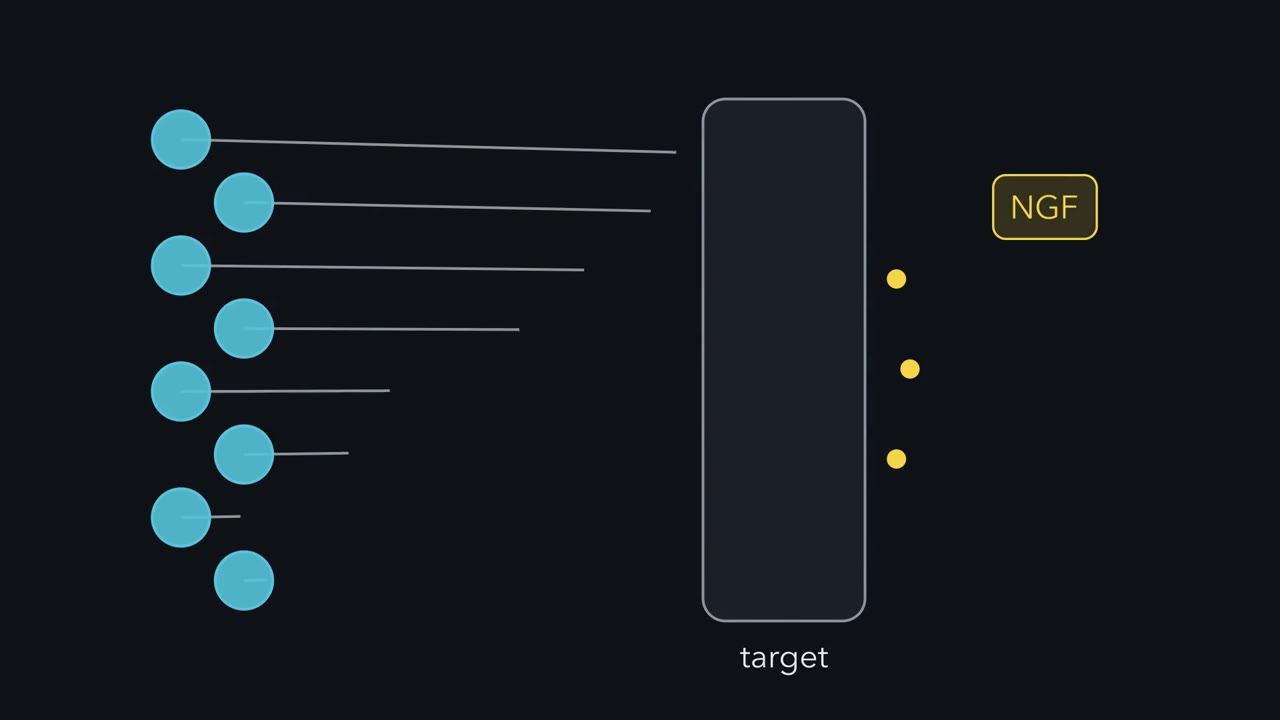 ▶ Watch Too Little to Go Around · 3:00
Read the transcript of “Too Little to Go Around”
Film transcript: Too Little to Go Around
A target makes too little NGF for every neuron that reaches it. So which neurons get to live? Start with what you already know. Sympathetic neurons live in small clusters of nerve cells called ganglia. They send axons to targets such as the eye, the salivary gland and the heart. Those targets release nerve growth factor, NGF. The target makes it, not the neurons. Neurons that get enough NGF live. Those that do not die through a pro-death gene called Bax. This is normal development, not damage. In many developing populations, roughly half the neurons die. The neurotrophic hypothesis puts it in one line. Neurons compete for a limiting amount of neurotrophic factor for survival.
Change the target, and the count follows. Give a chick embryo an extra limb, and fewer motor neurons on that side die. So the size of the target sets roughly how many neurons can win. But the hypothesis only says there is a contest. It does not say how the contest is decided. It also leaves a second question open. How does the outcome set the fit between a target and its neurons? The answer here comes from one cell type. Sympathetic neurons of the mouse superior cervical ganglion. That ganglion sits in the neck and supplies the head. Some experiments used cultured rat neurons. Make a guess before going on. If a target can feed only some neurons, what decides which ones?
Here is the idea this lesson builds. The target sets how many. The neurons decide which. Take neurons that are otherwise alike. A small lead can grow only if its signal rises faster than in proportion. In the published simulations, NGF raised its receptor, TrkA, and lengthened each TrkA signal, and both were needed for the neurons to separate. In the proposed model, winners then speed the death of losers, through a receptor called p75. The rule has limits. It does not say where a neuron's first small lead comes from. Arriving early, branching more or sitting closer are all candidates. The rule amplifies a head start. Faster than in proportion is needed, not enough: steady basal synthesis pulls neurons back together.
And the rule does not cover chick motor neurons. They draw on several factors at once. Takeaway. A limited supply sets roughly how many survive. The neurons' own feedback decides which ones.
From the film
- A limited NGF supply sets roughly how many sympathetic neurons survive.
- Among otherwise alike neurons, a small lead can grow only if its signal rises faster than in proportion to the lead.
- In the proposed model, the neurons' own feedback decides which ones survive, and winners speed the death of losers.
If every sympathetic neuron needs nerve growth factor (NGF), and the target makes too little for all of them, which neurons get to live?
Earlier in this unit you met the neurotrophic hypothesis in its short form: “Neurons compete for a limiting amount of neurotrophic factor for survival.” Targets such as the eye, the salivary gland and the heart release nerve growth factor (NGF). Sympathetic neurons, which live in small clusters of nerve cells called ganglia, send axons to those targets. Neurons that get enough NGF live; those that do not die through the pro-death gene Bax. In many developing populations roughly half the neurons die during normal development. When Margaret Hollyday and Viktor Hamburger grafted an extra limb onto chick embryos in 1976, fewer of the motor neurons supplying that side died: more target, more survivors, though they could not tell whether the limiting resource was a trophic factor or synaptic sites. See that lesson for the evidence.
The contest and its open questions
The hypothesis says there is a contest. It does not say how the contest is decided, or how the outcome sets the fit between a target and its neurons: both the number of neurons that survive and how densely the survivors cover the target have to be matched.
This lesson follows one answer, worked out in the sympathetic neurons of the mouse superior cervical ganglion, a ganglion in the neck that supplies the head, studied in mice and in cultured rat neurons. Three puzzles organize it.
- What turns a small, chance difference between neurons into life or death? A limited supply makes a contest, but it does not pick the winners.
- Do winners only outlast losers, or do they push them?
- Does surviving mean innervating? And, in a different system, why does paralysing a chick embryo save motor neurons?
The one idea to carry through this lesson. The target sets how many; the neurons decide which. A limited supply of nerve growth factor (NGF) makes a contest, and its size sets roughly how many neurons can win. Among neurons that are otherwise alike, a small lead can grow only if a neuron’s NGF signal rises faster than in proportion to that lead. In the published simulations, neurons separated only when NGF raised both its receptor, TrkA, and how long each TrkA signal lasts; the toy arithmetic below suggests why. In the proposed model, winners then speed the death of losers through brain-derived neurotrophic factor (BDNF), neurotrophin-4 (NT-4) and the receptor p75.
What the rule covers. NGF-dependent sympathetic neurons of the mouse superior cervical ganglion during the period of neuron death (late embryo to the first postnatal weeks), and the simulation in this lesson. It has three limits. It does not say where a neuron’s first small lead comes from: arriving early, branching more and sitting closer are all candidates, and the rule amplifies a head start rather than replacing one. (A lasting advantage, such as better access to the target, is a different case: it can pull a neuron ahead even with proportional feedback.) “Faster than in proportion” is needed but not enough: the extra gain also has to beat basal synthesis, TrkA made at a steady rate whatever NGF does, which tops every neuron up equally and pulls neurons back together. And it does not cover chick motor neurons, which depend on several factors at once and whose muscle activity may change what the target offers (the last section).
Why a limited supply is not enough
Read the transcript of “Why Sharing Fails”
Film transcript: Why Sharing Fails
Two neurons share one target. One starts with a tiny lead. Does the lead grow, shrink, or stay put? Neuron A carries a little more TrkA, the receptor that binds NGF. TrkA is a receptor tyrosine kinase. More receptor means the neuron catches more of the supply. By chance, A catches 52 percent of the NGF. Neuron B catches the rest. Now add feedback on receptor level. Each neuron makes TrkA in proportion to the NGF it catches. And each neuron's catch is simply proportional to its TrkA. Both neurons now make more receptor. But B grows by the same fraction as A. After many rounds, what share does neuron A hold?
Still 52 Proportional sharing keeps the ratio fixed, round after round. Each neuron's gain is a fixed fraction of what it already has. Add some steady basal synthesis of TrkA. Both neurons get the same top-up, so the shares drift back toward even. So in this setup, feedback on receptor level alone does not make a winner. Now let NGF do two things at once. It raises TrkA, so the neuron catches more. It also lengthens each signal, so every caught molecule counts for longer. For simple arithmetic, assume each signal lasts in proportion to the catch. And TrkA is made in proportion to the signal. Then each round squares the ratio of A to B.
Watch A's share climb, round after round, until it holds almost all of it. The lead feeds itself. That is positive feedback, the loop you met in signaling circuits. Here is the condition it needs. A lead can grow only when the reward rises faster than the lead.
What about arriving first? Arriving first may well give a neuron its small lead. Arrival order alone cannot explain how a small lead grows while the supply keeps coming. And the target keeps releasing NGF throughout the death period, not just at first. The simulation in the lesson splits its neurons another way. Its TrkA response to each neuron's share is switch-like. Takeaway. For identical neurons with proportional sharing and no basal synthesis, a lead stays frozen. To grow, the reward has to rise faster than the lead.
From the film
- With proportional sharing, a small lead stays frozen, so feedback on receptor level alone does not make a winner.
- A lead can grow only when the reward rises faster than the lead.
- Arrival order alone cannot explain how a small lead grows while the target keeps releasing NGF.
Start with two neurons sharing one target. By chance, neuron A carries a little more TrkA, the receptor tyrosine kinase that binds nerve growth factor (NGF) (see that lesson). It catches 52% of the NGF, and neuron B catches 48%.
Suppose each neuron’s catch is simply proportional to its TrkA, and each makes TrkA in proportion to the NGF it catches. Both neurons now make more TrkA, but B grows by the same fraction as A.
Predict. After many rounds, what share does neuron A hold?
Check your prediction
Still 52%. For every 52 parts of NGF that A catches, B catches 48, so A makes 52 parts of new TrkA for every 48 that B makes, and the ratio never moves. Add basal synthesis and both neurons get the same top-up, so the shares drift back toward even. In this setup, where the neurons differ only in TrkA, feedback on TrkA level alone does not make a winner.
This also corrects a tempting shortcut, that fair sharing would make every neuron live or die together. That holds only for identical neurons. Real neurons differ, and under proportional sharing their starting differences persist: the contest never makes the ratio between them grow. Whether each lives still depends on whether its absolute support clears the survival threshold, so a small difference near that threshold can still decide a fate; what proportional sharing cannot do is widen the gap.
Now let NGF do two things. It raises TrkA, so the neuron catches more, and it lengthens each signal, so every caught molecule counts for longer. A neuron’s signal is then roughly the NGF it catches times how long each catch keeps signaling. For simple arithmetic, assume that duration also scales with the catch, and that each neuron makes next round’s TrkA in proportion to its signal. Then each round squares the ratio of A’s share to B’s (52/48 is about 1.08, then 1.17, 1.38, 1.90), so the lead compounds:
| Round | 1 | 2 | 3 | 4 | 5 | 6 |
|---|---|---|---|---|---|---|
| A’s share, proportional | 52% | 52% | 52% | 52% | 52% | 52% |
| A’s share, level × duration | 52% | 54% | 58% | 65% | 78% | 93% |
The lead feeds itself. This is the positive feedback you met in the Cell Signaling course, where a signal that raises its own production can make a switch with two stable states (see the lesson on signaling circuits). The condition: a lead can grow only when the reward rises faster than the lead. The squaring is an assumed update and the “rounds” are a teaching device, not a measured law, a measured time or the published equations.
What about the first axon to arrive? Arriving first may give a neuron its 52%. If the first axon simply took all the NGF, no amplifier would be needed, but nothing in that rule explains how a neuron already receiving some NGF could fall behind, and the target keeps releasing NGF throughout the death period. Arrival order alone cannot explain how a small lead grows instead of fading.
In the simulation below, set the feedback strength and watch the neurons. It is not the two-neuron table: it tracks TrkA level only, and its neurons differ slightly in access to the target. It reaches “faster than in proportion” by a second route: each neuron’s TrkA synthesis responds to its share of NGF in a switch-like way, so a neuron just above an even share gains much more than one just below. Turn feedback off and they stay together.
In this sketch each neuron's TrkA responds steeply (switch-like) to its share of a limited NGF supply, so a small lead can grow into a win. With a merely proportional response the shares would barely change, which is why the published model needed NGF to raise both TrkA level and how long each TrkA signal lasts. This is a sketch of the logic in relative units, not a measurement or a prediction for real neurons. How the supply is divided among neurons and the cutoff for calling a split are choices made in this sketch, not taken from the lesson or the paper.
Who needs NGF? The Bax trick
Read the transcript of “The Bax Trick”
Film transcript: The Bax Trick
To learn what NGF does in a living animal, you remove it. But then the neurons die. What now? Without NGF, most of these neurons die. Their loss muddies any comparison. Deppmann, Ginty and colleagues found a way round it. They used mice lacking Bax. Bax is the pro-death gene. Without it, sympathetic neurons survive with or without NGF. So you can compare two ganglia that both keep their neurons. One comes from a mouse lacking Bax. The other comes from a mouse lacking both Bax and NGF. Because both keep their neurons, any difference between them points to NGF. RNA from whole ganglia was compared on microarrays. Genes lower without NGF became candidates.
Candidates were then checked by staining, by in situ hybridization, and in culture with and without NGF. The list held transcription factors, synaptic genes, genes for metabolism and cell size, and genes for axon growth. Now think back to the two neurons. Which kind of gene could make a rich-get-richer loop?
One whose product helps a neuron catch more NGF. And one gene on the list was the receptor itself. NGF raises and maintains TrkA. In newborn ganglia, TrkA fell without NGF. In cultured neurons, TrkA rose with NGF and fell without it. After long deprivation, signaling downstream of TrkA was greatly reduced too. Neurons deprived only briefly could still sustain signaling when NGF returned. So a neuron that catches NGF makes more of the receptor that catches it. That is the first loop. But remember the two neurons. With capture and synthesis both in proportion to receptor, this loop alone keeps the shares where they started. Two other genes on the list matter later.
BDNF and NT-4, neurotrophins that can kill through p75. The same two genotypes also answer a question about innervation. The last chapter returns to it. Takeaway. The Bax trick keeps neurons alive without NGF. It showed that NGF raises its own receptor.
From the film
- Mice lacking Bax keep their sympathetic neurons with or without NGF, so ganglia can be compared.
- NGF raises and maintains its own receptor, TrkA, in these neurons.
- By the two-neuron arithmetic, the TrkA receptor loop alone is only half of the answer.
To find what nerve growth factor (NGF) does to a neuron in a living animal, Deppmann, Ginty and colleagues needed ganglia that lack NGF yet still have neurons. Without NGF the neurons die, so they used mice lacking Bax, whose sympathetic neurons survive with or without NGF. Comparing ganglia from Bax-null mice with ganglia from mice lacking both Bax and NGF gave a list of NGF-dependent genes: transcription factors, synaptic genes, genes for metabolism and cell size, and genes for axon growth.
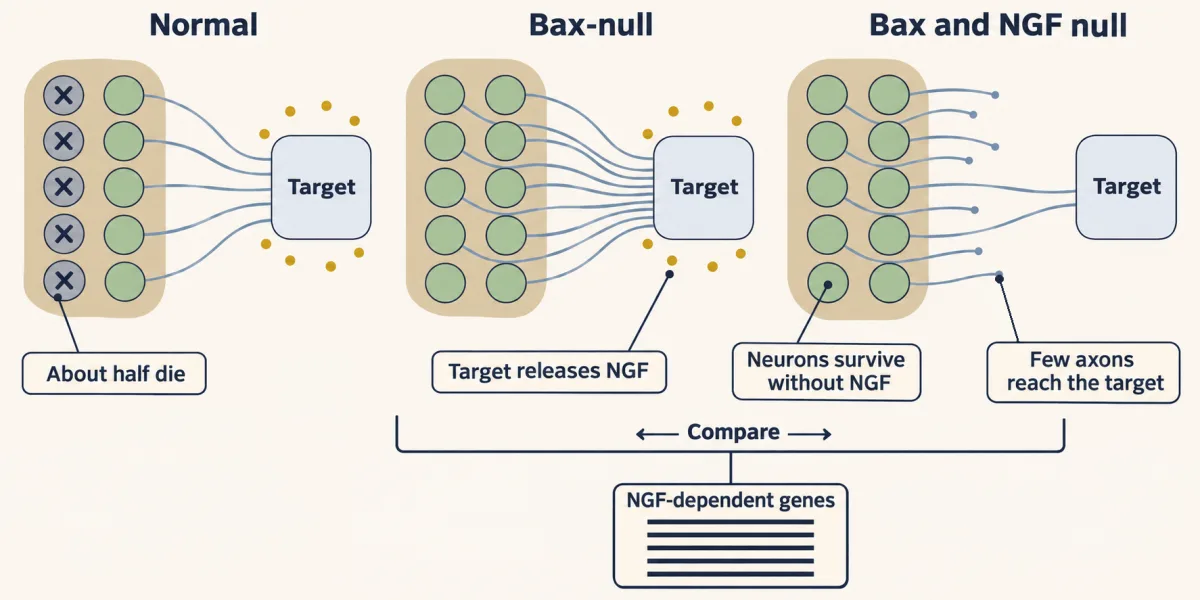
The genotypes this lesson uses (“-null” means the gene is deleted), with Bax-null as the reference:
| Genotype | Sympathetic neurons | TrkA | Target innervation at birth |
|---|---|---|---|
| NGF removed, Bax present | most die | hard to measure: neuron loss confounds it | severely reduced, but neuron loss and axon growth cannot be told apart |
| Bax-null | survive | maintained by NGF (the reference) | the reference |
| Bax/NGF double null | survive | falls | missing from some targets (salivary glands), greatly reduced in others (heart), near normal in a few (trachea) |
Now ask which gene on such a list could build the loop the last section needs: one whose product helps a neuron catch more NGF. One was the receptor itself. NGF raises and maintains TrkA: in newborn ganglia and in cultured neurons, TrkA fell without NGF and rose with it. In culture, 24 or 48 hours without NGF also greatly reduced signaling downstream of TrkA, read out as phosphorylated extracellular signal-regulated kinase (ERK) (a mitogen-activated protein kinase (MAPK)) and AKT, while neurons deprived for only 12 hours could still sustain signaling when NGF returned.
So a neuron that catches NGF makes more of the receptor that catches it. That is the first loop, and, by the two-neuron arithmetic, only half of the answer. Two other genes on the list matter later: Brain-derived neurotrophic factor (BDNF) and neurotrophin-4 (NT-4).
NGF lengthens its own signal
Read the transcript of “Only Both Loops Split Them”
Film transcript: Only Both Loops Split Them
If raising TrkA is not enough, what else must NGF change? NGF also controls how long its own signal lasts. NGF is caught at the axon tip, far from the cell body. Yet it changes which genes the nucleus turns on. So the signal has to travel back up the axon. Much of it travels inside endosomes. One protein that NGF induces, Coronin-1, keeps these signaling endosomes active longer. It is required for normal competition in the mouse. It is one mechanism, and there may be others. Now test the idea in a model. The computational neuroscientists Stefan Mihalas and Ernst Niebur joined the group. They simulated neurons competing for NGF that the target makes at a constant rate.
They compared four conditions. No feedback. Feedback on TrkA level alone. Feedback on signal duration alone. And feedback on both. Which of the four conditions split the neurons into winners and losers? Only feedback on both. With either one alone, competition failed. The two-neuron arithmetic gives a reason for both failures, at least in a toy version. Level alone, with capture in proportion to receptor, keeps every ratio fixed. Duration alone never changes the catch, so the shares stay put. Level and duration together close a loop. A signal that rises faster than the lead feeds the next catch, so in this toy the lead grows. This toy reason is not the published equations.
It only illustrates why one loop was not enough. In the published simulations, the two loops together separated winners from losers. The lab described the sequence as four stages. Naive. A young neuron responds poorly to NGF. Sensitization. It gets enough NGF to cross a threshold. From then on, NGF makes it more sensitive to NGF. Competitive advantage. It raises TrkA and strengthens the signaling downstream of it. Selection. It wins the supply, and neighbours that stayed behind lose. One more piece speeds the split. The next chapter asks how winners treat the losers. Takeaway. NGF raises both receptor level and signal duration. In the published model, only the two together split the neurons.
From the film
- NGF also controls how long its own signal lasts; Coronin-1 is one mechanism, and there may be others.
- In the published simulations, only feedback on both receptor level and signal duration split the neurons into winners and losers.
- The lab described four stages: naive, sensitization, competitive advantage and selection.
Nerve growth factor (NGF) also controls how long its own signal lasts. Much NGF signaling travels from axon tip to cell body inside endosomes (the subject of that lesson). In 2014 Deppmann’s laboratory, with Dong Suo as first author, reported that NGF induces Coronin-1, a protein that associates with these signaling endosomes, prolongs their signaling and is required for normal competition in the mouse. It is one mechanism; there may be others.
With the computational neuroscientists Stefan Mihalas and Ernst Niebur, the group simulated neurons competing for NGF that the target makes at a constant rate. They compared four conditions: no feedback, feedback on TrkA level alone, feedback on signal duration alone, and feedback on both.
Predict. Which of the four conditions separated the neurons into a winning group and a losing group?
Check your prediction
Only feedback on both; with either one alone, competition failed. The two-neuron arithmetic gives a toy reason. Level alone, with capture proportional to TrkA, keeps every ratio fixed. Duration alone makes the leader’s signal larger once, but nothing feeds that back into the next catch, so the shares stay put. Only together do they close a loop with a step that rises faster than the lead. This is the toy model’s reason, not the published equations.
The lab described the sequence as four stages.
- Naive. A young neuron responds poorly to NGF.
- Sensitization. A neuron that receives enough NGF crosses a threshold: from then on, NGF makes it more sensitive to NGF.
- Competitive advantage. It raises TrkA and strengthens the signaling downstream of it.
- Selection. It wins the supply, and neighbours that stayed behind lose.
Punishment: winners push losers
Read the transcript of “Winners Push Losers”
Film transcript: Winners Push Losers
Feedback explains how a winner pulls ahead. Does it need help? What should a punishment signal look like? It should come from strongly supported neurons, and kill weak ones. It should spare strong ones. And it should start only after TrkA has risen. The candidates were already on the gene list. Strongly supported neurons make BDNF and NT-4. Sympathetic neurons carry little of the usual receptor for these, TrkB. But they do carry p75.
p75 belongs to the tumour necrosis factor receptor family. In this setting, it can promote death. These factors can act on neighbouring neurons, strong ones included. Why are the winners spared? A neuron with strong NGF and TrkA signaling is protected. One likely reason: strong TrkA signaling keeps survival pathways high, such as AKT. That outweighs a death signal from p75. A weakly supported neuron has no such cushion. The lab tested three predictions in the mouse superior cervical ganglion. First, competing neurons differ in TrkA level. This was tested in ganglia lacking Bax. Second, neurons with low TrkA show high p75 death signaling, read out by phosphorylated c-Jun.
c-Jun is a transcription factor. A stress kinase downstream of p75 helps activate it on the way to death. Third, removing punishment should delay the loss but not prevent it. Sketch neuron number against age, in normal mice and in mice lacking p75. What does the second curve do?
Both start at similar numbers. The normal curve falls steeply in the first days after birth. The curve without p75 falls more slowly. So for a while, it has more neurons. The losers still die of too little NGF, through Bax. Only the extra push is gone. All three predictions held, including the delay. In the simulations, punishment made the split faster. Without it, weak neurons lingered. The endpoint is less settled. In the 2008 study, the null ganglion reached the normal number by six months. An earlier study from Freda Miller's laboratory also found the loss delayed. But it counted an excess that lasted into adulthood. So both found the loss delayed.
They report different numbers at the latest ages counted. Takeaway. In the proposed model, winners speed the death of losers through p75. Without it, the loss is delayed; whether any neurons are permanently spared is less settled.
From the film
- In the proposed model, well-supported neurons make BDNF and NT-4, which push weakly supported neighbours toward death through p75.
- Strong TrkA signaling likely protects the winners by keeping survival pathways such as AKT high.
- Without p75, the loss of neurons is delayed; whether any are permanently spared is less settled.
Feedback explains how a winner pulls ahead. Does it need help? Before looking at the candidates, list what a punishment signal would have to do. It should come from strongly supported neurons, kill weak ones, spare strong ones, and start only after TrkA has risen.
The candidates were already on the list of NGF-dependent genes. Strongly supported sympathetic neurons make brain-derived neurotrophic factor (BDNF) and neurotrophin-4 (NT-4), two other neurotrophins (members of NGF’s protein family). Sympathetic neurons carry little of their receptor TrkB, but they do carry p75, a member of the tumour necrosis factor receptor family (see that lesson and the course’s lesson on the receptors). In this setting, p75 can promote death. Because BDNF and NT-4 are themselves NGF-dependent genes, a neuron makes them mainly when it is well supported, which fits the requirement that punishment come from strong neurons, though it does not by itself show that they appear only after TrkA has risen.
Predict. BDNF and NT-4 released by strong neurons can act on neighbouring cell bodies, including other strong neurons. Why don’t they kill the winners?
Check your prediction
A neuron with strong NGF-TrkA signaling is protected; one with weak signaling is not. One likely reason is that strong TrkA signaling keeps survival pathways, such as AKT, high enough to outweigh a death signal from p75, while a weakly supported neuron has no such cushion. That protection is what makes the punishment selective.
The lab tested three predictions in mouse superior cervical ganglia:
- Competing neurons differ in TrkA level (tested in Bax-null ganglia).
- Neurons with low TrkA show high p75 death signaling, read out by phosphorylated c-Jun, a transcription factor that c-Jun N-terminal kinase (JNK), a stress kinase downstream of p75, helps activate on the way to death.
- Removing punishment delays but does not prevent the loss (tested in p75-null mice).
Predict. Sketch sympathetic neuron number against age, from before birth through the first weeks, for wild-type and p75-null ganglia.
Check your prediction
In the model, p75 hastens the death of neurons that are already losing. It does not hand out NGF, and a starved neuron dies without it, through TrkA loss and Bax. So remove p75 and the winners still take the limited NGF, and the losers still die of trophic deprivation, only more slowly.
Both curves start at similar numbers before birth. The wild-type curve falls steeply in the first postnatal days. The p75-null curve falls more slowly, so it has more neurons than wild-type in the first days after birth.
All three predictions held, including the delay. In the simulations, punishment hastened the killing of weak neurons more than ten-fold, a result of the model; without it weak neurons lingered.
The endpoint is less settled, because speeding the loss does not by itself fix where the count ends; that takes counts at later ages, or a model that specifies it. In the 2008 study the p75-null ganglion reached the wild-type number by six months. An earlier study from Freda Miller’s laboratory also reported delayed sympathetic neuron death in p75-null mice, but counted an excess that lasted into adulthood. So both found the loss delayed; they differ at the latest ages counted.
Design problem
How could you test the p75-null prediction you just sketched?
Saved in this browser only.
One way to do it
Count neurons in serial sections of the superior cervical ganglion at several ages in both genotypes. A curve that never falls would argue that p75 is required for death. A curve that falls just as fast would fail to support a role for punishment through p75. A curve that falls more slowly and then meets the wild-type number supports the model. One that stays above it at every adult age you count would suggest that p75 also changes the final number; following the curve to later ages tells a lasting change from a longer delay.
Systems matching: NGF also sets how much a target gets
Read the transcript of “Same Factor, Second Job”
Film transcript: Same Factor, Second Job
If a neuron survives, does it innervate its target normally? Go back to the mice lacking both Bax and NGF. Their sympathetic neurons survive. Now look at their targets at birth. Innervation is missing from some targets, such as the salivary glands. It is greatly reduced in others, such as the heart. A few, such as the trachea, are near normal. So survival does not mean normal innervation. Within a target, NGF helps axons grow and branch. So the factor that decides who lives also helps decide how much target each survivor covers. The broader task is called systems matching. Each target gets a fitting number of neurons, amount of innervation, synapses and dendrite shapes. NGF acts on several.
Now a different system, and a different variable. Chick motor neurons, and muscle activity. Curare blocks the acetylcholine receptors of muscle. The muscle stops responding to its nerve. Robert Pittman and Ronald Oppenheim gave curare to chick embryos during the period of motor neuron death. If active connections help an axon win, what should paralysis do to motor neuron death?
You might expect more death. Instead, fewer motor neurons died. That looked like a contradiction. Silencing the connection saved neurons. The usual explanations are interpretations, so hold them loosely. The most common reading is that paralysed muscle may allow more nerve branching and more synapses. That would give each motor neuron more access to trophic support. Note that chick motor neurons do not depend on NGF. They draw on several factors at once. In other systems, activity helps a winner. Active synapses can release more BDNF. Activity in the muscle and activity in the competing neurons are different variables. The results need not conflict.
So here is the rule once more. The target sets how many. The neurons decide which. In the published model, a lead grows because NGF raises TrkA and lengthens its signal. Punishment through p75 makes the losers die sooner. The rule is scoped to mouse sympathetic neurons. Chick motor neurons need their own account. Takeaway. NGF supply sets how many sympathetic neurons survive, the neurons' own feedback decides which, and NGF also shapes how much of many targets they cover. Muscle activity is a different variable, in a different system.
From the film
- In mice lacking both Bax and NGF, sympathetic neurons survive but innervation is missing from some targets, reduced in others and near normal in a few.
- NGF also helps axons grow and branch, so it helps set how much of many targets each survivor covers.
- Paralysing chick embryos with curare saved motor neurons; muscle activity is a different variable in a different system.
Survival is one part of tuning a developing circuit. The broader task is systems matching: each target gets a fitting number of neurons, amount of innervation, synapses and dendrite shapes. Nerve growth factor (NGF) acts on several of these.
Look back at the last column of the genotype table. With Bax gone, neurons survive without NGF, yet innervation at birth ranges from missing to near normal depending on the target. So survival and innervation are separable, and NGF is needed for final innervation of some targets, such as the salivary glands and, in part, the heart, but not all, such as the trachea. Within a target, NGF promotes axon growth and branching, so the factor whose supply sets how many neurons live also helps decide how much of many targets each survivor covers.
Activity: a different variable in a different system
Now a different system and a different variable. In work published in 1978 and 1979, Robert Pittman and Ronald Oppenheim treated chick embryos with curare, a drug that blocks the acetylcholine receptors of muscle, during the period of motor neuron death. The muscles stopped responding to their nerves.
Predict. If activity helps an axon win, as it does in many later forms of refinement, what should silencing the connection do to motor neuron death?
Check your prediction
You might expect more death. Instead, fewer motor neurons died. That is why the result looked like a contradiction: silencing the connection saved neurons.
The usual explanations are interpretations, so hold them loosely. The most common one is that paralysed muscle may allow more nerve branching and more synapses, giving each motor neuron more access to trophic support. Chick motor neurons do not depend on nerve growth factor (NGF); they draw on several factors at once, which Oppenheim called “an embarrassment of riches.”
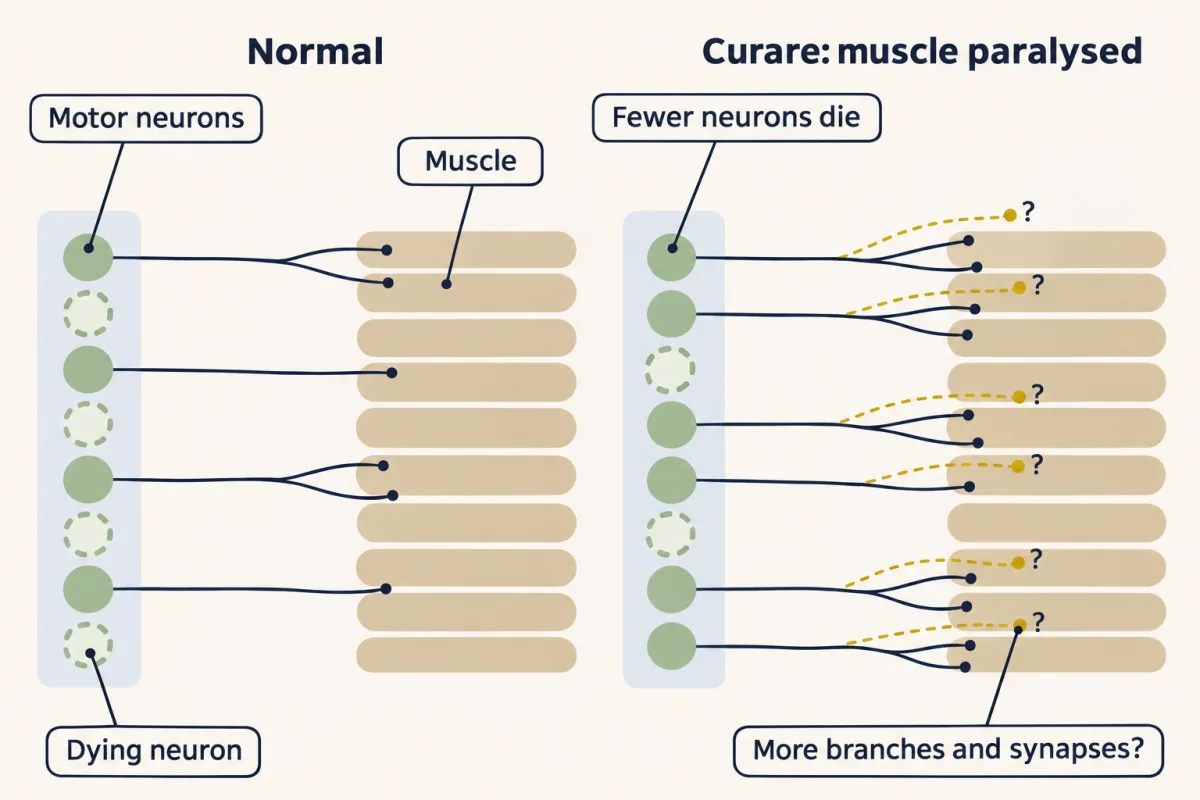
In other systems, activity helps a winner: active synapses can release more brain-derived neurotrophic factor (BDNF), which layers activity-dependent refinement on top of trophic competition. The two kinds of result need not conflict, because activity in the muscle and activity in the competing neurons are different variables.
Putting it together
The first two puzzles share the rule’s answer: the target sets how many; the neurons decide which, through feedback on TrkA and its signal and, in the proposed model, punishment through p75. The third has two parts. Nerve growth factor (NGF) also shapes how much of many targets each survivor covers. And in chick motor neurons, which draw on several factors, muscle activity is a separate variable that needs its own account.
Going deeper
The caricature, written out
A word-equation version of the feedback loop is
change in TrkA = basal synthesis + k × (NGF signal) − decay × TrkA
where the nerve growth factor (NGF) signal rises with both NGF and TrkA. Written this way it leaves out the ingredient that makes it a competition: a shared, finite supply, so that one neuron’s gain is another’s loss. With NGF held fixed outside every cell, nothing links one neuron’s fate to another’s: with a signal simply proportional to TrkA, identical neurons all settle toward the same TrkA level (or, with strong enough feedback, all grow without limit). Make the NGF signal each neuron’s share of a fixed supply and you have a contest, but with shares proportional to TrkA the ratios freeze, as in the two-neuron table.
Activity, muscle factors and axon pruning
An older idea, that inactive muscle makes more of the factors motor neurons need, has had little support from tests with extracts of paralysed muscle. In rodent sympathetic neurons, axon pruning uses a similar brain-derived neurotrophic factor (BDNF) and p75 punishment logic, acting on losing axons rather than on cell bodies (see that lesson).
Your notes
Select any text in the lesson to highlight it or add a note to it. Your highlights and notes are saved in this browser and collected in your notebook.
This browser is not letting the site save anything (a private window or strict privacy settings), so highlights and notes will be lost when you leave the page.
How we measure it
Bax-null background for comparing genotypes
Most neurons lacking NGF die, so their loss muddies any comparison. Removing the pro-death gene Bax keeps them alive, so ganglia from Bax-null mice and from mice lacking both Bax and NGF can be compared directly to see which genes and which axon projections need NGF.
Gene expression profiling of ganglia
RNA from whole ganglia of two genotypes is measured on microarrays and compared. Genes lower without NGF are candidate NGF-dependent genes, which are then confirmed by in situ hybridization, immunostaining or culture with and without NGF.
Computational modelling of competition
Neurons and their receptor levels are written as equations and simulated competing for NGF that the target makes at a constant rate. Turning feedback or punishment on and off in the model shows which features are needed for a clean, fast selection, and yields predictions for mutant mice.
Pharmacological paralysis of the chick embryo
Curare or a related blocker of muscle acetylcholine receptors is applied to the embryo during the death period. Counting motor neurons afterwards shows how neuromuscular activity affects survival.
Method films · the methods library
Practice questions on this lesson (3) → MCAT-style, original, each with an explanation
Where this lesson fits
Before thisReview first
- The Neurotrophic Hypothesis TestedThis course · Lesson 29
The lesson starts from the claim that neurons compete for limited target-derived factor and asks how that contest is decided.
- Neurotrophins, Trk Receptors and p75This course · Lesson 30
You need how TrkA and p75 signal survival or death to follow the feedback and punishment steps.
- Too Many Neurons: Naturally Occurring Cell DeathThis course · Lesson 28
It shows that roughly half of developing neurons die, which is the outcome the competition produces.
After thisStudy next
- The Signal from the Target Travels HomeThis course · Lesson 33
It explains how the NGF signal travels from axon tip to cell body in signaling endosomes, the route used here.
- Pruning Without Dying: Axons That Cut Themselves BackThis course · Lesson 34
It reuses the BDNF and p75 punishment logic on losing axons rather than whole cells.
- Synapse Elimination: One Muscle Fiber, One AxonThis course · Lesson 37
It extends competition for a target from neuron survival to which axons keep their synapses on one muscle fiber.
Elsewhere on the siteFilms, simulations and method films in other courses
- A neuron can take its survival signal in at the far end of its axonFilm · Cell Signaling
It shows how a neuron takes in its survival signal at the axon tip and carries it to the nucleus.
Suggested by an AI model from the lessons themselves, then checked. How we use AI
Finish line
Test yourself
8 questions
Practice and MCAT-style, with explained answers.
Next · Lesson 33
The Signal from the Target Travels Home
A neuron hears its survival signal at the far end of its axon. How does the message get home?
Continue →