A neuron can take its survival signal in at the far end of its axon
Read the transcript of “A neuron can take its survival signal in at the far end of its axon”
Film transcript: A neuron can take its survival signal in at the far end of its axon
The year is 1977. You grow sympathetic neurons in a special dish. A barrier divides the dish into three chambers. Fluid barely crosses the barrier. Small clusters of cell bodies are in one chamber. Their axons grow under the barrier into the next chamber. So you can keep the fluid around the far ends of the axons separate from the fluid around the cell bodies. After the axons have crossed, you do two runs. 1. You remove NGF from the far chamber only. NGF stays around the cell bodies. 2. You remove NGF from the cell bodies only. NGF stays at the far ends of the axons. Answer three questions. 1. Predict what happens to the axons and to the neurons in the first run.
2. Predict what happens to the axons and to the neurons in the second run. 3. What do the two results together tell you about where a neuron receives its survival signal? Robert Campenot built this dish and published the results in 1977. The dish let Campenot ask where a neuron needs NGF. - First run. When NGF was removed from the far chamber, the axons there stopped growing. Later they appeared to degenerate (break down). This happened even though the cell bodies behind them were in NGF the whole time. - Second run. Removing NGF from the cell bodies had much less effect. Many neurons survived, as long as their axons reached into a chamber that still had NGF.
The axons also did not grow into any chamber that lacked NGF. So the part of the neuron that needs NGF is the part at the target. An axon depends on the NGF in its own surroundings, whatever the fluid around the rest of the neuron contains. A cell body with no NGF of its own can survive on the NGF that its axons collect.
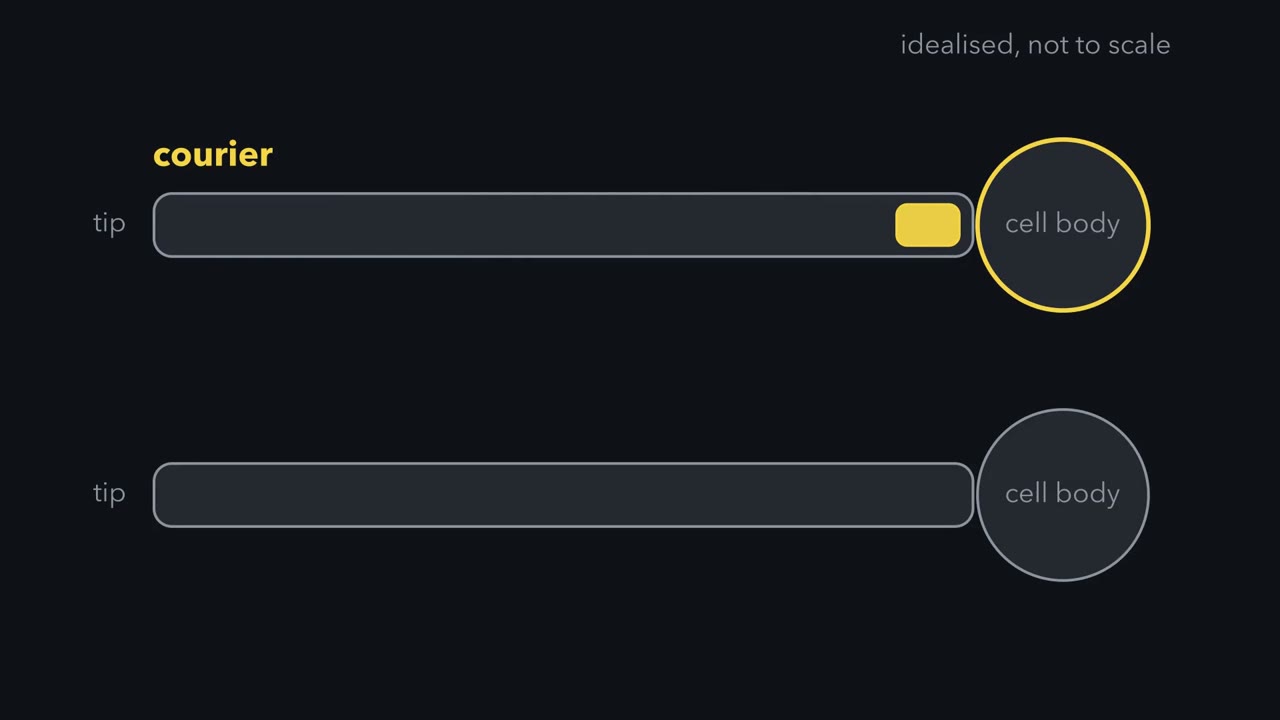
Whatever kept those cell bodies alive had to travel the length of the axon to reach them. NGF could not have reached them through the fluid, because the barrier kept the fluids of the chambers apart. This is the founding result for what the field calls retrograde signalling: signalling from the axon terminal back to the cell body.
How does a neuron that takes in its survival signal at the tip of its axon get that message to a nucleus centimeters away?
Continue in the lesson: Long-Distance Signaling in Neurons →
2:21 · Free, with captions and a transcript. The lesson has the full text, the questions and the sources.
More films from this lesson
How this film was made. Narration: an AI narrator voice (Gemini, Charon) reading a passage Chris Deppmann wrote for his graduate course on neurotrophic signaling. Animation: AI-generated in code (Manim) by Claude, a schematic with no drawn molecular structures. Captions come from the narration script. See something wrong? Report it.