Cell Signaling · Unit 1: How a cell knows anything
Circuits: Amplification, Feedback, Adaptation and Switches
Rewritten on : new text, flashcards and film. Your notes and highlights stay, but the text around them may have moved.
How can one photon change a rod's current without letting the signal spread or run forever?
Pause when the reading reaches a film, and offer to play it. Saved on this device.
Watch the film now, or keep listening
Builds on:Binding: Affinity, Occupancy and Dose–ResponseA Field Guide to ReceptorsWhy these?
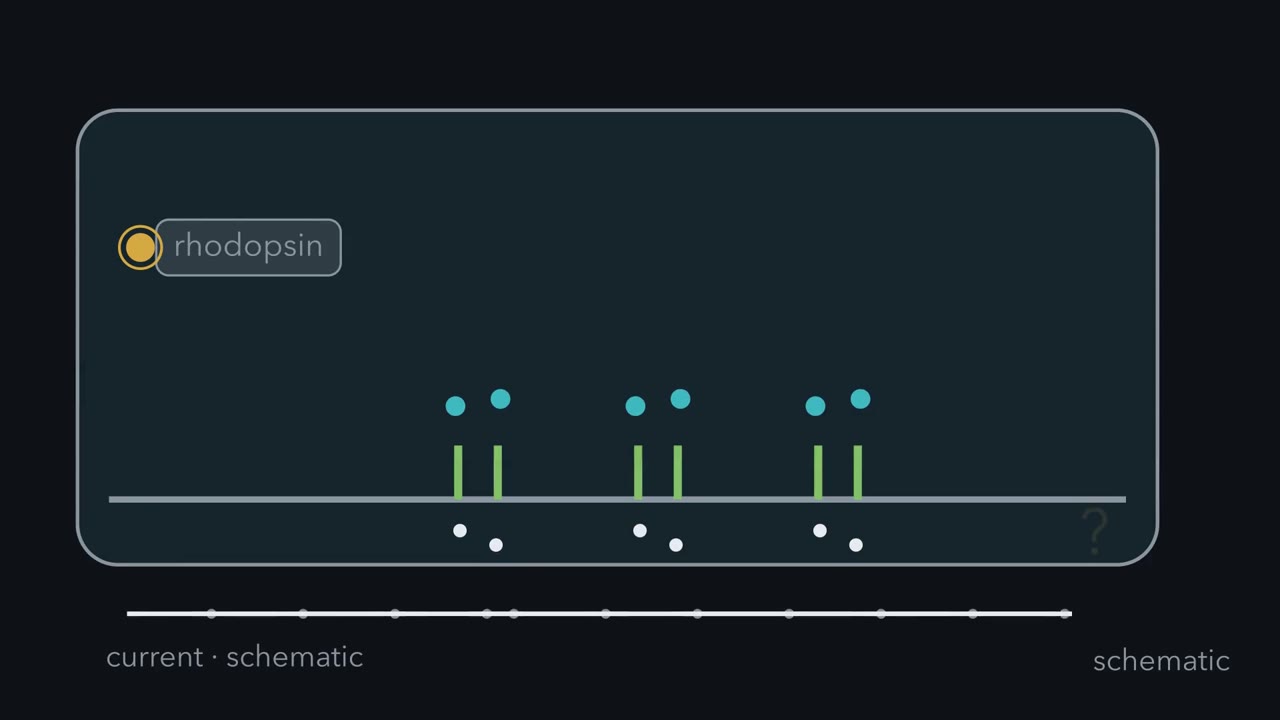 ▶ Watch How One Photon Becomes a Cellular Signal · 3:50
Read the transcript of “How One Photon Becomes a Cellular Signal”
Film transcript: How One Photon Becomes a Cellular Signal
How can one activated molecule change a whole cell's current without letting its signal spread or run forever? Follow one photon into a rod cell. Its pathway reveals both the power and the cost of amplification. In darkness, cGMP holds channels open, and ions carry a steady dark current. The photon activates one rhodopsin. It does not add current. It starts a relay that closes some channels, so the existing current dips. Active rhodopsin switches on many transducins. Each active transducin activates phosphodiesterase, which destroys cGMP. As cGMP falls, some channels close. The current dip is only a small fraction of the dark current. One event has become many downstream events.
Gain is output molecules per input molecule. In a simple unsaturated cascade, total gain is the product of the step gains. A catalytic step multiplies. A one-to-one handoff contributes no multiplication. The transducin handoff is one-to-one, between two catalytic stages.
A catalytic molecule reaches more targets by working faster or remaining active longer. Rate times active lifetime helps set that step's gain. Longer activity can also prolong output. But downstream shutoff or feedback can shorten a high-gain output.
Size and duration are not locked together. Now compare two invented routes on screen. Both start from one input. Which route produces more final output? Follow every branch, then multiply each route's displayed step gains.
The upper route wins because its displayed factors give the larger product. This rule has limits. Saturation, shared substrates, deactivation, and feedback can make real pathways depart from simple multiplication. Use the product only when the simple counting assumptions fit. Amplification also magnifies some upstream fluctuations, so weak signals need evidence. Rod researchers separated blank trials from responses and tested their counts against a Poisson distribution. Every active component needs a stop. Rhodopsin is shut down, and transducin splits bound GTP to switch itself off. A diffusible messenger can also reach unintended targets. Local binding, anchoring, and destruction restrict its useful pool.
Anchoring proteins can hold a kinase, its target, and a messenger-destroying enzyme within one neighbourhood. Amplification is therefore not free. A strong signal must be stopped and kept near the right targets. Return to the photon. Its cascade made a detectable dip because catalytic stages multiplied its effect, and timed shutoff ended the response. In other pathways, local anchoring and destruction can also limit the spread of a diffusible messenger. Those safeguards make amplification useful.
From the film
- Simple cascades multiply gain; high gain needs shutoff and sometimes insulation.
- In a simple unsaturated cascade, the total gain is the product of the step gains.
- Catalytic rate and active lifetime help set how many downstream molecules one active molecule reaches.
- Downstream shutoff or feedback can shorten a high-gain output, so size and duration are not locked together.
- Local binding, anchoring and destruction can keep a diffusible messenger near its intended targets.
One photon, absorbed by one rhodopsin molecule in a rod cell, changes the current through that cell by about one picoamp, a trillionth of an ampere. A single molecule cannot carry that current. How does its signal become large enough to register, yet remain local and stop?
A pathway diagram is only a wiring list. To predict behaviour, ask how much output one input produces, how output changes with time, and whether the response can reverse.
Gain is a product, within a simple model
The first film turned one photon’s path through rhodopsin, transducin and phosphodiesterase (PDE) into a product of step gains. Here are the measured numbers.
In darkness a rod carries a dark current of about 20 picoamps through channels that cGMP holds open. Denis Baylor, Trevor Lamb and King-Wai Yau recorded the single-photon dip from one toad rod in 1979: about one picoamp, a few percent of that current.
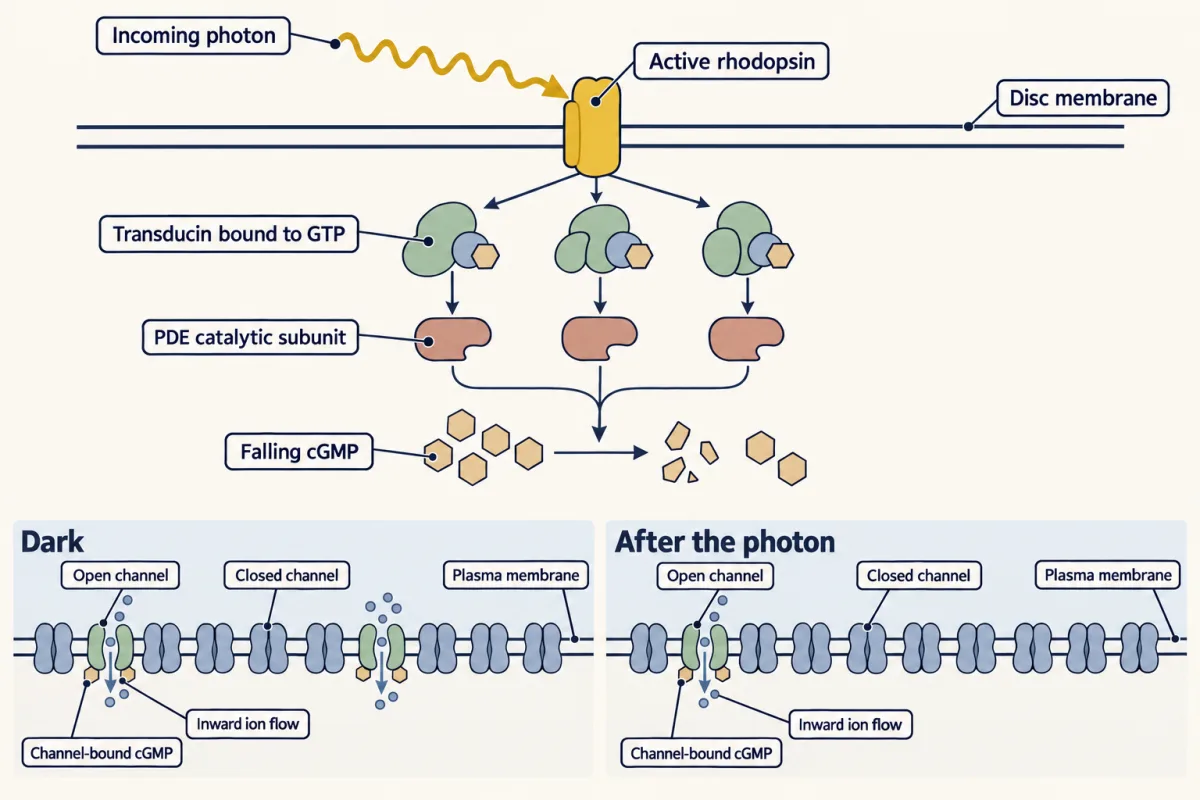
Gain is output molecules per input molecule. Rhodopsin to transducin and PDE to cGMP are catalytic steps, where one active molecule changes many downstream molecules while it stays active; the transducin-to-PDE handoff is one-to-one and multiplies nothing.
Leskov and colleagues measured the first step in isolated rod membranes as a rate: one active rhodopsin switches on transducin, and through it PDE, at 120 to 150 molecules per second. Rhodopsin is switched off quickly, though, so in an intact rod one photon activates only about 16 transducins in mouse and about 60 in frog. Those PDE molecules then destroy about 2,000 cGMP molecules in mouse and about 72,000 in frog.
Predict. Use the mouse numbers. Does more of the gain lie in the first catalytic step or the last?
Check your prediction
The last. The first step multiplies one rhodopsin into about 16 transducins. The last multiplies those 16 into about 2,000 destroyed cGMP molecules, roughly 125 per active PDE. In frog the split is about 60 against about 1,200.
The interactive uses a different cascade, epinephrine to glycogen breakdown. Change one step at a time.
One molecule in, millions out: output is the product of the gains.
The same final number can come from a real hormone (Normal), from a switch that has lost its OFF arm (Cholera), or from one that no longer needs its ON signal (Cushing's). That is the molecular logic of disease.
Amplification sends a bill
The first film named three costs: noise, shutoff and spread. The rod shows how the first two are paid; other pathways show the third.
First, noise: amplification can magnify upstream fluctuations, and a one-picoamp dip sits on a baseline that never stops moving. Baylor’s group could trust the dip only because they counted. They dimmed flashes until most trials were blanks; if each response is one photon caught at random, the blank fraction must follow a Poisson distribution, the signature of rare independent events. It did.
Second, shutoff. Rhodopsin kinase and arrestin shut down rhodopsin. The RGS9 complex speeds transducin’s self-shutoff by GTP splitting. The rod also uses negative feedback, output acting to reduce its own production: closing channels lowers calcium inside the cell, and calcium-sensing GCAP proteins speed the enzyme that makes cGMP.
Third, a diffusible messenger made in many copies risks reaching unintended targets. A cell that answers different receptors differently must keep each pool of messenger near where it was made. mAKAP, for example, holds a kinase, a messenger-destroying phosphodiesterase and the kinase’s target within nanometres, so the cyclic AMP that matters stays in that small neighbourhood. That is insulation, keeping one pathway’s signal away from another pathway’s targets, and it has to be built.
Amplification creates output; shutoff and feedback loops, like the rod’s calcium loop, decide how that output changes with time. The second film compares three feedback designs under a continuing input.
Read the transcript of “Three Ways a Signal Changes with Time”
Film transcript: Three Ways a Signal Changes with Time
The first film showed a cascade multiplying one input, then controlling its spread and shutoff. What can make an output fade, commit, or reset while input remains? One answer lies in how output loops back. Feedback begins when output changes its own production. A return arrow that reduces production is negative feedback. A return arrow that increases production is positive feedback. Timing and strength decide the result. The same pathway can therefore produce different dynamics.
Connections alone cannot predict the time course. Start with a continuing input and a delayed brake. Output rises before the brake accumulates. Then negative feedback lowers pathway activity, even though input remains. The brake's delay and strength help shape the pulse. Connections alone did not predict it. Now turn the return arrow forward.
Output strengthens its own production, so a small rise can recruit more activity. If the loop is strong and includes a steep step, the circuit can settle into low or high output. A weaker loop may only sharpen the response. An ultrasensitive response is steep, but steepness alone can reverse when input falls. Sufficient positive feedback can add bistability and memory. Then a temporary input may leave output in the high state. The memory outlasts the input that set it. A third circuit receives a continuing input. Three output traces appear on screen. Which trace represents adaptation?
Look for the defining pattern before choosing. Adaptation is the return toward rest while stimulus remains. So choose the trace returning toward its starting line. A delayed brake can make a similar shape. Integral feedback is a special negative feedback. It keeps correcting the gap from a reference output until the gap is zero. In bacterial chemotaxis, receptor methylation acts as a running total of that gap in an idealized model.
Correction continues until the error reaches zero. Engineers call this integral feedback. CheR adds methyl groups, while CheB removes them. Changing enzyme amounts can change how quickly correction proceeds and can shift other steady behaviour. Yet adaptation precision can remain robust. Robustness protects a specified property, not every feature of the response. Place the three designs side by side. Delayed negative feedback can limit duration. Sufficient positive feedback can sharpen commitment and preserve memory.
Integral feedback corrects until the error is zero. It can restore a reference output despite changing parts. The pathway's arrows begin the explanation, but kinetics finish it. Loop sign, strength, delay, and component lifetime determine whether output fades, commits, or adapts. Feedback reshapes time and reversibility.
From the film
- Feedback can limit duration, sharpen decisions, or restore resting output.
- Delayed negative feedback can make output fall while an input remains present.
- Sufficiently strong positive feedback can add bistability and memory to an ultrasensitive response.
- Integral feedback, a negative feedback that corrects until the error is zero, can make adaptation precise even when protein amounts change.
Negative feedback can set how long a signal lasts
The second film drew a delayed brake; here is a molecular design for one.
Predict. You have a growth factor, its receptor, a kinase and one protein X. How could X make kinase activity fall while the growth factor remains present? What must X sense, what must it act on, and what timing must it have?
One way to do it
Make X a phosphatase whose amount rises when the kinase is active and which removes the kinase’s phosphates.
- X senses the kinase’s output, so it appears only after the pathway has fired, and it acts on the kinase, so activity falls while the growth factor is still there.
- X acts late. If it worked as fast as the kinase, the signal would barely rise. If it must be made from scratch, the delay is minutes, and that delay sets the window.
- X is short-lived. If it lingered once the growth factor was gone, the cell could respond only weakly a second time.
Cells use this design: ERK drives production of DUSP-family phosphatases that remove ERK’s own phosphates.
The brake’s delay, strength and lifetime help set the activity window, but this is one design, not a universal timer: receptor traffic, component degradation and other loops can also set duration.
Positive feedback turns a dial into a switch
The second film drew an idealized switch. The experimental question is whether a smooth population average can hide individual switches.
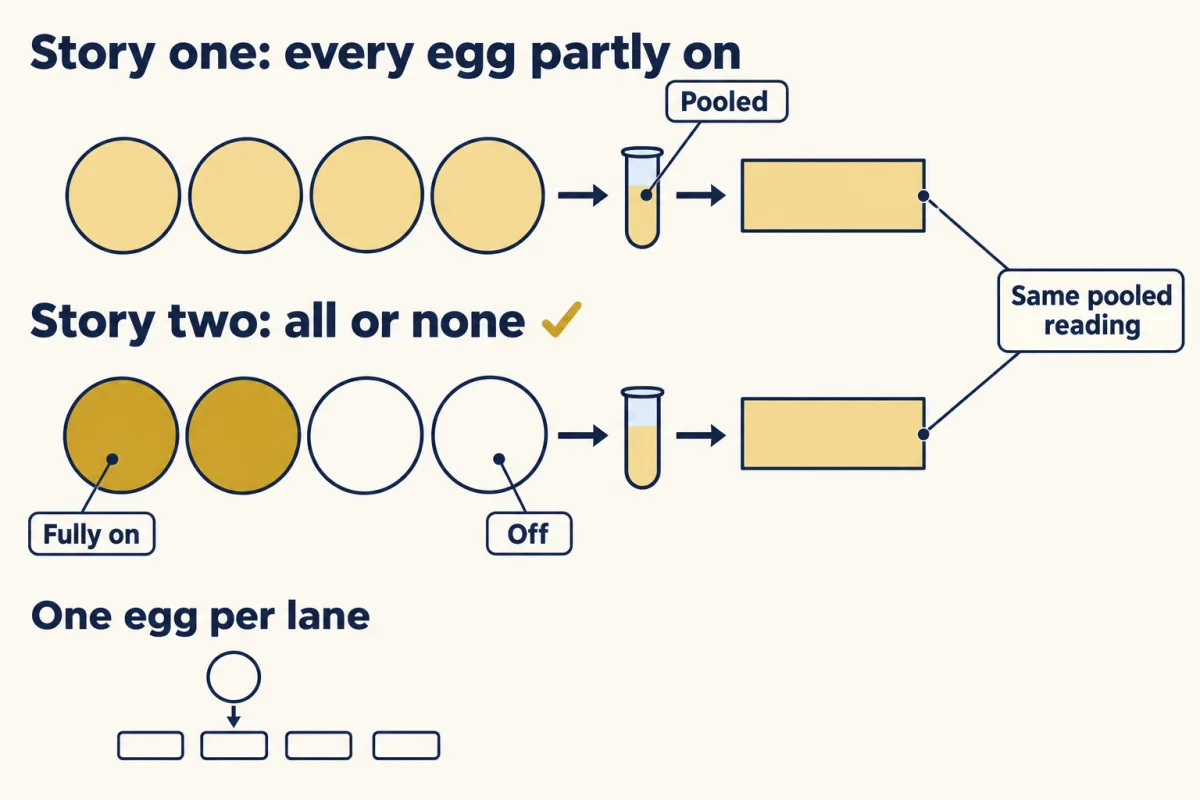
James Ferrell and Eric Machleder incubated Xenopus oocytes, immature frog eggs, in different concentrations of progesterone, the hormone that starts their maturation. Each egg is about 1.2 millimetres across, large enough to assay alone by immunoblot, a gel-based protein detection method in which active MAP kinase runs slightly slower. Pooling eggs at each dose produced a smooth S-shaped average.
Predict. Which experiment distinguishes two possibilities: every egg is partly active, or some eggs are fully active while the rest are off?
Check your prediction
Assay one egg per lane. A pooled average cannot distinguish intermediate cells from a mixture of fully on and off cells.
The single-oocyte assay supported the second story. Ferrell and Machleder reported on 8 May 1998 that the response had a Hill coefficient of at least 35. The Hill coefficient, n, measures how abruptly output rises with dose. Hemoglobin binding oxygen, with n about 3, is the textbook comparison.
response = dosen / (Kn + dosen), where K is the dose that gives half the maximal response
dose at 90% of maximum ÷ dose at 10% of maximum = 811/n
Predict. Use the second relation. How wide is the 10-to-90 percent dose span for n = 3 and n = 35?
Check your prediction
The spans are 811/3, about 4.3-fold, and 811/35, about 1.13-fold. For n = 1 the span is 81-fold. Larger n means a narrower, more switch-like response.
Extracellular signal-regulated kinase (ERK), a MAP kinase, turns on only after MAPK/ERK kinase (MEK) adds two phosphates, one to threonine and one to tyrosine one residue apart. One tag leaves ERK mostly off. MEK adds the phosphates in separate encounters, releasing ERK between them. This multisite process makes the response ultrasensitive: steeper than proportional, an S-shaped curve rather than a true threshold, and still reversible. Stacking three relay tiers sharpens it further. On 17 September 1996, Chi-Ying Huang and Ferrell published a calculation, confirmed in oocyte extracts, with a Hill coefficient about 4 to 5.
Thirty-five needs more. Positive feedback means that output increases its own production. Ferrell and Machleder proposed that a loop around the cascade drives an egg that has started switching the remaining distance. Sufficiently strong positive feedback can add bistability, two stable output states under the same conditions, and memory. Xiong and Ferrell showed in 2003 that an oocyte committed to maturation stays matured after hormone removal.
Eggs differ in switching threshold, so at an intermediate dose a homogenate reports the fraction that has flipped as if every egg responded partway.
Adaptation: returning to rest while the signal is still on
Adaptation is a return toward rest while the stimulus remains. It lets E. coli respond to a climb in attractant rather than stay saturated by the level already reached. The second film showed receptor methylation acting as a running total of the error, which engineers call integral feedback, a negative feedback that keeps correcting until the error is zero. Here is the molecular wiring.
The receptor controls CheA, which transfers a phosphate to CheY; phosphorylated CheY drives tumbling. CheR adds methyl groups to the receptor and CheB removes them. The idealized model works because CheB acts mainly on active receptors and CheR works near its top speed. Like turning a shower knob until the water feels right, correction speed affects arrival time, while “right” sets the stopping point.
In most networks, changing an enzyme’s amount shifts the steady state the network settles into. Barkai and Leibler derived in 1997 that this loop should instead return each cell to its own pre-stimulus output across wide ranges of enzyme levels. On 14 January 1999, Alon, Surette, Barkai and Leibler tested E. coli carrying different amounts of one circuit protein at a time. Adaptation time and steady-state behaviour varied strongly with protein concentration. The precision of adaptation did not. Robustness means that a specified output property holds when component amounts or rates vary; it never means that every property is protected.
With an overloaded correcting enzyme, a cell can still return within experimental error to its own pre-attractant rate while differing from normal neighbours in resting rate and return time.
Predict. Each receptor has a fixed number of methylation sites. What should happen at very high attractant levels?
Check your prediction
Free methylation sites run out before the error reaches zero, so real cells adapt measurably short of their starting rate. Exact adaptation is a limit of the model, not a guarantee.
Put the circuit words to work
| Circuit word | Question it answers |
|---|---|
| Gain | How many output molecules does one input produce? |
| Negative feedback | Does output act back to reduce its own production? |
| Positive feedback | Does output act back to increase its own production? |
| Feed-forward | Does one input reach an output by direct and indirect routes at once? |
| Ultrasensitive response | Does output climb from near zero to near maximum over a narrow input range? |
| Adaptation | Does output return toward rest while stimulus remains? |
| Robustness | Which specified output holds as parts or rates vary? |
| Insulation | How is one pathway’s signal kept from another’s targets? |
Cross-talk is signal passing between pathways. A cell may use that connection, or it may be an unwanted leak. Chris’s lectures borrow a picture from process control: water, malt and hops flow into a fermenter, a threshold indicator trips, and product goes to a storage tank. Two of his questions apply to every case here: “Insulation versus connectivity?” and “Does a signaling pathway have to be the most logical or efficient of all possible scenarios?” The chemotaxis circuit answers the second. It is not the simplest wiring that responds; its architecture and kinetics protect one output, how precisely each cell returns to its own starting rate, and not everything.
Going deeper
Different inputs, different activity windows
One summary figure attributes feedback-shaped activity windows of about 20 minutes after TNF (tumor necrosis factor), 30 after EGF (epidermal growth factor), 90 after NGF (nerve growth factor) and 120 after LPS, a molecule from bacterial outer membranes, to the loops handling each signal. These examples do not make feedback the only possible timer.
What the simple gain product leaves out
The product rule counts independently multiplying steps before saturation. Real pathways may share substrates, saturate enzymes, deactivate components while transmission continues, and feed output back into earlier steps. Rate multiplied by active lifetime helps set a step’s gain, but amplitude and duration are not locked together: downstream shutoff or feedback can shorten a high-gain output.
Exact adaptation is a model limit
Experiments show return within measurement limits over a range of protein amounts, not unlimited perfection.
Your notes
Select any text in the lesson to highlight it or add a note to it. Your highlights and notes are saved in this browser and collected in your notebook.
This browser is not letting the site save anything (a private window or strict privacy settings), so highlights and notes will be lost when you leave the page.
How we measure it
Suction-pipette recording from a single rod
A glass pipette draws in the outer segment of one rod and fits snugly around it, so the current through its channels can be recorded while flashes of known strength are delivered. Sorting trials into blank and response, and checking the counts against a Poisson distribution, shows whether a small dip is a real single-photon event or noise.
Single-oocyte immunoblotting
One frog egg per lane is run on a gel and probed with an antibody, so each cell gives its own reading of MAP kinase activity (active kinase runs slightly slower). Comparing single cells with a pooled lysate shows whether a smooth average hides all-or-none cells.
Fitting a Hill coefficient to a dose-response curve
The response is fitted with a curve whose exponent n measures steepness. The larger n is, the narrower the range of dose that takes the output from 10 percent to 90 percent of its maximum.
Titrating one component of a circuit
One protein of a pathway is produced at several levels, one protein per batch of cells, and the response is measured each time. Properties that move with the dose depend on the amounts; properties that stay put are robust to them.
Practice questions on this lesson (3) → MCAT-style, original, each with an explanation
Where this lesson fits
Before thisReview first
- Binding: Affinity, Occupancy and Dose–ResponseThis course · Lesson 3
Hill coefficients and dose-response curves are used here to describe how steeply a response turns on.
- A Field Guide to ReceptorsThis course · Lesson 4
You need to know what receptors, G proteins and their outputs are before following the rhodopsin-to-current chain.
After thisStudy next
- GTPase Switches: The TimerThis course · Lesson 7
Transducin's self-timed switch-off is the timer that sets how long this cascade stays loud.
- Turning the Signal Off: Arrestins, RGS Proteins and PhosphodiesterasesThis course · Lesson 16
Rhodopsin kinase, arrestin and RGS9 are the shut-off steps this lesson only names.
- Ras to MAPK: The Kinase CascadeThis course · Lesson 19
The three-tier kinase relay here is where the steep, switch-like response comes from.
Suggested by an AI model from the lessons themselves, then checked. How we use AI
Finish line
Test yourself
8 questions
Practice and MCAT-style, with explained answers.
Next · Lesson 6
Phosphorylation: Kinases and Phosphatases
How can one small chemical mark change what a protein does without rebuilding it?
Continue →