Developmental Neuroscience · Skim version
Competition: How Neurons Win a Target
Read the full lesson → Skim the whole course →
The guiding idea
If the target makes too little NGF for every neuron, which neurons get to live?
In mouse sympathetic neurons, a limited supply of NGF sets roughly how many neurons survive, and the neurons' own feedback on NGF signaling decides which.
From the film: Too Little to Go Around
- A limited NGF supply sets roughly how many sympathetic neurons survive.
- Among otherwise alike neurons, a small lead can grow only if its signal rises faster than in proportion to the lead.
- In the proposed model, the neurons' own feedback decides which ones survive, and winners speed the death of losers.
From the film: Why Sharing Fails
- With proportional sharing, a small lead stays frozen, so feedback on receptor level alone does not make a winner.
- A lead can grow only when the reward rises faster than the lead.
- Arrival order alone cannot explain how a small lead grows while the target keeps releasing NGF.
From the film: The Bax Trick
- Mice lacking Bax keep their sympathetic neurons with or without NGF, so ganglia can be compared.
- NGF raises and maintains its own receptor, TrkA, in these neurons.
- By the two-neuron arithmetic, the TrkA receptor loop alone is only half of the answer.
From the film: Only Both Loops Split Them
- NGF also controls how long its own signal lasts; Coronin-1 is one mechanism, and there may be others.
- In the published simulations, only feedback on both receptor level and signal duration split the neurons into winners and losers.
- The lab described four stages: naive, sensitization, competitive advantage and selection.
From the film: Winners Push Losers
- In the proposed model, well-supported neurons make BDNF and NT-4, which push weakly supported neighbours toward death through p75.
- Strong TrkA signaling likely protects the winners by keeping survival pathways such as AKT high.
- Without p75, the loss of neurons is delayed; whether any are permanently spared is less settled.
From the film: Same Factor, Second Job
- In mice lacking both Bax and NGF, sympathetic neurons survive but innervation is missing from some targets, reduced in others and near normal in a few.
- NGF also helps axons grow and branch, so it helps set how much of many targets each survivor covers.
- Paralysing chick embryos with curare saved motor neurons; muscle activity is a different variable in a different system.
-
The contest and its open questions
-
Why a limited supply is not enough
-
Who needs NGF? The Bax trick
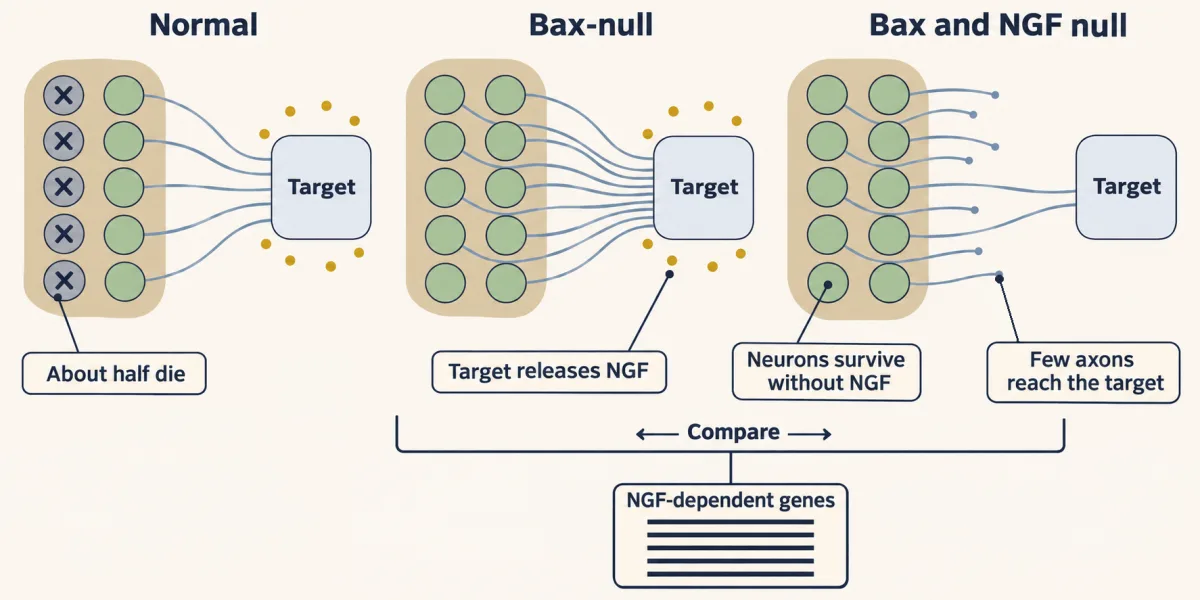
In mice lacking Bax, sympathetic neurons survive with or without NGF, but without NGF many targets are poorly innervated, so survival does not mean normal innervation. Comparing gene expression in Bax-null ganglia with Bax/NGF double-null ganglia gave a list of NGF-dependent genes. Cell and axon numbers are schematic. AI-generated illustration -
NGF lengthens its own signal
-
Punishment: winners push losers
-
Systems matching: NGF also sets how much a target gets
-
Activity: a different variable in a different system
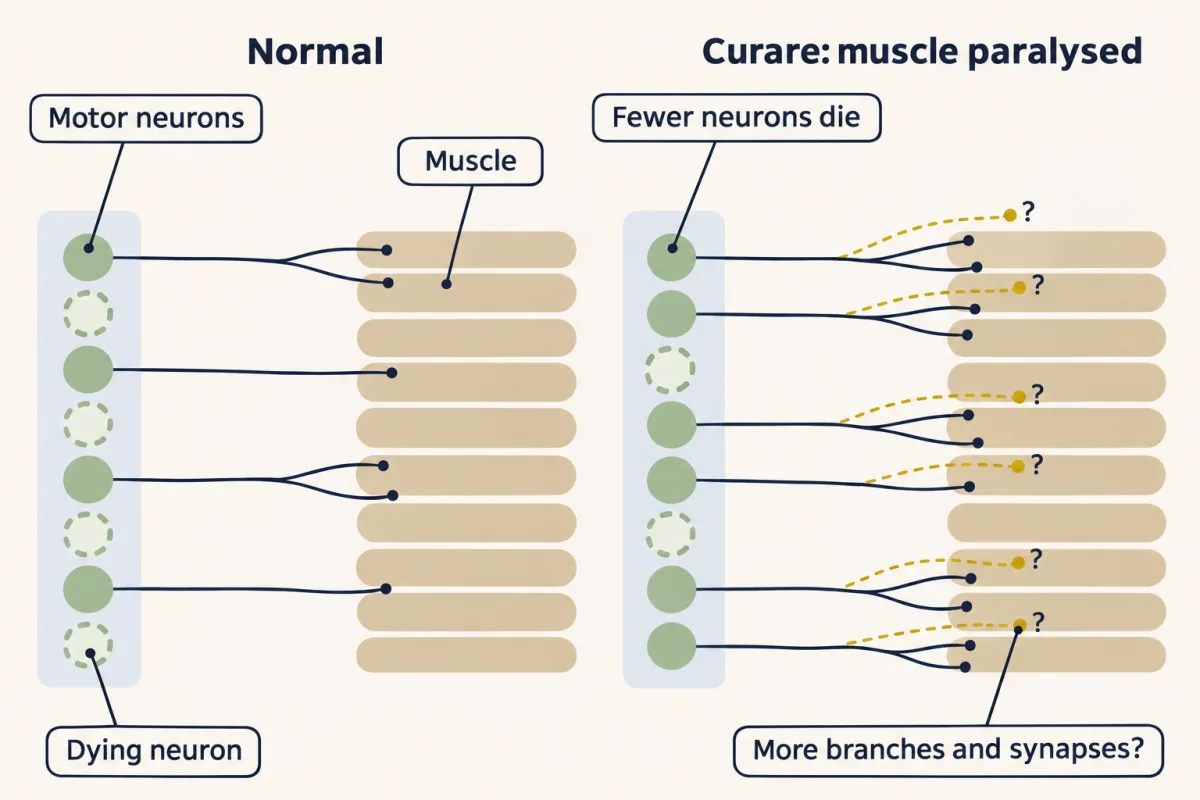
In chick embryos paralysed with curare, fewer motor neurons died, the opposite of what an activity-helps-winners rule predicts. The most common explanation, still an interpretation, is that paralysed muscle allows more branching and synapses, giving each motor neuron more access to trophic support. AI-generated illustration -
Putting it together
-
Going deeper
Where this lesson fits
Before thisReview first
- The Neurotrophic Hypothesis TestedThis course · Lesson 29
The lesson starts from the claim that neurons compete for limited target-derived factor and asks how that contest is decided.
- Neurotrophins, Trk Receptors and p75This course · Lesson 30
You need how TrkA and p75 signal survival or death to follow the feedback and punishment steps.
- Too Many Neurons: Naturally Occurring Cell DeathThis course · Lesson 28
It shows that roughly half of developing neurons die, which is the outcome the competition produces.
After thisStudy next
- The Signal from the Target Travels HomeThis course · Lesson 33
It explains how the NGF signal travels from axon tip to cell body in signaling endosomes, the route used here.
- Pruning Without Dying: Axons That Cut Themselves BackThis course · Lesson 34
It reuses the BDNF and p75 punishment logic on losing axons rather than whole cells.
- Synapse Elimination: One Muscle Fiber, One AxonThis course · Lesson 37
It extends competition for a target from neuron survival to which axons keep their synapses on one muscle fiber.
Elsewhere on the siteFilms, simulations and method films in other courses
- A neuron can take its survival signal in at the far end of its axonFilm · Cell Signaling
It shows how a neuron takes in its survival signal at the axon tip and carries it to the nucleus.
Suggested by an AI model from the lessons themselves, then checked. How we use AI