Physiology · Skim version
Body Water and Its Compartments
Read the full lesson → Skim the whole course →
The guiding idea
In the textbook model, retain a litre of solute-free water and about two-thirds ends up inside your cells; retain a litre of isotonic saline and none does. Why, and what does the first do to plasma sodium?
Why does a retained litre of water swell your cells while a litre of isotonic saline does not?
-
Where the water is
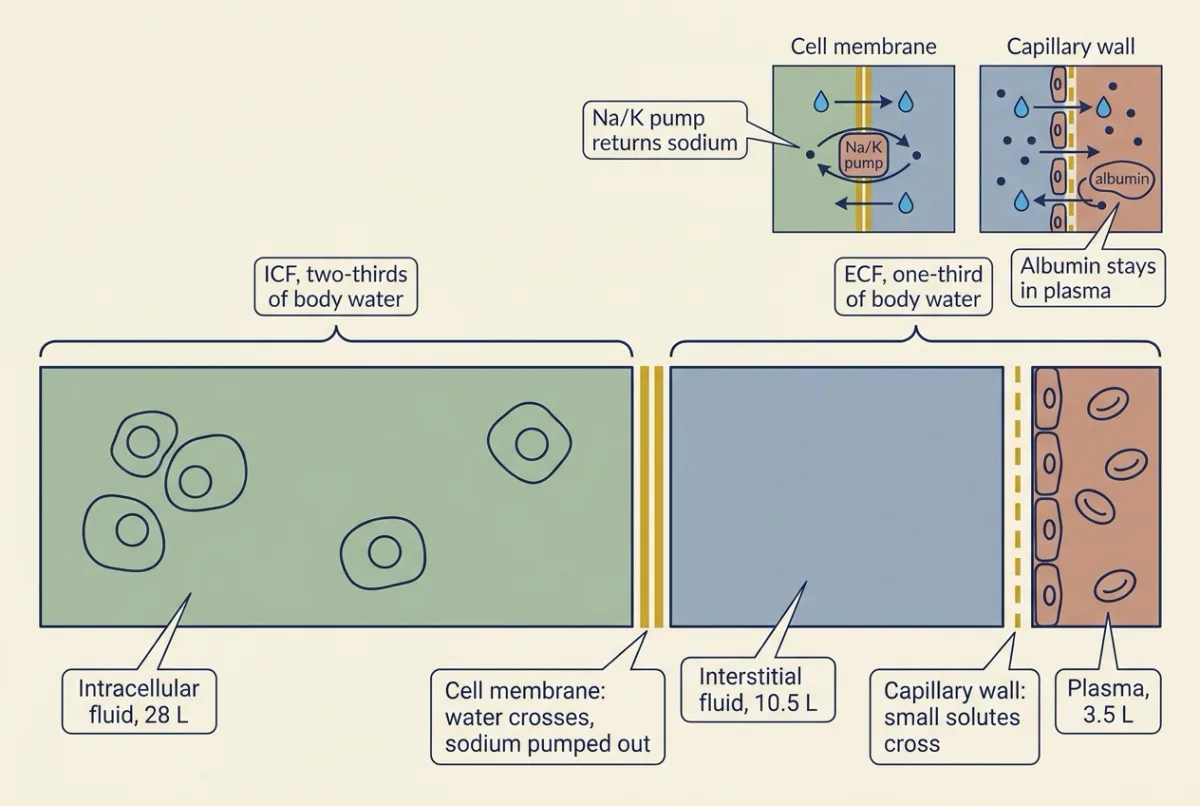
Two different walls divide body water: the cell membrane splits cells from the ECF by small solutes such as sodium salts, and the capillary wall splits plasma from interstitial fluid by protein, so never use one wall's rule for the other. AI-generated illustration -
Why water follows effective solute
-
Where does the litre go? Three trials
-
Plasma sodium reports water, not body sodium
-
Losses: bleeding and pure water loss
-
Measuring the tanks
-
The kidney adds a clock
-
Going deeper
Where this lesson fits
Before thisReview first
- Osmoregulation and Nitrogenous WasteOrganismal Biology · Starting college
It defines osmolality and shows how water follows solute across membranes, which this lesson uses to divide body water.
- Crossing the MembraneBiology · High school
You need osmosis across a cell membrane from there to see why water settles where trapped solute sits.
- Tissues, Organs and HomeostasisOrganismal Biology · Starting college
It introduces the extracellular fluid as the body's internal environment, which this lesson divides into plasma and interstitial fluid.
After thisStudy next
- Capillary Exchange, Lymph and EdemaThis course · Lesson 9
It splits the extracellular fluid between plasma and interstitial fluid, the division the solute rule here leaves open.
- Water, Sodium and Potassium BalanceThis course · Lesson 17
It takes the low-plasma-sodium idea further, linking water balance to body sodium and the kidney's control.
- Glomerular Filtration and Renal Blood FlowThis course · Lesson 15
The kidney that sets how long a retained load stays begins with filtration of plasma.
Suggested by an AI model from the lessons themselves, then checked. How we use AI