Cell Signaling · Unit 4: Receptors with enzymes attached
Ras to MAPK: The Kinase Cascade
Rewritten on : new text, flashcards and film. Your notes and highlights stay, but the text around them may have moved.
A growth factor stays outside the cell, yet through the same four proteins it can tell one cell to divide and another to grow nerve-like fibres—how does one relay carry two opposite orders?
The main idea, the figures and what the films show. Under each heading, "Read this part" opens it.
Both films in order, 7 minutes. Each one ends with what to take from it.
The whole lesson: about 18 minutes of reading and 7 of film.
Pause when the reading reaches a film, and offer to play it. Saved on this device.
Watch the film now, or keep listening
That is the end of the reading
This idea at other levels
This lesson teaches the Ras to MAPK cascade in Cell Signaling, a graduate course. Simpler: read a short college version here.
The college version · about 1 minute to read
An activated receptor tyrosine kinase recruits Grb2 and the exchange factor SOS, which loads Ras with GTP. Ras-GTP binds the Ras-binding domain of Raf and brings Raf to the membrane, where its autoinhibited shape opens and two Raf kinase domains pair. Raf phosphorylates MEK on two activation-loop serines. MEK, a dual-specificity kinase, phosphorylates ERK on a threonine and a tyrosine one residue apart, and ERK needs both. ERK phosphorylates cytoplasmic targets and nuclear transcription factors such as Elk-1, which switches on immediate early genes such as c-fos. The same three-tier plan, with other members, runs the JNK and p38 stress pathways, and scaffolds help keep the modules apart. ERK feeds back on SOS and Raf and induces phosphatases, which helps limit how long the signal lasts. In PC12 cells a brief ERK signal goes with proliferation and a sustained one with differentiation. Ras and B-Raf mutations hold the cascade on in cancer, and milder germline mutations cause the RASopathies.
See nearby ideasHide nearby ideas
The Ras to MAPK cascade
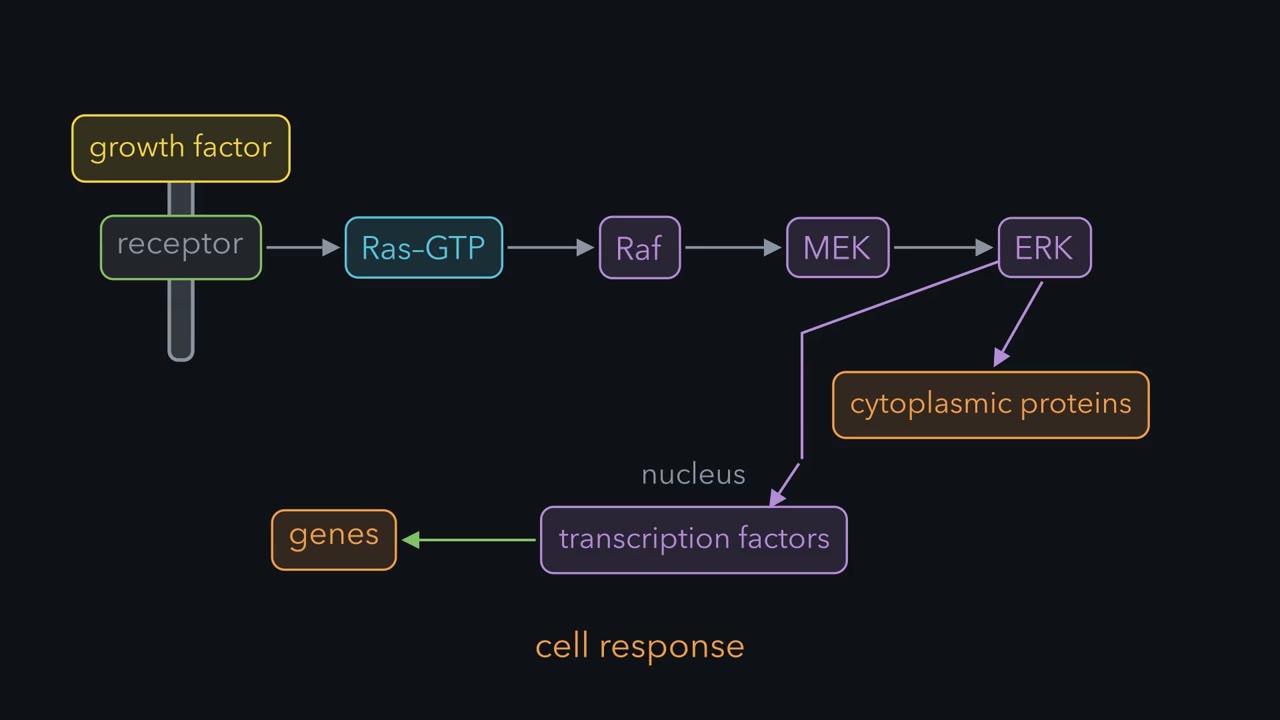
An active receptor switches on Ras, which starts a relay of three kinases ending at ERK, which acts on genes.
Taught at one level so far: graduate level.
Graduate · the level you chose
Ras to MAPK: The Kinase Cascade · this lesson
Ras-GTP catches Raf, then Raf, MEK and ERK relay it; PC12 cells read duration.
Cell Signaling · about 19 min · film 3:14 · 3 practice questions
Next door to the Ras to MAPK cascade
- Cell division (mitosis)The cascade ends at genes that tell a resting cell to enter the cell cycle.Nearest lesson: Asymmetric Division: Numb and the Neuroblast (graduate level)
- OncogenesHyperactive Ras or its downstream kinases appear in many cancers, as in melanoma with changed BRAF.Nearest lesson: Oncogenes: When the Switch Sticks (graduate level)
Short versions inside this lesson
The plainest version · about 1 minute to read
Imagine a line of people passing a message by tapping the next person on the shoulder. The message starts at the cell's front door and ends in the room where the cell keeps its instructions. In one kind of cell, if the tapping goes on for a short while, the cell makes more cells. If it goes on for a long while, the cell changes into a new kind of cell, and if it never stops, the cell can get sick.
Find an idea: every idea, searchable
Which lessons teach an idea, and the notes on each level, were written by AI models from the lessons and checked by a second model. A person has not yet read every one. How we use AI
About this lesson goals, parts
What you'll learn
- Trace the signal from an active receptor tyrosine kinase to a gene through Grb2 and SOS, Ras-GTP, Raf, MEK and ERK, and say what happens physically at each step.
- Predict the effects of Ras and B-Raf mutations, of the RASopathy mutations, and of Raf and MEK inhibitors.
- Explain what three kinases in a row give the cell, and recognise the same three-tier plan in the JNK and p38 pathways.
- Explain how the duration of ERK activity, shaped by feedback, is thought to let one cascade signal division or differentiation in PC12 cells.
Builds on:GTPase Switches: The Timer (read)Adaptors, Docking Proteins and Scaffolds (read)Receptor Tyrosine Kinases (read)Why these?
Rewritten on : new text, flashcards and film. Notes and highlights stay, but the text around them may have moved.
The main idea. A three-kinase relay can amplify, sharpen, and control a membrane signal; duration, cell context, and pathway state shape what the cascade does.
The films
 ▶ Watch Ras to ERK: Three Kinases in Series · 3:14
Read the transcript of “Ras to ERK: Three Kinases in Series”
Film transcript: Ras to ERK: Three Kinases in Series
A growth factor stays outside the cell. Why does it take three kinases in a row to tell the nucleus? The receptor sits at the surface, yet the cell's genes lie deep inside. Carrying that order across the cytoplasm takes a carefully built relay. First, the active receptor recruits Grb2 and SOS to the membrane.
SOS makes membrane-anchored Ras drop GDP, so plentiful GTP binds instead. Ras is not a kinase. Bound GTP pulls two flexible switch loops taut, making a surface Raf can grip. Active Ras acts by contact. It catches folded, resting Raf from the cytosol and holds Raf at the membrane.
Binding alone does not open Raf. Contact with membrane lipids and further steps help it unfold. Two Raf kinase domains then pair side to side, which normal activation requires. Paired Raf phosphorylates the middle kinase, MEK, on two serines. MEK is unusual among protein kinases. Most kinases target either serine and threonine, or tyrosine alone.
MEK is a dual-specificity kinase. It tags ERK on a threonine and a tyrosine, one residue apart, creating a two-phosphate lock. Pause and predict. Suppose a phosphatase removes just one of ERK's two phosphates, leaving the other phosphate attached. Does ERK stay half-active, or shut off completely?
ERK shuts off completely. Removing either phosphate silences it, because ERK requires both to align its active site. In the test tube, if one hit has chance p, two independent hits have chance p squared. So one in ten becomes one in a hundred, and one half becomes one quarter. At low MEK, p squared stays tiny, then climbs steeply. Three kinases in series do more than carry a message. Each tier can amplify the signal, sharpen its rise, and open control points for phosphatases and feedback.
MEK is a narrow pipe aimed almost only at ERK. Active ERK then fans out widely across cytoplasm and nucleus. In the nucleus, ERK phosphorylates Elk-1, which helps switch on c-fos. That is an immediate early gene, one of the first genes on, within minutes. So this three-tier relay is no wasteful detour.
Ras gripping Raf starts the chain at the membrane. Three kinases in series can then amplify, sharpen, and control that signal. Finally, ERK fans out to proteins and genes.
From the film: four take-homes
- A three-kinase relay can amplify, sharpen, and control a membrane signal.
- Ras-GTP is not a kinase: it grips Raf at the membrane, where Raf opens and pairs side to side.
- Paired Raf phosphorylates MEK on two serines, and dual-specificity MEK puts both a threonine and a tyrosine phosphate on ERK.
- ERK fans out to cytoplasmic and nuclear targets, while scaffolds keep parallel MAPK modules wired apart and placed where needed.
In PC12 cells, a line grown from a rat adrenal tumour, epidermal growth factor (EGF) makes the cell divide, while nerve growth factor (NGF) makes it stop dividing and grow long, nerve-like fibres—both through Ras, Raf, MAPK/ERK kinase (MEK) and extracellular signal-regulated kinase (ERK). Stuck on, this same relay drives many cancers, and mildly over-active it causes the RASopathy syndromes. The first film traced the relay from surface to nucleus; below are the physical mechanisms, the proof behind them, and the worked cases.
Ras-GTP catches Raf at the membrane
The opening steps review three earlier lessons. An active receptor tyrosine kinase carries phosphotyrosines on its tail. The adaptor Grb2 binds one with its SH2 domain and holds SOS with its SH3 domains, bringing SOS to the membrane where Ras sits on its lipid anchors (see adaptors and scaffolds and lipid anchors and addresses). SOS is a guanine nucleotide exchange factor (GEF): it makes Ras release GDP so plentiful GTP takes its place. Ras stays on until it cuts that GTP to GDP (GTPase switches).
With GTP in its pocket, two surface loops on Ras—switch I and switch II—snap taut into a shape effectors can grip; with GDP they go slack. Here Ras-GTP catches Raf, a serine/threonine kinase.
In a resting cell, Raf floats in the cytosol folded shut, its front half (carrying a Ras-binding domain) held against its kinase domain. Ras is not a kinase; it acts by contact. Moving Raf to the membrane is well established, but binding alone does not open Raf: membrane lipids and further steps help release the closed shape. Two Raf molecules then pair side to side, kinase domain beside kinase domain, which normal activation requires. Phosphates are added to and removed from Raf along the way, and their exact order is still being worked out.
Predict. A mutant Ras lacks its lipid anchor and floats in the cytosol, yet still binds GTP and catches Raf. Will it activate Raf and MAPK/ERK kinase (MEK)?
Check your prediction
No. Catching Raf in the cytosol fails to bring Raf to the membrane, where lipids and further steps help Raf open and pair. Ras works by contact and localization, not phosphorylation.
Three kinases in series, and the two-phosphate lock
Paired Raf phosphorylates MAPK/ERK kinase (MEK) on two serines in its activation loop, the flexible stretch beside the active site (the phosphorylation switch). Unlike most kinases (which target Ser/Thr or Tyr alone), MEK is a dual-specificity kinase: it phosphorylates ERK (extracellular signal-regulated kinase) on both a threonine and a tyrosine, one residue apart, in ERK’s activation loop. ERK needs both phosphates; strip either one off with a phosphatase and ERK goes quiet.
Predict. When Natalie Ahn fractionated EGF-treated cell extracts on chromatography columns, ERK stayed inactive with ATP alone until a different fraction was added back. Why did that rule out ERK activating itself?
Check your prediction
An activator that parts from ERK on a column is a separate protein. Purifying that activator (MEK) with Rony Seger showed it phosphorylates ERK on both threonine and tyrosine (see Going deeper).
What do three kinases in a row give the cell? Signaling circuits covered two answers—each tier can amplify, and the cascade can turn a graded input into an all-or-none output—and a third is control, giving phosphatases, feedback loops, and scaffolds separate points to act.
ERK’s two-phosphate lock is one ingredient of that sharpness. Suppose MEK fills ERK’s threonine and tyrosine sites independently in a test tube, and only doubly phosphorylated ERK is active. With illustrative round numbers, compare 10% occupancy per site at low MEK with 50% per site at higher MEK (a 5-fold rise per site):
- At 10% per site, doubly phosphorylated ERK is 0.10 × 0.10 = 0.01 (1%).
- At 50% per site, doubly phosphorylated ERK is 0.50 × 0.50 = 0.25 (25%).
Predict. Suppose you want half of all ERK doubly phosphorylated. With the two sites filled independently, how full must each site be?
Check your prediction
About 71% per site, because 0.71 × 0.71 ≈ 0.50. The square cuts both ways: it keeps doubly phosphorylated ERK very low while occupancy is low, and it means each site must be well filled before much ERK switches on. That is what makes the output steeper than the input—though crowding in living cells may change it (see Going deeper).
MEK has almost no known substrates besides ERK, making the middle of the chain a narrow pipe. ERK is a wide fan: it phosphorylates serines and threonines followed by a proline on many cytoplasmic proteins, and part of active ERK enters the nucleus to phosphorylate transcription factors such as Elk-1. Elk-1 helps switch on c-fos, the best-known immediate early gene—a gene turned on within minutes with no new protein made first, because the proteins it needs are already present; its product is often a transcription factor driving later genes.
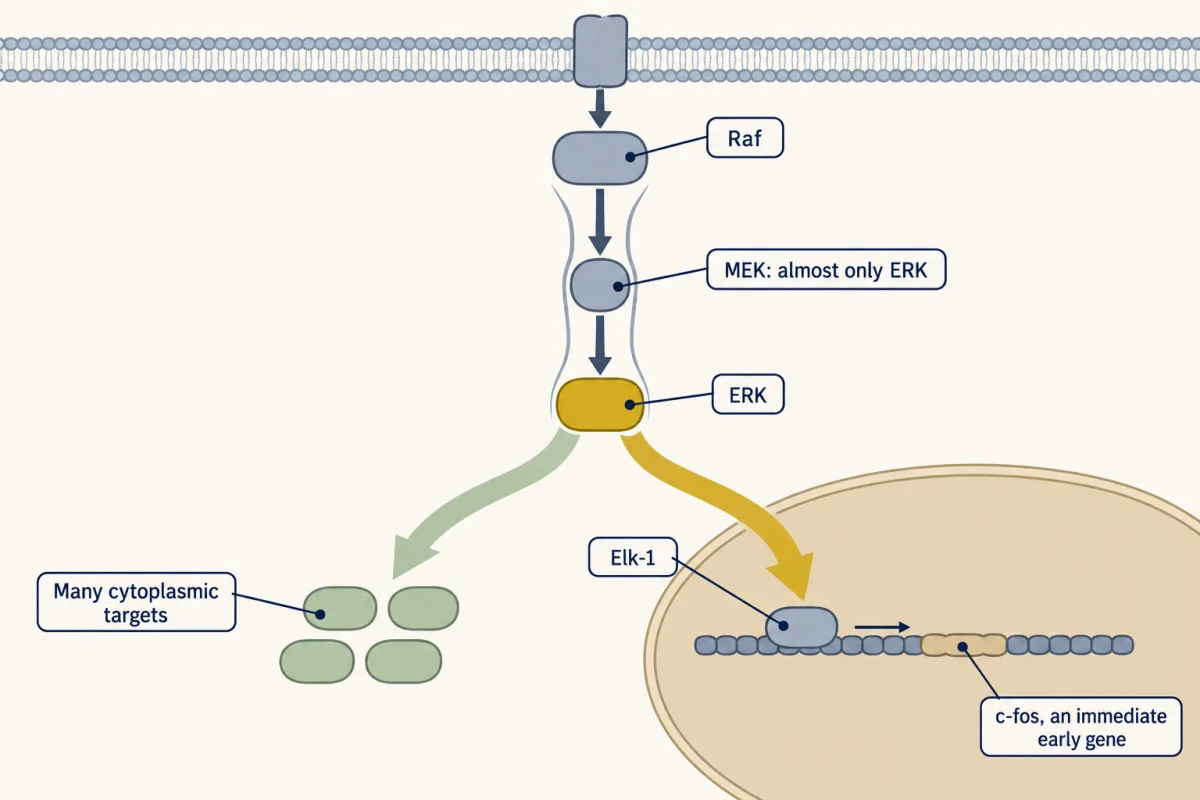
Do not memorize every downstream target; learn the logic of a narrow relay ending in a wide fan:
growth factor → receptor → Grb2 and SOS → Ras-GTP → Raf → MEK → ERK → transcription factors → immediate early genes
One three-tier plan, kept apart by scaffolds
Raf, MAPK/ERK kinase (MEK) and extracellular signal-regulated kinase (ERK) are one example of a general MAP kinase (MAPK) plan: a MAP kinase kinase kinase activates a MAP kinase kinase, which phosphorylates a MAP kinase on a threonine and a tyrosine in its activation loop. Animal cells run at least two more modules built this way, ending in c-Jun N-terminal kinase (JNK) and p38; they use their own kinases (some shared between JNK and p38) and respond mainly to stress such as ultraviolet light or inflammatory signals.
Look-alike cascades in one cytoplasm create a wiring problem, solved in part by scaffolds. A scaffold holds one module’s kinases side by side so they signal mainly to each other—as Ste5 does in yeast and KSR does for Raf, MEK and ERK (adaptors and scaffolds). Scaffolds also localize the cascade: paxillin gathers Raf, MEK and ERK at focal adhesions (where a cell grips its surroundings), and MP1 holds MEK and ERK on endosomes.
Wiring one module cleanly still leaves the bigger puzzle: how that same chain drives opposite cell fates and opposite drug responses. The second film explores how timing, cell identity, and pathway state alter what the cascade instructs.
Read the transcript of “Timing, Context, and Jammed Relays”
Film transcript: Timing, Context, and Jammed Relays
The first film traced how Ras, Raf, MEK, and ERK carry a membrane signal to genes. How can that same relay tell one cell to divide and another to stop dividing? In PC12 cells, EGF drives division, while NGF grows nerve-like fibres. A signal carries duration as well as strength, and ERK helps set its own clock. Active ERK sends fast negative feedback upstream, phosphorylating SOS and Raf to weaken them. ERK also induces phosphatases that strip both of its own phosphates. They act slowly because new protein must be made. How long the receptor stays active, plus this feedback, sets how long ERK stays on. In PC12 cells, EGF sparks a brief ERK pulse fading within an hour.
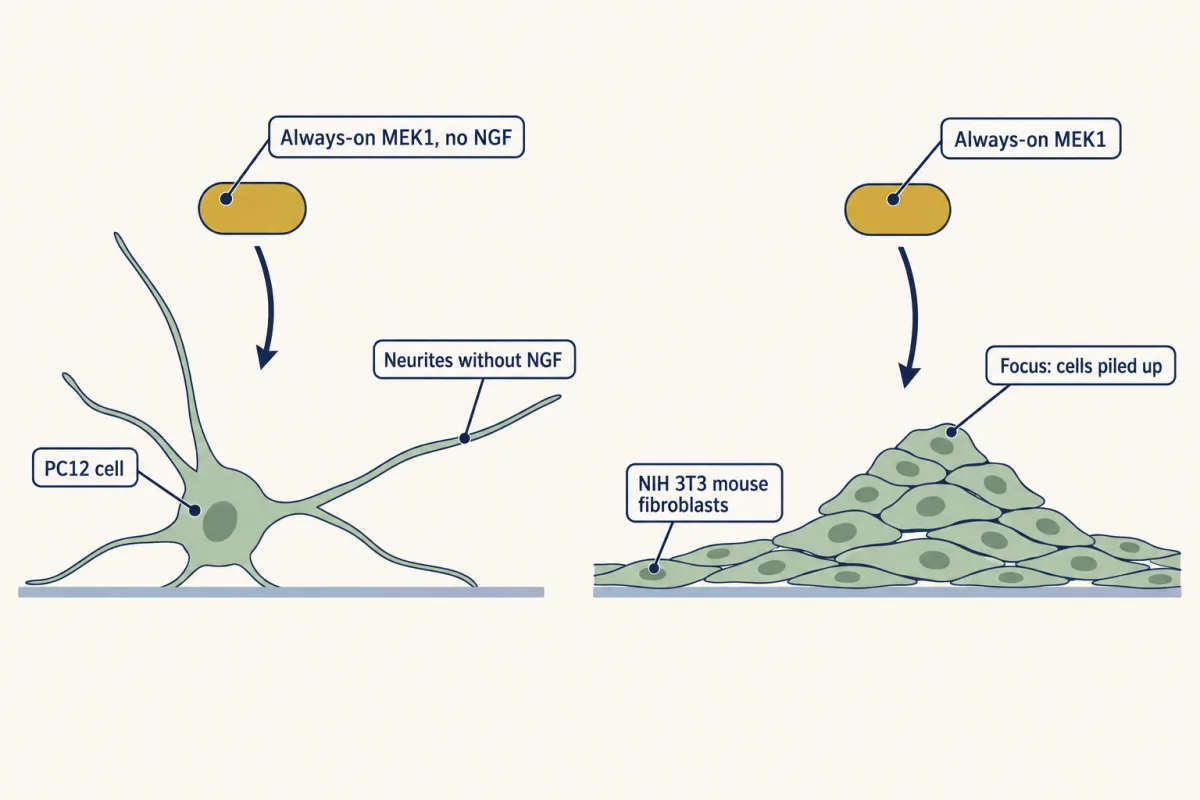
NGF holds ERK high for hours. Brief ERK goes with division, and sustained ERK with differentiation. How widely other cells use this clock stays open. Cell context matters just as much as timing. Researchers placed the same permanently active MEK into two cell types and got opposite answers. PC12 cells grew neurites with no growth factor at all. Mouse fibroblasts instead piled into disordered foci, a hallmark of transformation toward cancer. Human tumours jam this relay higher up. Ras normally shuts itself off by cutting GTP to GDP, helped by GAP proteins. A single base change, glycine 12 to valine, blunts that cut, so Ras stays on. One tier down, many melanomas carry mutant B-Raf V600E.
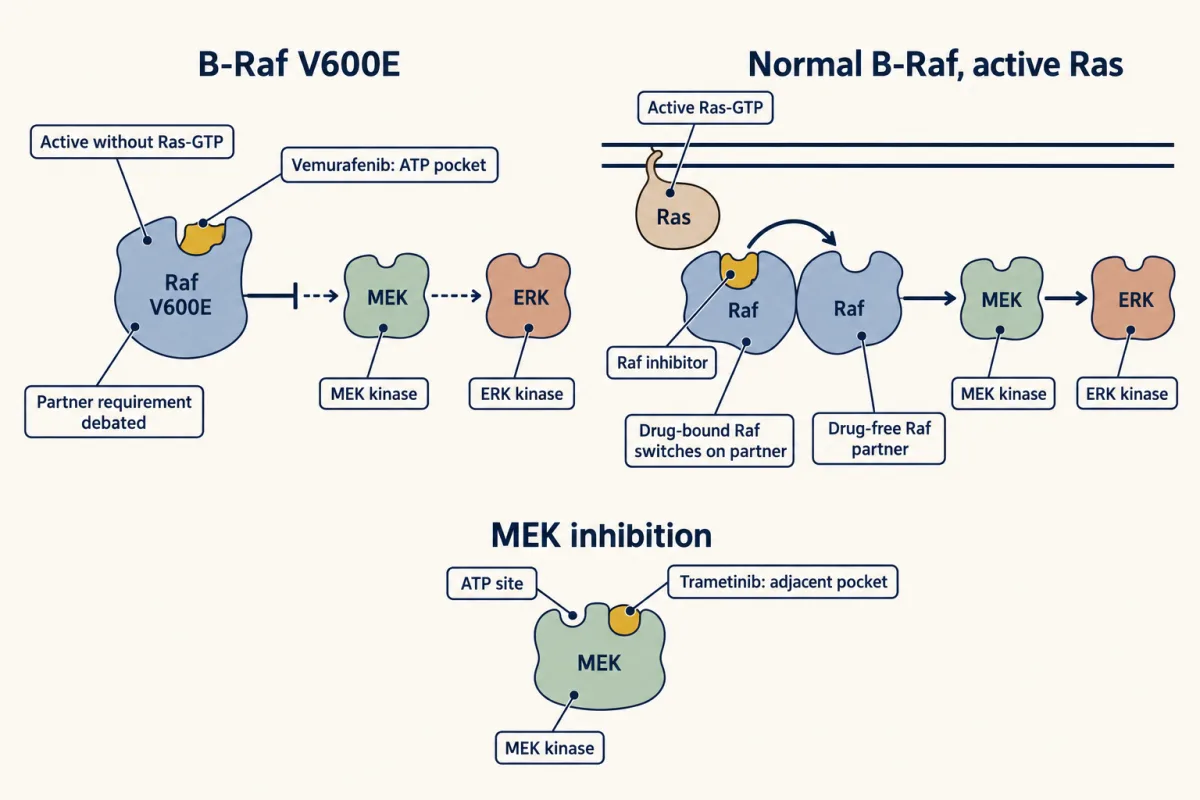
It signals without Ras-GTP, possibly even without a Raf partner. Now test how pathway state flips a drug. Vemurafenib plugs the ATP pocket and shuts down B-Raf V600E. Add that same drug to cells with active Ras and normal B-Raf. Does ERK fall, stay flat, or rise?
Surprisingly, ERK rises. Active Ras brings normal Raf molecules into pairs at the membrane. A drug-bound Raf cannot work itself, yet its contact still pushes the drug-free partner into an active shape. Trametinib binds a separate pocket beside MEK's ATP site. Blocking MEK below Raf helps close that escape, so both drugs are often combined. Milder germline over-activation causes developmental syndromes called RASopathies, including Noonan syndrome and neurofibromatosis type 1. In neurofibromatosis type 1, losing neurofibromin, one of Ras's GAP proteins, leaves Ras active too long. Every cell carries the change, yet tissues differ. Across health and disease, duration, cell context, and pathway state shape what the cascade does.
From the film
- Duration, cell context, and pathway state shape what the cascade does.
- ERK limits its own signal through fast feedback on SOS and Raf and slower induction of dual-specificity phosphatases.
- In PC12 cells a brief ERK pulse goes with division and a sustained plateau with differentiation, while the same always-on MEK transforms fibroblasts.
- ATP-pocket Raf inhibitors block B-Raf V600E but can paradoxically activate normal Raf pairs when Ras is active, which MEK inhibition blocks below Raf.
How long the signal stays on
The second film contrasted brief epidermal growth factor (EGF) signalling with sustained nerve growth factor (NGF) signalling in PC12 cells; here is how ERK’s two feedback arms split in speed, and where the evidence’s limits lie.
Negative feedback works alongside receptor persistence to set duration, and extracellular signal-regulated kinase (ERK) supplies two arms:
- Fast feedback: active ERK phosphorylates upstream proteins, including SOS and Raf, in ways that weaken them.
- Slow feedback: active ERK turns on genes for dual-specificity phosphatases that strip both phosphates back off ERK, taking longer because new protein must be made.
Predict. Treat PC12 cells with a drug that blocks new protein synthesis, then add EGF. Which feedback arm still acts right away, and which fails?
Check your prediction
Phosphorylation of SOS and Raf still acts right away because those proteins are already present; induction of dual-specificity phosphatases fails because it requires new protein synthesis.
How long the window stays open depends on stimulus, cell type, dose, and readout. In PC12 cells, ERK activity after EGF rises and falls within about an hour, whereas after NGF it climbs to a plateau lasting hours. In 1992 Christopher Marshall and Philip Cohen’s group in Dundee proposed that duration itself is the instruction—brief ERK for division, sustained ERK for differentiation—an idea Marshall expanded in a 1995 review. The rule comes from this one cell line, and how widely cells read kinases by the clock remains open.
When the cascade is stuck on: context, cancer, and drugs
Remember the second half of the guiding rule: duration, cell context, and pathway state shape what the cascade does. In 1994 Sally Cowley, Christopher Marshall and colleagues put permanently active MEK1 into two cell types: PC12 cells grew neurites with no nerve growth factor (NGF), while mouse NIH 3T3 fibroblasts piled into foci, disordered heaps marking transformation toward cancer. Unending extracellular signal-regulated kinase (ERK) means “differentiate” to a PC12 cell and “keep dividing” to an NIH 3T3 fibroblast.
Human cancers reach that state from higher up. In 1982 Robert Weinberg, Mariano Barbacid and Michael Wigler each compared a ras gene from one bladder-tumour cell line with the normal gene and found a single base change turning glycine 12 to valine—G12V, which blunts the GTP timer so Ras stays on (GTPase switches). Mutant RAS genes are common in cancers and vary widely by tissue: a 1989 survey found them in roughly nine of ten pancreatic tumours and about half of colorectal cancers (see Going deeper for updated overall figures).
Predict. A tumour carries Ras G12V. Will an EGF-receptor inhibitor shut down ERK in these cells? What about a MAPK/ERK kinase (MEK) inhibitor?
Check your prediction
An EGF-receptor inhibitor fails because Ras G12V stays stuck on independently of the receptor and SOS above it. A MEK inhibitor acts below Ras and Raf, shutting down ERK.
One tier down, roughly half of cutaneous melanomas (the common skin form) carry a mutation in B-Raf, one of three human Raf kinases, most often V600E. Glutamate in the activation loop makes B-Raf active without Ras-GTP; it is often described as signalling without a partner, though mutant B-Raf can pair and whether it truly works alone is debated.
Vemurafenib fills the ATP pocket of B-Raf V600E, while trametinib binds MEK in an allosteric pocket beside its ATP site to hold MEK inactive. As the second film showed, membrane Raf pairing explains why pathway state flips vemurafenib’s effect:
| Pathway state | Raf ATP-pocket drug (vemurafenib) | MEK allosteric drug (trametinib) |
|---|---|---|
| B-Raf V600E + normal Ras | Blocks mutant B-Raf → ERK falls | Holds MEK inactive → ERK falls |
| Active mutant Ras + normal B-Raf | Drug-bound Raf activates drug-free partner in pairs → ERK rises | Holds MEK inactive below Raf → ERK falls |
Blocking MEK cuts off signalling below Raf pairs, one reason Raf and MEK inhibitors are commonly combined.
The RASopathies are developmental syndromes from mutations, inherited or new at conception, that mildly over-activate this pathway; affected children share features of the face, heart and growth. Carried in every cell, the mutation still has tissue-specific effects, and rarer mosaic forms arise later in only some cells. They include Noonan syndrome, Costello syndrome, cardio-facio-cutaneous syndrome and neurofibromatosis type 1—where losing the Ras GAP neurofibromin removes Ras’s off-timer (see Going deeper for genes).
Raf is not Ras-GTP’s only target; PI 3-kinase is another, and it is the next lesson.
Design problem
In PC12 cells, the same Ras-to-ERK cascade answers epidermal growth factor (EGF) with division and NGF with an end to division and neurite growth. Design a two-part circuit that both sets signal duration and reads it so only sustained ERK triggers differentiation genes, then explain how Cowley and Marshall’s matched pair of MEK1 mutants (one always-on, one interfering) tests sufficiency and necessity.
Saved in this browser only.
One way to do it
Build two parts:
- Duration setter. Let ERK’s negative feedback shut EGF off within an hour while NGF resists shutoff—for example via longer receptor activity or positive feedback on Raf.
- Delayed persistence reader. Use a gene product made after a delay that survives only if ERK is still active. In fibroblasts, the immediate early protein c-Fos is short-lived unless ERK and RSK (a kinase ERK activates) phosphorylate it, so only sustained ERK stabilizes c-Fos long enough to turn on later genes.
Sufficiency and necessity: Always-on MEK1 mimics a sustained NGF signal without NGF or its other pathways, and drove neurite growth alone (showing MEK is sufficient). An interfering MEK1 that could not be activated blocked growth-factor-driven differentiation (showing MEK is necessary—nothing else stood in for it).
One caution: the duration rule comes from this one cell line, and how widely cells read kinases by the clock remains open.
Going deeper
How the activator of ERK was found
Melanie Cobb’s laboratory followed an insulin-stimulated kinase activity from rat cells through eight chromatography columns—more than 6,300-fold purified as one 43-kilodalton band—cloned its gene, and named it extracellular signal-regulated kinase (ERK). Its sequence resembled two yeast mating-pheromone kinases, KSS1 and FUS3. Natalie Ahn, in Edwin Krebs’s laboratory, then isolated two activities from EGF-treated fibroblasts in 1991 that switched on inactive ERK with ATP; purifying the activator with Rony Seger showed its dual specificity for threonine and tyrosine. Several laboratories reached MAPK/ERK kinase (MEK) at about the same time.
Does the two-phosphate lock stay steep in living cells?
The worked calculation assumes MEK phosphorylates ERK in two separate encounters, releasing singly phosphorylated ERK in between, as in dilute test tubes. Inside cells, scaffolds and crowding can change that: in HeLa cells, crowding appears to make phosphorylation nearly one step, lowering steepness, and how widely that holds is open.
How common are RAS mutations?
Beyond the 1989 tissue figures above, reviews have long quoted up to about 30% for all human tumours. A 2020 analysis cross-checking large public cancer-mutation databases put it nearer 19% of patients, varying widely by tissue.
Genes behind the RASopathies
Most of the genes are this lesson’s cast: PTPN11 (the phosphatase SHP2) in about half of Noonan syndrome cases and SOS1 and RAF1 in some others, HRAS in Costello syndrome, BRAF and the MEK genes in cardio-facio-cutaneous syndrome, and loss of the Ras GAP neurofibromin in neurofibromatosis type 1.
Your notes
Select any text in the lesson to highlight it or add a note to it. Your highlights and notes are saved in this browser and collected in your notebook.
This browser is not letting the site save anything (a private window or strict privacy settings), so highlights and notes will be lost when you leave the page.
Try the Predict questions again
Five Predict questions from this lesson, on their own. Answer each one first, then open its check.
A mutant Ras lacks its lipid anchor and floats in the cytosol, yet still binds GTP and catches Raf. Will it activate Raf and MEK?
From: Ras-GTP catches Raf at the membrane
Check your prediction
No. Catching Raf in the cytosol fails to bring Raf to the membrane, where lipids and further steps help Raf open and pair. Ras works by contact and localization, not phosphorylation.
When Natalie Ahn fractionated EGF-treated cell extracts on chromatography columns, ERK stayed inactive with ATP alone until a different fraction was added back. Why did that rule out ERK activating itself?
From: Three kinases in series, and the two-phosphate lock
Check your prediction
An activator that parts from ERK on a column is a separate protein. Purifying that activator (MEK) with Rony Seger showed it phosphorylates ERK on both threonine and tyrosine (see Going deeper).
Suppose you want half of all ERK doubly phosphorylated. With the two sites filled independently, how full must each site be?
From: Three kinases in series, and the two-phosphate lock
Check your prediction
About 71% per site, because 0.71 × 0.71 ≈ 0.50. The square cuts both ways: it keeps doubly phosphorylated ERK very low while occupancy is low, and it means each site must be well filled before much ERK switches on. That is what makes the output steeper than the input—though crowding in living cells may change it (see Going deeper).
Treat PC12 cells with a drug that blocks new protein synthesis, then add EGF. Which feedback arm still acts right away, and which fails?
From: How long the signal stays on
Check your prediction
Phosphorylation of SOS and Raf still acts right away because those proteins are already present; induction of dual-specificity phosphatases fails because it requires new protein synthesis.
A tumour carries Ras G12V. Will an EGF-receptor inhibitor shut down ERK in these cells? What about a MEK inhibitor?
From: When the cascade is stuck on: context, cancer, and drugs
Check your prediction
An EGF-receptor inhibitor fails because Ras G12V stays stuck on independently of the receptor and SOS above it. A MEK inhibitor acts below Ras and Raf, shutting down ERK.
How we measure it
DNA transfection and the focus-formation assay
DNA from tumour cells is precipitated with calcium phosphate and added to a flat, single layer of mouse NIH 3T3 fibroblasts. Cells that take up a transforming gene stop respecting their neighbours and pile into foci that can be counted. The assay shows that a piece of DNA is enough to change how a cell grows, with the caution that NIH 3T3 cells are already part of the way to transformed.
Activity-guided protein purification
A cell extract is passed over a series of chromatography columns, and every fraction is tested for one activity, here the ability to phosphorylate a test protein or to switch on ERK. Following the activity until a single band remains ties a behaviour to one protein that can then be sequenced and cloned.
Always-on and interfering mutants
A kinase is mutated so that it stays active with no signal from above, or so that it blocks the normal enzyme. For MEK the active form was made by replacing the serines that Raf phosphorylates with acidic residues that imitate phosphate. The active form tests whether a step is sufficient for an outcome, and the interfering form tests whether it is necessary.
Time course of ERK activity
Cells are stimulated and sampled at intervals, and each sample is tested for ERK activity or for ERK carrying both activating phosphates. The result is a curve of activity against time, which is how a brief response is told apart from a sustained one.
Method films · the methods library
- Bioassays 1:35
- Clonal and colony assays 3:43
- Engineered mutants: site-directed, dominant-negative and constitutively active 4:25
- In vitro kinase assay 3:42
- Next-generation sequencing and genome assembly 3:50
- Protein purification and column chromatography 4:14
- Sequence alignment and homology search 3:45
- X-ray crystallography 4:06
Practice questions on this lesson (3) → MCAT-style, original, each with an explanation
Where this lesson fits
Before thisReview first
- GTPase Switches: The TimerThis course · Lesson 7
Ras-GTP, SOS as an exchange factor and the GTP timer are used here without being taught again.
- Adaptors, Docking Proteins and ScaffoldsThis course · Lesson 10
Grb2, SOS and the scaffolds KSR and MP1 are used here as known parts.
- Receptor Tyrosine KinasesThis course · Lesson 18
The active receptor with phosphotyrosines on its tail is where this cascade starts.
After thisStudy next
- The Shape of a Signal: Size, Duration, Frequency and PlaceThis course · Lesson 35
It takes the idea that ERK duration is read as an instruction further, using EGF and NGF.
- Signaling to the Nucleus: CREB, AP-1 and Immediate Early GenesThis course · Lesson 32
It follows active ERK into the nucleus to Elk-1, c-fos and other immediate early genes.
- Oncogenes: When the Switch SticksThis course · Lesson 41
It develops the stuck-on switch, with RAS and B-Raf mutations driving cancer.
Elsewhere on the siteFilms, simulations and method films in other courses
- One Rise, One FallFilm · Cell Biology
Growth-factor ERK signalling pushes cells into the cycle, which the cyclin-CDK control here drives.
Suggested by an AI model from the lessons themselves, then checked. How we use AI
That is the skim: you have the shape of it.
That is both films: the lesson in pictures.
The rest of the lesson is here when you want it.
Finish line
Test yourself
8 questions
Practice and MCAT-style, with explained answers.
Next · Lesson 20
PI 3-Kinase, Akt and Insulin
Insulin never crosses the cell membrane, so how does it move glucose transporters to the surface within minutes?
Continue →Rewritten on : new text, flashcards and film. Notes and highlights stay, but the text around them may have moved.