Cell Signaling · Skim version
Ras to MAPK: The Kinase Cascade
Read the full lesson → Skim the whole course →
The guiding idea
A growth factor at the cell surface switches on Ras, and a relay of three kinases carries the message to the cell's proteins and genes. The same relay, stuck on, is found in many cancers, and in PC12 cells how long it stays on seems to decide what the cell does.
How does a signal get from an active receptor at the membrane to a gene in the nucleus?
-
The idea: Ras-GTP catches Raf and holds it at the membrane
-
Three kinases in a row, with a two-phosphate lock at the end
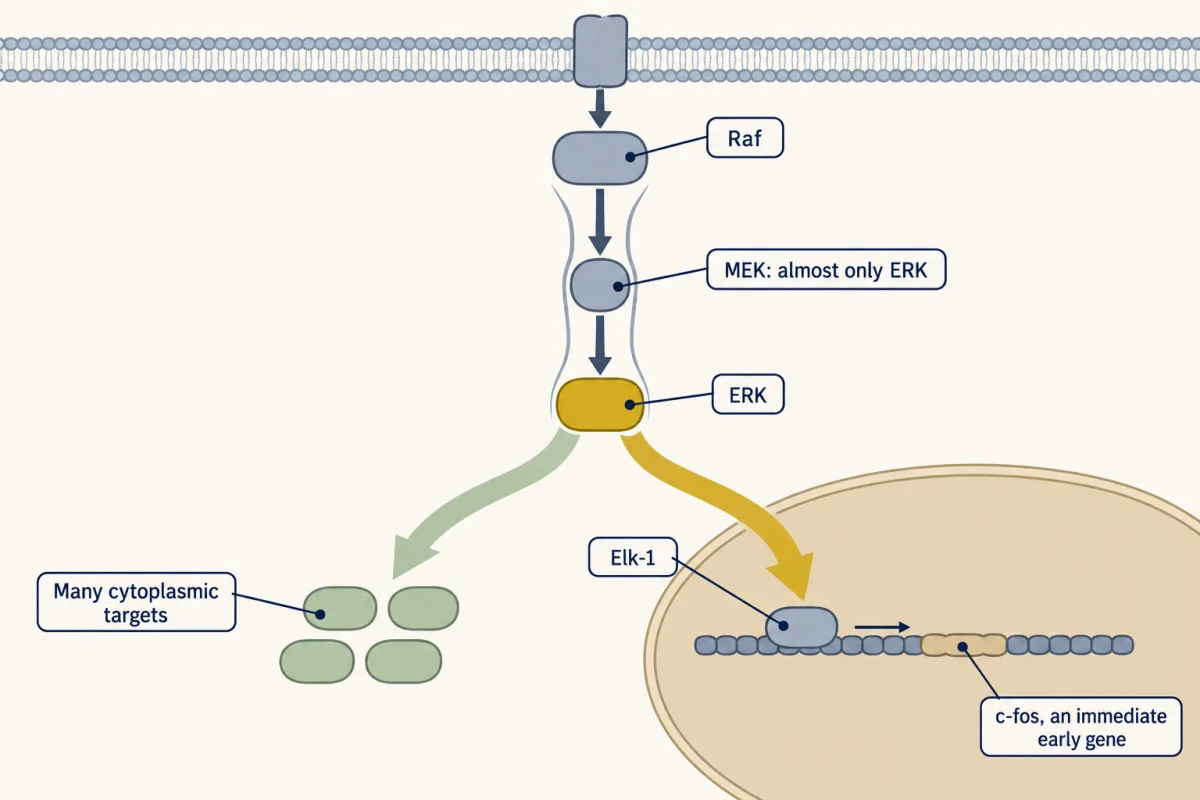
A narrow relay that ends in a wide fan: MEK has almost no known substrate but ERK, while ERK reaches many cytoplasmic proteins and, in the nucleus, transcription factors such as Elk-1, which helps switch on c-fos. AI-generated illustration -
One design, several cascades
-
How long is the signal on?
-
When the cascade is stuck on
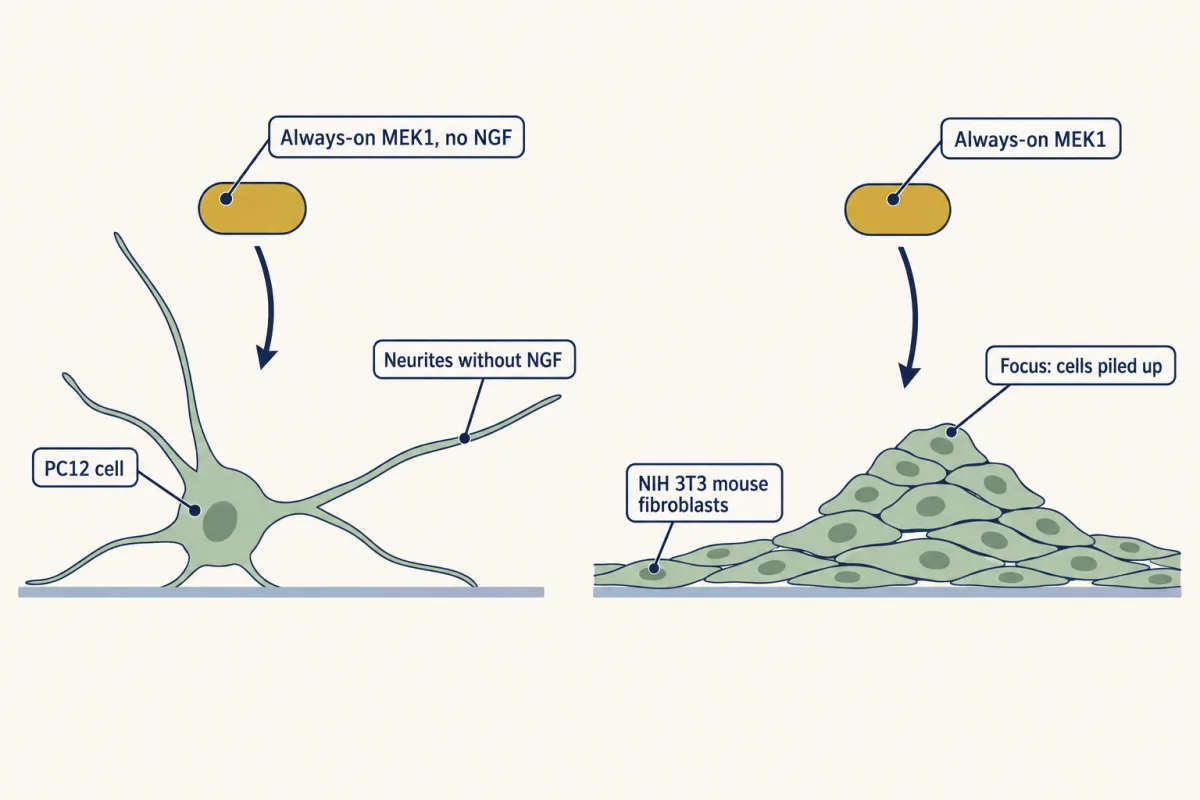
The same permanently active MEK1 tells a PC12 cell to grow neurites without NGF and tells mouse fibroblasts to pile up into foci. AI-generated illustration 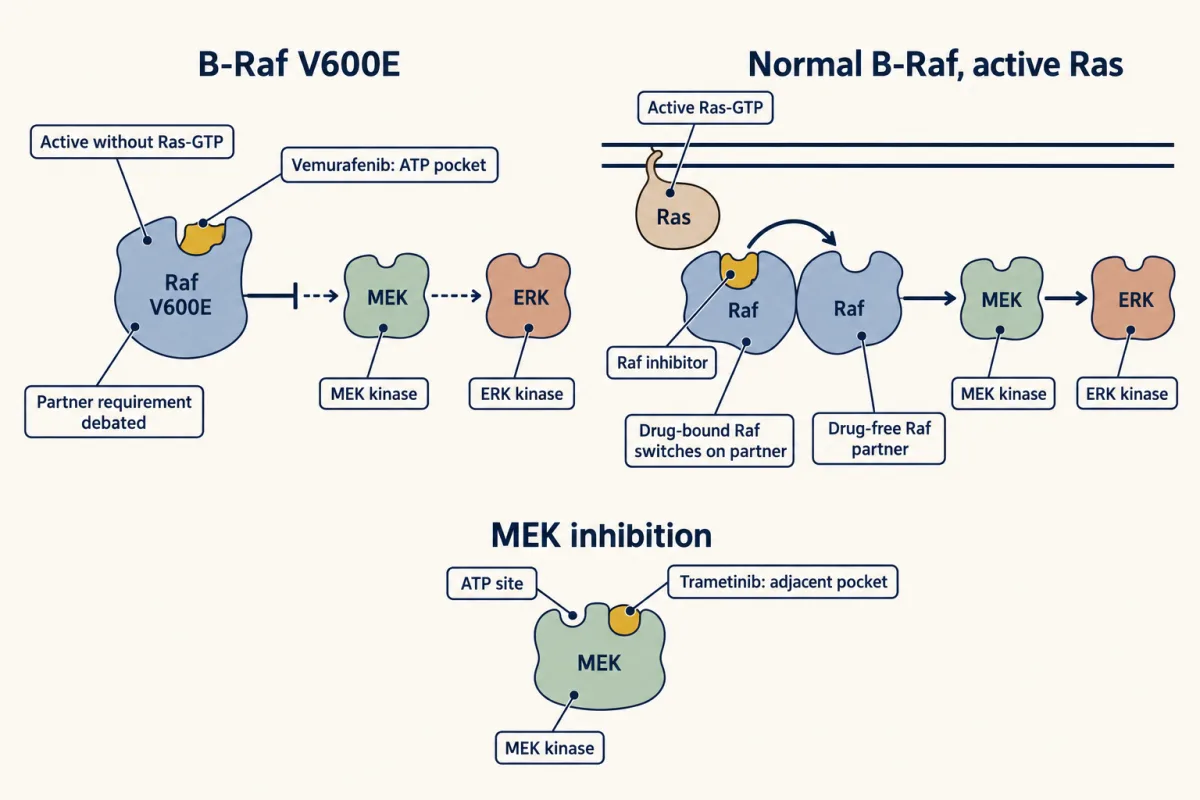
Vemurafenib occupies the ATP pocket of B-Raf V600E and inhibits signalling to MEK and ERK. The mutant needs no Ras-GTP, but whether it acts without a partner is debated; its pairing state is omitted here. With normal B-Raf and active Ras, a drug-bound Raf can activate a drug-free Raf partner, increasing MEK–ERK signalling. Trametinib binds a pocket beside the MEK ATP site and holds MEK inactive, blocking the cascade below Raf. AI-generated illustration -
Going deeper
Where this lesson fits
Before thisReview first
- GTPase Switches: The TimerThis course · Lesson 7
Ras-GTP, SOS as an exchange factor and the GTP timer are used here without being taught again.
- Adaptors, Docking Proteins and ScaffoldsThis course · Lesson 10
Grb2, SOS and the scaffolds KSR and MP1 are used here as known parts.
- Receptor Tyrosine KinasesThis course · Lesson 18
The active receptor with phosphotyrosines on its tail is where this cascade starts.
After thisStudy next
- The Shape of a Signal: Size, Duration, Frequency and PlaceThis course · Lesson 35
It takes the idea that ERK duration is read as an instruction further, using EGF and NGF.
- Signaling to the Nucleus: CREB, AP-1 and Immediate Early GenesThis course · Lesson 32
It follows active ERK into the nucleus to Elk-1, c-fos and other immediate early genes.
- Oncogenes: When the Switch SticksThis course · Lesson 41
It develops the stuck-on switch, with RAS and B-Raf mutations driving cancer.
Elsewhere on the siteFilms, simulations and method films in other courses
- One Rise, One FallFilm · Cell Biology
Growth-factor ERK signalling pushes cells into the cycle, which the cyclin-CDK control here drives.
Suggested by an AI model from the lessons themselves, then checked. How we use AI