Cell Signaling · Unit 2: The parts — switches and wiring
GTPase Switches: The Timer
Rewritten on : new text, flashcards and film. Your notes and highlights stay, but the text around them may have moved.
After a receptor lets go, what decides how long an already-loaded G protein keeps signaling?
Pause when the reading reaches a film, and offer to play it. Saved on this device.
Watch the film now, or keep listening
Builds on:Binding: Affinity, Occupancy and Dose–ResponseA Field Guide to ReceptorsCircuits: Amplification, Feedback, Adaptation and SwitchesWhy these?
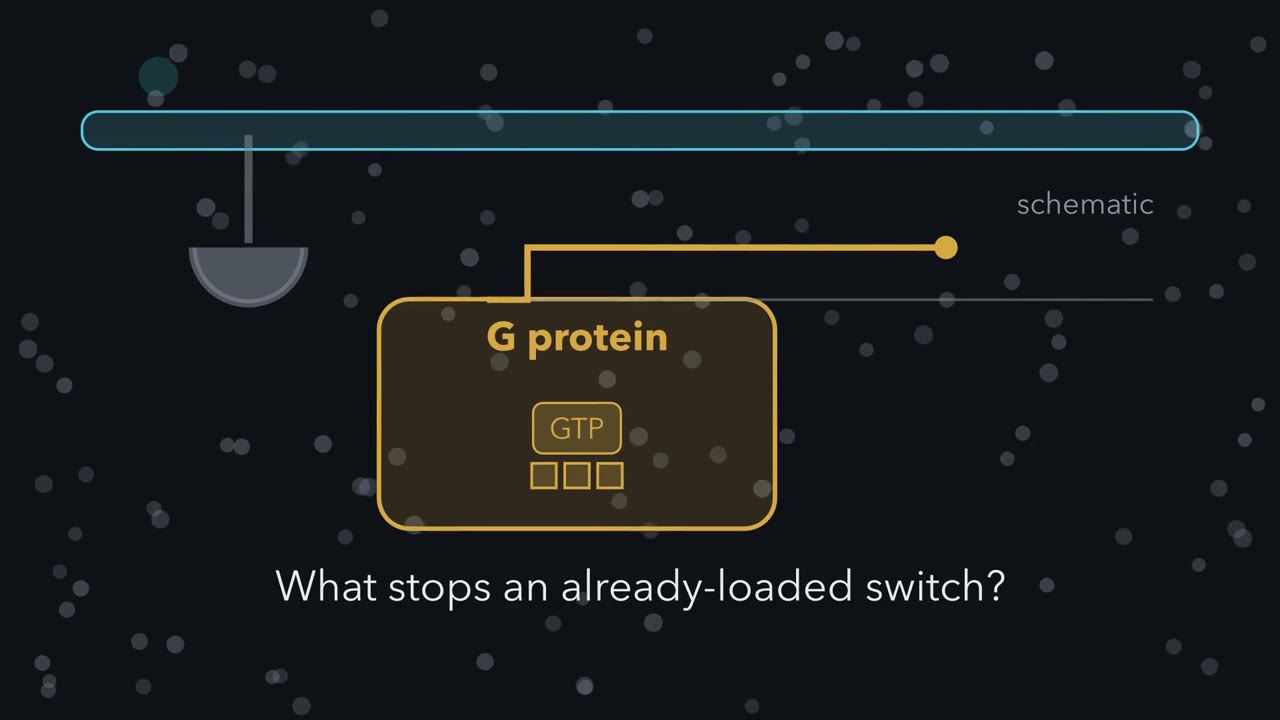 ▶ Watch The Timer Inside the Switch · 3:40
Read the transcript of “The Timer Inside the Switch”
Film transcript: The Timer Inside the Switch
A receptor has let go, yet a G protein remains active. What decides when that already-loaded switch stops? Follow that molecule beneath the membrane and watch its active interval. The answer lies inside the nucleotide the protein carries.
Start with the switch off. It holds GDP, shown as a slate token with its phosphate tabs. The protein grips that token tightly, so exchange is slow without help. That resting complex waits beside the receptor in the membrane. An occupied receptor acts as a guanine nucleotide exchange factor, or GEF. It opens the grip and promotes GDP release.
GTP, far more plentiful than GDP, then takes the empty place. The receptor promotes exchange; it does not hand over GTP. GTP changes the protein's shape. The block turns gold, its activity trace rises, and a target beside it switches on. This GTP-bound interval is the state we will time. Alpha and beta-gamma can each regulate targets after the rearrangement. The G protein is also an enzyme, a GTPase. After a variable wait, it cuts off GTP's last phosphate. GDP remains, the shape relaxes, and the target turns off.
Cutting always returns this switch to its GDP-bound state. Here is the rule for that loaded molecule. Faster GTP cutting shortens an already-loaded GTPase's time on. Loading starts the interval; hydrolysis ends it. The rule does not say how often loading begins. Now compare matched gold switches. A GAP approaches only the lower switch and accelerates its cutting reaction. Both begin with the same GTP and target. Which gold interval should end sooner? Hold your answer.
The lower interval ends first. The GAP does not remove GTP or supply fuel. It helps the GTPase reach the cutting transition faster, then leaves GDP behind. The products are unchanged; only the speed differs. For first-order cutting, the average active time is the reciprocal of the cutting rate constant. A larger rate constant means a shorter mean interval. The exact wait still varies among molecules.
Fewer molecules remain active at each later time. A whole-cell response has other clocks. Receptors can reload many switches, targets can turn off, and messengers can be cleared. Those clocks also shape the pathway-level trace. Our rule isolates a single already-loaded GTPase's lifetime. That distinction makes experiments readable. Change loading, and you change how often switches start. Change GTP cutting, and you change how long each loaded switch remains active. Keeping those controls separate prevents a common reasoning error.
From the film
- Faster GTP cutting shortens an already-loaded GTPase's time on.
- A GEF promotes GDP release so GTP can bind and turn the switch on.
- A GAP accelerates GTP cutting and returns the switch to its GDP-bound state.
- The rule describes one loaded switch; other steps can shape a whole-cell response.
After a receptor lets go, what decides how long an already-loaded G protein keeps signaling?
The first film built the cycle; the text times it and tests it against experiments.
The one idea. Faster GTP cutting shortens an already-loaded GTPase’s time on.
Scope: one GTPase molecule after GTP loading, when first-order hydrolysis ends its active state. Receptor shutoff, repeated loading, effector kinetics and messenger removal can also shape a whole-cell response.
From switch cycle to timer
A GTPase cuts the GTP it binds: on with GTP, off with GDP, which is GTP minus its third phosphate.
A guanine nucleotide exchange factor (GEF) promotes release of bound GDP. GTP is far more plentiful than GDP in the cell, so GTP usually takes the empty place. For a heterotrimeric G protein under a receptor, the occupied receptor is the GEF. GTP binding rearranges the complex and can separate alpha from beta-gamma. Alpha regulates a target such as adenylyl cyclase; beta-gamma can also signal, for example by opening potassium channels in the heart. After alpha cuts GTP, it rejoins beta-gamma.
Intrinsic cutting is slow; a GTPase-activating protein (GAP) binds the GTPase and accelerates it. The G protein reloads slowly by itself, but one occupied receptor can load many freely moving G proteins in succession, and each can switch on a cyclase of its own.
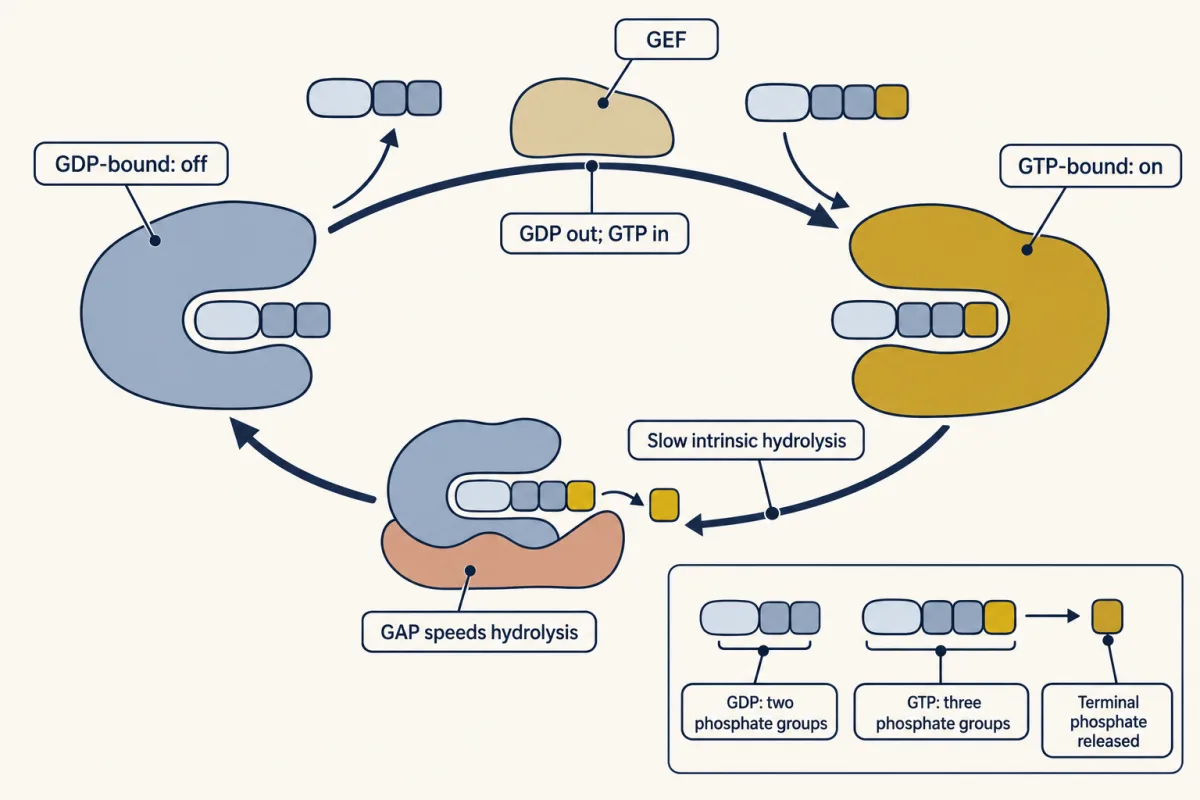
For first-order cutting:
mean time on = 1 / k(cut)
The hormone and the receptor start the clock, but they do not appear in the equation; it describes one loaded switch. If k(cut) is 0.05 per second, a round number chosen for illustration, the mean time on is 20 seconds. Speeding the step 40-fold shortens that mean to half a second.
Predict. A purified G alpha cuts GTP with k(cut) = 0.02 per second. Saturating RGS raises it to 1.0 per second. What are the two mean lifetimes, and by what factor does the lifetime change?
Check your prediction
The means are 1/0.02 = 50 seconds and 1/1.0 = 1 second, a 50-fold shorter lifetime. A rate constant is not a duration; take its reciprocal.
- Fraction on (sketch)
- —
- One molecule stays on
- —
The off step sets the duration: the GEF turns the switch on, and how fast GTP is cut decides how long it stays on. The picture is a sketch of the logic. Only the 20 s example (an illustrative round number for a G alpha subunit) and the 40-fold speed-up (the lesson’s lower bound for RGS4 and GAIP on Gi alpha-1) come from the lesson.
The first film separated how often switches are loaded from how long each stays on. That split explains a washout: while hormone is present, occupied receptors keep loading fresh G proteins; after washout, loading nearly stops and each loaded protein runs out its own clock.
Predict. A pathway’s cyclic AMP falls slowly after hormone washout. What additional measurement would help distinguish slow GTP cutting from slow cyclic AMP clearance?
Check your prediction
Measure GTP-bound Gs alpha as well as cyclic AMP. If Gs alpha returns to GDP quickly while cyclic AMP stays high, downstream clearance is slow. If GTP-bound Gs alpha persists, the delay lies at or before its off step. A whole-pathway trace alone cannot identify the clock.
Two implementations of the cycle
Two main kinds of protein run this switch: heterotrimeric G proteins and small GTPases such as Ras.
| Trimeric G proteins | Small GTPases such as Ras | |
|---|---|---|
| Build | Alpha, beta and gamma subunits; alpha holds the nucleotide | One small protein, about 20 to 25 kilodaltons |
| Loads GTP (GEF) | The occupied receptor itself | For Ras, SOS; each family has its own GEFs |
| Speeds GTP cutting (GAP) | RGS proteins for the Gi and Gq families, but not Gs; some effectors, such as phospholipase C-beta | For Ras, neurofibromin and p120 GAP; each family has its own GAPs |
| Examples | Gs, Gi, Gq | Ras, Rho, Rab, Arf, Ran |
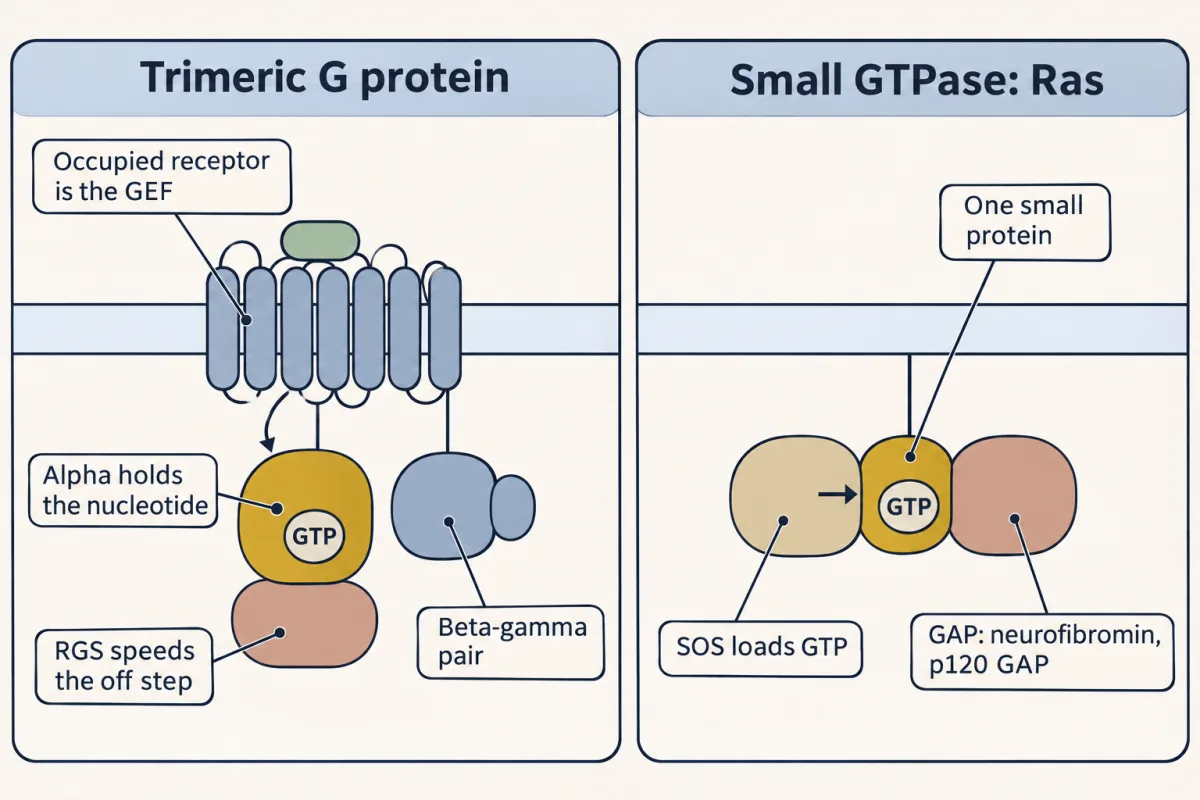
Different alpha subunits point at different targets. Gs switches adenylyl cyclase on, Gi turns it down, and Gq switches on phospholipase C-beta. For Gi- and Gq-family subunits, but not Gs, major GAPs include RGS proteins, regulators of G-protein signaling. Some effectors are GAPs too: phospholipase C-beta speeds GTP cutting by the Gq that activated it. RGS4 and its relative GAIP make a Gi-family G protein cut at least 40 times faster in vitro. GAIP binds the GTP-holding form, acting only while the switch is on, so more of these RGS proteins can shorten a Gi-coupled response.
Predict. Gq activates phospholipase C-beta, which then speeds Gq’s GTP cutting. Is that connection reinforcing or self-limiting?
Check your prediction
Self-limiting. The effector that active Gq turns on accelerates Gq’s return to GDP, so the same encounter couples output to shutoff.
Ras is a single small chain with no receptor attached. SOS, short for son of sevenless, is its exchange factor, and growth-factor receptors recruit it to the membrane. Ras cuts its GTP slowly. In 1987 Frank McCormick and Meg Trahey found the first GAP, a factor that sped normal Ras’s GTP cutting more than 200-fold in vitro and did nothing to the oncogenic mutant. That was a crude extract; purified GAP was later found to speed the step about 100,000-fold. The structure of Ras itself, holding a GTP analogue it could not cut, showed a fold that matches EF-Tu, a bacterial protein that delivers tRNAs to the ribosome. Ras and EF-Tu inherited the same ancient fold from a common ancestor.
Ras is one of five small-GTPase families, each with its own GEFs and GAPs:
- Ras: cell growth and proliferation.
- Rho: the actin cytoskeleton and cell shape.
- Rab: vesicle traffic between membranes.
- Arf: the budding of vesicles, also membrane traffic.
- Ran: movement of proteins into and out of the nucleus.
The shared cycle now lets us classify failures by the step they change.
Read the transcript of “How the Timer Breaks”
Film transcript: How the Timer Breaks
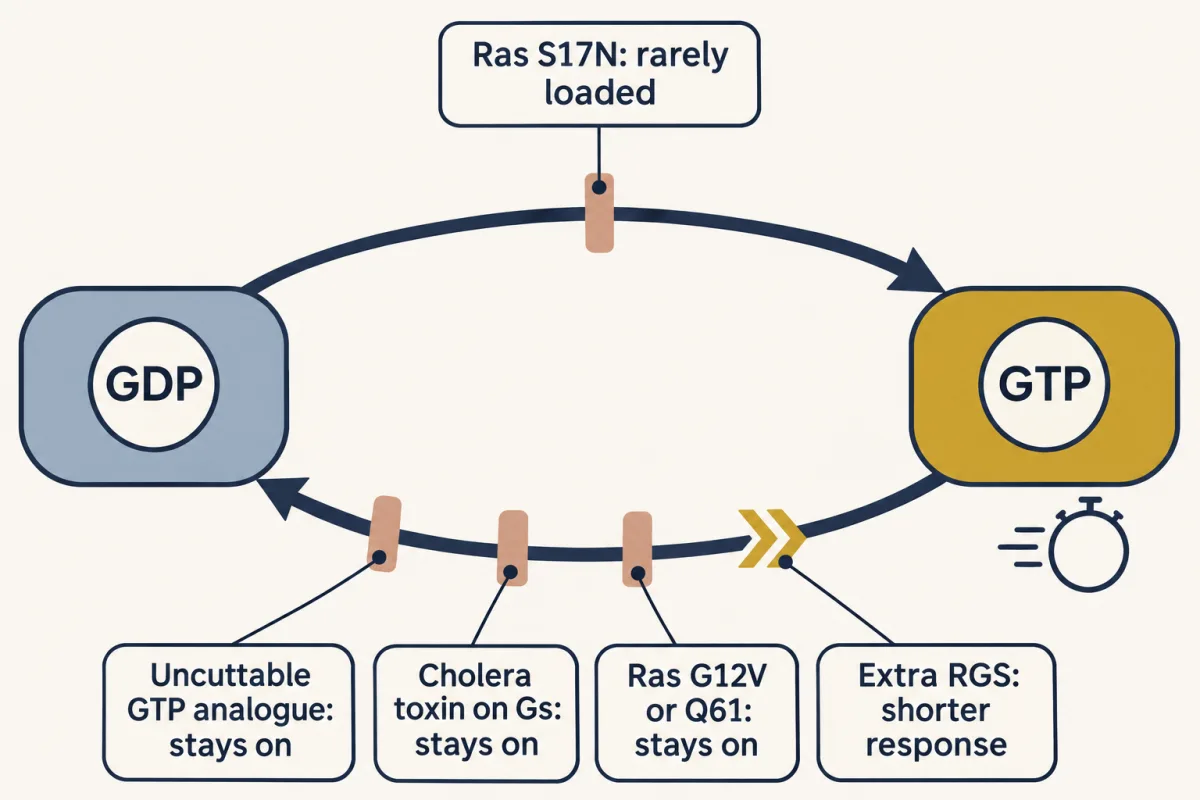
The first film followed a gold, GTP-loaded switch until cutting turned it slate. If cutting ends that interval, what happens when something blocks the cut or speeds it up? Use the same colors and the same switch. Begin with the ordinary cycle. A teal loading event starts a gold interval. Intrinsic cutting later removes the final phosphate, leaving GDP and ending the interval. This is our neutral reference for every perturbation. Replace GTP with an analogue the protein can bind but cannot cut. Loading still turns the switch on. Nothing changes at the loading arrow. The off event fails, so the gold interval persists after receptor input ends. Cholera toxin reaches the same logic through Gs.
Its modification obstructs Gs alpha's hydrolysis, so adenylyl cyclase remains active and cyclic AMP stays elevated. The timer stalls downstream of the receptor. Now add extra RGS protein to an already-loaded G alpha that this RGS can regulate. All other parts begin matched. Should its active interval grow longer, grow shorter, or stay unchanged?
Shorter. RGS accelerates cutting for the Gi and Gq families. The final phosphate leaves sooner, so the block returns to slate earlier. That family boundary matters. RGS does not have this effect on Gs. Ras G12V breaks GAP-assisted cutting differently.
GAP may bind, but the catalytic arrangement fails. This is catalytic failure, not missing GAP. Ras therefore remains GTP-bound far longer than normal. Ras Q61, shown beside it, also weakens cutting, even without GAP. Both mutants keep the gold interval abnormally long. They damage the off route, although their detailed defects differ. Dominant-negative Ras S17N is the mirror image. It binds GTP poorly and fails to activate targets. That failure sits on the loading side. It may also hold exchange factors away from normal Ras. Sort every case by its changed arrow. The analogue, toxin, and activating Ras mutants obstruct cutting.
Extra RGS accelerates cutting only for its substrates. Dominant-negative Ras impairs loading. One cycle can therefore organize every case. This classification predicts direction, not the exact shape of every cell response. Receptor shutoff, target kinetics, and messenger clearance still contribute. The map keeps that limit visible. First locate the changed step, then judge the trace. A lasting signal is therefore not mysterious once the cycle is mapped. Ask whether loading increased, cutting slowed, or clearance changed. The same map prevents blaming the receptor automatically.
The position of the defect determines the prediction.
From the film
- Block GTP cutting to prolong signaling; speed it to shorten signaling.
- Faster GTP cutting shortens an already-loaded GTPase's time on.
- Uncuttable GTP, cholera toxin and some Ras mutations obstruct the off step.
- Extra RGS protein shortens Gi- and Gq-family signals, not Gs; Ras S17N impairs loading.
Breaking the timer
The second film gave the direction of each break; here are the experiments and molecular detail behind it.
An uncuttable GTP. In Gpp(NH)p the oxygen bridging the last two phosphates is replaced by NH, so the G protein can bind it and cannot cut it. In 1975 Schramm and Rodbell treated frog red blood cell membranes with isoproterenol, a drug that activates the adrenaline receptor, together with Gpp(NH)p. Adenylyl cyclase stayed on through extensive washing, sonication and detergent, and propranolol, which blocks the receptor, could no longer reverse it. With isoproterenol alone, diluting the drug dropped activity to nearly nothing.
Predict. If Gpp(NH)p merely locked the receptor on, what should propranolol still be able to do after washing? Does the result fit that model?
Check your prediction
The blocker should still turn off a receptor-dependent response. It did not, which places the persistent state downstream of the receptor, in the G protein holding the uncuttable nucleotide.
Cholera toxin. In 1976 and 1977 Joel Moss and Martha Vaughan showed that the toxin is an enzyme. It splits NAD and can attach its ADP-ribose group to the amino acid arginine. In 1978 D. Michael Gill and R. Meren, and in a separate study Cassel and Pfeuffer, showed that the target is the cyclase system’s GTP-binding protein, now called Gs. The attached group blocks the step that switches Gs off, so cyclic AMP stays high. An intestinal cell responds by opening cystic fibrosis transmembrane conductance regulator (CFTR) chloride channels; salt leaves into the gut, water follows, and the result is the watery diarrhea of cholera.
Ras G12V and Q61. A Ras GTPase-activating protein (GAP) helps form the transition-state arrangement for hydrolysis by placing an arginine in the nucleotide pocket. Glycine 12 sits beside that site. Replacing it with valine puts a bulkier side chain where the GAP’s arginine must reach and disrupts the catalytic arrangement, so GAP can bind without giving its normal acceleration. Glutamine 61, changed to lysine in the tumor mutant Q61K, helps stabilize the cutting reaction’s transition state. Q61 mutants cut poorly with or without GAP. Either way Ras stays GTP-bound and keeps signaling. A single amino-acid change at codon 12 occurs in many cancers.
The mirror image: S17N. Asparagine in place of serine 17 lowers Ras’s affinity for GTP much more than for GDP. So Ras is rarely loaded with GTP, and even holding GTP it fails to switch on its targets. It is also thought to hold on to exchange factors such as SOS, soaking up what normal Ras in the same cell needs. A mutant that blocks its normal partner this way is called dominant-negative.
Predict. What rescue experiment would support the proposal that S17N suppresses normal Ras by soaking up SOS?
Check your prediction
Supply more SOS and measure GTP loading of normal Ras. If loading recovers, the exchange factor was the limiting part S17N had taken up.
The second film sorted these cases by the arrow each changes: block GTP cutting to prolong signaling; speed it to shorten signaling. Before applying that, check two things it took for granted: that the regulator acts on that GTPase (RGS proteins do not act on Gs), and that the experiment asks about an already-loaded switch.
Going deeper
How the GTP requirement and the transducer were found
Around 1970, Martin Rodbell’s laboratory at the National Institutes of Health studied how glucagon switches on adenylyl cyclase in liver membranes. Adenylyl cyclase makes cyclic AMP, a messenger that carries the hormone signal inside. In plain buffer, glucagon stuck to the membranes and would not wash off; with ATP present it came off within seconds. The cause was GTP contaminating the ATP. Added deliberately, GTP proved necessary: without it, glucagon barely activated the cyclase.
GTP was not the fuel, because the cyclase runs on ATP, and a trace was enough, so it was not used up once per cyclic AMP made. It was acting as a regulator, not a raw material.
For years many laboratories had trouble reproducing the effect, partly because their membranes and nucleotides were not as clean. If ATP is 1% GTP, the “no GTP” tube can already hold enough for a full response, and adding more GTP only scatters the data.
Rodbell had a second problem. Many different hormone receptors switch on the same enzyme, and he thought it impossible that all were built into it. So he proposed a separate component, a transducer, passing the signal between them, before anyone knew what it was.
Here is a UVa moment: the answer came from Alfred Gilman’s pharmacology laboratory at the University of Virginia in the 1970s. Gilman used cyc⁻ lymphoma cells, in which hormone cannot raise cyclic AMP because the link between receptor and enzyme is missing. He and Elliott Ross added a soluble extract from normal cells to cyc⁻ membranes, and the response returned even when the extract’s own cyclase had been inactivated. The transducer was therefore a separate, movable protein. Using that rescue as an assay, Gilman and colleagues purified Gs from rabbit liver membranes. The protein carried alpha and beta subunits; a small gamma subunit was missed at first. G protein means guanine-nucleotide-binding protein.
The first Ras structures
In 1988 Sung-Hou Kim’s group in Berkeley solved the first structure of Ras, holding GDP. In 1989 a Heidelberg team including Emil Pai, Wolfgang Kabsch, Kenneth Holmes and Alfred Wittinghofer solved Ras holding a GTP analogue it could not cut, and its fold matched EF-Tu, a bacterial protein that delivers tRNAs to the ribosome.
The S17N affinity figures
In the 1988 study that introduced it, asparagine in place of serine 17 lowered Ras’s affinity for GTP 20- to 40-fold without much change for GDP; later work found GDP binding is weakened too, but far less than GTP binding.
Your notes
Select any text in the lesson to highlight it or add a note to it. Your highlights and notes are saved in this browser and collected in your notebook.
This browser is not letting the site save anything (a private window or strict privacy settings), so highlights and notes will be lost when you leave the page.
How we measure it
Adenylyl cyclase assay with and without GTP
Membranes are incubated with a hormone and ATP, and the cyclic AMP made is measured, with guanine nucleotides left out or added. It showed that the hormone response needs GTP although the enzyme's fuel is ATP.
Non-hydrolyzable GTP analogues (Gpp(NH)p, GTPgammaS)
An analogue that the G protein can bind but cannot cut is added in place of GTP. The switch stays loaded, so the response outlives the hormone, which pointed to cutting GTP as the off step.
Reconstitution of cyc⁻ membranes
A soluble extract from normal cells is added to membranes from cells that cannot make cyclic AMP in response to hormone. Restored responsiveness shows that the missing component is a separate protein, and the same test can follow it through purification.
X-ray crystallography with a bound analogue
A GTPase is crystallized with an uncuttable GTP analogue in its pocket, which holds the switch in its on shape. The structure shows what the on state looks like and which residues grip the nucleotide.
Method films · the methods library
- Cell-free extracts and reconstitution 4:01
- Engineered mutants: site-directed, dominant-negative and constitutively active 4:25
- Pharmacological blockade and inhibitors 4:10
- Protein purification and column chromatography 4:14
- Receptor binding and dose-response analysis 4:18
- Spectrophotometry and enzyme kinetics 4:17
- X-ray crystallography 4:06
Practice questions on this lesson (3) → MCAT-style, original, each with an explanation
Where this lesson fits
Before thisReview first
- Binding: Affinity, Occupancy and Dose–ResponseThis course · Lesson 3
You need occupancy and affinity from there to follow how GTP and GDP binding set a switch's state.
- A Field Guide to ReceptorsThis course · Lesson 4
You need the receptor types from there to see why a G protein sits under the receptor.
- Circuits: Amplification, Feedback, Adaptation and SwitchesThis course · Lesson 5
The switches and timing ideas from there are used here to read a switch's duration.
After thisStudy next
- GPCRs and Trimeric G ProteinsThis course · Lesson 12
It applies the GEF, GAP and self-cutting cycle to the receptor and trimeric G protein pair.
- Turning the Signal Off: Arrestins, RGS Proteins and PhosphodiesterasesThis course · Lesson 16
RGS proteins as GAPs are used there to shut off G protein signals.
- Ras to MAPK: The Kinase CascadeThis course · Lesson 19
Ras loaded by SOS and switched off by its GAPs drives the kinase relay here.
Suggested by an AI model from the lessons themselves, then checked. How we use AI
Finish line
Test yourself
8 questions
Practice and MCAT-style, with explained answers.
Next · Lesson 8
Ubiquitin and Regulated Proteolysis as Signals
Why would a cell build a protein only to destroy it within minutes?
Continue →