Organismal Biology · Skim version
Auxin and Plant Hormones: How Plants Steer Growth
Read the full lesson → Skim the whole course →
The guiding idea
Light an oat seedling from one side and it bends toward the lamp. The tip senses the light, yet the bend forms lower down. What told it?
A shoot or root bends because its two flanks grow at different rates.
From the film: Which Side Grows Faster?
- A shoot bends because its two flanks grow at different rates: the shaded flank lengthens more than the lit flank.
- The Darwins showed that light is sensed near the tip; Boysen-Jensen concluded that a substance from the tip passes down the shaded side; Went collected it in agar.
- Split grass coleoptile tips gave the same total recovered auxin activity in light and in the dark, but more came from the shaded half: the unchanged total supports auxin moving to the shaded side rather than being destroyed.
- Growth is not proportional to auxin: over a wide range it rises to a peak, and past the peak more auxin slows growth.
From the film: Same Auxin, Opposite Bends
- Dense starch-filled plastids settle to the lower side of root-cap cells and act as one gravity sensor.
- In Arabidopsis root-cap cells, PIN3 carriers move to the new lower face and send auxin toward the lower side.
- Roots respond to much lower auxin levels than shoots. Over the range involved, more auxin on the lower flank slows a root there and speeds a shoot, so the root curves down and the shoot up.
- The dose curves give the sign of each bend, not its cause: each tissue turns auxin into growth in its own way, and why roots are so sensitive is not fully explained.
-
Bending toward light: what the controls ruled out
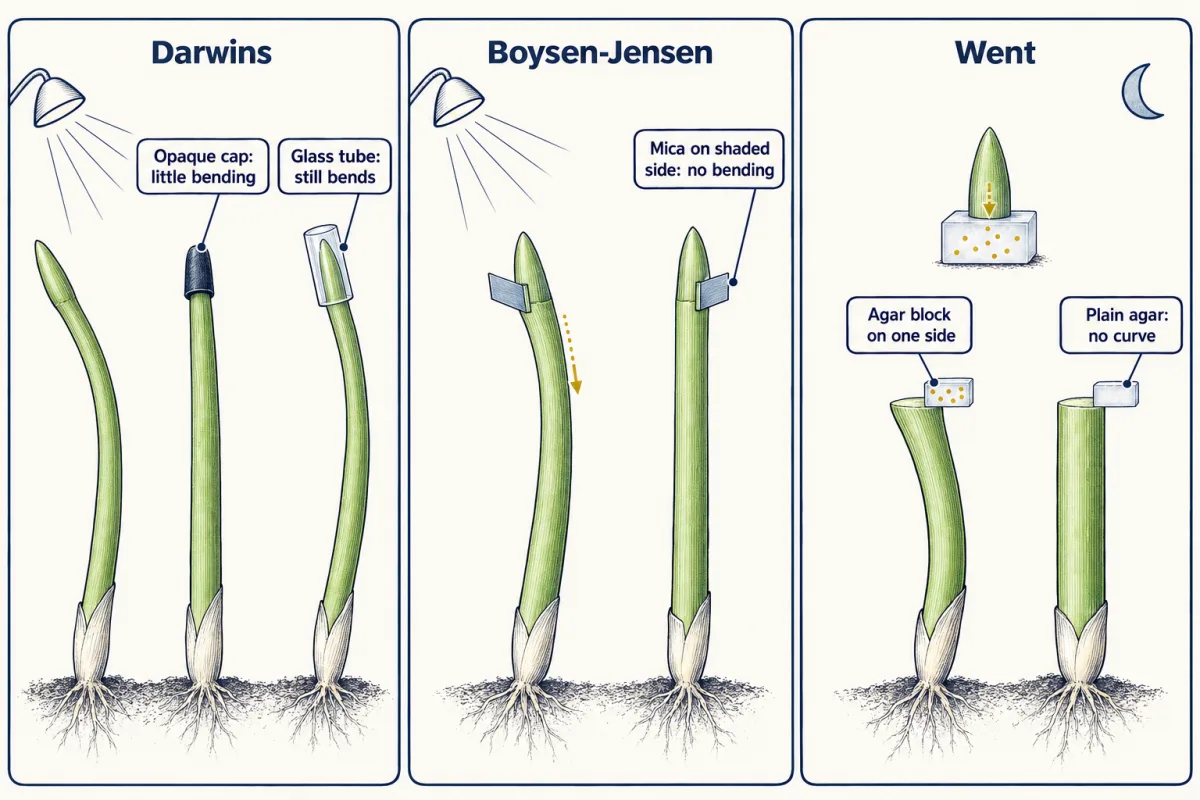
Light is sensed at the tip, and Boysen-Jensen concluded that a substance from the tip moves down the shaded side. Each test had its control: a glass tube beside the opaque cap, lit-side mica beside shaded-side mica, plain agar beside agar that had held tips. AI-generated illustration -
Moved or destroyed?
-
Up and down: gravitropism in roots and shoots
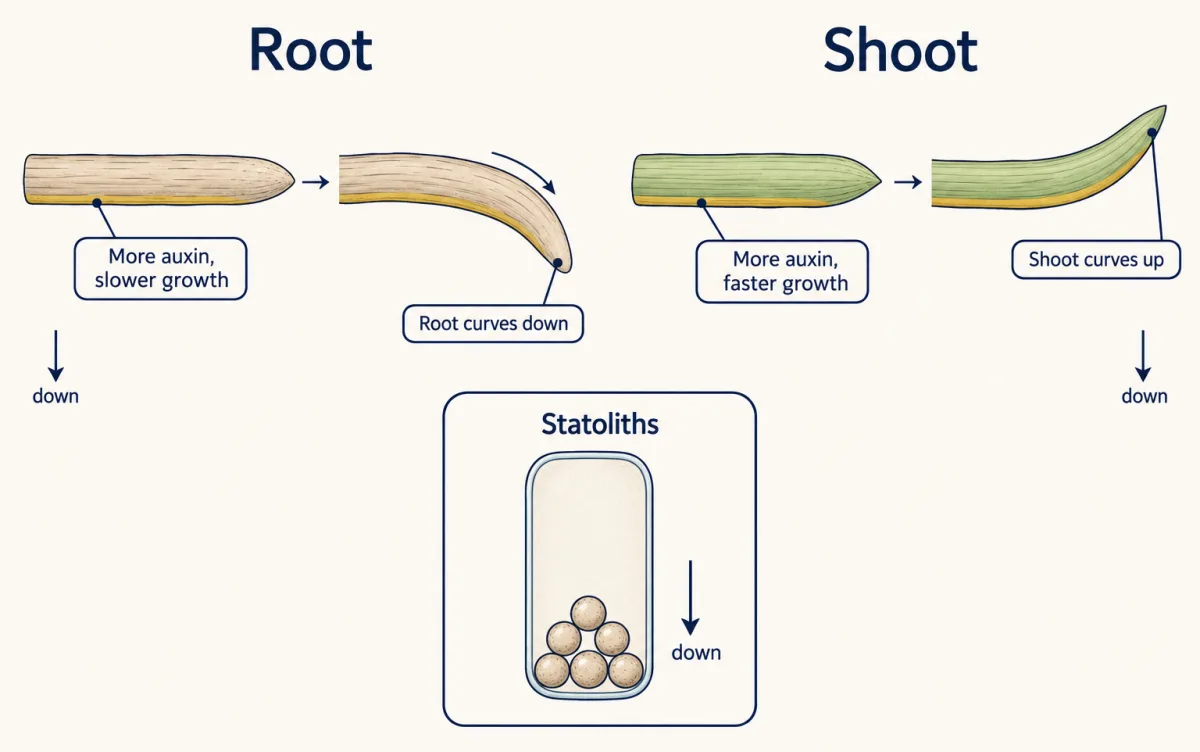
Gravity sends extra auxin to the lower side. A root's lower flank then grows slower, so it curves down; a shoot's grows faster, so it curves up. Settled starch in root-cap cells is one gravity sensor. AI-generated illustration -
The other hormones
-
Light as information: phytochrome, night length and a travelling signal
-
Signals of attack
-
Going deeper
Where this lesson fits
Before thisReview first
- Plant Body and GrowthThis course · Lesson 22
You need the idea of cell elongation and growing tips from there to follow how flanks grow at different rates.
- Hormones and the Endocrine SystemThis course · Lesson 8
You need the definition of a hormone and how it differs from a nerve signal to contrast plant hormones with those.
- Moving Water and Sugar in PlantsThis course · Lesson 23
Stomatal closure by abscisic acid and phloem movement of the flowering signal rely on how water and sugar move in plants.
After thisStudy next
- Double Fertilization: How a Flower Makes a SeedThis course · Lesson 26
It builds on the flowering signal travelling from leaf to apex and shows how a flower makes a seed.
Elsewhere on the siteFilms, simulations and method films in other courses
- Set Up: Hidden Leaf ColorsFilm · Biology Together
A plant's changing leaf colour in autumn is a plant response to the shortening days that this lesson explains.
- RadioimmunoassayMethod film
Measuring tiny amounts of hormone by competition with a labelled copy is how auxin-like levels can be quantified.
Suggested by an AI model from the lessons themselves, then checked. How we use AI