Life Science · Skim version
Plant Cells and Animal Cells
Read the full lesson → Skim the whole course →
The guiding idea
Why does a limp stalk of celery get crisp again in water, when drinking water does not make you any stiffer?
A plant cell has most of the same working parts as your cells, inside a stiff box: when its water tank, the large central vacuole, is full, it pushes the cell out against the box, and that holds soft plant parts up.
From the film: A Water Balloon in a Box
- Plant and animal cells share most of their working parts, such as the nucleus, cell membrane and cytoplasm.
- Plant cells add three parts: a stiff cell wall, chloroplasts in green cells, and one large central vacuole in most full-grown cells.
- When the central vacuole fills with water, it pushes the cell out against its stiff wall, and the cell becomes firm.
- Many firm cells side by side hold up soft plant parts like a celery stalk.
- Your cells have no wall, so water does not hold you up; your skeleton does.
From the film: Looking at Real Cells
- Under a light microscope, onion skin and waterweed leaf cells look boxy, with straight walls.
- Cheek cells have no wall and are thin and flat, like tiles.
- For a rough size, count similar cells lying end to end across the circle of light, then divide the circle's width by that count to get their average width.
- Not every plant cell is green: onion bulb skin cells and some waterweed leaf cells have no chloroplasts.
-
Explore: build a cell for a job
-
Explain: the parts all these cells share
-
Explain: three parts plants add
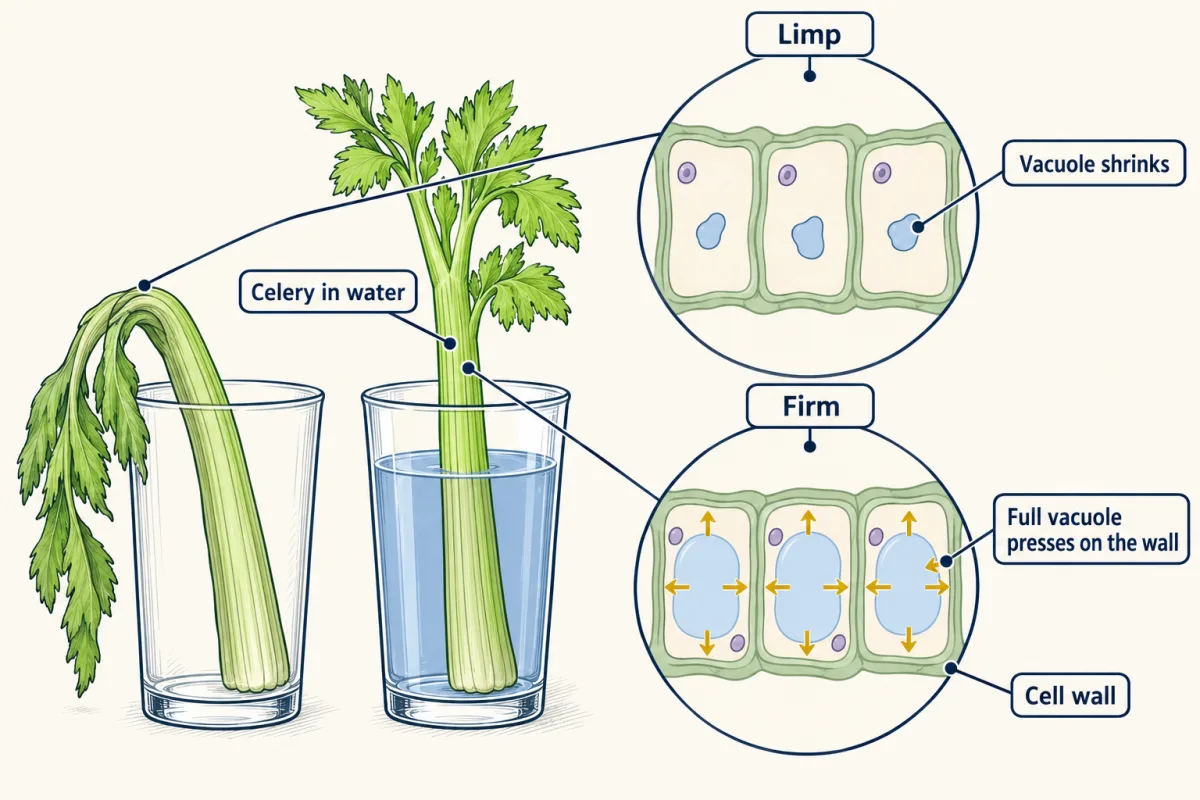
When water fills each large central vacuole, it pushes the cell out against its stiff wall, and many firm cells make a firm stalk. AI-generated illustration 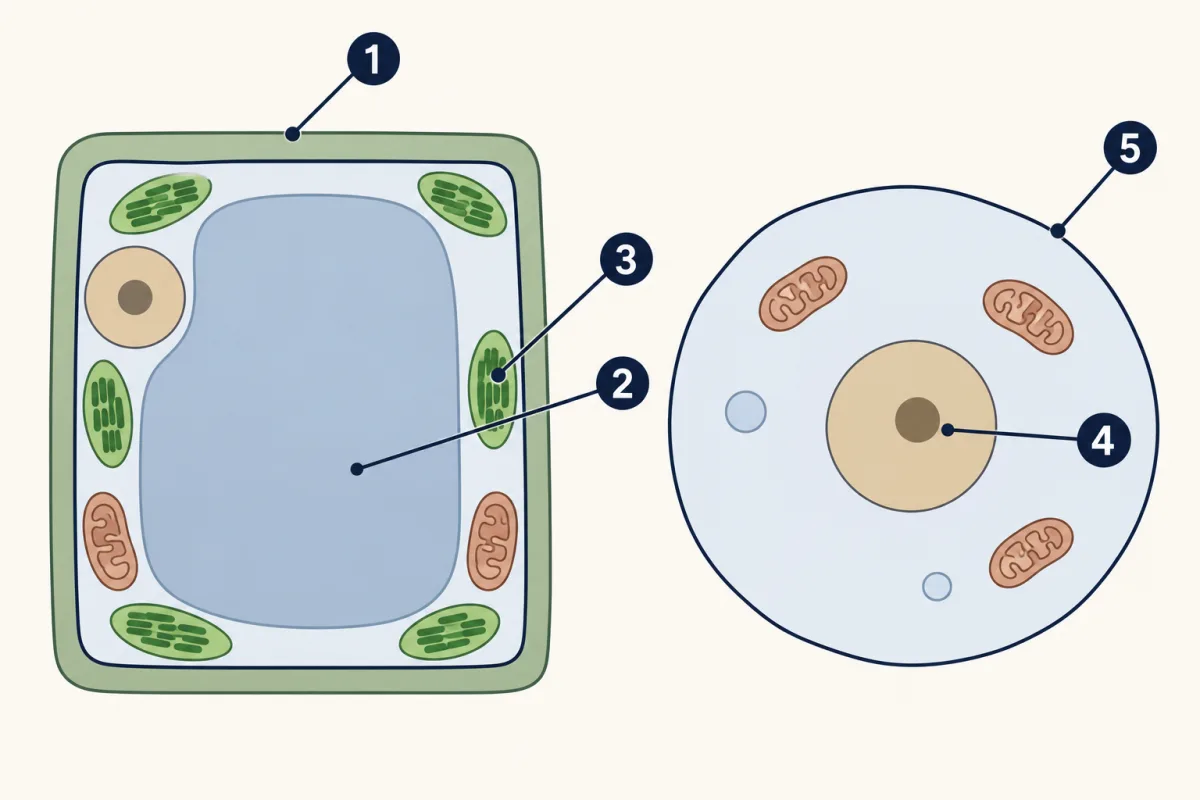
- cell wall
- large central vacuole
- chloroplast
- nucleus
- cell membrane
-
Elaborate: look at real cells
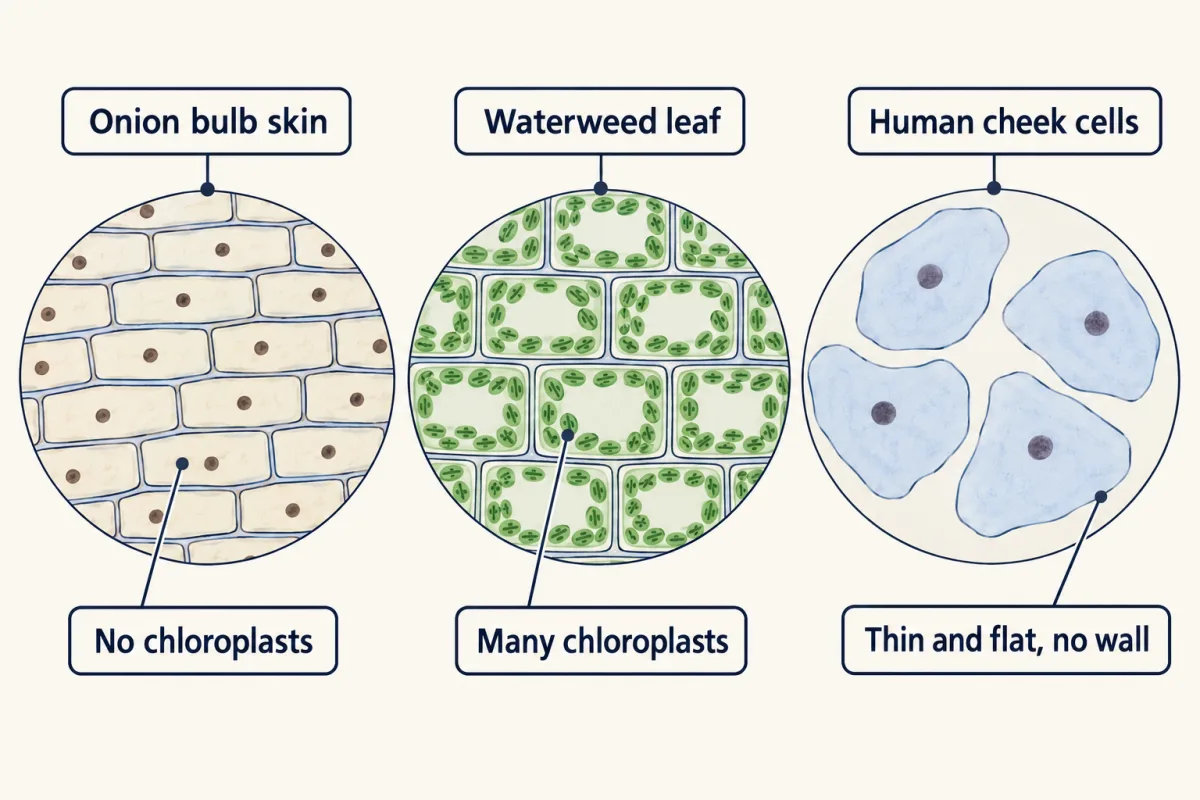
A wall gives plant cells straight sides, and only some plant cells are green. The circles are not drawn to the same scale. AI-generated illustration -
Evaluate: check your thinking
-
Going deeper
Where this lesson fits
Before thisReview first
- Inside a CellThis course · Lesson 2
You need the organelles and their jobs from there, since this lesson compares those parts between plant and animal cells.
- Cells Are EverywhereThis course · Lesson 1
It shows that living things are made of cells, which this lesson compares between plants and animals.
After thisStudy next
- Diffusion and OsmosisThis course · Lesson 5
It explains how water crosses a membrane, which is what fills and empties a plant cell's central vacuole.
- Photosynthesis Feeds the WorldThis course · Lesson 9
It shows how chloroplasts use light to make sugar, the job introduced here.
- Crossing the MembraneOne level up · Biology
It takes water movement across a membrane further, explaining why a cell in salty or plain water goes limp or firm.
Elsewhere on the siteFilms, simulations and method films in other courses
- Set Up: Thirsty CeleryFilm · Biology Together
It shows water traveling up a celery stalk, the same celery that gets crisp in this lesson.
Suggested by an AI model from the lessons themselves, then checked. How we use AI