Cell Signaling · Unit 5: Signals that build and defend an animal
Notch: Signaling by Contact and by Cutting
Rewritten on : new text, flashcards and film. Your notes and highlights stay, but the text around them may have moved.
How do two identical cells, side by side, decide which one becomes the nerve cell?
The main idea, the figures and what the films show. Under each heading, "Read this part" opens it.
Both films in order, 7 minutes. Each one ends with what to take from it.
The whole lesson: about 19 minutes of reading and 7 of film.
Pause when the reading reaches a film, and offer to play it. Saved on this device.
Watch the film now, or keep listening
That is the end of the reading
This idea at other levels
This lesson teaches Notch signaling in Cell Signaling, a graduate course. Simpler: read a short college version here.
The college version · about 1 minute to read
Notch is a single-pass membrane receptor whose ligands (Delta and Serrate in flies, the Delta-like and Jagged proteins in mammals) are also single-pass membrane proteins, so the signal passes only between cells in contact. The mature mammalian receptor has already been cut once in the Golgi by a furin-like protease. Ligand binding plus a pull from the sending cell, which takes the ligand in by endocytosis, opens the negative regulatory region and exposes a second site, which an ADAM protease cuts. γ-Secretase, whose catalytic subunit is presenilin, then cuts within the membrane and releases the Notch intracellular domain (NICD). NICD enters the nucleus, binds the DNA-binding protein CSL and recruits Mastermind, turning on targets such as the Hes genes. The path has no second messenger and no kinase relay, so nothing is amplified before the gene, and each receptor is used once. In lateral inhibition, received signal lowers a cell's own ligand, so a small difference between neighbours grows into opposite fates.
See nearby ideasHide nearby ideas
This lesson also teaches one more idea; its ladder is below.
Notch signaling
Notch is a receptor for touching cells: a neighbour's pull gets it cut, and the freed piece switches genes on.
Taught at one level so far: graduate level.
Graduate · the level you chose
Notch: Signaling by Contact and by Cutting · this lesson
Three cuts free the receptor's inner part: no relay, no amplification, one use.
Cell Signaling · about 19 min · film 3:28 · 3 practice questions
Next door to Notch signaling
- Lateral inhibition between equal neighboursNotch lets two equal neighbours take opposite fates, one sending and one receiving.Nearest lesson: Proneural Genes and Lateral Inhibition (graduate level)
- Cell division (mitosis)At some divisions only one daughter hears Notch, because the other inherited a blocker.Nearest lesson: Asymmetric Division: Numb and the Neuroblast (graduate level)
Lateral inhibition between equal neighbours
Neighbouring cells that start alike hold each other back, until one takes a different fate, such as becoming a neuron.
Taught at one level so far: graduate level.
Graduate · the level you chose
Notch: Signaling by Contact and by Cutting · this lesson
Worm anchor cell: lose LIN-12 and both cells become anchor cells.
Cell Signaling · about 19 min · 3 practice questions
Proneural Genes and Lateral Inhibition
Fly clusters, Notch and Delta mosaics, and why a steep loop breaks ties.
Developmental Neuroscience · about 30 min · film 2:37 · 3 practice questions
Next door to lateral inhibition
- Notch signalingNotch is the receptor in touching cells that lets one cell hold its neighbour back.
- Proneural genesProneural genes say which cells may become neurons, and the neighbours then compete for that place.Nearest lesson: Proneural Genes and Lateral Inhibition (graduate level)
Short versions inside this lesson
The plainest version · about 1 minute to read
Two friends stand side by side, and each one wants to be the leader. They hold hands and tug. The one who tugs a little harder makes the other tug less, and soon one is the leader and the other is the helper. Cells do this with a protein called Notch: a tug from the neighbour snips a piece off Notch, and that piece carries the message "you are the helper" to the middle of the cell.
Find an idea: every idea, searchable
Which lessons teach an idea, and the notes on each level, were written by AI models from the lessons and checked by a second model. A person has not yet read every one. How we use AI
About this lesson goals, parts
What you'll learn
- Explain why Notch signals mainly between cells that touch, given that its ligands are membrane proteins on the neighbour.
- Trace the three cuts that free the inner part of Notch, and state what each cut needs.
- Compare Notch with a kinase cascade and with the STAT and Smad routes in amplification, reversal and reuse of the receptor.
- Predict the result of lateral inhibition when the receptor or the ligand is missing, and name two diseases of the pathway.
Builds on:Ubiquitin and Regulated Proteolysis as Signals (read)Cytokine Receptors and JAK–STAT (read)TGF-β and Smads (read)Why these?
Rewritten on : new text, flashcards and film. Notes and highlights stay, but the text around them may have moved.
The main idea. A neighbour's pull lets proteases cut one Notch into one nuclear signal; when Notch lowers a cell's sending, equal neighbours split into opposite fates.
The films
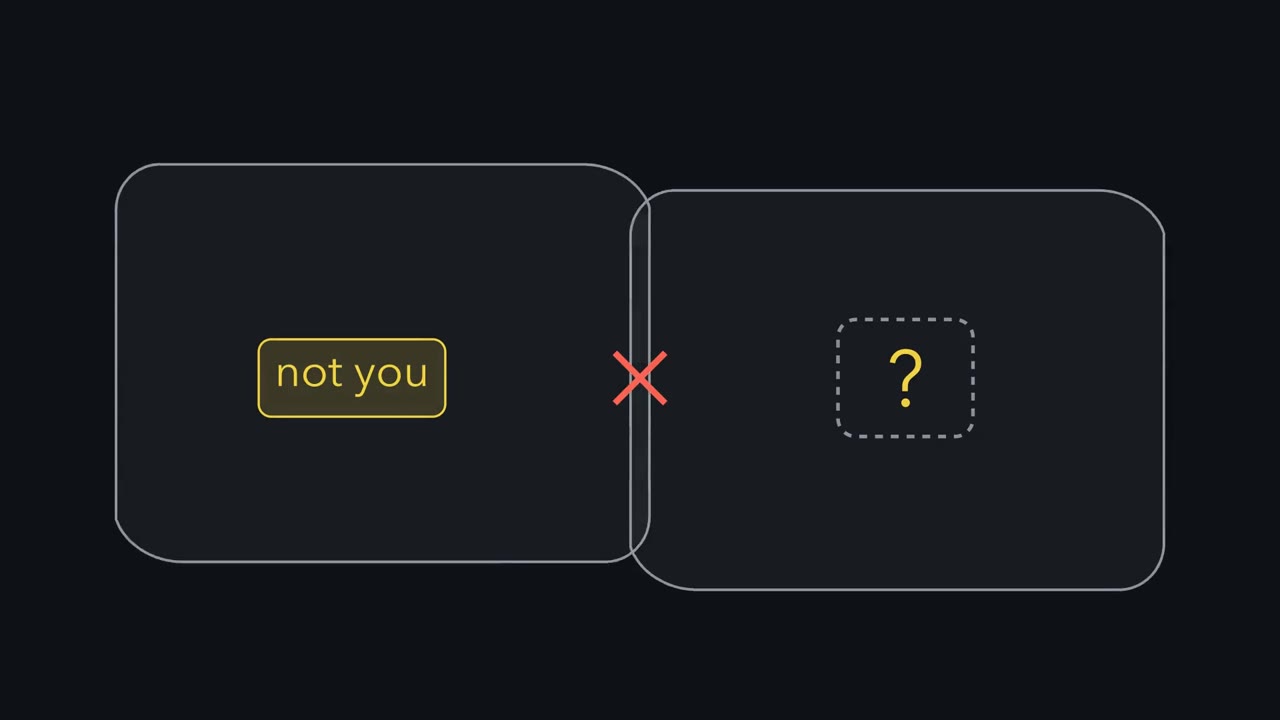 ▶ Watch The Pull and the Cuts: One Receptor, One Message · 3:28
Read the transcript of “The Pull and the Cuts: One Receptor, One Message”
Film transcript: The Pull and the Cuts: One Receptor, One Message
Without Notch, a fly embryo builds too much nervous system and too little skin. How does one cell tell a touching neighbour, “not you”? Its signal never leaves the sending cell. Most signals you have met leave the cell that makes them. Notch ligands stay bolted inside the sending cell's membrane. The Notch receptor stays bolted inside the receiving cell right across from it. Because both proteins span their membranes, they usually meet only where two cell surfaces touch. Just outside the receiving membrane, Notch folds into a compact lock that hides its cutting spot. Now picture a loose piece of ligand floating freely in solution. It binds Notch with no cell holding on to pull.
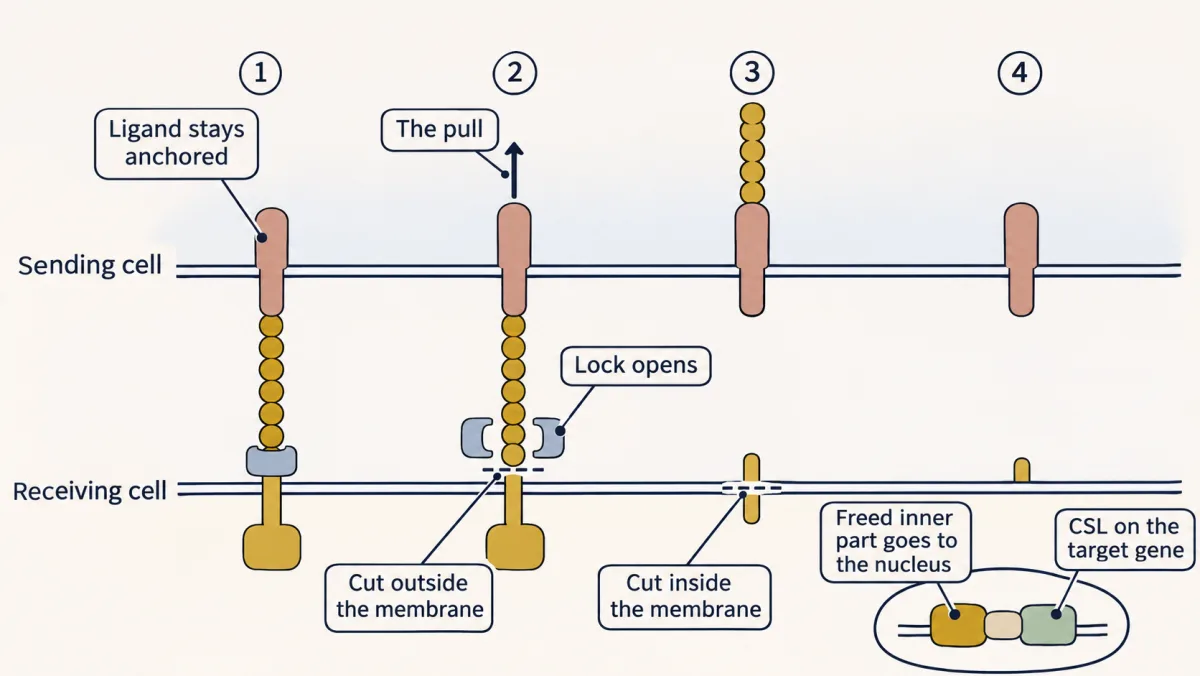
Will the receptor switch on? No. Binding alone leaves the lock shut, so loose ligand generally fails to switch Notch on. In the standard account, the sending cell draws its bound ligand inward by endocytosis. That tug peels the gold lock open. Mammalian Notch gets one harmless preparation cut while it is made. The two halves stay clasped together. Now the neighbour's pull triggers the active cuts. First, an ADAM protease shears the newly exposed site outside the membrane. The outer piece departs upward with the ligand, leaving a short stub. Next comes a cut in an unlikely place: inside the oily membrane itself.
Gamma γ-Secretase accepts a receptor stub only after most of the outer part is trimmed away. Cutting a protein needs water, but the membrane's interior is dry. So presenilin, its cutting subunit, holds its cutting site in a pocket water can reach. It snips the stub, freeing the inner tail. That freed piece, NICD, travels directly into the nucleus. In the standard model, CSL sits on target genes with co-repressors holding them off. NICD binds CSL, displaces co-repressors, and recruits Mastermind.
Target genes turn on, and many make repressors that say, “not you.” Here is the rule. A neighbour's pull lets proteases cut one Notch into one nuclear signal. Compare Notch with a kinase cascade. Watch the schematic counters: active kinases multiply the message while the receptor stays intact. Notch has no second messenger and no kinase relay. Each cut receptor is used up once. What the cell buys is a direct, local count of how many receptors a neighbour pulled. The message also stays brief. A nuclear kinase marks the freed tail, ubiquitin tags attach, and the proteasome destroys it. Once pulling stops, no fresh tails arrive, and many direct target genes soon go quiet.
From the film: four take-homes
- A neighbour's pull lets proteases cut one Notch into one nuclear signal.
- Because Notch ligands stay anchored in the sending cell's membrane, the main fly and mammalian pathways signal where cells touch, and binding without a pull leaves the lock shut.
- After a mammalian preparation cut carrying no signal, pulling lets an ADAM protease cut outside the membrane and γ-secretase cut inside it, freeing NICD to join CSL and Mastermind.
- With no second messenger and no kinase relay, each cut receptor yields one brief, unamplified signal that is soon cleared by the proteasome.
A fruit fly with one broken copy of a gene called Notch has nicks in the edges of its wings. An embryo with no working copy builds too much nervous system and too little skin.
The nicked wing, first described in 1914, gave the gene its name. In the embryo’s outer layer, each cell chooses between nerve precursor and skin; without Notch, far too many choose nerve. So Notch does not make a nerve cell—it lets a cell be told “not you”. Fly Notch and the worm cell-fate gene lin-12 encode one family of single-pass membrane receptors (see Going deeper). The first film showed how a neighbour’s pull turns Notch into a nuclear signal; below are the biochemical details, the experiments that showed them, and how equal neighbours use that signal.
Touch, pull and the lock
Notch’s ligands are single-pass membrane proteins fixed in the sending cell: Delta and Serrate in flies, and the Delta-like and Jagged proteins in mammals. Because Notch is anchored in the receiving cell, the main fly and mammalian pathways signal only where cells touch (worms have a few secreted ligands, and cells can touch across several diameters via thin extensions). In an early test, cultured fly cells that do not normally stick together were made to produce either Notch or Delta, and Notch cells clumped with Delta cells.
The first film showed why binding alone fails: just outside the receiving membrane, three small modules fold into a lock—the negative regulatory region—that hides Notch’s cutting site. In the standard account, the sending cell pulls bound ligand inward by endocytosis (the pinching-in of membrane to form a vesicle), and the tug peels the lock open.
Predict. Free ligand pieces in solution generally fail to switch Notch on. What happens if you fix those same ligand pieces to a culture dish before adding Notch cells, and why?
Check your prediction
The dish-bound ligand switches Notch on. Anchoring prevents the ligand from drifting with the receptor, so tension can peel open the negative regulatory region.
One preparation cut and two signal-triggered cuts
Mammalian Notch undergoes three cuts, but only the last two carry a signal:
- Preparation (Cut 1, mammalian Golgi). While the receptor is made, a furin-like protease cuts its outer part once. The two pieces stay clasped together and reach the surface that way; this cut prepares Notch and carries no signal.
- Outside the membrane (Cut 2, after the pull). An ADAM protease (ADAM10 in mammals) cuts the newly exposed site. The outer part leaves with the ligand, leaving a membrane-anchored stub.
- Inside the membrane (Cut 3). γ-Secretase—a four-protein complex whose cutting subunit is presenilin—cuts the stub within its membrane-spanning segment. It accepts a stub only after most of the outer part is trimmed away, so Cut 2 must come first. Because hydrolysing a peptide bond needs water in an oily bilayer, presenilin holds its two catalytic aspartates in a pocket water can reach.
Cut 3 frees the Notch intracellular domain (NICD), which enters the nucleus. There, the DNA-binding protein CSL holds target genes off with co-repressors in the standard account; NICD binds CSL, displaces co-repressors and recruits the co-activator Mastermind to switch targets on. Many targets encode Hes-family repressors—a two-step sign flip in which activating a repressor shuts off the nerve programme and tells the cell “not you”. Live imaging in flies refines the off state: without signal, CSL binds DNA only briefly, staying far longer once NICD and Mastermind arrive.
How proteolytic release was shown
Four experiments showed, step by step, that Notch’s freed inner part is the signal, each answering an objection to the one before. In 1993, Gary Struhl, Kevin Fitzgerald and Iva Greenwald expressed only the free inner part of fly Notch or worm LIN-12 (other fly groups saw the same), leaving the objection that excess free fragment might drift into nuclei without real cutting. In 1996, Raphael Kopan, Eric Schroeter, Harold Weintraub and Jeffrey Nye tested outer-deleted, membrane-anchored mouse Notch1 with and without protease inhibitors. Still, endogenous nuclear NICD from intact Notch is too scarce to see by antibody staining.
Predict. Struhl and A. Adachi (1998) inserted a transcription activator into the inner tail of intact, full-length Notch in living flies so a sensitive reporter turned on only if that tail reached the nucleus. Where should the reporter turn on?
Check your prediction
Only where ligand is present. Without a neighbour’s ligand, the intact receptor stays uncut at the membrane and keeps the activator out of the nucleus.
Kopan’s laboratory reported ligand-induced release from full-length mouse Notch1 that same year (parallel fly reports are in Going deeper), and in 1999 Struhl and Greenwald—alongside other fly and mouse laboratories—showed that Notch needs Presenilin to signal.
| Year | Test construct or mutant | Objection answered | Result |
|---|---|---|---|
| 1993 | Free inner part alone (fly Notch, worm LIN-12) | Does the inner tail carry the signal? | Enters fly nuclei; activates Notch fates without ligand |
| 1996 | Outer-deleted, membrane-anchored mouse Notch1 ± inhibitor | Is a membrane receptor really cut? | Cut frees tail to nucleus; protease inhibitors block it |
| 1998 | Intact Notch carrying a nuclear-access reporter | Does ligand cut intact Notch in vivo? | Reporter turns on only where ligand is present |
| 1999 | Loss of Presenilin | Does release need Presenilin? | Signalling fails; Notch loses nuclear access |
What this design gives up, and what it buys
The first film contrasted Notch with a kinase cascade; signal transducer and activator of transcription (STAT) and Smad routes from Unit 4 sharpen the point. There too a protein moves from membrane to nucleus, yet the receptor (or its borrowed kinase) acts catalytically on one STAT or Smad after another. In Notch, the traveller is a piece of the receptor itself.
| Pathway | Amplification before nucleus | Receptor reuse | Nuclear traveller |
|---|---|---|---|
| Kinase cascade (RTK) | High; phosphatases reset | Reused | Downstream kinase or factor |
| STAT / Smad (Unit 4) | Catalytic (many copies modified) | Reused | Phosphorylated STAT or Smad |
| Notch | None (1 cut → 1 NICD) | Used once (irreversible) | Freed receptor inner domain |
Put numbers on the gap: 100 pulled Notch receptors release 100 Notch intracellular domains (NICDs) and leave 100 fewer intact receptors, whereas 100 active receptor kinases driving a 20-fold cascade produce 2,000 modified substrates while all 100 receptors stay intact.
What the cell buys is a local, non-diffusing count. The signal is also brief: a nuclear kinase marks NICD’s tail, an E3 ligase adds ubiquitin, and the proteasome destroys it (see the lesson on ubiquitin and proteolysis), so many direct target genes go quiet soon after cutting stops. Standing nuclear NICD thus reflects both 1:1 release and rapid clearance.
Predict. A fly with one broken copy of Notch makes roughly half the normal number of receptors. Why does a 50% drop show up readily here (nicked wings), unlike in many kinase cascades?
Check your prediction
With no amplification before the gene to cover a shortfall, half the receptors yield roughly half the NICD count—a likely reason one broken Notch copy nicks the wing.
One pulled receptor delivers one unamplified message to a touching cell; the next question is how two identical neighbours use that local count to split into opposite fates.
Read the transcript of “Equal Neighbours, Opposite Fates”
Film transcript: Equal Neighbours, Opposite Fates
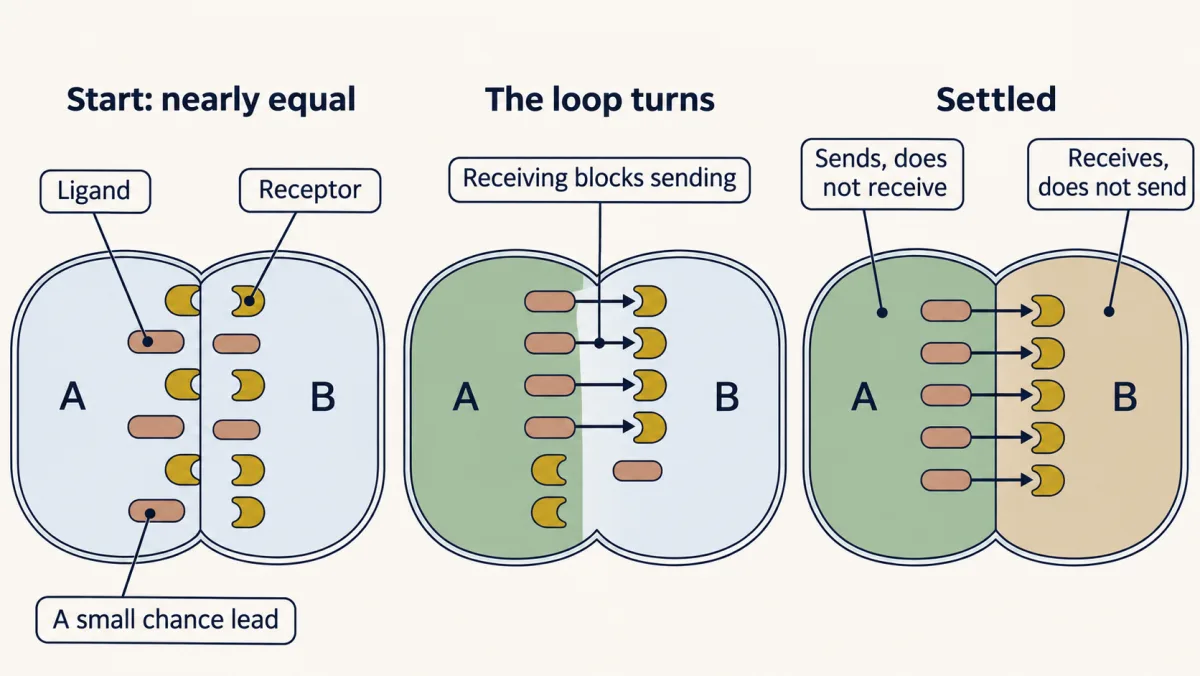
In the first film, a neighbour's pull turned one Notch receptor into one nuclear signal. Now set two identical touching cells side by side: how do they pick opposite fates? Nothing outside tells them which cell becomes nerve and which cell becomes skin. Both neighbours begin with the same toolkit. Each cell displays amber ligands to send and teal Notch receptors to receive. At the start, both pull equally on each other across their shared border. Neither cell has a lead, and neither cell has committed to a fate. Then random chance gives the left cell slightly more ligand. It pulls harder on the right cell's Notch receptors, releasing more cyan inner tail into the right nucleus.
There, in the textbook model, Notch turns on repressors with two linked jobs. They block the nerve programme, and they lower the right cell's own sending. Pause here and follow the loop one step back across the border. The right cell now displays fewer amber ligands than before. What happens next to the Notch signal reaching the left cell, and to the left cell's own sending?
With less ligand pulling on its Notch, the left cell receives less inhibition. Its nerve programme stays active, and it puts even more ligand on its surface. The left cell lowers the right cell's sending, and the right cell's sending lowers the left's. Two brakes in a row make positive feedback: quieting its neighbour boosts the left cell. When Notch lowers a cell's sending, equal neighbours split into opposite fates. Watch the schematic curves below pull apart as each cycle widens that tiny head start. Soon the left cell sends without receiving and adopts the nerve fate. The right cell receives without sending and adopts the skin fate. Biologists call this neighbour-sorting circuit lateral inhibition.
Now zoom out from one pair to a whole sheet of touching cells. Because the Notch signal neither diffuses nor multiplies, each cell compares itself only with the neighbours it contacts. Every emerging nerve precursor suppresses the ring of cells touching it, leaving spaced nerve cells surrounded by skin. Cells can also tune that spacing without abandoning direct contact. On a fly's back, cells send out thin moving extensions that touch neighbours a few cell widths away. Live imaging shows these contacts help space the bristles, still using touch rather than diffusion. In flies and worms alike, this mutual brake turns a small starting gap into a clean choice. Two neighbours need no outside map and no diffusing signal.
By weakening a neighbour's ability to send back, a tiny difference grows into two opposite fates.
From the film
- When Notch lowers a cell's sending, equal neighbours split into opposite fates.
- In lateral inhibition, received Notch turns on repressors that block the nerve programme and lower the cell's own sending, turning two inhibitions into positive feedback across two cells.
- Because the signal neither diffuses nor multiplies, each cell compares itself only with cells it contacts, producing fine-grained spacing.
- Cells can also widen that spacing using thin, moving cell extensions while still relying on direct contact.
Two equal neighbours, two fates
The second film traced how lateral inhibition widens a tiny chance lead across two touching cells. The sharpest genetic test comes from a worm larva’s gonad, where two equivalent neighbouring cells (Z1.ppp and Z4.aaa) lie side by side. Normally one becomes the anchor cell (AC) and the other a ventral uterine precursor (VU), each taking the AC fate in about half of animals. Greenwald’s thesis work with Paul Sternberg and Robert Horvitz tied this choice to lin-12 (the worm Notch receptor), and both cells initially express LIN-12 and its ligand LAG-2 before diverging into receptor-only VU and ligand-only AC.
Predict. If a mutation locks LIN-12 constitutively ON in both worm gonad cells without any ligand, what fate do the two cells take?
Check your prediction
Neither becomes an anchor cell. Constitutive LIN-12 runs the received-signal programme in both cells, suppressing the default AC fate.
| Perturbation (worm gonad or fly sheet) | Outcome | What it shows |
|---|---|---|
| Normal touching pair | One sender (AC/nerve), one receiver (VU/skin) | Chance lead widened by mutual inhibition |
| One neighbour laser-ablated (worm) | Survivor always becomes AC | AC is default; VU requires a neighbour |
| Neither cell has Notch / LIN-12 | Both AC / excess nerve, too little skin | Without receptor, no cell hears “not you” |
| Overactive LIN-12 in both cells | Neither becomes AC | Constitutive signal suppresses AC fate |
| Mosaic: only cell A lacks LIN-12 | Cell A always becomes AC; B becomes VU | The cell that cannot hear ends up as sender |
In the textbook model of the fly, received Notch turns on Hes-type repressors that shut off both the nerve-fate genes and Delta production. Once again, when Notch lowers a cell’s sending, equal neighbours split into opposite fates—and because the signal neither diffuses nor multiplies, each cell compares itself only with cells it touches, including neighbours a few diameters away reached by thin moving extensions on the fly’s back (live imaging shows these help space bristles).
Design problem
Two neighbouring cells start out the same. One must become a nerve cell and the other a skin cell, with no outside cue. Design a circuit between them that turns a small chance difference into opposite fates, then predict what the tissue looks like if the receptor is missing from every cell.
Saved in this browser only.
One way to do it
Give each cell a surface ligand and a receptor with two rules: received signal blocks the nerve programme (favouring skin) and lowers the cell’s own ligand production. A slight chance lead in cell A lowers cell B’s ligand, which lowers the signal back to A—two inhibitions in a row create positive feedback (the switch-making loop from the lesson on signaling circuits), stretched across two cells until A sends (nerve) and B receives (skin).
Without the receptor, no cell can be told “not you”. Every cell runs the nerve programme, giving too much nervous system and too little skin—the fly embryo at the top of this lesson, and the worm without LIN-12 where both cells become anchor cells.
When Notch is stuck on, or missing
Stuck on. In 1991, human NOTCH1 was found broken by a chromosome rearrangement in rare cases of T-cell acute lymphoblastic leukaemia, leaving a shortened receptor. In 2004, NOTCH1 mutations were reported in over half of cases, clustering in two places: some loosen the lock near the membrane so Cut 2 happens without a pull, while others remove the tail region that marks Notch intracellular domain (NICD) for destruction so each NICD lasts longer.
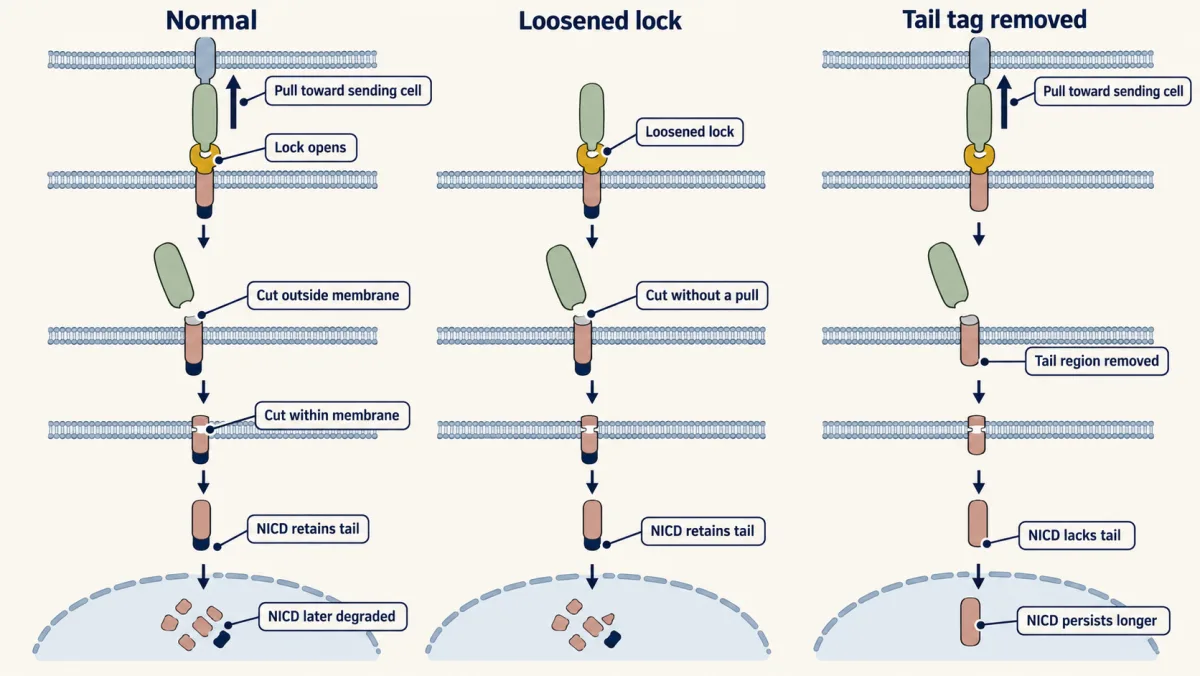
Predict. Cultured T-cell leukaemia cells from Patient 1 carry a lock-loosening NOTCH1 mutation; cells from Patient 2 carry a tail-deletion mutation with an intact lock. If you block ligand binding outside both lines, how do they differ?
Check your prediction
Patient 1’s cells keep cutting Notch without any pull. Patient 2’s cells stop releasing new NICD because their intact lock still needs a pull, though existing NICD clears more slowly than normal.
Missing. Alagille syndrome is a dominant genetic disease in which, in most cases, one copy of JAG1 (encoding Jagged1) is broken. Most affected children have too few bile ducts in the liver and many have a heart defect; severity varies widely. As in the fly’s wing, one working copy is not enough.
Shared scissors. γ-Secretase also cuts amyloid precursor protein, producing the peptide that builds up in the brain in Alzheimer’s disease. In 1995, Diane Levitan and Greenwald found that worm sel-12 (which helps lin-12 signal) resembles a human gene mutated in inherited, early-onset Alzheimer’s disease. Drugs that block γ-secretase lower that peptide but also block the Notch cut: in rodents they turned dividing cells of the gut lining into mucus-secreting goblet cells, the change expected when Notch is lost there. A large trial of one such drug, semagacestat, was stopped in 2010 after patients taking it did worse than those on placebo.
Going deeper
How fly Notch and worm lin-12 were linked (1985)
In December 1985, Spyros Artavanis-Tsakonas’s laboratory sequenced fly Notch (followed soon after by Michael Young’s laboratory), finding a large single-pass membrane protein with 36 outer repeats resembling epidermal growth factor. In the same issue of Cell, Iva Greenwald reported the same repeats in worm lin-12, uniting a nicked-wing fly mutant and a worm cell-fate gene into one receptor family.
Parallel 1998 and 1999 cleavage reports
Alongside Struhl and Adachi’s 1998 fly reporter and Kopan’s mouse Notch1 release report, two other fly laboratories—Lecourtois and Schweisguth, and Kidd, Lieber and Young—reported ligand-dependent processing of Notch. In 1999, other fly and mouse laboratories likewise reported the Presenilin requirement at the same time as Struhl and Greenwald.
Your notes
Select any text in the lesson to highlight it or add a note to it. Your highlights and notes are saved in this browser and collected in your notebook.
This browser is not letting the site save anything (a private window or strict privacy settings), so highlights and notes will be lost when you leave the page.
Try the Predict questions again
Five Predict questions from this lesson, on their own. Answer each one first, then open its check.
Free ligand pieces in solution generally fail to switch Notch on. What happens if you fix those same ligand pieces to a culture dish before adding Notch cells, and why?
From: Touch, pull and the lock
Check your prediction
The dish-bound ligand switches Notch on. Anchoring prevents the ligand from drifting with the receptor, so tension can peel open the negative regulatory region.
Struhl and A. Adachi (1998) inserted a transcription activator into the inner tail of intact, full-length Notch in living flies so a sensitive reporter turned on only if that tail reached the nucleus. Where should the reporter turn on?
From: One preparation cut and two signal-triggered cuts
Check your prediction
Only where ligand is present. Without a neighbour’s ligand, the intact receptor stays uncut at the membrane and keeps the activator out of the nucleus.
A fly with one broken copy of Notch makes roughly half the normal number of receptors. Why does a 50% drop show up readily here (nicked wings), unlike in many kinase cascades?
From: What this design gives up, and what it buys
Check your prediction
With no amplification before the gene to cover a shortfall, half the receptors yield roughly half the NICD count—a likely reason one broken Notch copy nicks the wing.
If a mutation locks LIN-12 constitutively ON in both worm gonad cells without any ligand, what fate do the two cells take?
From: Two equal neighbours, two fates
Check your prediction
Neither becomes an anchor cell. Constitutive LIN-12 runs the received-signal programme in both cells, suppressing the default AC fate.
Cultured T-cell leukaemia cells from Patient 1 carry a lock-loosening NOTCH1 mutation; cells from Patient 2 carry a tail-deletion mutation with an intact lock. If you block ligand binding outside both lines, how do they differ?
From: When Notch is stuck on, or missing
Check your prediction
Patient 1’s cells keep cutting Notch without any pull. Patient 2’s cells stop releasing new NICD because their intact lock still needs a pull, though existing NICD clears more slowly than normal.
How we measure it
Laser ablation of single cells
A laser focused through a microscope kills one chosen cell in a living, transparent worm. What the remaining cells then do shows what they needed from the cell that is gone. Here it showed that the choice between anchor cell and uterine precursor depends on a neighbour.
Genetic mosaics
An animal is made in which some cells carry a working gene and others do not. Asking which cell must have the gene shows where the gene acts. For lin-12, the cell that lacks the receptor always takes the anchor cell fate, so the receptor acts in the cell that receives.
Truncated receptors
Parts of a receptor are deleted and what remains is produced in cells or animals. If a fragment acts like the activated receptor with no ligand present, that fragment carries the signal. The inner part of Notch passed this test in flies, worms and mouse cells.
Nuclear-access reporter
A transcription activator such as Gal4-VP16 is inserted into the receptor, and a reporter gene responds to it. The reporter turns on only if that part of the receptor reaches the nucleus, which detects amounts too small to see by antibody staining.
Method films · the methods library
- Cell adhesion, migration and mechanics assays 3:53
- Cryo-electron microscopy 4:06
- Engineered mutants: site-directed, dominant-negative and constitutively active 4:25
- Forward genetic screens 4:07
- Gene cloning: vectors, libraries and screening 4:04
- Genetic mosaic analysis 3:32
- Immunohistochemistry and immunofluorescence 4:06
- Next-generation sequencing and genome assembly 3:50
- Optical trap (optical tweezers) 2:52
- Pharmacological blockade and inhibitors 4:10
- Reporter gene assays 2:42
- Targeted cell ablation 3:58
- X-ray crystallography 4:06
Practice questions on this lesson (3) → MCAT-style, original, each with an explanation
Where this lesson fits
Before thisReview first
- Ubiquitin and Regulated Proteolysis as SignalsThis course · Lesson 8
NICD is marked by a kinase and an E3 ligase and destroyed by the proteasome, which that lesson explains.
- Cytokine Receptors and JAK–STATThis course · Lesson 22
The lesson compares Notch with the STAT route, so you need to know how a receptor kinase sends STAT to the nucleus.
- TGF-β and SmadsThis course · Lesson 23
Notch is set against the Smad route, where one active receptor phosphorylates many Smads that carry the signal to genes.
After thisStudy next
- Hedgehog and the Primary CiliumThis course · Lesson 26
Another developmental signal that tells embryonic cells their fate, which lets you compare how it reads position without a cut receptor.
- The Shape of a Signal: Size, Duration, Frequency and PlaceThis course · Lesson 35
Notch's brief, one-for-one dose signal is an example of how duration and size shape what a cell reads.
- Reverse Signaling: When the Ligand Is Also a ReceptorThis course · Lesson 39
Notch ligands are membrane proteins on a neighbour, and that lesson asks which cell gets the message when ligand and receptor are both anchored.
Elsewhere on the siteFilms, simulations and method films in other courses
- Equal Cells, One WinnerFilm · Developmental Neuroscience
It shows how Notch picks one winner from equal cells, the lateral inhibition used here.
- Two Jobs, One DivisionFilm · Developmental Neuroscience
It shows Numb marking one daughter so Notch signaling differs between sisters.
Suggested by an AI model from the lessons themselves, then checked. How we use AI
That is the skim: you have the shape of it.
That is both films: the lesson in pictures.
The rest of the lesson is here when you want it.
Finish line
Test yourself
8 questions
Practice and MCAT-style, with explained answers.
Next · Lesson 26
Hedgehog and the Primary Cilium
How does one signal tell the cells of an embryo where they are, and why do a lamb-deforming plant and a skin cancer drug hit the same protein?
Continue →Rewritten on : new text, flashcards and film. Notes and highlights stay, but the text around them may have moved.