Cell Signaling · Skim version
Notch: Signaling by Contact and by Cutting
Read the full lesson → Skim the whole course →
The guiding idea
How do two identical cells, side by side, decide which one becomes the nerve cell?
Notch is a receptor that signals almost always between cells that touch, and it does so by being cut: the freed inner part of the receptor travels to the nucleus and switches genes on.
-
The idea: the signal is a touch and a pull
-
Three cuts: how the receptor becomes the message
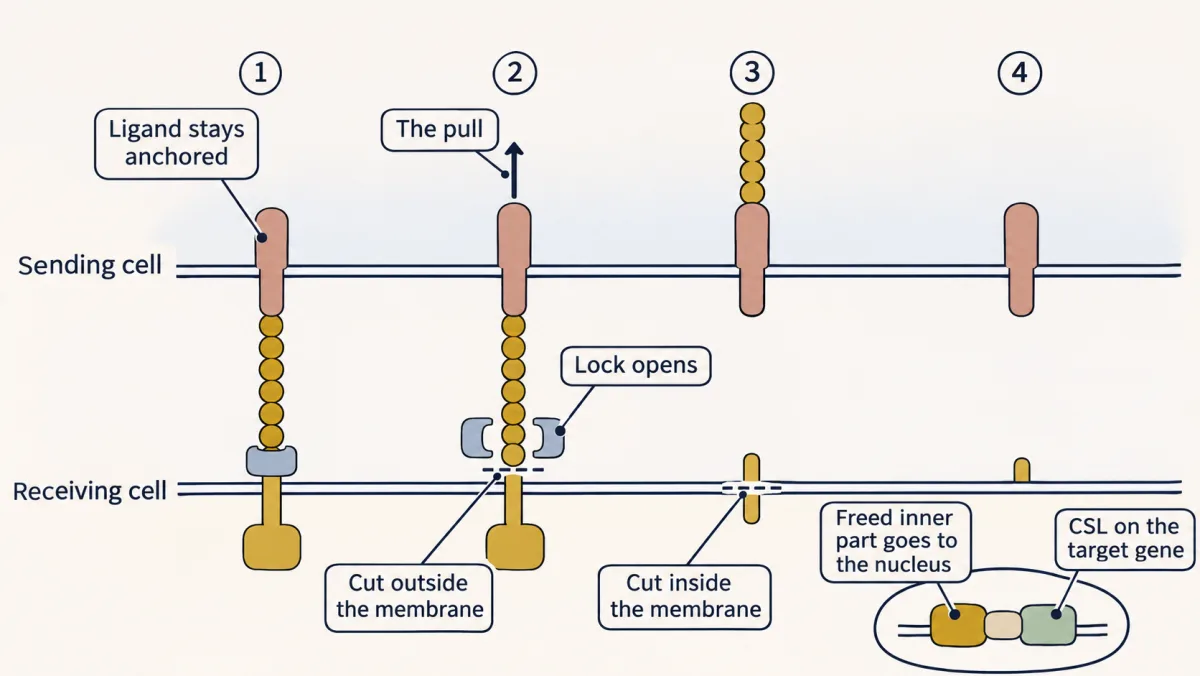
The ligand never leaves the sending cell. A pull opens the lock just outside the membrane, the second cut, made there, releases the outer part with the ligand, and the third cut, inside the membrane, frees the receptor's inner part, which goes to the nucleus and acts on target genes with CSL. AI-generated illustration -
What this design gives up, and what it buys
-
Two equal neighbours, two fates
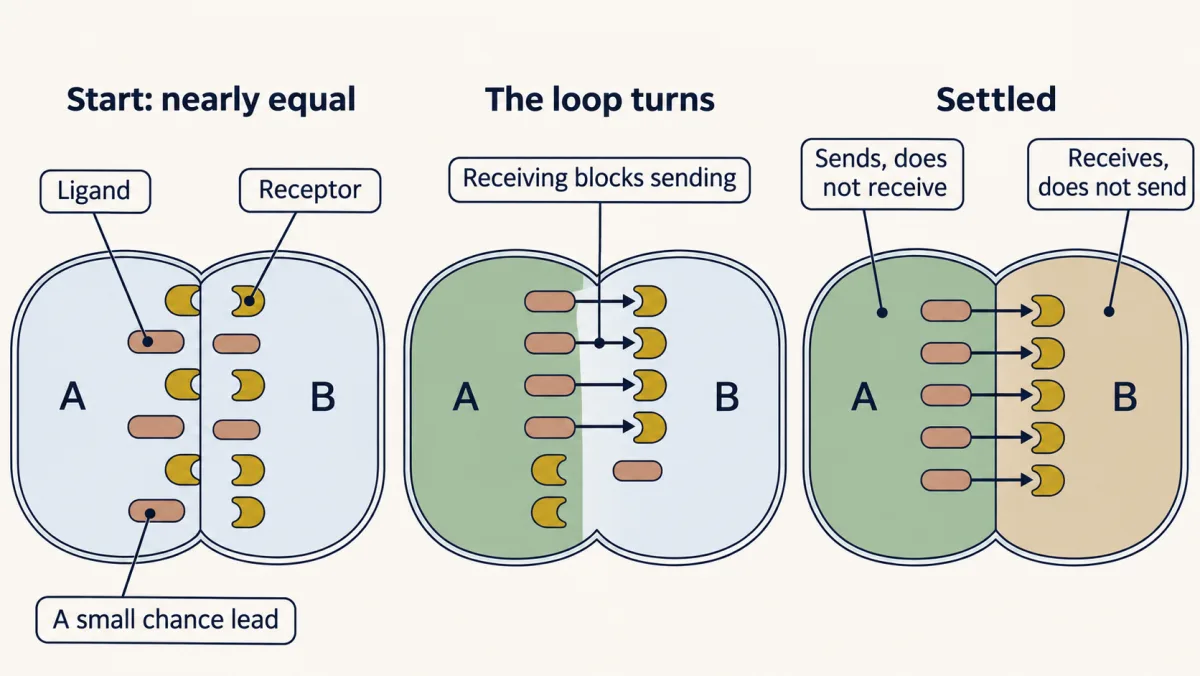
Lateral inhibition stretches a positive feedback loop across two cells: received signal blocks the receiving cell's nerve programme and its own ligand production, so a small chance lead widens until one cell sends without receiving and its neighbour receives without sending. Because the signal neither diffuses nor multiplies, each cell compares itself only with the cells it touches. AI-generated illustration -
When Notch is stuck on, or missing
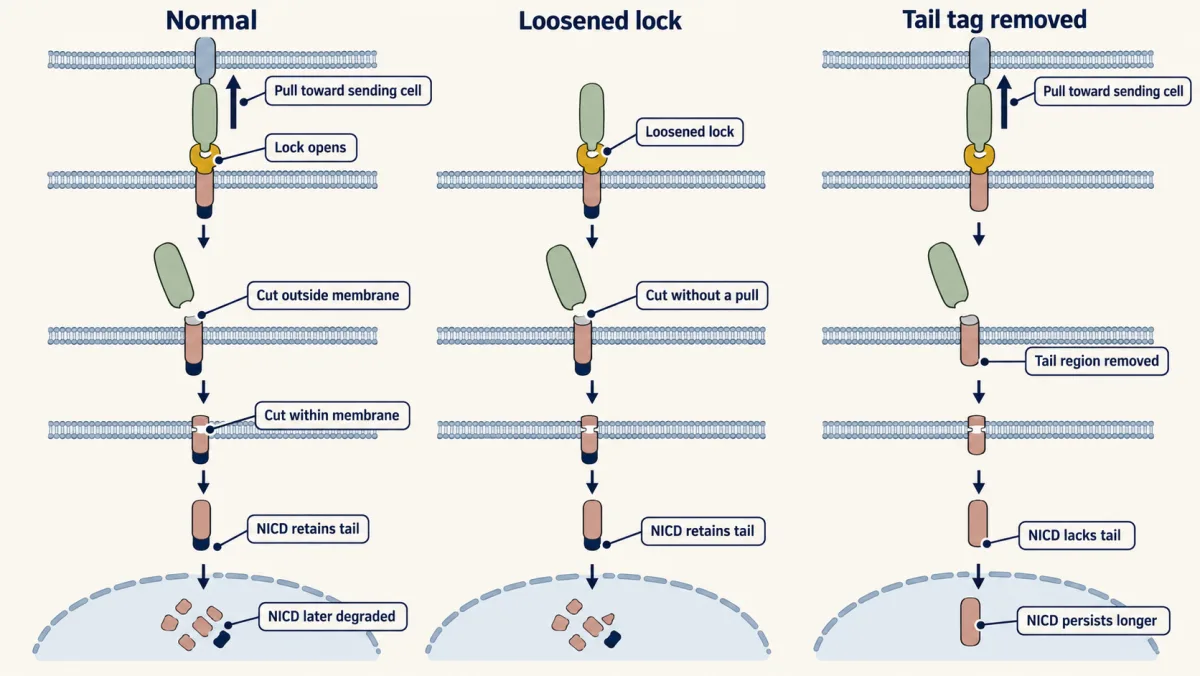
Mutations in NOTCH1 in T-cell acute lymphoblastic leukaemia cluster in two places. Some loosen the lock near the membrane, so the second cut happens without a pull; others remove the part of the tail that marks NICD for destruction, so each NICD lasts longer. AI-generated illustration
Where this lesson fits
Before thisReview first
- Ubiquitin and Regulated Proteolysis as SignalsThis course · Lesson 8
NICD is marked by a kinase and an E3 ligase and destroyed by the proteasome, which that lesson explains.
- Cytokine Receptors and JAK–STATThis course · Lesson 22
The lesson compares Notch with the STAT route, so you need to know how a receptor kinase sends STAT to the nucleus.
- TGF-β and SmadsThis course · Lesson 23
Notch is set against the Smad route, where one active receptor phosphorylates many Smads that carry the signal to genes.
After thisStudy next
- Hedgehog and the Primary CiliumThis course · Lesson 26
Another developmental signal that tells embryonic cells their fate, which lets you compare how it reads position without a cut receptor.
- The Shape of a Signal: Size, Duration, Frequency and PlaceThis course · Lesson 35
Notch's brief, one-for-one dose signal is an example of how duration and size shape what a cell reads.
- Reverse Signaling: When the Ligand Is Also a ReceptorThis course · Lesson 39
Notch ligands are membrane proteins on a neighbour, and that lesson asks which cell gets the message when ligand and receptor are both anchored.
Elsewhere on the siteFilms, simulations and method films in other courses
- Equal Cells, One WinnerFilm · Developmental Neuroscience
It shows how Notch picks one winner from equal cells, the lateral inhibition used here.
- Two Jobs, One DivisionFilm · Developmental Neuroscience
It shows Numb marking one daughter so Notch signaling differs between sisters.
Suggested by an AI model from the lessons themselves, then checked. How we use AI