Biochemistry · Supplement · Integration of Metabolism
Integration of Metabolism: How the Body Switches Fuels
Rewritten on : new film. Your notes and highlights stay, but the text around them may have moved.
Fed, fasting, starving: led by two hormones, the body turns every pathway in this course up or down in a timed sequence.
The main idea, the figures and what the films show. Under each heading, "Read this part" opens it.
Both films in order, 6 minutes.
The whole lesson: about 22 minutes of reading and 6 of film.
Pause when the reading reaches a film, and offer to play it. Saved on this device.
Watch the film now, or keep listening
That is the end of the reading
This idea at other levels
This lesson teaches fasting in Biochemistry, an upper-level college course. Simpler: read a short high school version here.
The high school version · about 1 minute to read
Metabolism isn't separate pathways; it's one system that changes with how recently you ate. Fed: insulin is high, so you store glucose as glycogen and can turn extra carbohydrate into fat. Early fasting: glucagon rises and the liver breaks down glycogen. Longer fasting: the liver, and later the kidneys, make new glucose (gluconeogenesis) and fat is released from storage. Starvation: the liver makes ketone bodies, and as their blood level climbs the brain burns more of them, so far less muscle has to be broken down to make glucose. The fatty acids in fat cannot be turned into glucose, which is why this matters. Organs also trade fuel — muscle sends lactate and alanine to the liver, the liver sends back glucose and ketones.
See every levelHide the levels
This lesson also teaches one more idea; its ladder is below.
Fed, fasting and starving
As hours without food pass, the body shifts from meal sugar to stored sugar, then new glucose, fat and ketones.
Taught at one level so far: upper-level college.
College, upper level · the level you chose
Integration of Metabolism: How the Body Switches Fuels · this lesson
From lunch to five weeks: brain switches to ketones, sparing muscle.
Biochemistry · about 22 min · film 2:32 · 5 practice questions
Next door to fasting
- Ketone bodiesIn a long fast the liver turns fat into ketones, which the brain can burn when sugar runs low.Nearest lesson: Fatty Acid Degradation: The β-Oxidation Spiral (upper-level college)
- Making new glucose (gluconeogenesis)Once stored sugar is gone, the liver builds new glucose from other molecules to keep the brain fed.Nearest lesson: Gluconeogenesis: Pushing Glucose Back Uphill (upper-level college)
Blood sugar control
Insulin and glucagon keep the sugar in your blood steady between meals and after them.
Taught at three levels: a first college course, upper-level college and graduate level.
Graduate · the level you chose
Insulin never enters the cell: Akt moves glucose transporters and stores glycogen.
Cell Signaling · about 15 min · film 3:21 · 3 practice questions
College, upper level · the level you chose
Integration of Metabolism: How the Body Switches Fuels · this lesson
One insulin-to-glucagon ratio, read differently by liver, muscle and fat.
Biochemistry · about 22 min · film 2:32 · 5 practice questions
Insulin, Glucagon and Blood Glucose
Beta cells burn glucose to sense it; oral glucose releases more insulin than intravenous.
Physiology · about 29 min · film 2:45 · 5 practice questions
College, a first course · the level you chose
Hormones and the Endocrine System
Glucose as a loop: beta cells, insulin, and glucagon between meals.
Organismal Biology · about 20 min · film 3:20 · 3 practice questions
Play the ladder · 4 films, about 12 min, from a first college course to graduate level. Each film waits for you to press play.
Next door to blood sugar control
- Homeostasis and feedbackBlood sugar is held steady by negative feedback.Nearest lesson: Autonomic Control and the Hypothalamus (upper-level college)
- Cellular respirationOnce glucose is inside a cell, this is how the energy comes out.Nearest lesson: Metabolism: Basic Concepts and Design (upper-level college)
Short versions inside this lesson
The graduate version · about 1 minute to read
Integration is the layering of timescales onto a shared chemical core. Allosteric and covalent control act in seconds-to-minutes (energy charge, AMPK, the cAMP/PKA reciprocal phosphorylation of glycogen synthase/phosphorylase, the bifunctional PFK-2/FBPase-2 setting fructose-2,6-bisphosphate to choose glycolysis vs gluconeogenesis); hormonal control (insulin, glucagon and catecholamines within seconds to minutes; cortisol over hours through gene expression) sets the program and is interpreted tissue-specifically by transporter and enzyme complements (GLUT4 in muscle/adipose; the liver's glucose-6-phosphatase and lack of SCOT). The substrate cycles (Cori, glucose-alanine) and the ketone-body system are inter-organ flux controllers that also handle nitrogen (alanine → urea cycle). The convergence on acetyl-CoA/the citric acid cycle makes fuels interchangeable at the terminal step (though irreversible PDH means even-chain fatty acids give no net glucose), while control sits mainly at pathway-specific enzymes, and the failure modes are diagnostic: insulin loss decouples the program from blood glucose (DKA), and tissue-specific enzyme absences (here, SCOT silenced in hepatocytes) dictate who exports versus consumes a fuel.
The plainest version · about 1 minute to read
Your body is like a kitchen that never closes. Right after you eat, it stores leftovers. A few hours later it starts using the stored food. If you go a long time without eating, it switches to burning fat and even makes a special backup fuel (ketones) so your brain keeps working. Two hormones — insulin after eating, glucagon when hungry — are the light switches that flip the whole kitchen between 'store' and 'use.'
Find an idea: every idea, searchable
Which lessons teach an idea, and the notes on each level, were written by AI models from the lessons and checked by a second model. A person has not yet read every one. How we use AI
About this lesson goals, parts
What you'll learn
- Explain why the fatty acids of fat cannot be turned into glucose (the one-way funnel), and use that to describe what keeps blood glucose up from a meal through a fast of weeks.
- Explain how the insulin-to-glucagon ratio acts as the body's master switch between building and burning.
- Trace the inter-organ fuel economy — Cori cycle, glucose-alanine cycle, free fatty acids, and ketone bodies — and which organ exports what.
- Explain why the brain shifts to ketone bodies in prolonged starvation, and how that spares muscle protein.
- State the unifying idea: all fuels converge on the citric acid cycle, the common terminal pathway, most of them by way of acetyl-CoA.
Builds on:Gluconeogenesis: Pushing Glucose Back Uphill (read)Fatty Acid Degradation: The β-Oxidation Spiral (read)Signal-Transduction Pathways: How Cells Compute With Molecular Switches (read)Why these?
Rewritten on : new film. Notes and highlights stay, but the text around them may have moved.
The main idea. The pathways in this course don't run in isolation — their rates shift in a timed sequence as you move from fed to fasting to starving, coordinated mainly by two hormones, while organs trade fuels.
The films
 ▶ Watch How the body switches fuels · 2:32
Read the transcript of “How the body switches fuels”
Film transcript: How the body switches fuels
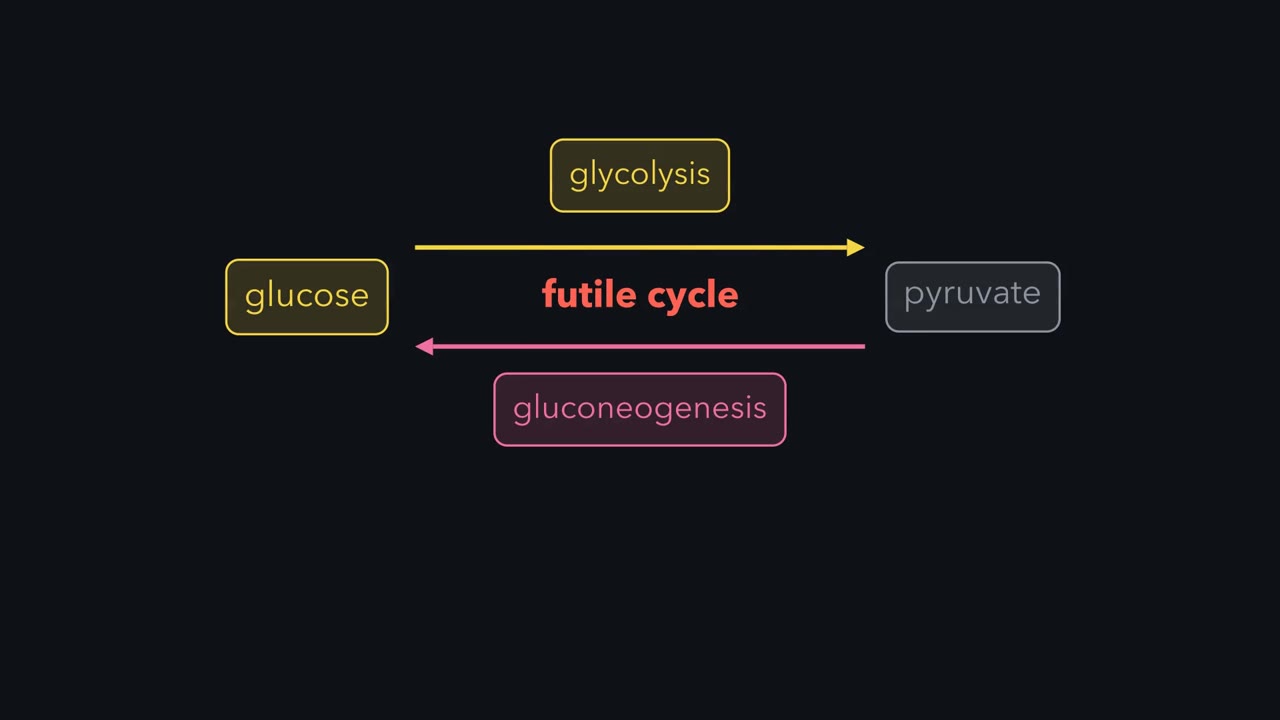
Every pathway in this course has been running in your body the whole time you read it, but at different rates. Many are opposites that could waste energy if both ran flat out in one cell. So the body turns them up and down in a timed sequence, as you move from fed to fasting to starving. Watch the hours after a meal and you see a relay, each runner handing blood glucose to the next. Right after eating, glucose floods in from the gut and insulin rises. Liver, muscle, and fat hear: store. The liver lays down glycogen, and muscle takes up glucose. From four to sixteen hours, no more dietary glucose arrives, and glucagon rises. The liver now maintains blood sugar by breaking down its glycogen.
That store is finite, and largely gone within about a day. By the end of an overnight fast, making new glucose already supplies roughly as much as glycogen breakdown does. Next comes fasting, at one to two days. Gluconeogenesis grows as glycogen dwindles. The liver, and more and more the kidney, makes glucose from scratch, drawing on lactate, the amino acid alanine, and glycerol. Meanwhile adipose tissue releases free fatty acids. These become the major fuel for muscle and liver. In starvation, the brain is the problem child. It normally burns about 120 grams of glucose a day, and long-chain fatty acids are only a minor fuel. They reach brain tissue, where astrocytes burn some, but neurons rely on other fuels. If glucose were the only option, the body would make all 120 grams by gluconeogenesis. The main raw material would be your own muscle protein.
You would consume yourself within weeks. Ketone bodies are the escape. They are small and water-soluble, and they cross into the brain. In starvation, liver ketone production climbs, as the flood of fatty-acid-derived acetyl-CoA becomes ketone bodies that are exported. Over days to weeks the brain adapts to burn them, cutting its glucose requirement to roughly 40 grams a day. That protein-sparing effect decides whether you survive a long fast. The liver makes ketone bodies but cannot use them. It lacks SCOT, the enzyme that reactivates acetoacetate so it can be burned. So everything it produces is shipped out to the brain, heart, and muscle. Ketogenesis is an export business.
You carry about 15 kilograms of fat and about 100 grams of glycogen in your liver, and your brain burns about 120 grams of glucose a day. The fat holds months of the brain’s energy; the glycogen holds less than a day of its glucose. Yet in a long fast the body guards its glucose and spends muscle to do it. Why? The answer sets the order in which every pathway in this course turns up and down.
The one-way funnel: why fat cannot become glucose
Hans Krebs saw the shared core: “all foodstuffs are burnt through a common terminal pathway.” Carbohydrate, fat and protein are stripped to acetyl-CoA, a two-carbon fragment carried on coenzyme A (some amino acids enter as other citric acid cycle intermediates instead), and burned in the same cycle. That is why, in cells with mitochondria, most fuels can pay for ATP.
Predict. If every fuel ends up as acetyl-CoA, why can’t the liver turn the acetyl-CoA from fat into glucose?
Check your prediction
Glucose made from acetyl-CoA would have to pass through pyruvate or oxaloacetate, and acetyl-CoA cannot get back to either.
- Backward is closed. Pyruvate dehydrogenase turns pyruvate into acetyl-CoA and releases CO₂. In animals the step cannot run in reverse.
- Through the cycle gains nothing. Acetyl-CoA (2 carbons) joins oxaloacetate (4) to make citrate (6), and the cycle releases two CO₂ (6 carbons to 5 to 4) before oxaloacetate comes back. Two carbons in, two out: no extra oxaloacetate for glucose.
Of fat, only the glycerol backbone, about a tenth of its mass, and a little from odd-chain fatty acids can become glucose.
Some tissues must have glucose. Red blood cells have no mitochondria, so glycolysis is their only source of ATP. Long-chain fatty acids reach brain tissue, and astrocytes burn some, but they supply only a minor share of the brain’s energy; neurons rely on other fuels.
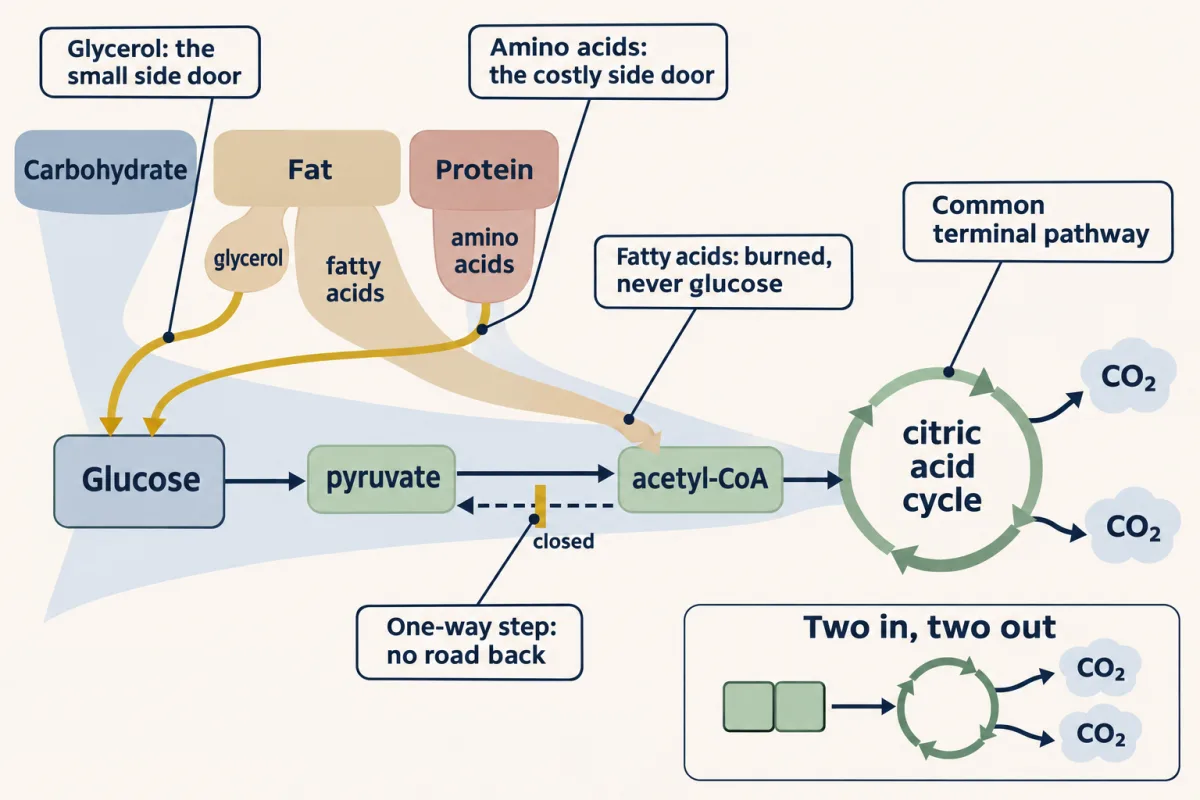
The one idea to carry through this lesson. The fatty acids of fat can be burned but cannot be turned into glucose (only fat’s small glycerol backbone can), and the brain and red blood cells need glucose. So fasting is glucose rationing:
- Low insulin switches every tissue that can burn fat over to fat.
- The liver supplies glucose, first from its glycogen, then by making it new (gluconeogenesis) from the only new carbon it can use: glycerol from fat’s backbone and amino acids, mostly from muscle protein.
- The liver turns surplus fatty acids into ketone bodies, which the brain can burn in place of most of its glucose, so less muscle has to be spent.
This holds for a healthy adult fasting up to weeks; hard exercise strains the cell’s own ATP (Going deeper, “AMP-activated protein kinase (AMPK)”).
One signal, read differently by each tissue
Many pathways are opposites that would cancel into an ATP-wasting futile cycle if both ran flat out, so two pancreatic hormones set them as a group. Insulin rises after a meal and means store. Glucagon rises when blood glucose falls and means release. Both enter the portal vein, which runs straight to the liver, so the liver meets them first and at the highest concentrations. Because they push its enzymes in opposite directions, the liver responds to their balance, the insulin-to-glucagon ratio.
| Tissue | Insulin high (fed) | Insulin low, glucagon high | Releases glucose into blood? |
|---|---|---|---|
| Liver | stores glycogen | breaks down glycogen, makes new glucose and ketone bodies | Yes: has glucose-6-phosphatase |
| Muscle | takes up glucose (insulin brings GLUT4 to the surface), stores glycogen | burns fatty acids; releases amino acids | No |
| Fat tissue | stores fat | insulin’s brake on fat breakdown (lipolysis) comes off | No |
Predict. Muscle holds three to four times as much glycogen as the liver. Overnight, why doesn’t it help hold up your blood glucose?
Check your prediction
Glycogen breaks down (through glucose-1-phosphate) to glucose-6-phosphate, whose phosphate traps the sugar in the cell; only cells with glucose-6-phosphatase (chiefly liver and kidney) can remove it. Muscle also lacks glucagon receptors, so it keeps its glycogen for its own work, when epinephrine or hard exercise calls.
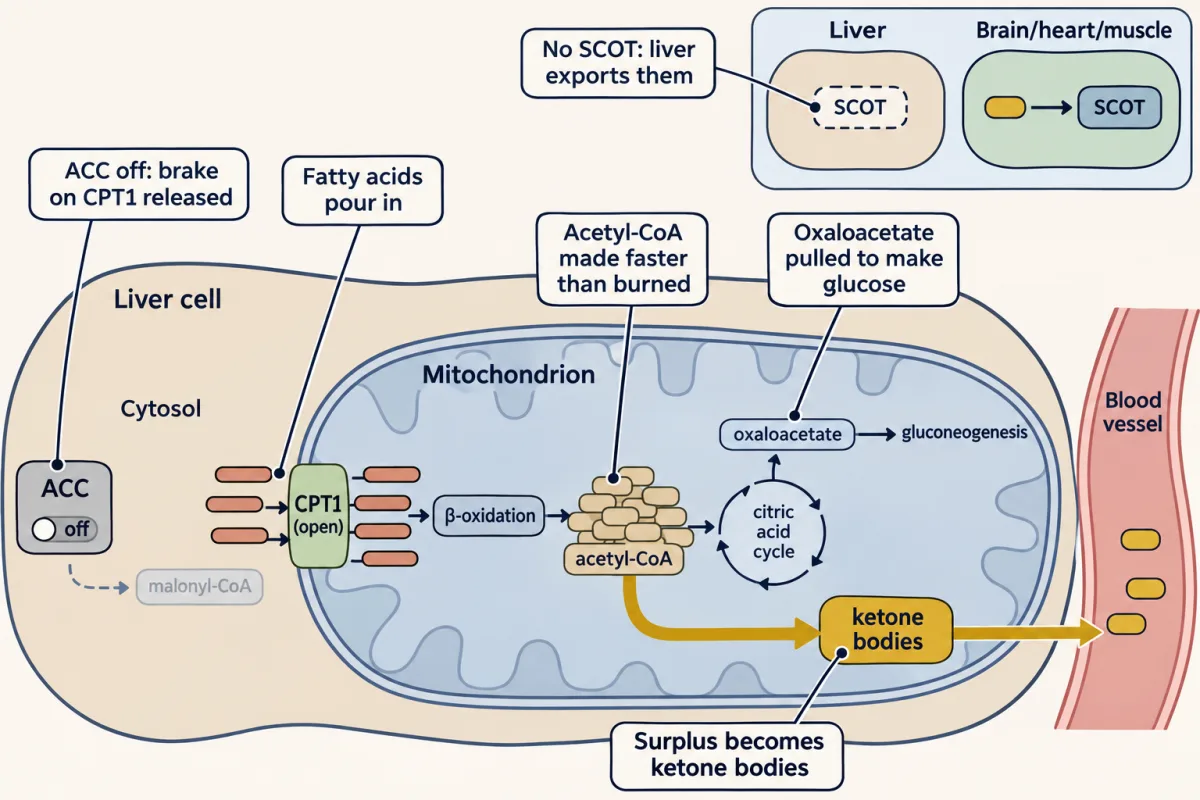
In the liver, glucagon raises cyclic AMP, which turns on protein kinase A (PKA). PKA’s phosphates switch glycogen synthase off and glycogen phosphorylase (through phosphorylase kinase) on, so storing stops and breakdown starts at once. Glucagon signaling also keeps acetyl-CoA carboxylase (ACC), the first enzyme of fat synthesis, phosphorylated and off (the key phosphate is added mainly by AMP-activated protein kinase (AMPK)). Insulin reverses both, mainly through a phosphatase. ACC’s product, malonyl-CoA, normally blocks the carnitine shuttle (CPT1) that lets fatty acids into mitochondria. Hold that for day three.
Read the transcript of “Who Pays for Glucose?”
Film transcript: Who Pays for Glucose?
The first film ended with the brain turning to ketone bodies. Now follow the blood from an overnight fast through five weeks without food. Glucose slips by only about 1 mM. Ketones climb from about 0.1 mM to 7 or 8. If glucose barely moves, who is paying for it?
At first the liver pays from savings: its glycogen, about 100 grams. Within a day or two, that store is mostly spent. After that, nearly all glucose must be made new. Made from what? The fatty acids of fat cannot become glucose. Only fat's glycerol backbone can, about 15 to 20 grams a day. The main raw material left is your own muscle protein. Muscle protein is broken into amino acids. Alanine carries carbon and nitrogen to the liver. The carbon can become glucose; the nitrogen is dumped as urea. The kidney joins in more and more. By five weeks, it makes about as much glucose as the liver. Now total the brain's bill.
Burning only glucose, it needs about 120 grams a day. Glycerol covers 15 to 20. The rest would cost about 180 grams of muscle protein daily. At that rate, a third of an adult's protein would be gone in about two and a half weeks. Here is the whole idea.
Blood glucose stays nearly level. Underneath, the body keeps changing who pays for it, and how much. Ketones cut the brain's glucose need to about a third, roughly 40 grams a day. Does muscle's share of the bill fall to a third as well? Or further?
Further: to about a fifth. In these rough sums, glycerol still covers its 15 to 20 grams. So the whole cut comes off muscle's share. At that smaller bill, the fat, about 75 days of energy, runs out before the protein does. These sums show direction and size only. Measured protein loss in long starvation runs lower, nearer 20 grams a day. Back to five weeks. Blood glucose has barely moved. Behind it, the brain runs about two-thirds on ketones. The kidney makes about as much glucose as the liver. And muscle pays a fraction of its old bill. So the steady number in the blood hides a shifting bill. Glycogen pays first, then muscle protein. Then fat, through ketones, takes over most of the brain's fuel.
From the film
- From an overnight fast through five weeks without food, blood glucose slips by only about one millimolar while ketones climb from about 0.1 to 7 or 8 mM.
- Liver glycogen, about 100 grams, is mostly spent within a day or two; after that nearly all glucose is made new, by the liver and more and more by the kidney.
- Fatty acids cannot become glucose; only fat's glycerol backbone can, about 15 to 20 grams a day, so the main raw material left is muscle protein.
- Alanine carries carbon and nitrogen from muscle to the liver: the carbon can become glucose, and the nitrogen is dumped as urea.
- In rough sums, ketones cut the brain's glucose need to about a third, and the protein bill for it falls further, to about a fifth.
One person’s fast, from lunch to five weeks
Follow yourself into a long fast (values rounded from classic human fasting studies). After the first hours blood glucose drifts down only modestly while the liver’s source of it changes completely.
| Time since the meal | Blood glucose | Insulin : glucagon | Ketones | The liver’s glucose comes from | Brain burns |
|---|---|---|---|---|---|
| 2 h | about 6–7 mM | high | about 0.1 mM | none exported; storing | glucose |
| 12 h | about 4.5–5 mM | falling | about 0.1–0.2 mM | glycogen and new glucose, about half each | glucose |
| 24 h | about 4–4.5 mM | low | about 0.3–0.5 mM | mostly new glucose | glucose |
| 3 days | about 3.5–4 mM | low | about 2–3 mM | new glucose, kidney’s share rising; protein breakdown near its peak | glucose, more ketones |
| 5 weeks | about 3.5–4 mM | low | about 7–8 mM (mostly β-hydroxybutyrate) | new glucose only, about 40 g a day, with the kidney now making about as much again | about two-thirds ketones |
“New glucose” in the table includes recycled lactate carbon, not only new carbon. The film at the top groups this timeline into stages and rounds glycogen to “about a day”; in life the stages blend.
New glucose carbon from:
The body never lets blood glucose drift far — it just keeps changing who pays for it. First the meal covers the bill; then liver glycogen and new glucose share it, about half each overnight; by the second or third day it is almost all new glucose. The stages blend. New glucose is built from the glycerol off your fat and amino acids pulled from muscle (lactate only recycles carbon the body already had). Run that too long and you would burn through your own muscle. The escape hatch is ketogenesis: the liver ships ketone bodies the brain learns to burn, cutting its glucose need from roughly 120 to 40 grams a day over days to weeks. That protein-sparing adaptation is what makes a long fast survivable.
The first day: store, then spend glycogen
After lunch, high insulin runs the fed column of the tissue table; the liver can also turn surplus carbohydrate into fat, though fat tissue stores mostly dietary fat. Once the gut is empty, glucagon rises and the liver breaks down its glycogen, a finite store that, with new glucose sharing the load (about half each by the end of an overnight fast), is mostly used up within a day or two. Fat tissue releases free fatty acids, the major fuel for muscle and liver, which the funnel keeps from becoming glucose.
Where the new glucose comes from
In gluconeogenesis the liver, joined more and more by the kidney, makes glucose from lactate, glycerol and amino acids (chiefly alanine for the liver, glutamine for the kidney). The film lists them as equals: as chemistry they are, as accounting they are not.
Predict. Red blood cells and working muscle turn glucose into lactate, and the liver rebuilds glucose from it. Does this Cori cycle give the brain any new glucose?
Check your prediction
No. The Cori cycle, first mapped by the Coris, sends the same carbon around again at a cost to the liver of about 6 ATP equivalents (4 ATP and 2 GTP) per glucose rebuilt, against 2 ATP gained by glycolysis. The brain burns nearly all of its glucose to CO₂, and that carbon does not come back. The brain is the drain; only glycerol and the carbon skeletons of amino acids from broken-down protein bring new carbon.
In the glucose-alanine cycle muscle exports carbon and nitrogen as alanine, handing the liver a gluconeogenic substrate (part of its carbon is recycled glucose, like lactate’s) and the nitrogen it will dump as urea. Toggle the map to see the traffic shift.
Two states, two logics, and a long-fast endgame. Fed, insulin is high and the body distributes and stores: glucose from the gut reaches every tissue, and the liver and adipose bank the surplus as glycogen and fat. Fasted, the priority flips to mobilize and protect the brain: adipose releases fatty acids and glycerol, muscle sends alanine (carbon from its protein, plus nitrogen the liver dumps as urea) and lactate (recycled carbon, no gain for the brain), and the liver makes fresh glucose and ketone bodies to keep the brain running. Weeks in, ketones carry most of the brain's load and far less muscle is spent. No tissue is selfish here; the blood is just a ledger, and the hormones decide which way the entries point.
By day three: ketogenesis in full swing
Predict. With acetyl-CoA carboxylase (ACC) off, what happens to fatty acids reaching the liver, and why does a liver burning fat flat out make ketone bodies it cannot use?
Check your prediction
Malonyl-CoA is low, so the carnitine shuttle opens and fatty acids pour into the liver’s mitochondria. β-oxidation makes acetyl-CoA faster than the liver’s own citric acid cycle burns it: the liver needs only so much ATP, and its oxaloacetate, which acetyl-CoA needs to enter the cycle, is being pulled toward gluconeogenesis. The surplus becomes ketone bodies. Lacking SCOT, the enzyme that reactivates acetoacetate into acetoacetyl-CoA for burning, the liver ships everything it makes to the brain, heart and muscle. Ketogenesis is an export business.
Weeks: the brain switches, and muscle is spared
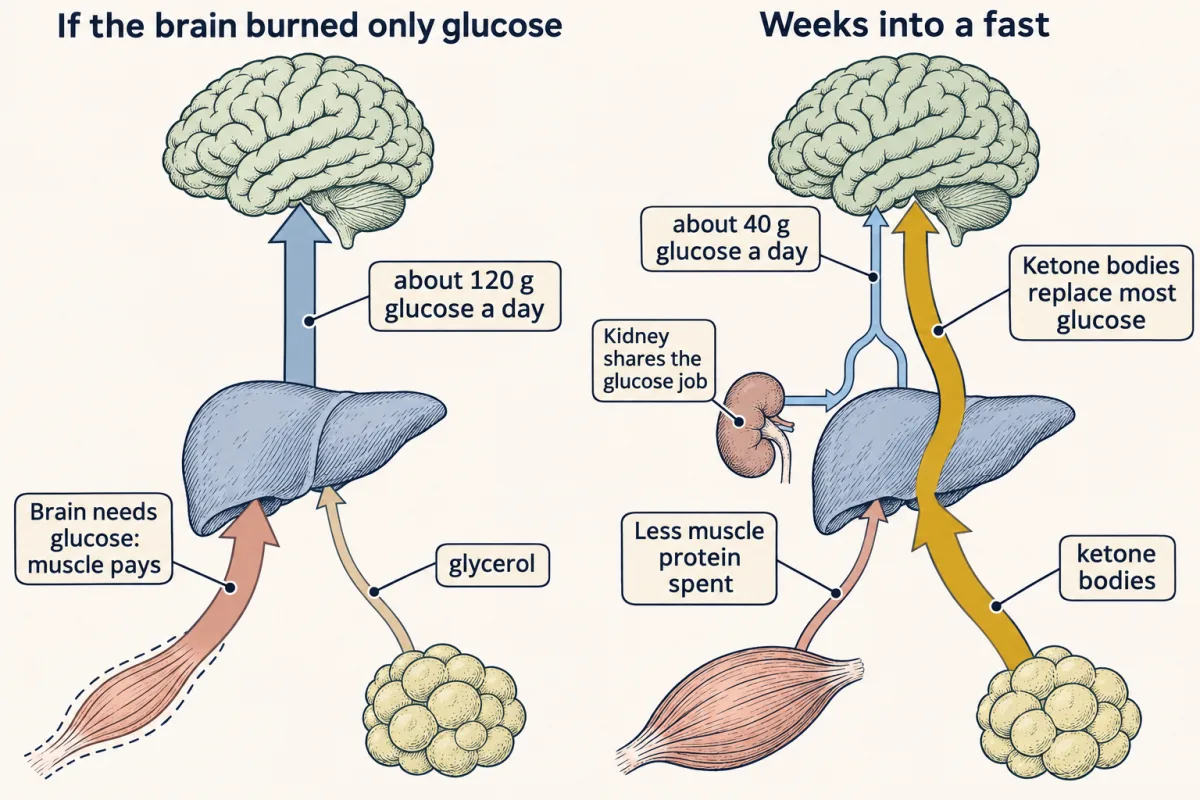
If the brain burned only glucose, gluconeogenesis would have to make all 120 grams a day. Glycerol covers about 15–20 grams, so the main raw material would be your own muscle protein, about 180 grams a day. You would consume yourself within weeks.
Ketone bodies are the escape: small and water-soluble, they cross into the brain. As blood ketones climb over days to weeks (see the table), the brain takes up more of them (and, in animal studies, makes more of the transporters that carry them in). Its glucose need falls to roughly 40 grams a day and the protein bill for the brain’s share falls to about a fifth. That protein-sparing effect is what makes a long fast survivable. These are rough sums; measured losses run lower (Going deeper, “The protein arithmetic”).
When the brake is missing: diabetic ketoacidosis
Predict. In untreated type 1 diabetes, blood glucose can sit near 25 mM, about five times the overnight level. Predict the ketones.
Check your prediction
High: usually above 3 mM, and in severe cases 10–20 mM or more. With insulin absent and glucagon high, fat breakdown and ketogenesis run unopposed, muscle and fat take up little glucose, and the liver keeps releasing more: diabetic ketoacidosis, the body starving in the middle of plenty.
Tissues respond to the hormone signal, not directly to the blood glucose level. Every row of the fast table is the one idea at work: fat burned wherever possible, glucose rationed for the tissues that need it, ketones stretching the ration. Metabolism is not a list of pathways but one switched, organ-spanning system for keeping you alive between meals.
Going deeper
Reciprocal control
Insulin and glucagon also set the bifunctional enzyme PFK-2/FBPase-2, whose product, fructose-2,6-bisphosphate, chooses between glycolysis and gluconeogenesis. These phosphorylation switches act in seconds to minutes, as does epinephrine; cortisol acts over hours through gene expression.
AMPK
Inside each cell, AMP-activated protein kinase (AMPK) reads the AMP:ATP and ADP:ATP ratios. When ATP runs low, as in hard exercise, it shuts off building (ACC among its targets) and turns on burning, answering the cell’s own energy stress rather than the meal clock.
The protein arithmetic
Round numbers for a 70 kg adult: about 180 g of protein a day would strip a third of the body’s roughly 10 kg of protein in about two and a half weeks. At about 40 g a day, the fat (about 75 days of energy) runs out first. These show direction and size only; measured protein loss in prolonged starvation is nearer 20 g a day.
Glycogen and ketogenesis, in detail
Studies of fasting people show liver glycogen still contributing at about 22 hours, with near-total reliance on new glucose by about two to three days. Beyond the malonyl-CoA gate on CPT1, the main driver, fasting raises mitochondrial 3-hydroxy-3-methylglutaryl coenzyme A (HMG-CoA) synthase, the liver enzyme that commits acetyl-CoA to ketone bodies.
Two small exceptions
The funnel has two small leaks besides glycerol. Odd-chain fatty acids end in propionyl-CoA, which becomes succinyl-CoA, so they give a little glucose. Plants and many bacteria bypass the cycle’s two CO₂ steps with the glyoxylate cycle, which mammals lack.
Your notes
Select any text in the lesson to highlight it or add a note to it. Your highlights and notes are saved in this browser and collected in your notebook.
This browser is not letting the site save anything (a private window or strict privacy settings), so highlights and notes will be lost when you leave the page.
Try the Predict questions again
Four Predict questions from this lesson, on their own. Answer each one first, then open its check.
If every fuel ends up as acetyl-CoA, why can’t the liver turn the acetyl-CoA from fat into glucose?
From: The one-way funnel: why fat cannot become glucose
Check your prediction
Glucose made from acetyl-CoA would have to pass through pyruvate or oxaloacetate, and acetyl-CoA cannot get back to either.
- Backward is closed. Pyruvate dehydrogenase turns pyruvate into acetyl-CoA and releases CO₂. In animals the step cannot run in reverse.
- Through the cycle gains nothing. Acetyl-CoA (2 carbons) joins oxaloacetate (4) to make citrate (6), and the cycle releases two CO₂ (6 carbons to 5 to 4) before oxaloacetate comes back. Two carbons in, two out: no extra oxaloacetate for glucose.
Of fat, only the glycerol backbone, about a tenth of its mass, and a little from odd-chain fatty acids can become glucose.
Muscle holds three to four times as much glycogen as the liver. Overnight, why doesn’t it help hold up your blood glucose?
From: One signal, read differently by each tissue
Check your prediction
Glycogen breaks down (through glucose-1-phosphate) to glucose-6-phosphate, whose phosphate traps the sugar in the cell; only cells with glucose-6-phosphatase (chiefly liver and kidney) can remove it. Muscle also lacks glucagon receptors, so it keeps its glycogen for its own work, when epinephrine or hard exercise calls.
Red blood cells and working muscle turn glucose into lactate, and the liver rebuilds glucose from it. Does this Cori cycle give the brain any new glucose?
From: One person's fast, from lunch to five weeks
Check your prediction
No. The Cori cycle, first mapped by the Coris, sends the same carbon around again at a cost to the liver of about 6 ATP equivalents (4 ATP and 2 GTP) per glucose rebuilt, against 2 ATP gained by glycolysis. The brain burns nearly all of its glucose to CO₂, and that carbon does not come back. The brain is the drain; only glycerol and the carbon skeletons of amino acids from broken-down protein bring new carbon.
In untreated type 1 diabetes, blood glucose can sit near 25 mM, about five times the overnight level. Predict the ketones.
From: When the brake is missing: diabetic ketoacidosis
Check your prediction
High: usually above 3 mM, and in severe cases 10–20 mM or more. With insulin absent and glucagon high, fat breakdown and ketogenesis run unopposed, muscle and fat take up little glucose, and the liver keeps releasing more: diabetic ketoacidosis, the body starving in the middle of plenty.
How we measure it
Inter-organ fuel cycling
Trading partly-spent fuel between tissues so the whole body stays supplied: the Cori cycle (lactate→glucose), the glucose-alanine cycle (carbon + nitrogen to the liver), and ketone-body export from liver to brain and muscle.
Hormonal reciprocal control
Insulin (fed/anabolic) and glucagon (fasting/catabolic) push the same enzymes in opposite directions, mostly by changing their phosphorylation: glycogen synthase against glycogen phosphorylase, the kinase and phosphatase halves of PFK-2/FBPase-2, and acetyl-CoA carboxylase (ACC), the gate into fat synthesis. One signal flips many switches at once.
Fuel sensing
AMPK reads the cell's AMP:ATP and ADP:ATP ratios and, when energy runs low (as in hard exercise), shuts off building and turns on burning. It responds to the cell's own energy stress, separately from the fed/fasted hormones.
Practice questions on this lesson (5) → MCAT-style, original, each with an explanation
Where this lesson fits
Before thisReview first
- Gluconeogenesis: Pushing Glucose Back UphillThis course · Lesson 17
You need how the liver makes new glucose from lactate, glycerol and amino acids to follow the fasting timeline.
- Fatty Acid Degradation: The β-Oxidation SpiralThis course · Lesson 25
Burning fat to acetyl-CoA, and why that cannot give glucose, underlies the one-way funnel and ketone production.
- Signal-Transduction Pathways: How Cells Compute With Molecular SwitchesThis course · Lesson 13
Glucagon's cAMP and protein kinase A relay is used here to switch glycogen and fat enzymes.
After thisStudy next
- Autonomic Control and the HypothalamusNeuroscience · College: going further
This takes the idea of body-wide fuel and hunger control further, showing how the brain senses and steers feeding.
- Insulin, Glucagon and Blood GlucosePhysiology · College: going further
This takes the insulin and glucagon ratio further, showing how the body's glucose level is held and measured.
- Exercise: The Whole Body at WorkPhysiology · College: going further
This takes the idea of switching fuels further, applying it to a body working hard on muscle fuel supply.
Elsewhere on the siteFilms, simulations and method films in other courses
- mTORC1: Two Signals at the LysosomeFilm · Cell Signaling
It covers how AMPK reads cell energy and turns pathways on or off, as in the lesson's AMPK section.
- Writing a Membrane Address for AktFilm · Cell Signaling
It follows how insulin signals inside cells to move glucose transporters, the tissue reading of insulin used here.
Suggested by an AI model from the lessons themselves, then checked. How we use AI
That is the skim: you have the shape of it.
That is both films: the lesson in pictures.
The rest of the lesson is here when you want it.
Finish line
Test yourself
9 questions
Practice and MCAT-style, with explained answers.
Play it · about 6 min
Flux Foundry
Run the whole-body engine through rest, a fast, a feast and a sprint.
Play →That's the last lesson · Next course
Neuroscience
How neurons signal, and how circuits of them sense, move, regulate the body, feel, remember and decide.
Start the next course →Also in the arcade for this lesson: Mixing Board, MCAT Gauntlet
Before you move on: review the questions you missed , or go back to all lessons in this course.
← Lesson 29 · Nucleotide Metabolism: Build It, Recycle It, or Pay in Uric Acid
Rewritten on : new film. Notes and highlights stay, but the text around them may have moved.