Two Yeses to Grow, One Veto
Read the transcript of “Two Yeses to Grow, One Veto”
Film transcript: Two Yeses to Grow, One Veto
How does a cell decide it can afford to grow? Growth is expensive. Making protein uses amino acids and much of a cell's ATP. So a kinase called mTOR, inside a complex named mTOR C1, asks two questions. In the standard model, it switches on only when both get a yes. The first question: has the body said grow? A growth factor switches on Akt. Akt phosphorylates a protein of the TSC complex, which takes the complex out of action. The TSC complex is a GAP, an off switch for a small GT -Pase called Rheb. So Rheb stays loaded with GTP. Rheb with GTP is the direct activator of mTOR -C1. The second question: are there amino acids? How cells sense amino acids was unknown.
The link was the Rags, small GT paces. They do not raise the kinase activity of mTOR -C1. They move it. Without amino acids, mTOR -C1 stays spread through the cytoplasm. With them, it gathers on the surface of the lysosome, the cell's acidic digestive compartment. That surface is where it is thought to meet Rheb. Rheb with GTP can activate only a complex that has been brought to it. Growth factors set whether Rheb is on. Amino acids set delivery, and losing them also calls TSC to Rheb. This is an AND gate. With both, mTOR -C1 acts on proteins that control the first step of making protein. With no growth factor, Rheb is off, so the complex stays off.
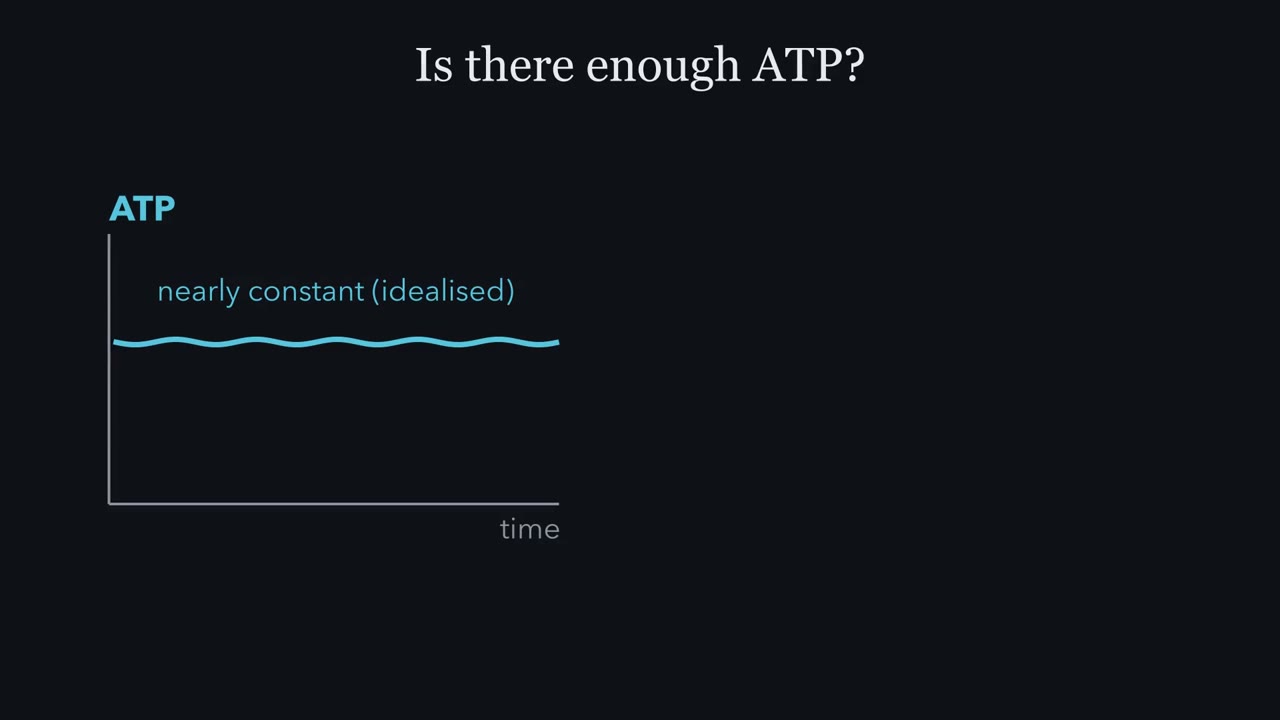
With no amino acids, the complex leaves the lysosome and stays off. A third gauge reads energy. A healthy cell keeps ATP nearly constant, so ATP is a poor alarm. AMP moves most. With round numbers, when ATP falls by a tenth, AMP rises almost fourfold. So the kinase AMPK reads AMP. Once on, AMPK makes the TSC complex more active. That drains Rheb of GTP. It also phosphorylates Raptor, which inhibits mTOR -C1. Energy can veto growth, even when growth factors and amino acids are present. You can now predict a cell. When fed, every input says yes, and protein synthesis runs. With no amino acids, mTOR -C1 leaves the lysosome, and translation slows.
With no energy, AMPK switches on. It shuts mTOR -C1 off, even when everything else is present. Keep this rule: two yeses to grow, and low energy can veto them.
How does a cell decide it can afford to grow?
Continue in the lesson: mTOR and AMPK: Reading Nutrients and Energy →
3:15 · Free, with captions and a transcript. The lesson has the full text, the questions and the sources.
More films from this lesson
How this film was made. Narration: an AI narrator voice (ElevenLabs, Sarah) reading narration written from this lesson's text. Animation: AI-generated in code (Manim) by Claude, a schematic with no drawn molecular structures. Captions come from the narration script. See something wrong? Report it.