Biochemistry · Skim version
Integration of Metabolism: How the Body Switches Fuels
Read the full lesson → Skim the whole course →
The guiding idea
Fed, fasting, starving: led by two hormones, the body turns every pathway in this course up or down in a timed sequence.
The pathways in this course don't run in isolation — their rates shift in a timed sequence as you move from fed to fasting to starving, coordinated mainly by two hormones, while organs trade fuels.
-
The one-way funnel: why fat cannot become glucose
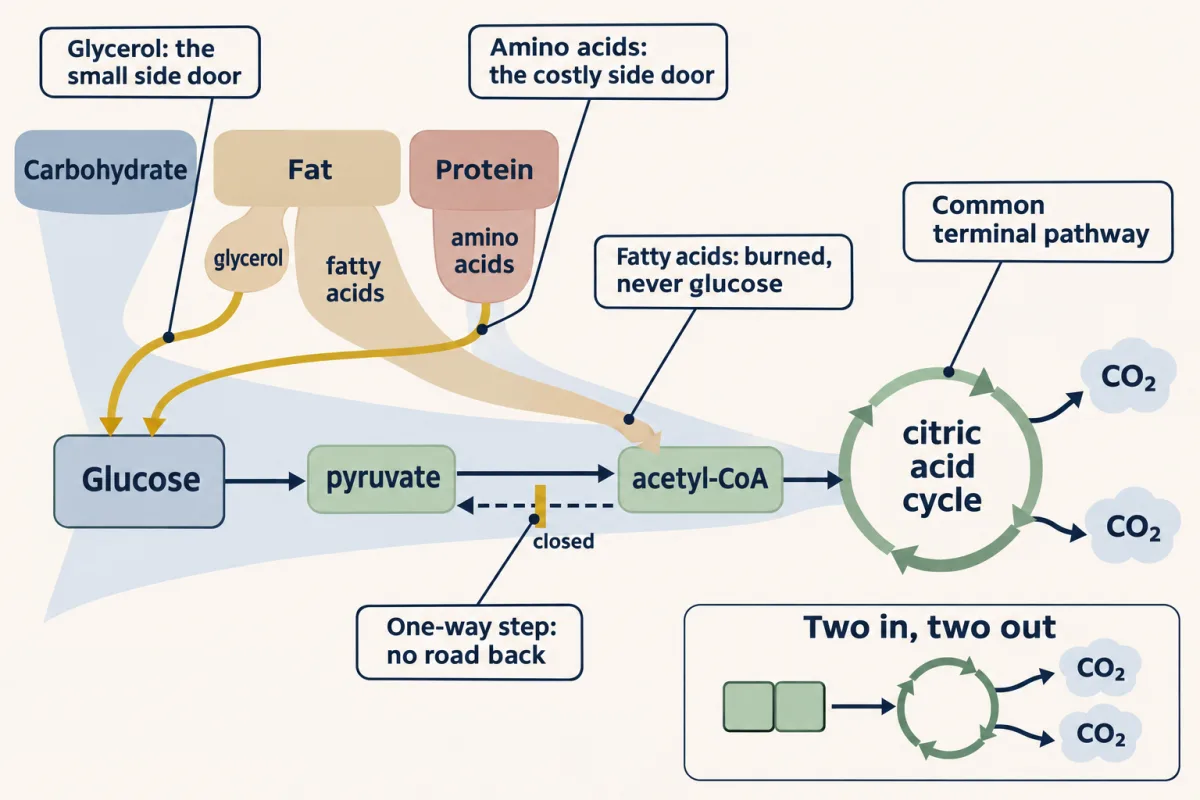
The one-way funnel. Every fuel can be burned through acetyl-CoA, but acetyl-CoA cannot be turned back into glucose: the pyruvate dehydrogenase step runs one way, and the citric acid cycle gives back as CO2 the two carbons it takes in. Of fat, only the glycerol backbone can become glucose; the other new carbon comes from amino acids, mostly from muscle protein. AI-generated illustration -
One signal, read differently by each tissue
-
One person’s fast, from lunch to five weeks
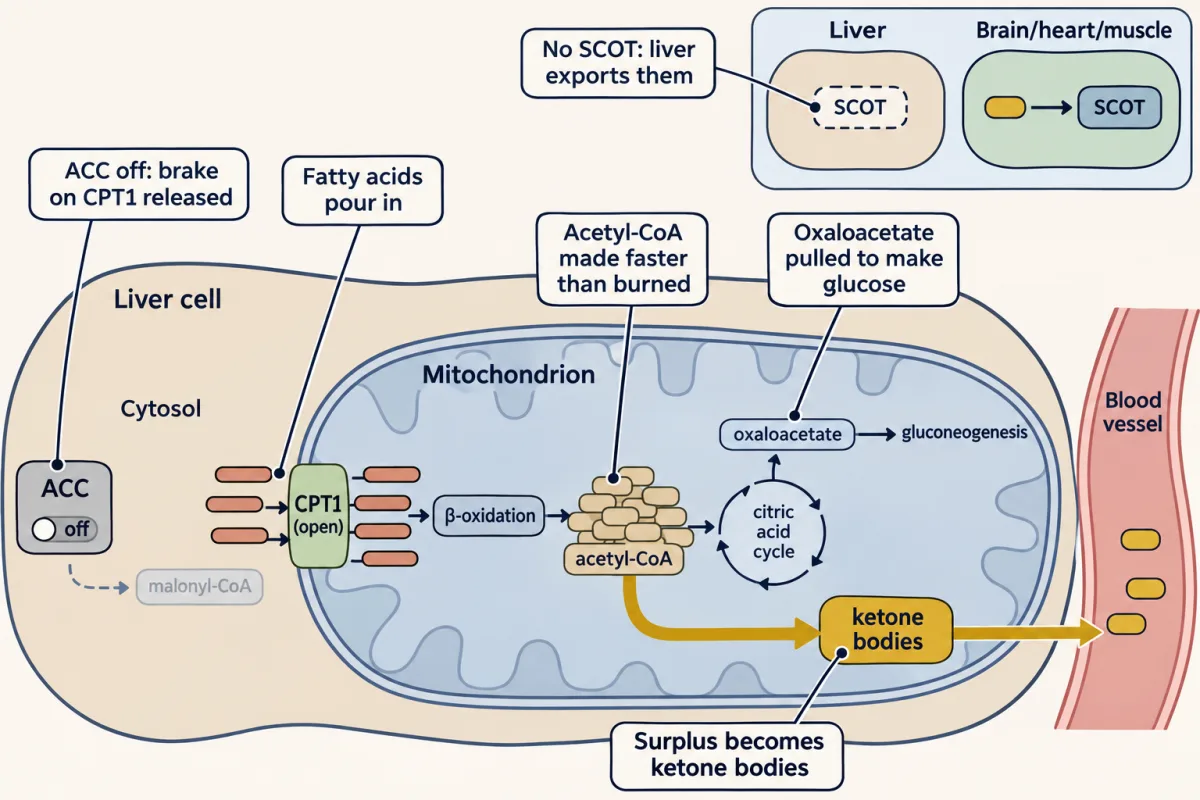
Why a fasting liver makes ketone bodies it cannot burn. With ACC off, malonyl-CoA falls and the carnitine shuttle (CPT1) opens. Beta-oxidation then makes acetyl-CoA faster than the liver's citric acid cycle uses it, partly because oxaloacetate is going to gluconeogenesis. The surplus becomes ketone bodies, and since the liver lacks SCOT it exports them all. AI-generated illustration 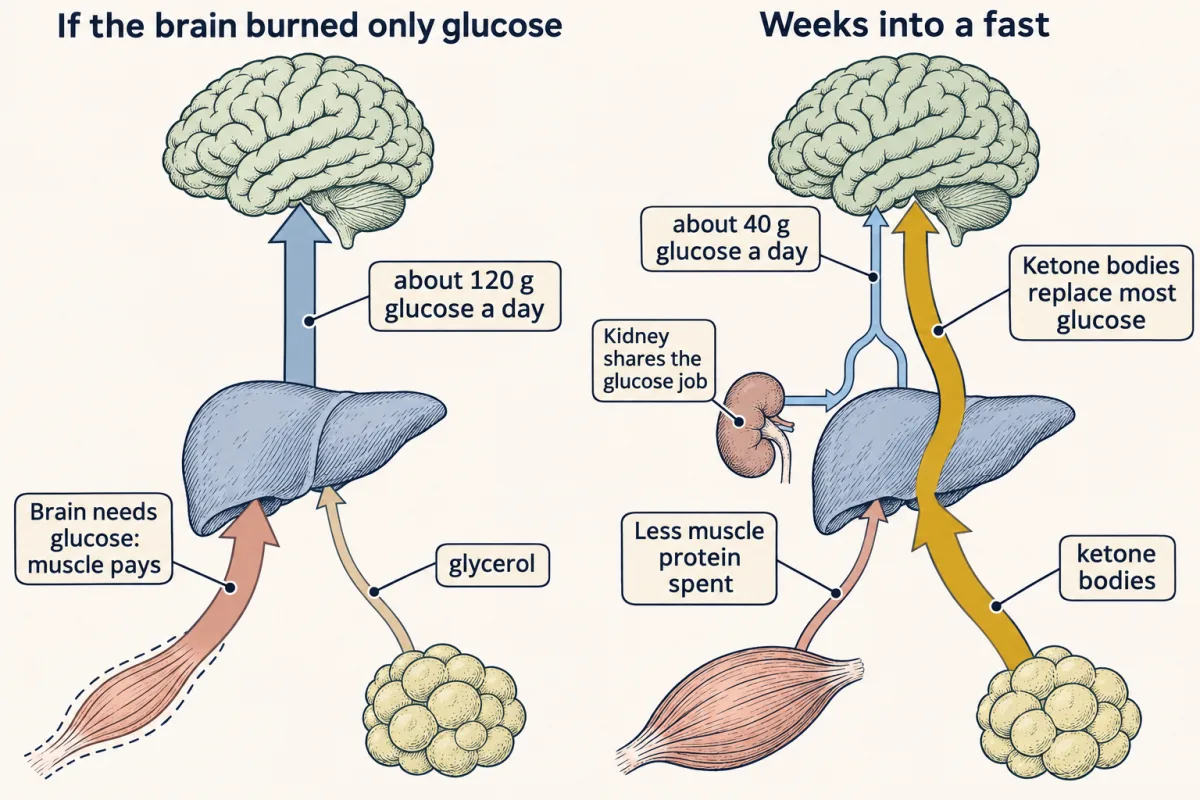
Protein sparing. If the brain kept burning only glucose, most of its 120 grams a day would have to be made from muscle protein. Weeks into a fast, ketone bodies made from fat supply most of the brain's fuel, its glucose need falls to roughly 40 grams a day, and far less muscle is spent. Arrow widths show direction and rough size only. AI-generated illustration -
When the brake is missing: diabetic ketoacidosis
-
Going deeper
Where this lesson fits
Before thisReview first
- Gluconeogenesis: Pushing Glucose Back UphillThis course · Lesson 17
You need how the liver makes new glucose from lactate, glycerol and amino acids to follow the fasting timeline.
- Fatty Acid Degradation: The β-Oxidation SpiralThis course · Lesson 25
Burning fat to acetyl-CoA, and why that cannot give glucose, underlies the one-way funnel and ketone production.
- Signal-Transduction Pathways: How Cells Compute With Molecular SwitchesThis course · Lesson 13
Glucagon's cAMP and protein kinase A relay is used here to switch glycogen and fat enzymes.
After thisStudy next
- Autonomic Control and the HypothalamusNeuroscience · College: going further
This takes the idea of body-wide fuel and hunger control further, showing how the brain senses and steers feeding.
- Insulin, Glucagon and Blood GlucosePhysiology · College: going further
This takes the insulin and glucagon ratio further, showing how the body's glucose level is held and measured.
- Exercise: The Whole Body at WorkPhysiology · College: going further
This takes the idea of switching fuels further, applying it to a body working hard on muscle fuel supply.
Elsewhere on the siteFilms, simulations and method films in other courses
- Two Yeses to Grow, One VetoFilm · Cell Signaling
It covers how AMPK reads cell energy and turns pathways on or off, as in the lesson's AMPK section.
- A Membrane Address for AktFilm · Cell Signaling
It follows how insulin signals inside cells to move glucose transporters, the tissue reading of insulin used here.
Suggested by an AI model from the lessons themselves, then checked. How we use AI